
BAR-231 · Lesson 1 of 12 · 21 min
Becoming a lawyer in New Jersey
▶ Video coming soon A video version of this lesson is on the way.
Teresa Albanese grew up in Hamilton Township, in Mercer County, a short drive from the State House in Trenton where her grandfather worked for thirty years as a building engineer. She finished law school at an ABA-approved New Jersey law school in May 2026. Since June 2026 she has worked as a law clerk at Vellucci & Kaczmarek, a four-lawyer firm on West State Street in Trenton that handles car accidents and falls, claims against towns and school boards, divorces and estates. The firm's senior partner, Joan Vellucci, has practiced in Mercer County for twenty-six years and still keeps a paper desk calendar with every filing deadline written in red. Teresa filed her application for the February 2027 New Jersey bar examination in October 2026 and joined Hollis Marchetti's online study group in the fall.
At her first one-on-one call with Marchetti, Teresa explained what was confusing her. 'Everyone at the firm passed a New Jersey exam that had New Jersey essays on it,' she said. 'Joan still talks about the day she wrote about the entire controversy doctrine in a hotel ballroom. My classmates say there is no New Jersey law on the exam anymore, that the score moves to New York and Pennsylvania, and that New Jersey is changing to something called NextGen. And I keep hearing that I might not even need the MPRE because I got a B plus in Professional Responsibility. I want one clear picture of what I am taking in February and what else stands between me and the oath.'
Marchetti pulled up her checklist. 'New Jersey has given the Uniform Bar Examination since February 2017. That means no New Jersey essays: the Multistate Performance Test and the Multistate Essay Examination on day one, the Multistate Bar Examination on day two, and a total scaled score of 266 or higher to pass. The Supreme Court of New Jersey has adopted the NextGen exam, but it does not start until July 2028, so February 2027 is the current UBE. Alongside the exam, the Committee on Character must certify you, and you need to satisfy New Jersey's professional responsibility requirement. Your law school grade may well do that, which is a New Jersey feature many people do not know about. And New Jersey law matters more than your classmates think. It shows up in the first week of practice, in the CLE you must take as a new lawyer, and in the habits Joan expects of you.'
This lesson maps the whole process: who controls admission in New Jersey, the bodies that do the work, the routes into practice and the usual order of events for a first-time candidate. Later lessons take each step in detail and then turn to the distinctive New Jersey law a new lawyer meets in Trenton, Newark, Camden, Hackensack, New Brunswick or at the Shore.
The Supreme Court of New Jersey controls admission
Admission to practice law in New Jersey is a judicial function. Under the 1947 New Jersey Constitution, the Supreme Court has jurisdiction over the admission of persons to the practice of law and over the discipline of those admitted. The Court exercises that power through the Rules of Court, and the rules on admission are collected in Rule 1:24 (bar examinations and qualifications for admission), Rule 1:25 (the Committee on Character) and the related rules on the practice of law in Rule 1:21. When the Court changes the exam, it does so by order or notice. In November 2025, for example, it issued a notice adopting the NextGen Uniform Bar Examination with a first administration in July 2028.
That structure matters in practice. A candidate who needs a ruling on eligibility, an extension or a review of a character decision deals with the Board of Bar Examiners or the Committee on Character under the Rules and, if the matter goes further, with the Supreme Court itself. Classmates, bar review companies and senior lawyers are useful sources of background, but they are not authority. Teresa keeps a folder with the current Rules of Court on admission, the application instructions for the February 2027 exam and every email she receives from the Board.
The Board of Bar Examiners and the Committee on Character
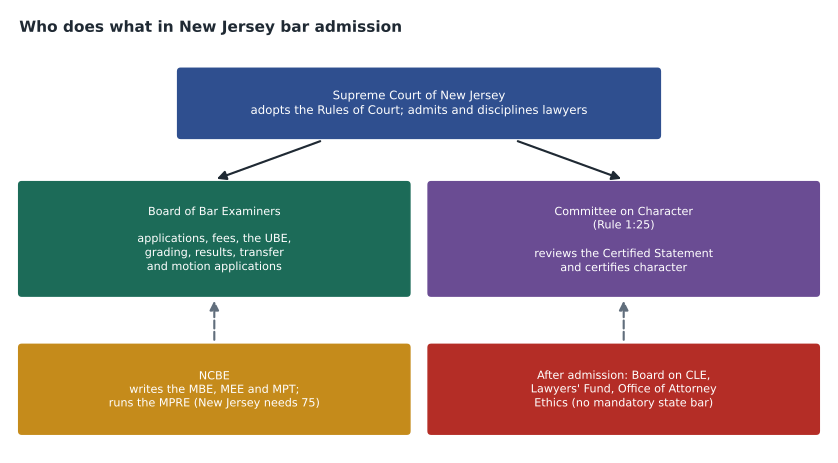
The New Jersey Board of Bar Examiners administers the examination. Its office is in Trenton, with a mailing address at a post office box, and its website at njbarexams.org posts the application, instructions, deadlines and notices for each administration. The Board receives applications, collects fees, confirms that each applicant meets the educational requirement, arranges the exam, grades the written portions under the UBE grading process and certifies the results. The Board also handles applications for admission by transferred UBE score and by motion.
The Committee on Character is a separate body created under Rule 1:25. It reviews each candidate's background and decides whether to certify that the candidate has the good character required for admission. A candidate can pass the exam and still not be admitted until the Committee certifies character. The Committee works from the Certified Statement of Candidate, a detailed questionnaire about education, employment, residences, finances, driving history, court involvement and other matters, together with fingerprint results, driver's abstracts and other records it gathers. Lesson 3 covers that process in detail.
Other bodies a new lawyer will meet
Several other bodies appear in a New Jersey lawyer's life soon after admission. The National Conference of Bar Examiners writes the MBE, MEE and MPT and runs the Multistate Professional Responsibility Examination. The Board on Continuing Legal Education administers the mandatory CLE rules, including the special requirement for newly admitted lawyers. The New Jersey Lawyers' Fund for Client Protection collects an annual fee from every lawyer through the annual attorney registration process and reimburses clients who lose money through a lawyer's dishonest conduct. The Office of Attorney Ethics investigates and prosecutes serious disciplinary matters and runs the Random Audit Compliance Program for trust accounts. The New Jersey State Bar Association, by contrast, is a voluntary organization: New Jersey has no mandatory, unified state bar, so membership in the State Bar Association is a choice, not a condition of practice.
That last point surprises candidates who come from states with an integrated bar. In New Jersey, the duties that an integrated bar would handle in other states are split among the Supreme Court and its committees. Annual registration and the Lawyers' Fund fee run through the Court's attorney registration system. Ethics opinions come from the Supreme Court's Advisory Committee on Professional Ethics. Advertising questions go to the Committee on Attorney Advertising. Discipline runs through district ethics committees, the Office of Attorney Ethics, the Disciplinary Review Board and the Supreme Court.
| Body | What it does for a candidate or new lawyer |
|---|---|
| Supreme Court of New Jersey | Adopts the Rules of Court; admits applicants; disciplines lawyers |
| Board of Bar Examiners | Applications, fees, exam administration, grading, results, UBE transfer and motion applications |
| Committee on Character | Reviews the Certified Statement of Candidate and certifies character |
| NCBE | Writes the MBE, MEE and MPT; runs the MPRE |
| Board on Continuing Legal Education | CLE rules, including the new-admittee requirement |
| Lawyers' Fund for Client Protection | Annual fee through attorney registration; reimburses clients for lawyer theft |
| Office of Attorney Ethics | Investigates and prosecutes serious discipline; random trust account audits |
| New Jersey State Bar Association | Voluntary bar association; its institute offers CLE |
Three routes into New Jersey practice
There are three main routes to a plenary New Jersey license. The first, and the one Teresa is taking, is admission by examination: sit and pass the New Jersey administration of the UBE, satisfy the professional responsibility requirement, obtain character certification and take the oath. The second is admission by transferred UBE score under Rule 1:24-3: a candidate who earned a scaled score of 266 or more on the UBE in another jurisdiction within the past 36 months can apply to New Jersey on that score, again subject to character review and the other requirements. The third is admission by motion under Rule 1:24-4, available to experienced lawyers who have practiced for five of the last seven years in a jurisdiction that would admit New Jersey lawyers on motion, who previously passed a bar exam, and who complete a New Jersey ethics and professionalism course.
Two other paths allow limited practice. A lawyer licensed elsewhere may appear in a particular New Jersey case pro hac vice, by motion to the court, associated with New Jersey counsel. An in-house lawyer licensed in another United States jurisdiction may apply for a limited license to work for a single employer under Rule 1:27-2. Neither of those routes gives the general right to practice that a plenary license gives, and neither is a substitute for admission for someone who intends to build a New Jersey practice.
Why New Jersey candidates often think about two licenses
New Jersey sits between two very large legal markets, New York City and Philadelphia. In its November 2025 notice adopting NextGen, the Supreme Court observed that most New Jersey attorneys hold a second license, typically in New York or Pennsylvania. That reality shapes candidate decisions. A UBE score earned in New Jersey can be transferred to other UBE jurisdictions within their own time limits and minimum scores, and many candidates plan to use one exam for two admissions.
Teresa's plan is typical. She will sit for the February 2027 exam in New Jersey. If she passes, she expects to apply in Pennsylvania on her UBE score later in 2027 because the firm has clients across the Delaware River in Bucks County. New York would require its own additional steps beyond the UBE score, which Marchetti told her to research on New York's official sources when the time comes. The point for now is that each jurisdiction sets its own minimum score and its own time window, so the plan must be checked against each jurisdiction's current rules, not a chart from a few years ago.
The order of events for a first-time candidate
Most first-time candidates follow the same sequence. They finish an ABA-approved J.D. They file the bar examination application with the Board by the first filing deadline, along with the fee and the Certified Statement of Candidate. They complete the steps the Board's acknowledgment packet lists: the law school certificate, the professional responsibility proof, driver's abstracts and fingerprinting. They sit the two-day exam in late February or late July. They respond promptly to any inquiries from the Committee on Character. When the Board releases results and the Committee certifies character, they are eligible for admission and take the oath, sign the roll of attorneys and register with the attorney registration system.
After admission, the obligations begin almost at once. A new lawyer must complete annual attorney registration and pay the Lawyers' Fund fee, maintain trust and business accounts if practicing privately and holding client funds, and meet the CLE requirement, including the special 16-credit requirement for newly admitted lawyers in New Jersey-specific subjects. Lesson 11 covers those duties.
Worked problem
Mapping a candidate's next twelve months
Teresa filed her February 2027 application on October 20, 2026, before the October 31 first filing deadline. She earned a B plus in a three-credit Professional Responsibility course in her second year of law school. She also took the MPRE in August 2025 and scored 97. She expects to apply in Pennsylvania on a transferred UBE score if she passes. Build her checklist from now until she can practice in New Jersey.
Show solution
- Confirm the Board's acknowledgment and complete every item in the packet: the law school certificate, the professional responsibility proof, original driver's abstracts and fingerprints.
- Professional responsibility: either route may work. Her course grade may satisfy New Jersey if the course meets the Board's requirements, and her MPRE score of 97 is well above New Jersey's 75. She should file the proof the Board asks for and keep both on record because Pennsylvania will want the MPRE.
- Study for the UBE in late February 2027: two MPT tasks and six MEE questions on day one, the MBE on day two, with 266 needed to pass.
- Answer any Committee on Character inquiries promptly and update the Certified Statement if anything changes before admission.
- After results and certification: oath, roll of attorneys, attorney registration and the Lawyers' Fund fee, then the new-admittee CLE requirement beginning the January after admission.
Answer: Teresa's critical path is the exam itself; her professional responsibility requirement is already met on paper. The Pennsylvania transfer is a separate application under Pennsylvania's rules once she has a passing score.
How this course is organized
Lessons 2 through 6 cover the admission process: eligibility and deadlines, character and the professional responsibility requirement, the UBE format and scoring, the NextGen transition and what the exam does and does not test. Lessons 7 through 10 cover the New Jersey law a new lawyer needs in early practice and that sometimes appears in performance-test files and in the new-admittee CLE: civil practice and the entire controversy doctrine, torts and claims against public entities, family law and estates, and attorney regulation. Lesson 11 covers score transfer, admission by motion and life after admission. Lesson 12 is a capstone with original practice questions and an exam-day plan.
Marchetti closed the first call with a reminder that applied to everything that followed. 'Write down the source for every rule you rely on,' she said. 'If it came from the Board, the Rules of Court or a statute, keep the citation. If it came from a classmate, check it. New Jersey rules change by order, and the people who get hurt are the ones who relied on what was true three years ago.'
Common mistakes
MistakeNew Jersey still has its own New Jersey essays.
InsteadNew Jersey has given the UBE since February 2017. There is no jurisdiction-drafted component; the exam is the MPT, MEE and MBE.
MistakeNextGen starts in New Jersey in 2027.
InsteadThe Supreme Court adopted NextGen in November 2025 with a first administration in July 2028. The current UBE runs through February 2028.
MistakeEvery candidate must take the MPRE.
InsteadNew Jersey accepts an MPRE scaled score of 75 or a qualifying law school professional responsibility course grade. Candidates who want portability should still take the MPRE.
MistakeNew Jersey has a mandatory state bar like many other states.
InsteadThe New Jersey State Bar Association is voluntary. Registration, the Lawyers' Fund, ethics opinions and discipline run through the Supreme Court and its committees.
MistakePassing the exam is the last step.
InsteadThe Committee on Character must also certify the candidate, and the candidate must take the oath and register before practicing.
Summary and key terms
- The Supreme Court of New Jersey controls admission and discipline under the 1947 Constitution and the Rules of Court, especially Rules 1:24, 1:25 and 1:21.
- The Board of Bar Examiners runs the exam; the Committee on Character certifies character under Rule 1:25.
- New Jersey gives the UBE (MPT, MEE and MBE) with a passing score of 266; NextGen begins in July 2028.
- Routes in are admission by examination, by transferred UBE score within 36 months and by motion after five of the last seven years of practice in a reciprocal jurisdiction.
- New Jersey has no mandatory unified bar; the Lawyers' Fund, the Office of Attorney Ethics and the Board on CLE are arms of the Court.
- Many New Jersey lawyers also hold a New York or Pennsylvania license, so score portability matters.
- 0
- Board of Bar Examiners
- 1
- Committee on Character
- 2
- Rules of Court
- 3
- Certified Statement of Candidate
- 4
- admission by motion
- 5
- transferred UBE score
- 6
- pro hac vice
- 7
- Lawyers' Fund for Client Protection
- 8
- Office of Attorney Ethics
Practice problems
Work each problem on paper first, then reveal the answer to check.
Which body admits applicants to practice law in New Jersey?
Show answer
The Supreme Court of New Jersey, acting under the 1947 Constitution and the Rules of Court.
What does the Committee on Character do?
Show answer
It reviews each candidate's Certified Statement and other records and decides whether to certify the candidate's character under Rule 1:25.
Does New Jersey have a jurisdiction-specific exam component?
Show answer
No. New Jersey gives the UBE with no New Jersey essays or New Jersey law course required for admission.
Is membership in the New Jersey State Bar Association required to practice?
Show answer
No. It is a voluntary association. Registration and the Lawyers' Fund fee run through the Supreme Court's attorney registration system.
Lesson quiz · 5 questions
Score 60% or more to complete this lesson.
Create a free account to save your progress, take quizzes and earn a certificate.