
BAR-231 · Lesson 10 of 12 · 19 min
New Jersey attorney regulation: the RPCs, trust accounts and contingent fees
▶ Video coming soon A video version of this lesson is on the way.
Every new lawyer at Vellucci & Kaczmarek hears the same story in the first month. Years ago, Joan Vellucci explains, a lawyer she knew from the courthouse borrowed money from his trust account to cover the office rent for two months. He fully intended to pay it back, and he did, before anyone noticed. Then a random audit found the gap in his records, and the Supreme Court disbarred him. 'In New Jersey,' Joan says, 'you do not get a second chance with client money. Learn the trust account rules before you learn anything else.'
The MPRE tests the ABA Model Rules of Professional Conduct. New Jersey has its own Rules of Professional Conduct, known as the RPCs, adopted by the Supreme Court and based on the Model Rules, but with several important differences. New Jersey also regulates lawyers through its Rules of Court, especially Rule 1:21 on the practice of law, Rule 1:20 on discipline and Rule 1:28 on the Lawyers' Fund for Client Protection. This lesson covers the distinctive features a new New Jersey lawyer must know, starting with client funds.
In re Wilson and knowing misappropriation
The foundation of New Jersey's approach to client money is In re Wilson (1979). The Supreme Court held that a lawyer who knowingly misappropriates client funds will almost invariably be disbarred. The Court defined misappropriation broadly: any unauthorized use by a lawyer of clients' funds entrusted to the lawyer, including not only stealing but also unauthorized temporary use for the lawyer's own purpose, whether or not the lawyer derives personal gain. Mitigating circumstances such as financial pressure, an intent to repay, actual repayment, contrition, cooperation, inexperience or a previously unblemished record generally do not change the result.
The Court explained that the controlling concern is public confidence in the bar. Clients hand their money to lawyers because they trust the profession, and the Court concluded that only a near-automatic rule of disbarment would protect that trust. The Wilson rule has been applied for more than four decades and has been extended to escrow funds held for third parties. Negligent misappropriation, by contrast, such as an accounting error caused by poor recordkeeping, is treated less severely, usually with a reprimand or suspension, though it is still serious.
Trust and business accounts
Rule 1:21-6 sets detailed requirements for lawyers in private practice who hold client funds. A lawyer must maintain a trust account for client funds and a separate business account for the firm's operating funds, both at an approved financial institution in New Jersey. RPC 1.15 requires client funds to be kept in a separate account at a New Jersey financial institution and records to be kept for seven years. The rule prescribes the records to be kept, including receipts and disbursements journals and client ledgers, and requires a reconciliation, at least monthly, of the cash receipts and disbursements journals, the checkbook balance, the bank statement balance and the client ledger balances. Trust accounts must be designated Attorney Trust Account, and business accounts Attorney Business Account or a similar approved title. Overdraft protection on a trust account is prohibited, and approved institutions agree to report to the Office of Attorney Ethics whenever a trust account instrument is presented against insufficient funds, whether or not it is honored.
Most nominal or short-term client funds are held in IOLTA accounts under Rule 1:28A, with the interest paid to the IOLTA Fund of the Bar of New Jersey to support legal services for people of limited means. The Office of Attorney Ethics runs the Random Audit Compliance Program, which audits law firms' trust and business accounting records without any suspicion of wrongdoing. Many Wilson cases begin with a random audit or an overdraft notice.
| Requirement | Source |
|---|---|
| Separate trust and business accounts at a New Jersey institution | Rule 1:21-6; RPC 1.15 |
| Detailed journals and client ledgers; reconciliation at least monthly | Rule 1:21-6 |
| Records kept for seven years | RPC 1.15 and Rule 1:21-6 |
| Interest on nominal or short-term funds to the IOLTA Fund | Rule 1:28A |
| Overdraft reporting to the Office of Attorney Ethics | Rule 1:21-6 |
| Random audits without suspicion | Office of Attorney Ethics program |
Confidentiality: mandatory disclosure under RPC 1.6
New Jersey's confidentiality rule differs sharply from the Model Rule. Model Rule 1.6(b) permits disclosure in certain circumstances, but never requires it. New Jersey RPC 1.6(b) requires disclosure. A lawyer shall reveal information relating to the representation to the proper authorities, as soon as and to the extent the lawyer reasonably believes necessary, to prevent the client or another person from committing a criminal, illegal or fraudulent act that the lawyer reasonably believes is likely to result in death or substantial bodily harm, or in substantial injury to the financial interest or property of another, and to prevent a fraud on a tribunal.
RPC 1.6(c) and (d) add permissive disclosures, including to rectify the consequences of a client's criminal, illegal or fraudulent act in which the lawyer's services were used, to establish a claim or defense in a controversy with the client, to comply with other law or court order and to detect conflicts arising from changes in employment or firm composition. RPC 1.6(e) defines reasonable belief for these purposes as a belief based on information that has some foundation in fact and constitutes prima facie evidence of the matters referred to.
The practical consequence is that a New Jersey lawyer who learns that a client is about to commit a fraud that will cause substantial financial harm to someone else does not have the option of staying silent, as a lawyer in a Model Rules state might. On the MPRE, by contrast, a candidate should answer under Model Rule 1.6, which makes most such disclosures permissive.
Fees
RPC 1.5(b) requires that, when the lawyer has not regularly represented the client, the basis or rate of the fee be communicated in writing to the client before or within a reasonable time after commencing the representation. The Model Rule says only that it should preferably be in writing. RPC 1.5(c) requires contingent fee agreements to be in writing, stating the method of calculation, including the percentage to the lawyer in the event of settlement, trial or appeal and how expenses are handled, and requires a written closing statement at the end. RPC 1.5(d) bars contingent fees in domestic relations matters and in representing criminal defendants.
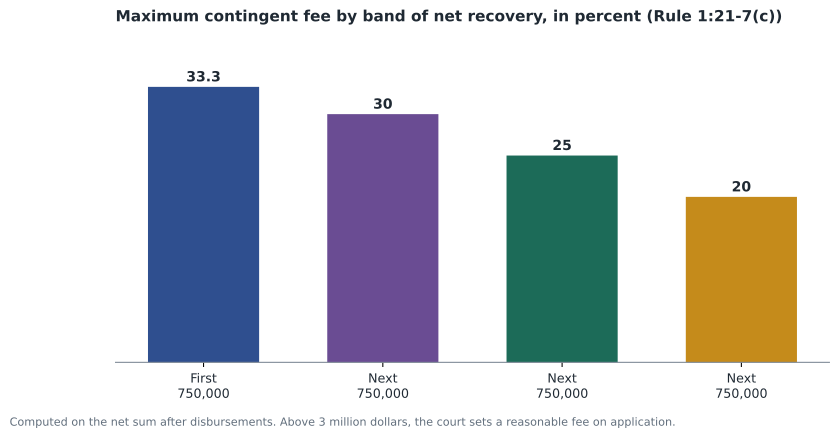
New Jersey also caps contingent fees in tort cases by court rule. Under Rule 1:21-7(c), in matters where a client's claim for damages is based on the alleged tortious conduct of another, including products liability claims, and the client is not a subrogee, the fee may not exceed 33 and one-third percent of the first 750,000 dollars recovered, 30 percent of the next 750,000 dollars, 25 percent of the next 750,000 dollars and 20 percent of the next 750,000 dollars. Fees on amounts beyond those bands are set by application to the court for a reasonable fee. The fee is computed on the net sum recovered after deducting disbursements, but not liens such as medical bills. Where the client is a minor or incapacitated, the fee on a settlement before the jury is empaneled is limited to 25 percent. Statutory discrimination and employment claims are excluded from the caps. A lawyer who believes the capped fee is inadequate may apply to the court for a reasonable fee on notice to the client.
| Portion of net recovery | Maximum contingent fee under Rule 1:21-7(c) |
|---|---|
| First 750,000 dollars | 33 and one-third percent |
| Next 750,000 dollars | 30 percent |
| Next 750,000 dollars | 25 percent |
| Next 750,000 dollars | 20 percent |
| Above 3,000,000 dollars | Reasonable fee set on application to the court |
Worked problem
Computing a capped contingent fee
The broken-wrist client settles her claims against the private defendants for 900,000 dollars. The firm spent 30,000 dollars on experts and records. Her health insurer has a lien of 40,000 dollars. What is the maximum fee under Rule 1:21-7(c)?
Show solution
- Net sum: 900,000 dollars less 30,000 dollars of disbursements equals 870,000 dollars. The lien is not deducted before computing the fee.
- First band: 33 and one-third percent of 750,000 dollars equals 250,000 dollars.
- Second band: 30 percent of the remaining 120,000 dollars equals 36,000 dollars.
- Maximum fee: 250,000 plus 36,000 equals 286,000 dollars.
- The agreement had to be in writing, and the firm must give the client a signed closing statement.
Answer: The maximum fee is 286,000 dollars. The firm may charge less, but not more without a court application.
Conflicts and other differences
Several other New Jersey RPCs depart from the Model Rules. Under RPC 1.7(b)(1), a public entity cannot consent to a representation that involves a concurrent conflict; New Jersey takes a stricter approach to conflicts involving government clients. RPC 1.10 allows screening of a lateral lawyer to avoid imputing a conflict to the new firm only where the lawyer did not have primary responsibility for the matter at the former firm, receives no part of the fee and the former client receives prompt written notice. RPC 1.16(d) states that no lawyer shall assert a common law retaining lien over a client's file. RPC 3.3(a)(5) requires a lawyer not to knowingly fail to disclose to a tribunal a material fact knowing that the omission is reasonably certain to mislead the tribunal, unless disclosure is protected by a recognized privilege or otherwise prohibited by law.
RPC 8.4(g) makes it misconduct for a lawyer, in a professional capacity, to engage in conduct involving discrimination because of protected characteristics, including race, religion, sex, sexual orientation, socioeconomic status and disability, where the conduct is intended or likely to cause harm. RPC 8.3 requires reporting another lawyer's misconduct that raises a substantial question as to honesty, trustworthiness or fitness, subject to an exception for information gained through the state's Lawyers Assistance Program.
Advertising
New Jersey regulates advertising closely. RPC 7.2 requires advertisements to be predominantly informational, bars drawings, animations, dramatizations, music and lyrics in televised advertisements, and requires lawyers to keep copies of advertisements and website content for three years. RPC 7.1 limits comparative statements and requires a specific disclaimer when a lawyer cites a comparison or ranking by an outside organization. RPC 7.3 bars unsolicited direct contact concerning a specific mass-disaster event within 30 days of the event, and requires that targeted letters bear the word ADVERTISEMENT in capitals at the top of the first page and on the envelope and include a notice that the recipient may report an inaccurate or misleading letter to the Committee on Attorney Advertising. RPC 7.4 limits claims of certification to certifications by the Supreme Court's Board on Attorney Certification or by an ABA-approved organization, with disclosure requirements.
Office and practice rules
New Jersey long required every practicing lawyer to maintain a bona fide office. In amendments effective February 1, 2013, the Supreme Court eliminated that requirement. Rule 1:21-1(a) now requires instead that a lawyer designate one or more fixed physical locations for inspection of client files and financial records on short notice, receipt of mail and service of process; be reasonably available for in-person consultation; and structure the practice to ensure prompt and reliable communication with clients, other counsel and courts. A lawyer without a fixed New Jersey location must designate the Clerk of the Supreme Court as agent for service of process.
Discipline and support structures
Lawyer discipline in New Jersey begins with grievances filed with district ethics committees, volunteer bodies of lawyers and public members, or with the Office of Attorney Ethics, which handles serious, complex and emergent matters. Hearings are held before a hearing panel or special master. The Disciplinary Review Board reviews the results and recommends discipline, and the Supreme Court decides. Ethics questions can be submitted to the Supreme Court's Advisory Committee on Professional Ethics, and advertising questions to the Committee on Attorney Advertising. Every lawyer must complete annual attorney registration and pay the annual fee to the Lawyers' Fund for Client Protection, which reimburses clients who lose money because of a lawyer's dishonest conduct.
Common mistakes
MistakeA lawyer who repays borrowed trust funds before anyone notices will receive a lesser sanction.
InsteadUnder In re Wilson, knowing misappropriation, even temporary and repaid, leads almost invariably to disbarment.
MistakeNew Jersey RPC 1.6 makes disclosure to prevent fraud permissive, like the Model Rule.
InsteadRPC 1.6(b) requires disclosure to the proper authorities to prevent acts likely to cause death, substantial bodily harm or substantial financial injury, and fraud on a tribunal.
MistakeContingent fees are computed on the gross recovery.
InsteadRule 1:21-7(d) computes the fee on the net sum after disbursements; liens are not deducted first.
MistakeA New Jersey lawyer must maintain a bona fide office.
InsteadThe requirement was eliminated effective February 1, 2013, replaced by fixed-location designation and availability duties.
MistakeA public entity may consent to a concurrent conflict.
InsteadUnder RPC 1.7(b)(1), a public entity cannot consent.
Summary and key terms
- In re Wilson (1979): knowing misappropriation of client funds, including temporary use, leads almost invariably to disbarment.
- Rule 1:21-6 and RPC 1.15 require trust and business accounts at New Jersey institutions, detailed records kept seven years and at least monthly reconciliation; IOLTA under Rule 1:28A.
- RPC 1.6(b) requires disclosure to prevent death, substantial bodily harm, substantial financial injury and fraud on a tribunal.
- RPC 1.5(b) requires written fee terms for new clients; 1.5(d) bars contingent fees in domestic relations and criminal defense.
- Rule 1:21-7(c) caps tort contingent fees: 33 and one-third, 30, 25 and 20 percent on successive 750,000-dollar bands, computed on the net sum.
- The bona fide office rule ended in 2013; advertising rules (RPC 7.1 to 7.4) are detailed; discipline runs through district ethics committees, the OAE, the DRB and the Supreme Court.
- 0
- Rules of Professional Conduct (RPCs)
- 1
- knowing misappropriation
- 2
- Random Audit Compliance Program
- 3
- IOLTA
- 4
- monthly reconciliation
- 5
- mandatory disclosure
- 6
- contingent fee
- 7
- net sum
- 8
- Disciplinary Review Board
- 9
- Advisory Committee on Professional Ethics
Practice problems
Work each problem on paper first, then reveal the answer to check.
What sanction does In re Wilson require for knowing misappropriation?
Show answer
Disbarment, almost invariably, regardless of repayment or intent to repay.
Is disclosure under New Jersey RPC 1.6(b) permissive or mandatory?
Show answer
Mandatory: the lawyer shall reveal information to the proper authorities in the listed circumstances.
What is the maximum contingent fee on the first 750,000 dollars of a tort recovery?
Show answer
33 and one-third percent of the net sum.
When did New Jersey eliminate the bona fide office requirement?
Show answer
Effective February 1, 2013.
Lesson quiz · 5 questions
Score 60% or more to complete this lesson.
Create a free account to save your progress, take quizzes and earn a certificate.