
BAR-226 · Lesson 7 of 12 · 20 min
Missouri courts, the Nonpartisan Court Plan and civil procedure
▶ Video coming soon A video version of this lesson is on the way.
Marcus's first assignment at his firm had been a car-accident case: a client rear-ended on a Kansas City street, a defendant who insisted the client had stopped short, and an insurer that would not move. The partner asked Marcus to draft the petition. 'Petition,' Marcus said to the group, 'not complaint. That was the first Missouri word I learned at work.' The second was 'fact pleading,' when the partner sent the first draft back with the note: more facts, fewer conclusions. Hollis smiled. 'That is the whole lesson in two notes.'
This lesson describes how Missouri's courts are organized, how many of its judges are chosen under the Nonpartisan Court Plan, and the features of Missouri civil procedure that most often surprise lawyers trained on the federal rules.
The court system
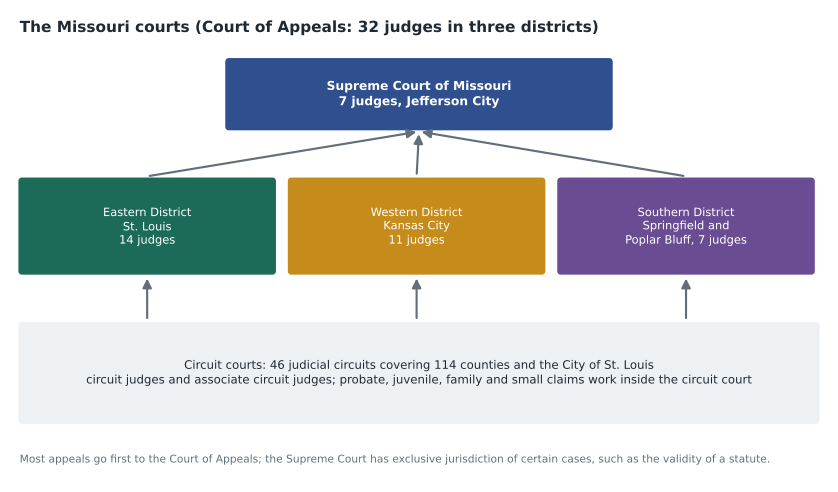
Missouri's judicial power is set out in Article V of the Missouri Constitution. At the top is the Supreme Court of Missouri, with seven judges sitting in Jefferson City. Below it is the Missouri Court of Appeals, a single court divided into three geographic districts: the Eastern District in St. Louis, with fourteen judges; the Western District in Kansas City, with eleven; and the Southern District, with offices in Springfield and Poplar Bluff and seven judges. Appeals are heard by three-judge panels.
Most appeals go first to the Court of Appeals. The Supreme Court has exclusive appellate jurisdiction of a short list of cases defined in the constitution, including cases involving the validity of a treaty or statute of the United States or of a Missouri statute or constitutional provision, the construction of the state's revenue laws, title to statewide office and cases in which a death sentence has been imposed. The Supreme Court can also take cases by transfer from the Court of Appeals, before or after opinion, when a case raises a question of general interest or importance or when the law needs to be reexamined.
The trial courts are the circuit courts. Missouri is divided into 46 judicial circuits, which together cover all 114 counties and the City of St. Louis, an independent city that is not part of any county. Each circuit has circuit judges and associate circuit judges. Associate circuit judges hear smaller civil cases, misdemeanors, preliminary hearings in felony cases, and in many circuits probate and other assigned matters. Small claims, up to 5,000 dollars, are heard in the circuit court under simplified procedures. Probate, juvenile and family matters are handled in divisions of the circuit court rather than in separate courts.
The Nonpartisan Court Plan
In November 1940, Missouri voters approved an initiative creating what the Missouri courts call the Nonpartisan Court Plan and what many writers elsewhere call the Missouri Plan. It replaced partisan election of judges for the courts it covers with a system of merit selection followed by retention elections. Many other states later adopted versions of it.
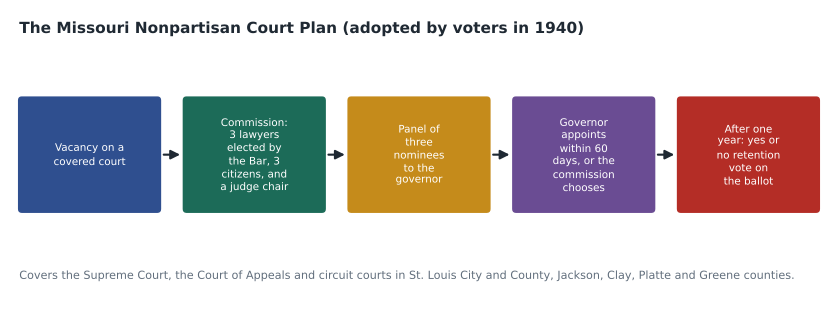
The plan works in three steps. When a vacancy occurs on a covered court, a nominating commission accepts applications, interviews candidates and sends a panel of three names to the governor. For the appellate courts, the Appellate Judicial Commission has seven members: three lawyers elected by members of The Missouri Bar, three citizens appointed by the governor and the chief justice as chair, with each Court of Appeals district represented by one lawyer and one citizen member. Circuit commissions have five members: the chief judge of the local appellate district, two lawyers elected by the local bar and two citizens appointed by the governor. The governor then appoints one of the three nominees. If the governor does not act within 60 days, the commission makes the appointment from the panel.
After at least a year in office, the new judge stands for retention at the next general election. The ballot asks simply whether the judge should be retained, without a party label. A judge who receives a majority of yes votes serves a full term, and at the end of each term the judge stands for retention again. Full terms are twelve years for judges of the Supreme Court and the Court of Appeals and six years for circuit judges.
The plan covers the Supreme Court, the Court of Appeals and the circuit courts in the City of St. Louis and in Jackson County, which were included in 1940, St. Louis County, added in 1970, Clay and Platte counties, added in 1973, and Greene County, added in 2008. Other circuits can adopt the plan by a vote of their residents. In the rest of the state, circuit and associate circuit judges are elected in partisan elections. A Missouri lawyer who practices across the state therefore appears before judges chosen in two very different ways.
The rules of civil procedure
Civil procedure in Missouri courts is governed by the Supreme Court Rules, principally Rules 41 through 101, together with statutes in the Revised Statutes of Missouri on subjects such as venue and limitations. The rules are numbered differently from the federal rules and differ in substance in several ways a new lawyer must learn.
Missouri is a fact-pleading state. Rule 55.05 requires a petition to contain a short and plain statement of the facts showing that the pleader is entitled to relief. Missouri courts read that language to require the ultimate facts supporting each element of the claim, not bare legal conclusions. The federal system and many states use notice pleading, which is more forgiving. A Missouri petition that alleges only that the defendant 'was negligent and caused damage' invites a motion to dismiss for failure to state a claim. A better petition alleges what the defendant did or failed to do, where and when, and how it caused the injury. That is what Marcus's partner meant by 'more facts, fewer conclusions.'
Venue is set mainly by statute rather than by rule. Section 508.010, as rewritten in 2005, provides that in a tort case in which the plaintiff was first injured in Missouri, venue lies in the county where the plaintiff was first injured. Other rules apply when the injury occurred outside Missouri and in non-tort cases. Venue was a frequent battleground before 2005 because some counties were considered more favorable to plaintiffs, and the 2005 statute was designed to tie tort venue to the place of injury.
A party in Missouri may obtain one change of judge without stating a reason. Under Rule 51.05, a timely application for change of judge must be granted, and no cause need be shown; the application must be filed within the time the rule allows, measured from service of process or from the designation of the trial judge. Lawyers from federal practice, where a judge can be removed only for cause, are often surprised by this.
Summary judgment under Rule 74.04 follows a structured format. The moving party must file a statement of uncontroverted material facts in numbered paragraphs, each supported by specific references to the record, and the opposing party must respond to each paragraph by admitting or denying it, with record support for any denial. A fact not properly denied is deemed admitted. The leading Missouri case, ITT Commercial Finance Corp. v. Mid-America Marine Supply Corp., 854 S.W.2d 371 (Mo. banc 1993), explains the burdens on each side and treats summary judgment as a tool for cases in which there is no genuine dispute of material fact.
A plaintiff may voluntarily dismiss a civil action without prejudice at any time before evidence is introduced at trial, under Rule 67.01, without the court's permission. Combined with Missouri's savings statute, section 516.230, which allows a plaintiff who suffers a nonsuit to file a new action within one year, this gives plaintiffs more flexibility than federal practice does. A second voluntary dismissal and the details of the savings statute have their own limits, which a lawyer should check before relying on them.
Juries and instructions
Missouri civil juries in circuit court have twelve members, and the Missouri Constitution allows a verdict in a civil case by three-fourths of the jurors, so nine of twelve may return a verdict. Criminal verdicts must be unanimous.
Missouri uses Missouri Approved Instructions, known as MAI. Under Rule 70.02, when an MAI instruction applies to the case, the court must give it, and departure from an applicable MAI instruction is presumed to be error. New lawyers learn quickly that much of a Missouri trial is built backward from the verdict director, the MAI instruction that tells the jury what it must find for the plaintiff. Marcus said the partner had told him to read the verdict director for a rear-end collision case before drafting a single interrogatory.
Judgments and appeals
Missouri's rules on finality have traps. Under Rule 74.01, a judgment must be in writing, signed by the judge and denominated a judgment; a signed docket entry or order that is not called a judgment is not appealable. A judgment becomes final for purposes of appeal thirty days after entry if no timely authorized after-trial motion is filed, and a motion for new trial must be filed within thirty days after entry of judgment. The notice of appeal must then be filed no later than ten days after the judgment becomes final. Missing that ten-day deadline can be cured only in limited circumstances, by a motion for special order to file a late notice of appeal within the time the rules allow.
Limitations
Missouri's general statute of limitations for personal injury and many other actions is five years, under section 516.120, which is longer than in most states. Some claims have shorter periods, including two years for medical malpractice under section 516.105 and three years for wrongful death under section 537.100. Under section 516.100, a cause of action accrues when the damage is sustained and capable of ascertainment, and the Supreme Court of Missouri held in Powel v. Chaminade College Preparatory, Inc., 197 S.W.3d 576 (Mo. banc 2006), that the test is when a reasonable person would have been put on notice that an injury and substantial damages may have occurred. Bills to cut the five-year period to two years were filed in both 2025 and 2026 and passed the House in at least one form, but none had become law by the end of the 2026 session. A new lawyer should check whether that has changed before relying on the five-year period.
A recent change
In 2026 the General Assembly passed and the governor signed, on July 13, 2026, SB 1067, which provides a procedure for early dismissal of certain claims based on a party's public expression. Missouri had previously had a narrow statute protecting speech at public meetings. A lawyer defending a defamation or similar claim arising from speech, or bringing one, should read the new procedure, because procedures of this kind often have short deadlines and fee-shifting provisions.
Worked problem
A rear-end petition
Marcus's client was rear-ended in Kansas City, in Jackson County, on March 3, 2025. The defendant lives in Clay County. Where may the action be filed, how must the petition be pleaded, and when does the general limitations period run out?
Show solution
- Section 508.010 places tort venue in the county where the plaintiff was first injured, if the injury occurred in Missouri.
- The client was first injured in Jackson County, so venue lies there.
- Missouri requires fact pleading under Rule 55.05: the petition must allege the ultimate facts supporting duty, breach, causation and damages.
- The general personal injury period under section 516.120 is five years from accrual.
Answer: File in the Circuit Court of Jackson County, plead specific facts about the collision and the injuries, and file well within five years of March 3, 2025, checking for any later change in the limitations statute.
Common mistakes
MistakeMissouri uses notice pleading like the federal rules.
InsteadMissouri requires fact pleading: the ultimate facts supporting each element.
MistakeAll Missouri judges are chosen under the Nonpartisan Court Plan.
InsteadThe plan covers the appellate courts and six circuit jurisdictions; elsewhere, circuit judges are elected.
MistakeA civil jury verdict in Missouri must be unanimous.
InsteadThree-fourths of the jurors may return a civil verdict.
MistakeA signed order is always appealable.
InsteadUnder Rule 74.01, the writing must be denominated a judgment.
MistakeMissouri's personal injury limitations period is two years.
InsteadIt is five years under section 516.120; proposals to shorten it had not passed by the end of 2026.
Practice problems
Work each problem on paper first, then reveal the answer to check.
How many districts does the Missouri Court of Appeals have, and where are they?
Show answer
Three: Eastern (St. Louis), Western (Kansas City) and Southern (Springfield and Poplar Bluff).
Under the Nonpartisan Court Plan, how many nominees go to the governor and how long does the governor have?
Show answer
Three nominees; 60 days, after which the commission appoints.
Where does venue lie for a tort in which the plaintiff was first injured in Missouri?
Show answer
In the county where the plaintiff was first injured (section 508.010).
How long after a Missouri judgment becomes final must the notice of appeal be filed?
Show answer
No later than ten days.
What does Rule 70.02 require about MAI instructions?
Show answer
An applicable MAI instruction must be given; departure is presumed to be error.
Summary and key terms
- The Supreme Court (7 judges), the Court of Appeals (three districts, 32 judges) and 46 circuits make up the Missouri courts.
- The 1940 Nonpartisan Court Plan uses commissions, three-name panels, a 60-day appointment window and retention elections.
- Missouri requires fact pleading and sets tort venue by the place of first injury under section 508.010.
- Rule 51.05 allows one change of judge without cause; Rule 74.04 requires numbered statements of uncontroverted facts.
- Civil verdicts need three-fourths of the jury, and applicable MAI instructions are mandatory.
- The notice of appeal is due within ten days after the judgment is final; the general limitations period is five years.
- Nonpartisan Court Plan
- Missouri's 1940 merit-selection system with commissions, gubernatorial appointment and retention elections.
- fact pleading
- Pleading that requires the ultimate facts supporting each element of a claim.
- MAI
- Missouri Approved Instructions, which must be used when applicable.
- verdict director
- The MAI instruction telling the jury what it must find to return a verdict for a party.
- change of judge
- Under Rule 51.05, one timely request for a different judge, granted without cause.
Lesson quiz · 5 questions
Score 60% or more to complete this lesson.
Create a free account to save your progress, take quizzes and earn a certificate.