
BAR-226 · Lesson 2 of 12 · 21 min
Eligibility, education, application deadlines and fees
▶ Video coming soon A video version of this lesson is on the way.
At the second session Hollis asked Marcus to pull up the confirmation page from his own application. He had filed in the second week of February 2026, a few days after the July application period opened on February 1. 'I wanted it done before I started bar review,' he said. 'I also had a semester of school left to finish, and I did not trust myself to remember a March deadline in the middle of everything else.' Hollis approved. 'Early filing is the cheapest insurance in this process,' she said. 'Late filing costs money, and missing the last deadline costs a season.'
This lesson covers who may sit the Missouri bar exam, the education requirement and its alternatives, the filing calendar for February and July, the fees and the rules on postponement, accommodations and repeat attempts.
The education requirement
Rule 8.07 sets the eligibility requirements for the exam. The standard route is a first professional degree in law, a JD or an LLB, from a law school approved by the American Bar Association. Most Missouri candidates satisfy the rule that way, through one of the state's four ABA-approved law schools or a school elsewhere in the country.
Missouri is not limited to ABA graduates. NCBE's chart for Missouri reports that graduates of out-of-state law schools that are not ABA-approved may qualify if they meet additional requirements, such as a specified amount of study at an ABA-approved school, admission in another state or a specified number of years of practice. Graduates of foreign law schools may also qualify with additional requirements, such as further study at an ABA-approved school, practice in a foreign jurisdiction or admission in another United States jurisdiction. A graduate law degree such as an LLM, standing alone, does not make a foreign-educated applicant eligible. These routes are fact-specific, and an applicant who needs one should read Rule 8.07 and the Board's regulations closely and expect the Board to ask for documentation, including official transcripts and, where needed, English translations.
The rule is about the degree, not the timing of graduation. A third-year student may file an application before graduating, and the law school then certifies the degree once it is conferred. Marcus filed in February while he was still a student and finished his last semester in May. The Board needed his final transcript and the school's certification before it could approve him to sit, and it told him when the documents had arrived.
Who is not eligible, for now
Rule 8.04 lists circumstances that prevent a person from applying for a time. A person with a pending felony charge may not apply until the charge is disposed of. A person convicted of a felony, or who pleaded guilty or no contest to one, may not apply until the conditions in Rule 8.04 have been met. A lawyer facing a pending disciplinary complaint, or suspended or disbarred in another jurisdiction, may not apply until the matter is resolved or the lawyer is reinstated. Even after a favorable resolution, the Board may still consider the underlying conduct in its character and fitness review. Lesson 3 explains that review.
The filing calendar
Missouri gives the bar exam twice a year, on the last consecutive Tuesday and Wednesday in February and July. For the February 2027 exam that means Tuesday, February 23 and Wednesday, February 24. For July 2027 it means Tuesday, July 27 and Wednesday, July 28. The first NextGen exam was given on July 28 and 29, 2026.
Each exam has an application period and a series of deadlines. For a February exam, the application period opens on September 1 of the year before and the first filing deadline is October 1. For a July exam, the period opens on February 1 and the first deadline is March 1. After the first deadline, the Board accepts late applications with an increased fee until a final date: December 1 for February, May 1 for July. NCBE's current chart lists two late tiers for each exam, November 1 and December 1 for February 2027, and April 1 and May 1 for July, with the fee rising at each tier. When a deadline falls on a weekend or legal holiday, it moves to the next business day, which is why NCBE lists March 2 as the first deadline for July 2026: March 1, 2026 was a Sunday.
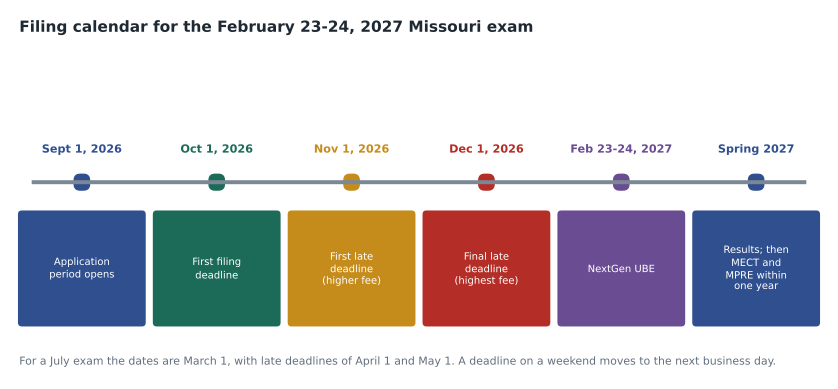
Rule 8.07 also gives applicants who failed the most recent exam a later date. Results from a February exam come out in the spring, after the March 1 deadline for July has passed, so a candidate who did not pass in February can file for July until May 1. Hollis noted that this is a deadline, not a grace period: the repeater who waits until the last week risks the same problems with missing documents as anyone else.
What properly filed means
The deadlines apply to properly filed applications. Under the Board's regulation, an application is properly filed only when the Board has the full fee, every required electronic part of the application and the signed authorization and release. An applicant who submits the online form on September 30 but mails the release a week later has not met the October 1 deadline, and the application will be treated as late.
Marcus said the authorization and release had been the step he nearly forgot. The form allows the Board to obtain records from anyone who has information about the applicant, and it needs a signature in the form the Board specifies. He printed it, signed it and sent it the same day he submitted the online application, then checked his account until it showed as received.
Fees
Fees are set by the Board and change from time to time, so the official fee schedule on mble.org is the only reliable source for a given exam. NCBE's Comprehensive Guide, which collects information from every jurisdiction, lists Missouri's application fees for first-time takers as ranging from 560 dollars to 1,400 dollars, and for repeaters from 560 dollars to 850 dollars. The range reflects the timing tiers and the type of applicant: the lowest fee applies to an applicant who files by the first deadline, and the fee steps up at each late deadline. The Guide lists the fee for admission by transferred score and for admission without examination at 1,500 dollars each.
The NextGen exam is taken on the examinee's own laptop, and NCBE charges a technology fee for the testing software, paid separately from the Board's application fee. Other costs sit outside the Board entirely: MPRE registration with NCBE, score transfer fees if the candidate later sends a score to another jurisdiction, bar review courses, travel and lodging for the exam. Marcus said he had kept a simple spreadsheet. 'The Board fee was not the biggest number,' he said. 'Bar review was. But the Board fee was the one with a deadline attached.'
Postponement and withdrawal
An applicant who cannot sit the exam may postpone once. Under the Board's regulation, the applicant must give written notice by 5:00 p.m. on the fourteenth day before the exam and pay a postponement fee, and the application fee then carries forward to the next exam. An applicant who gives notice after that point generally must pay the full application fee again for a later exam. The rule rewards honesty about readiness. A candidate who knows three weeks out that she cannot sit should postpone then, not on the morning of the exam.
Accommodations
Applicants with disabilities may request testing accommodations. The Board's regulations require a petition for accommodations to be filed with the application, with the supporting documentation and fee the Board prescribes, by the application deadline. Because the NextGen exam is computer-based, accommodations may involve extra time, separate rooms, breaks or assistive technology compatible with NCBE's software. Candidates who need accommodations should start gathering documentation early, since medical and educational records can take weeks to obtain.
Attempts and review
NCBE's chart reports that Missouri places no limit on the number of attempts to pass the exam. A candidate who fails may file again for the next administration. Missouri does not permit regrading, rescoring or appeals of exam scores: the Board's regulations say that there is no review of essay or written scores or of the result. A candidate who falls short should study the score report, rebuild the plan and sit again rather than challenge the grade.
| Item | February 2027 exam | July 2027 exam |
|---|---|---|
| Application period opens | September 1, 2026 | February 1, 2027 |
| First filing deadline | October 1, 2026 | March 1, 2027 |
| Late deadlines (higher fees) | November 1 and December 1, 2026 | April 1 and May 1, 2027 |
| Exam days | February 23-24, 2027 | July 27-28, 2027 |
A checklist
Hollis asked Marcus to turn his experience into a checklist for future candidates, and he produced seven lines. Create the NCBE account first, because the application asks for the NCBE number. Open the Board's application on the first day of the period and save as you go. Order transcripts and gather addresses, employers and court records for every year the application covers. Sign and send the authorization and release the same day you submit. Pay the full fee by the first deadline. If you need accommodations, file the petition with the application. Then watch your account and answer every Board request quickly.
'You will notice,' Marcus said, 'that none of that is law. It is just paperwork. But the people I knew who got into trouble got into trouble on paperwork.'
Worked problem
A late filing
Delphine Okafor, a hypothetical third-year student, plans to sit the February 2027 Missouri exam. She submits the online application on October 1, 2026, pays the first-tier fee and mails the signed authorization and release on October 6. Was her application filed by the first deadline?
Show solution
- The first deadline for a February exam is October 1.
- Under the Board's regulation, an application is properly filed only when the full fee, all electronic parts and the signed authorization and release have been received.
- The release arrived after October 1, so the application was not properly filed by that date.
- Late applications are accepted with an increased fee until the final date of December 1.
Answer: No. Her application is treated as late. She can still sit in February if the application is completed by a late deadline, but she should expect the higher fee that applies to the tier in which it becomes complete.
Common mistakes
MistakeOnly ABA graduates can sit the Missouri bar exam.
InsteadThe ABA JD is the standard route, but non-ABA and foreign graduates may qualify under Rule 8.07 with additional requirements.
MistakeAn LLM makes a foreign lawyer eligible in Missouri.
InsteadAn LLM alone does not; the applicant must meet one of the additional requirements.
MistakeThe deadline for a February exam is December 1.
InsteadThe first deadline is October 1; December 1 is the final late deadline, with the highest fee.
MistakeSubmitting the online form meets the deadline.
InsteadThe application must be properly filed: fee, all electronic parts and the signed authorization and release.
MistakeA low score can be appealed or regraded.
InsteadMissouri allows no regrading, rescoring or appeal of scores.
Practice problems
Work each problem on paper first, then reveal the answer to check.
On what days does Missouri give the bar exam?
Show answer
The last consecutive Tuesday and Wednesday in February and July.
What are the first filing deadlines for February and July?
Show answer
October 1 for February and March 1 for July.
What are the final late deadlines?
Show answer
December 1 for February and May 1 for July.
How many times may an applicant postpone, and by when must notice be given?
Show answer
Once, by 5:00 p.m. on the fourteenth day before the exam, with a postponement fee.
Does Missouri limit the number of attempts?
Show answer
No.
February or July
Most new graduates sit in July, right after law school ends, and Missouri's July calendar is built for them: the application period opens on February 1, while they are still in their last semester, and the first deadline of March 1 comes before graduation. The law school certifies the degree after commencement. Candidates who graduate in December, who need more time, or who did not pass in July sit in February, with an application period that opens on September 1 and a first deadline of October 1.
Neither exam is easier. NCBE equates scores across administrations, so a 610 means the same thing in February as in July. February groups usually include more repeaters, which tends to make February pass rates lower in many jurisdictions, but that reflects who is taking the exam, not its difficulty. The choice should turn on readiness, work and family obligations, and how much uninterrupted study time a candidate can protect.
What slows an application
Hollis listed the documents that most often delay Missouri files. Transcripts from every college and law school attended, including summer programs elsewhere, must reach the Board directly from the schools. Court records for any charge or citation, even one dismissed or expunged, must be obtained from the court that handled it. Applicants who have lived in several states need complete address histories with dates. Foreign-educated applicants need evaluations and translations. Each of these can take weeks, and none of them can be rushed in the last days before a deadline. The practical rule is to order every outside record the week the application is opened.
Summary and key terms
- The standard education route is a JD or LLB from an ABA-approved law school; Rule 8.07 allows some non-ABA and foreign graduates with additional requirements.
- Rule 8.04 bars applying while a felony charge or out-of-state disciplinary matter is pending.
- First deadlines: October 1 for February and March 1 for July; late filing with higher fees until December 1 or May 1.
- An application counts only when properly filed: fee, all electronic parts and the signed authorization and release.
- NCBE lists first-time fees of 560 to 1,400 dollars; the Board's schedule controls.
- One postponement is allowed with notice fourteen days before the exam; there is no attempt limit and no regrading.
- Rule 8.07
- The Missouri rule on eligibility to sit the exam and the filing deadlines.
- properly filed
- An application with the full fee, all electronic parts and the signed authorization and release.
- authorization and release
- The signed form allowing the Board to collect records about the applicant.
- late filing period
- The period after the first deadline when applications are accepted with higher fees.
- postponement
- A one-time deferral to the next exam, with notice by the fourteenth day before the exam.
Lesson quiz · 5 questions
Score 60% or more to complete this lesson.
Create a free account to save your progress, take quizzes and earn a certificate.