
BAR-226 · Lesson 12 of 12 · 21 min
Capstone: Missouri practice questions and an exam-day plan
▶ Video coming soon A video version of this lesson is on the way.
For the last session, Hollis did something she had promised at the start: she handed Marcus a problem he had never seen and asked him to answer it the way a Missouri lawyer would, out loud, in IRAC form, while the group listened. Then she turned the tables and asked him to write the exam-day plan he wished someone had handed him in July 2026. 'Half of this course was about getting in,' she said. 'The other half was about what you meet once you are in. The capstone is both.'
This lesson contains an original Missouri fact pattern with a model answer, a set of short practice questions across the course, and a written plan for the NextGen exam days and the steps that follow.
The problem
The facts are hypothetical. On April 14, 2026, Augustin Reyes was driving east on a city street in Springfield, Greene County, Missouri. A dump truck owned by the City of Springfield and driven by a city employee on a paving assignment ran a stop sign and struck the driver's side of Augustin's car. A second vehicle, a pickup driven by Corrine Talley, who was speeding, then hit Augustin's car from behind. Augustin, who was not wearing his seat belt, suffered serious injuries. His medical bills were billed at 140,000 dollars, of which his insurer paid 61,000 dollars in full satisfaction. He also lost wages.
Augustin consults a Springfield lawyer in November 2026. He wants to know whom he can sue, where, by when, what effect his own conduct will have, and whether he can recover punitive damages from the city because the truck driver had two earlier stop-sign violations in his personnel file. He also mentions that his mother died without a will in September 2026, survived by his father and by Augustin and his half-sister, her daughter from an earlier marriage, and asks what his father will receive from her estate of 300,000 dollars. Finally, the lawyer, newly admitted, wonders whether she can deposit Augustin's eventual settlement check into her own operating account until it clears.
Model answer: the claim against the city
Issue. Can Augustin recover from the City of Springfield despite sovereign immunity, and if so, how much and of what kind?
Rule. Under section 537.600, sovereign immunity is waived for injuries directly resulting from the negligent acts or omissions of public employees arising out of the operation of motor vehicles within the course of their employment. Liability under the waiver is limited by section 537.610 to amounts adjusted annually from base limits of 2,000,000 dollars per occurrence and 300,000 dollars per person. Punitive damages may not be awarded against a public entity. SB 916, signed July 13, 2026, reenacted these sections, mainly to address contractors working for the Missouri Department of Transportation; it does not change the motor vehicle waiver as applied to a city employee driving a city truck.
Application. The city's employee was driving a city truck on a paving assignment, within the course of employment, and negligently ran a stop sign. That fits the motor vehicle waiver. The city is therefore liable for compensatory damages caused by its employee's negligence, up to the per-person limit in effect under section 537.610. The truck driver's earlier violations might matter to a negligent supervision theory, but they cannot support punitive damages against the city, because punitive damages are barred against public entities.
Conclusion. Augustin can sue the city for compensatory damages under the motor vehicle waiver, subject to the section 537.610 limits, but not for punitive damages.
Model answer: fault, joint and several liability and damages
Issue. How do Augustin's failure to wear a seat belt and the two defendants' fault affect his recovery?
Rule. Missouri applies pure comparative fault under Gustafson v. Benda, so a plaintiff's damages are reduced by his own percentage of fault. Missouri limits the effect of seat belt nonuse by statute, and the evidence and its effect on damages are restricted; a lawyer must check the current statute before advising. Under section 537.067, a defendant is jointly and severally liable for the judgment only if found 51 percent or more at fault; otherwise it is liable only for its share. Missouri law allows evidence of the amounts actually paid to satisfy medical charges, not only the amounts billed.
Application. Suppose a jury assigns 10 percent of the fault to Augustin, 60 percent to the city and 30 percent to Talley, and finds total damages of 400,000 dollars. Augustin's recovery is reduced to 360,000 dollars. The city, at 60 percent, would ordinarily be jointly and severally liable for the whole judgment, but its liability is also capped under section 537.610, so the cap, not joint and several liability, will likely set the most Augustin can collect from it. Talley, at 30 percent, is liable only for her share, 120,000 dollars. On medical expenses, the defense may introduce the 61,000 dollars actually paid, and the jury will weigh that against the 140,000 dollars billed.
Conclusion. Augustin recovers his damages reduced by his own share of fault. Talley pays only her share. The city's 60 percent share would make it jointly and severally liable, but its total exposure is limited by the statutory cap.
Model answer: venue, pleading and limitations
Issue. Where must the action be filed, how must it be pleaded and by when?
Rule. Under section 508.010, tort venue lies in the county where the plaintiff was first injured, if the injury occurred in Missouri. Missouri requires fact pleading under Rule 55.05. The general limitations period for personal injury is five years under section 516.120, and bills to shorten it had not become law by the end of the 2026 session.
Application. Augustin was first injured in Greene County, so venue lies in the Circuit Court of Greene County. His petition must allege the specific facts of the collision, the city employee's course of employment, Talley's speeding, the causal connection and the damages, not mere conclusions. The general period runs to April 2031, but a careful lawyer files well before then and checks for any change in the law and for any notice requirements that may apply to claims against the city.
Conclusion. File in Greene County, plead facts, and file promptly.
Model answer: the mother's estate
Issue. What share of his late wife's intestate estate does Augustin's father take?
Rule. Under section 474.010, if a decedent leaves a spouse and issue, one or more of whom are not issue of the spouse, the spouse takes one-half of the intestate estate.
Application. The mother left her husband, Augustin, who is the husband's son, and a daughter from an earlier marriage, who is not the husband's issue. Because one of the issue is not the spouse's, the spouse takes one-half rather than the first 20,000 dollars plus one-half of the balance.
Conclusion. Augustin's father takes 150,000 dollars, one-half of the 300,000 dollar estate, plus any exempt property and family allowance; the other 150,000 dollars passes to Augustin and his half-sister in equal shares.
Model answer: the settlement check
Issue. May the lawyer deposit the settlement check into her operating account?
Rule. Rule 4-1.15 requires client funds to be held in a client trust account separate from the lawyer's own funds; the lawyer may put her own money in the trust account only to cover bank charges.
Application. A settlement check payable to the client and the lawyer contains client funds, and usually funds owed to lienholders and the lawyer's fee. Until those amounts are determined and disbursed, they must be held in trust. Depositing the check in the operating account would commingle client funds with the lawyer's own.
Conclusion. No. The check must go into the client trust account, and the lawyer must disburse from it by check to named payees or authorized electronic transfer, never to cash.
Short practice questions
Hollis then fired a set of short questions at the group, and Marcus answered each in a sentence. They appear below as practice items, together with an exam-day plan. A candidate working through this course alone should answer each before reading the answer.
The exam-day plan
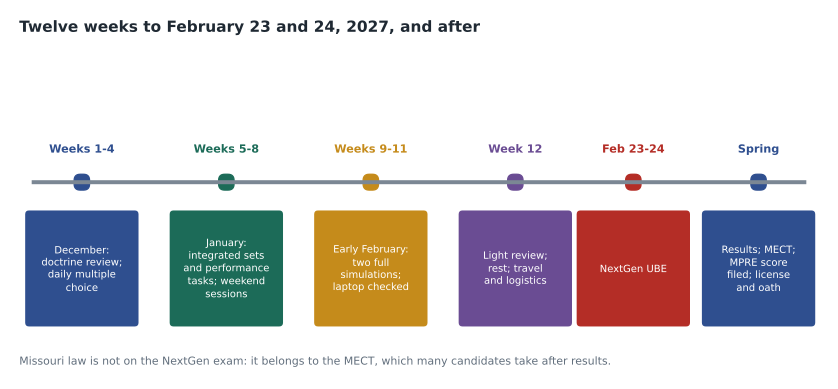
Marcus wrote his plan for a candidate sitting the February 23 and 24, 2027 exam, built on what he had learned in July 2026. Twelve weeks out, the candidate should have a study schedule organized by NextGen item type, not by subject alone, with daily multiple-choice practice and weekly integrated sets and performance tasks. Eight weeks out, the candidate should take a full simulated exam on the same laptop that will be used on exam day, in three-hour blocks matching the real schedule. Four weeks out, the candidate should take a second simulation, confirm that the laptop meets NCBE's requirements and install and test the exam software as soon as NCBE allows.
In the final week, the candidate should study lightly, confirm the test site and reporting time from the Board's instructions, book lodging near the site if travel is needed, and pack the night before: laptop, charger, admission materials and identification as the Board directs, and anything else the Board's rules permit. On each exam day, the candidate should arrive early, eat a real breakfast and bring a lunch that can wait. 'Expect something to go wrong,' Marcus said. 'In July we had a delayed start, and some people finished their first-day sections the next morning. It did not hurt anyone's score, according to NCBE, but it hurt the people who let it rattle them. If it happens to you, eat something, breathe and wait for instructions.'
Within each session, the candidate should keep to a time budget. A reasonable approach is to glance at the whole session first, note the performance task and integrated set, and decide in advance how many minutes each part gets. Multiple-choice questions should not be allowed to consume time meant for the performance task, which counts heavily and rewards a complete product. When the session ends, the candidate should let it go and not discuss answers with others at lunch.
After the exam, the plan turns to the remaining requirements. A candidate who has not yet taken the MECT should read the current outlines and take it, and file the certificate. A candidate without a qualifying MPRE score should register for the next MPRE. The candidate should keep the character and fitness application current until licensed. When results arrive, the one-year windows for the MECT and the MPRE begin, but the goal is to have both done so that licensing can follow quickly.
Hollis closed the session, and the course, with a summary she had written on the screen at the very first meeting: who, what, when. Who admits Missouri lawyers: the Supreme Court of Missouri, through its Board of Law Examiners. What a candidate must do: meet the education requirement, file on time, pass character and fitness, score 610 on the NextGen exam, complete the MECT and file an MPRE score of 80. When: by October 1 or March 1 for the application, and within one year after the notice of passing for the MECT and MPRE. 'Everything else,' she said, 'is Missouri law, and you will spend your career learning it.' Marcus said he planned to start by reading the verdict director for his car case one more time.
Practice problems
Work each problem on paper first, then reveal the answer to check.
A Missouri jury finds the plaintiff 55 percent at fault and the defendant 45 percent, with damages of 50,000 dollars. What does the plaintiff recover?
Show answer
22,500 dollars, under pure comparative fault.
A defendant is found 50 percent at fault. Is it jointly and severally liable under section 537.067?
Show answer
No; the threshold is 51 percent.
What is Missouri's NextGen passing score?
Show answer
610.
What must a passing applicant file within one year after notice of passing?
Show answer
The MECT certificate and a qualifying MPRE score of 80.
How many witnesses does a Missouri will need?
Show answer
Two.
Which statement must appear in most Missouri lawyer advertising?
Show answer
The choice of a lawyer is an important decision and should not be based solely upon advertisements.
What custody presumption has Missouri applied since 2023?
Show answer
Equal or approximately equal parenting time is in the child's best interests, rebuttable by a preponderance of the evidence.
How many districts does the Missouri Court of Appeals have?
Show answer
Three.
Common mistakes
MistakeA city is liable for punitive damages when its driver has a bad record.
InsteadPunitive damages may not be awarded against a Missouri public entity.
MistakeJoint and several liability lets a plaintiff collect beyond a public entity's statutory cap.
InsteadThe section 537.610 limits cap the public entity's liability.
MistakeA spouse always takes 20,000 dollars plus half by intestacy.
InsteadWhere any issue are not the spouse's, the spouse takes one-half.
MistakeA settlement check can sit in the operating account until it clears.
InsteadClient funds belong in the trust account under Rule 4-1.15.
MistakeExam-day delays should be made up by rushing.
InsteadFollow instructions, keep to the time budget and stay calm; NCBE found delayed examinees in July 2026 performed consistently.
Using this capstone
A candidate working alone can use the problem above as a timed exercise: allow forty-five minutes, write an answer in IRAC form for each issue, and then compare it with the model answer, noting any rule that was missing or misstated. The same habit of identifying the issue, stating the rule precisely, applying it to the facts and concluding is what the performance tasks and integrated sets on the NextGen exam reward.
Summary and key terms
- IRAC structure keeps Missouri answers organized: issue, rule, application, conclusion.
- Claims against public entities start with section 537.600 waivers and section 537.610 caps; no punitive damages.
- Pure comparative fault and the 51 percent rule decide who pays what among private defendants.
- Venue follows the place of first injury; fact pleading and the five-year limitations period apply.
- Intestate shares and trust account rules are frequent practical questions for new Missouri lawyers.
- A twelve-week plan, two full simulations and calm handling of delays prepare a candidate for exam days.
- IRAC
- Issue, rule, application and conclusion, a structure for legal analysis.
- commingling
- Mixing client funds with a lawyer's own funds, forbidden by Rule 4-1.15.
- time budget
- A plan allocating minutes to each part of an exam session.
- simulated exam
- A full timed practice exam taken under realistic conditions.
- statutory cap
- A legislated limit on damages, such as section 537.610 for public entities.
Lesson quiz · 5 questions
Score 60% or more to complete this lesson.
Create a free account to save your progress, take quizzes and earn a certificate.