
BAR-226 · Lesson 4 of 12 · 20 min
The Missouri bar exam: the NextGen UBE, scoring and the 610 passing score
▶ Video coming soon A video version of this lesson is on the way.
Hollis opened the fourth session with a single question for Marcus: 'Describe the exam to someone who has never seen it, in one minute.' He took a breath. 'Nine hours, three sessions of three hours. Two on Tuesday, one Wednesday morning. Every session has multiple-choice questions, an integrated set and a performance task. You type everything on your own laptop. One score, from 500 to 750. In Missouri you need 610.' Hollis checked her watch. 'Forty seconds. That is the lesson. The rest is detail.'
This lesson fills in the detail: how the NextGen Uniform Bar Examination is structured as Missouri gives it, what it tests, how it is scored, what Missouri's passing score of 610 means, and what happened at the first administration in July 2026.
The structure
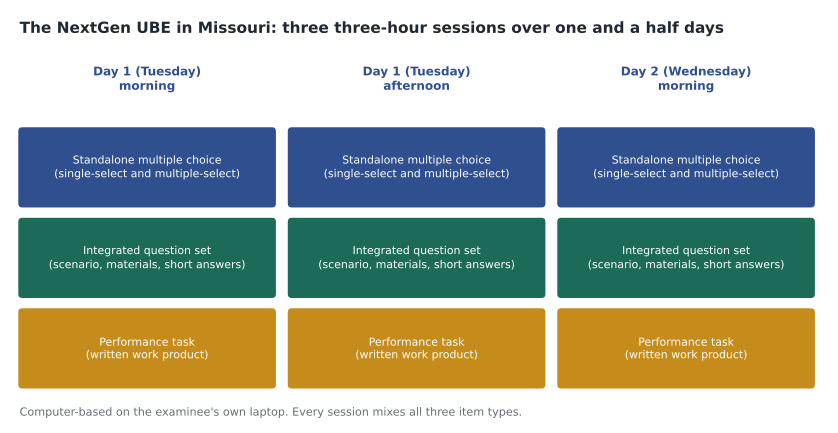
The NextGen UBE is a nine-hour exam given over one and a half days. NCBE divides it into three sessions of three hours each. In Missouri the first day, a Tuesday, has a morning session and an afternoon session with a lunch break between them, and the second day, a Wednesday, has a single morning session. Every session contains three kinds of item. Standalone multiple-choice questions come in two forms: single-select questions with one correct answer, and multiple-select questions that ask the examinee to choose a stated number of correct answers from a list. Integrated question sets begin with a scenario and legal materials, such as a statute, a contract, a set of emails or a short case excerpt, and then ask several related questions, some multiple-choice and some calling for short written answers. Performance tasks ask the examinee to produce a piece of written work, such as a memo, a letter or part of a brief, using materials provided in the task; some include a research element in which the examinee must decide which materials to consult.
The legacy UBE that Missouri gave through February 2026 was a twelve-hour exam over two full days: a day of essays and performance tests, and a day of the 200-question MBE. The NextGen exam is shorter and mixes the item types throughout, so there is no longer a writing day and a multiple-choice day.
Computer-based testing
The NextGen exam is computer-based. Examinees bring their own laptops, install NCBE's secure testing software before the exam and take every session on screen at a site run by the Board. The software presents the questions, keeps time, flags questions for review and records written answers typed into response boxes. Because everything happens in the software, practice in a similar interface is part of preparation. NCBE publishes a tutorial and sample questions that show how multiple-select questions, integrated sets and performance tasks look on screen. Marcus said he had worked through the tutorial twice and had taken one full timed practice session on his own laptop, with the same power cord and the same chair height he expected at the exam. 'It sounds fussy,' he said, 'but on the day, nothing about the screen surprised me.'
What the exam tests
The NextGen exam tests foundational lawyering skills and foundational legal concepts together. NCBE's skills list includes legal research, legal writing, issue spotting and analysis, investigation and evaluation, client counseling and advising, negotiation and dispute resolution, and client relationship and management. Its concepts list covers the core doctrine of civil procedure, contract law, evidence, torts, business associations, constitutional law, criminal law and constitutional protections of accused persons, and real property. Bar review providers report that family law and trusts and estates are within the tested scope for the administrations through at least February 2028, and NCBE's outlines mark some topics for detailed knowledge and others for more limited treatment.
Professional responsibility appears inside the skills rather than as a separate subject. NCBE identifies specific Model Rules that may be tested within counseling, negotiation and client relationship tasks, such as the rules on competence, scope of representation, diligence, communication, confidentiality, conflicts, candor to the tribunal, truthfulness to others and dealing with represented and unrepresented persons. A task about advising a client may include a question about what the lawyer may disclose or whom the lawyer may contact. The separate MPRE still tests professional responsibility in depth.
The exam tests general law, not Missouri law. A question about comparative fault on the NextGen exam tests the general approach that the materials or the majority of states use, not Missouri's pure comparative fault rule, unless the question's materials supply Missouri's rule. Missouri law belongs to the MECT. Marcus put it bluntly: 'If you catch yourself answering a NextGen question with a Missouri rule you learned at work, stop and read the materials again.'
How the score is built
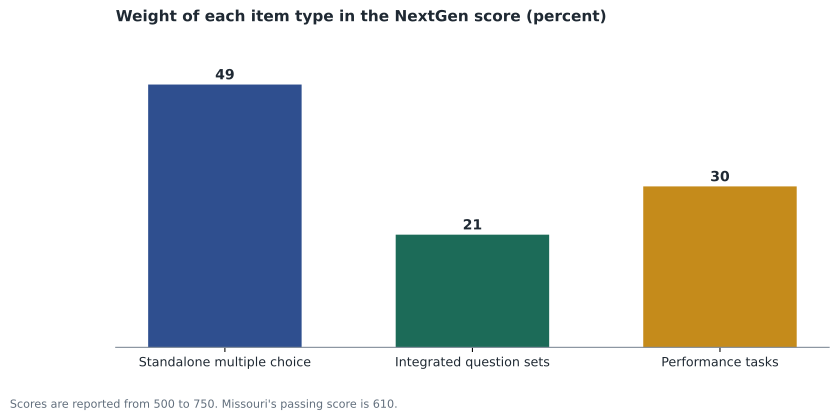
NCBE reports a single NextGen score on a scale from 500 to 750. The three item types are weighted. According to NCBE, standalone multiple-choice questions count for 49 percent of the total, integrated question sets for 21 percent and performance tasks for 30 percent. Taken together, the parts that involve written answers, the integrated sets and the performance tasks, account for slightly more than half of the score.
NCBE scores the multiple-choice items. Missouri graders score the written answers using NCBE's grading materials, and NCBE scales and equates the results. Equating adjusts for small differences in difficulty between exam forms, so that a 610 in February 2027 reflects the same level of performance as a 610 in July 2026. Scaling places the written scores on the same scale as the multiple-choice scores so they can be combined. The final score is compensatory: strength in one part can offset weakness in another, and Missouri sets no separate minimum for each part. Only the total decides the result.
Missouri's passing score of 610
Under the Board's regulations, a scaled total score of at least 610 is required to pass the NextGen UBE in Missouri. On the legacy UBE, Missouri's passing score was 260 on the 400-point scale, one of the lower passing scores among UBE jurisdictions. The two numbers are on different scales and cannot be compared by simple arithmetic. NCBE published information relating the two scales so that jurisdictions could set NextGen passing scores reflecting a standard comparable to their legacy scores, and Iowa, which also used 260 on the legacy exam, likewise chose 610 for NextGen.
A score of 610 is the minimum. An applicant who scores 610 passes; an applicant who scores 609 does not. Because Missouri does not regrade or rescore, there is no route to turn a 609 into a 610 after the fact. A passing Missouri score is also a score that can later be transferred to other jurisdictions that accept NextGen scores, subject to their own passing scores and time limits. Marcus's 648 cleared Missouri's line by 38 points, which mattered later when he looked at jurisdictions with higher passing scores.
| Exam | Scale | Missouri passing score | Given in Missouri |
|---|---|---|---|
| Legacy UBE | 0 to 400 | 260 | Through February 2026 |
| NextGen UBE | 500 to 750 | 610 | From July 2026 |
The first administration
Missouri gave its first NextGen exam on Tuesday and Wednesday, July 28 and 29, 2026. It was one of ten jurisdictions in the first operational administration. NCBE reported afterward that about 2,640 applicants tested at sixteen sites and that the testing platform performed as designed, while some sites had local problems. In Missouri, delayed starts kept some applicants from finishing the full first day's schedule, and they completed the remaining sections the following day. Marcus was in a room with a delayed first morning. 'Nobody panicked,' he said. 'The proctors told us what was happening, and we waited. I ate half my lunch early, which I do not recommend.' NCBE later reported that examinees on the adjusted schedule performed consistently with the broader population.
On September 25, 2026, NCBE released national figures for the July administration. Across the ten jurisdictions, 2,630 examinees received official scores. The mean score was 640.6 and the median 640. Using each jurisdiction's own passing score, 72.7 percent passed, including 85.2 percent of examinees who had never taken a bar exam anywhere and 41.0 percent of repeat takers. NCBE's figures are aggregate. This course does not state a Missouri pass rate, because none appears in the sources it relies on, but NCBE's jurisdiction pages publish pass rates by jurisdiction as they become available.
Results
Marcus received his result on Friday, October 2, 2026. Under Rule 8.03 and the Board's regulations, an applicant who passes the exam but has not yet met every other requirement receives written notice of passing, but the applicant's name is not made public until those requirements are met. That rule explains why some candidates who passed did not see their names on a published list right away: the MECT, the MPRE score or a character and fitness matter was still open. The Board may also withhold results while it confirms that a score is valid, if it has reasonable concern about validity.
The written notice of passing starts the clock for the MECT and the MPRE. Both must be completed or filed no later than one year after that notice. Marcus had finished both before the exam, so his file was complete when his result arrived, and he was licensed shortly afterward.
Strategy by item type
Standalone multiple-choice questions reward breadth, speed and careful reading of the call. Multiple-select questions punish partial knowledge, because the examinee must identify every correct option the question asks for. Timed practice with careful review of every explanation is the best preparation.
Integrated question sets reward reading. The scenario and materials contain the law the examinee needs, sometimes in a form that differs from the general rule. Short written answers should be direct: give the answer, give the reason, cite the material.
Performance tasks reward following instructions. The task memo says what to write, for whom and in what form. The examinee should read the task memo first, skim the materials, outline and then write, and should budget time so the product is complete. An organized, complete answer that follows the instructions scores better than a brilliant partial one.
Worked problem
Reading a score
Junie Fairbanks, a hypothetical Missouri candidate, scores 607 on the July 2027 NextGen exam. Her performance tasks were strong but her multiple-choice work was weak. She asks whether her strong writing can be regraded to get her to 610, and whether her writing score can be banked for next time.
Show solution
- Missouri requires a total scaled score of 610.
- The score is compensatory, with no separate minimums and no banking of parts.
- The Board's regulations allow no regrading, rescoring or review of scores.
- Standalone multiple choice is 49 percent of the score, the largest single share.
Answer: She did not pass and cannot obtain a regrade or carry part of her score forward. She can sit again, and her best plan is to keep her writing sharp while putting most of her time into multiple-choice practice, where the weight and her room for improvement are greatest.
Common mistakes
MistakeThe NextGen exam has a multiple-choice day and a writing day.
InsteadEvery session mixes multiple choice, an integrated set and a performance task.
MistakeMissouri's passing score is 260.
InsteadThat was the legacy UBE score; the NextGen passing score is 610 on the 500 to 750 scale.
MistakeMissouri requires a minimum on each item type.
InsteadOnly the total score matters; the score is compensatory.
MistakeA passing applicant's name is published immediately.
InsteadNames are not made public until all other requirements are met.
MistakeNextGen questions test Missouri law.
InsteadThey test general law; Missouri law is covered by the MECT.
Practice problems
Work each problem on paper first, then reveal the answer to check.
How is the NextGen exam scheduled in Missouri?
Show answer
Three three-hour sessions: Tuesday morning and afternoon and Wednesday morning.
What are the three score weights?
Show answer
Standalone multiple choice 49 percent, integrated sets 21 percent, performance tasks 30 percent.
What is Missouri's NextGen passing score, and what was its legacy UBE passing score?
Show answer
610 on the NextGen scale; 260 on the legacy scale.
When did Missouri first give the NextGen exam?
Show answer
July 28 and 29, 2026.
What national pass rate did NCBE report for July 2026?
Show answer
72.7 percent, with a mean score of 640.6.
How the exam days run
The Board sends each examinee instructions before the exam covering the test site, reporting times, permitted items, identification and laptop requirements. Examinees report early on Tuesday morning, check in, set up their laptops and wait for the proctors to start the session. After the morning session there is a lunch break before the afternoon session, and Wednesday has a single morning session. Between sessions, examinees may not discuss the questions, and the software locks each session once its time ends. Marcus advised reading the Board's instructions twice: once when they arrive, and once the night before the exam. 'Everything people got wrong on check-in day was in the instructions,' he said.
Hollis added that the exam rewards steady pacing over bursts of speed. An examinee who finishes every session with a few minutes to spare, having attempted every item, usually scores better than one who polishes early answers and leaves later items blank, because every point on the exam counts the same toward the total.
Summary and key terms
- The NextGen UBE is nine hours in three three-hour sessions: Tuesday morning and afternoon and Wednesday morning.
- Each session mixes standalone multiple choice, an integrated question set and a performance task, on the examinee's laptop.
- Weights: standalone multiple choice 49 percent, integrated sets 21 percent, performance tasks 30 percent.
- Scores run from 500 to 750; Missouri requires 610 (260 on the legacy UBE); there is no regrading.
- The exam tests general law; Missouri law is tested by the MECT.
- July 2026: delayed starts in Missouri, national pass rate 72.7 percent; passing names are withheld until all requirements are met.
- NextGen UBE
- NCBE's computer-based bar exam, first given in Missouri in July 2026 and scored from 500 to 750.
- integrated question set
- A NextGen item with a scenario and materials followed by multiple-choice and short written questions.
- performance task
- A NextGen task producing written work from provided materials.
- equating
- Statistical adjustment that keeps scores comparable across exam forms.
- compensatory scoring
- Scoring in which strength in one part can offset weakness in another.
Lesson quiz · 5 questions
Score 60% or more to complete this lesson.
Create a free account to save your progress, take quizzes and earn a certificate.