
BAR-226 · Lesson 3 of 12 · 21 min
Character and fitness and the MPRE
▶ Video coming soon A video version of this lesson is on the way.
Marcus admitted at the third session that the character and fitness section of his application had worried him more than the exam. He had nothing dramatic to report: a speeding ticket from his second year of college, a part-time job he had left on bad terms after a scheduling dispute, and a credit card that had gone thirty days past due during a hard semester. 'I kept thinking each one would sink me,' he said. Hollis shook her head. 'None of those sinks anyone. What sinks people is leaving them off.'
This lesson explains Missouri's character and fitness review under Rule 8.11, the procedure when the Board has concerns, conditional approval, hearings and appeals, and the MPRE requirement under Rule 8.08(b).
Why character and fitness exists
Every jurisdiction asks whether an applicant can be trusted with clients' money, secrets and cases, and whether the applicant can meet deadlines, follow court orders and deal honestly with courts and opponents. The bar exam measures knowledge and skill. The character and fitness review measures conduct. In Missouri the Board must approve each applicant's character and fitness under Rule 8.11 before the applicant can be licensed, whatever route to admission the applicant follows.
The applicant carries the burden. It is not the Board's job to prove that an applicant is unfit; it is the applicant's job to show, through a complete and candid application, that he or she has the honesty, trustworthiness, diligence and reliability a lawyer needs. Most applicants meet that burden without difficulty, because most applicants' histories contain nothing more than ordinary mistakes honestly reported.
What the application asks
The Missouri application asks for a detailed history: every residence, school and job for the years the form covers, every license held, any criminal charges or citations, civil lawsuits, financial problems such as defaults or bankruptcies, academic or employment discipline, and conduct in other licensing processes. It asks the applicant to sign the authorization and release that lets the Board gather records directly from schools, employers, courts and agencies. The Board compares what it finds with what the applicant reported.
That comparison is why candor matters so much. A traffic ticket the applicant disclosed is a minor fact. The same ticket, left off the form and found by the Board, becomes a question about honesty, and honesty in the application is itself part of the review. Marcus disclosed all three items. For the job he had left, he wrote a short, factual explanation and did not argue with his former manager on paper. For the late credit card, he listed the account, explained the semester, and attached a recent statement showing the account in good standing.
How the review proceeds
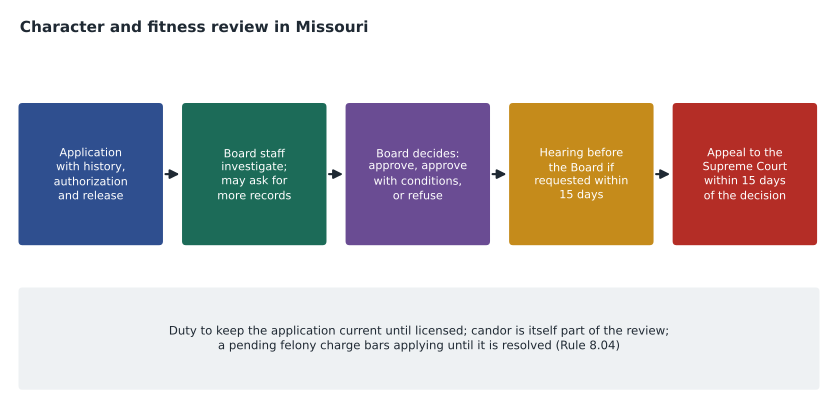
After the application is properly filed, Board staff review it and begin collecting records. Many applications are approved without further contact. Where something needs explanation, the Board may ask the applicant for more information or documents, such as court dispositions, letters from employers, proof that debts have been paid or records of treatment. Prompt, complete answers move the file forward. Applicants who ignore requests or answer them partially create delay and new questions.
The duty to disclose does not end when the application is filed. Applicants must keep the application current until they are licensed. A new citation, arrest, lawsuit, default or academic action that occurs after filing must be reported. Marcus said he had a reminder on his calendar to reread the questions once a month during bar study, 'just to make sure nothing in my life had changed an answer.'
What the Board considers
The Board looks at conduct, not labels. Its regulations direct it to consider criminal conduct even if the conduct does not fall within the felony categories in Rule 8.04, and the review covers dishonesty, neglect of financial obligations, violation of court orders, academic misconduct, misconduct in employment and similar matters. Like other boards, it weighs factors such as the applicant's age at the time, how recent and how serious the conduct was, whether it was a pattern or a single incident, the applicant's candor about it, and evidence of rehabilitation.
Mental health deserves a careful word. Seeking counseling or treatment is not misconduct, and a history of treatment is not in itself a reason to deny admission. The review focuses on conduct that bears on the ability to practice. Candidates who worry about this area should read the current application questions carefully and answer exactly what is asked.
Conditional approval
Missouri's rules allow the Board to approve an applicant on conditions instead of refusing approval outright. Under Rule 8.11, conditions may include participation in treatment or a program, monitoring or reporting requirements. An applicant approved on conditions must comply with them and must self-report any violation. A material violation can lead the Board to revoke the conditional approval and refuse permission to sit for the exam or to be licensed. Conditional approval is a middle path: it lets an applicant who has shown real progress move forward while giving the Board a way to confirm that progress continues.
Hearings and appeals
If the Board refuses to approve an applicant, Rule 8.12 gives the applicant fifteen days to request a hearing before the Board. The Board's decision after the hearing must be in writing. An applicant who is still refused may appeal to the Supreme Court of Missouri within fifteen days of the Board's written decision. The Court decides the appeal on the record made before the Board and does not take additional evidence. That last point matters for strategy: an applicant who has letters of reference, treatment records or other evidence should present it at the Board hearing, because there will be no second chance to add it.
Hollis gave the group a short rule of thumb. 'Answer every question. Explain without arguing. Attach the paper that proves it. Update it when something changes. If it ever goes to a hearing, bring everything to the hearing.'
The MPRE requirement
Rule 8.08(b) requires every applicant admitted by examination to know legal ethics and the Missouri Rules of Professional Conduct, and to show that knowledge by earning a scaled score of at least 80 on the Multistate Professional Responsibility Examination. The certified score must reach the Board no later than one year after the applicant receives written notice of passing the bar exam. An applicant who passes the bar exam but does not file a qualifying MPRE score within that year cannot be licensed on that result.
The same score, 80, applies to applicants admitted by transferred score under Rule 8.09, and the same one-year window runs from the Board's notice that it has received an acceptable transferred score. NCBE's chart notes that Missouri applies time parameters to MPRE scores but that there is no MPRE time limit for admission without examination under Rule 8.10. Candidates whose MPRE score is several years old should check the Board's current regulations on how old a score may be before relying on it.
About the MPRE
The MPRE is written and administered by NCBE. It is a two-hour, sixty-question multiple-choice exam, of which fifty questions are scored and ten are unscored pretest items. Scores are reported on a scale from 50 to 150. NCBE gives the exam several times a year, and candidates register through their NCBE accounts. The questions test the ABA Model Rules of Professional Conduct and the ABA Model Code of Judicial Conduct, along with generally accepted principles from case law and procedural rules, not the rules of any one state. Missouri's version of the rules is largely parallel to the Model Rules, but where Missouri differs, the MPRE answer follows the Model Rule.
Most candidates take the MPRE during law school, often in the second or third year. Marcus took it in 2025 and passed with room to spare. He later learned that the same score also satisfied Kansas's MPRE requirement of 80, which mattered when he looked into using his NextGen score there. 'A good MPRE score travels,' he said. 'Most states take it, and many use 80, though a few set it higher.' The MPRE is separate from the NextGen exam, and the move to NextGen did not eliminate it: Missouri still requires both.
| Requirement | Rule | What Missouri requires |
|---|---|---|
| Character and fitness approval | Rule 8.11 | Board approval before licensing, on every route |
| Hearing after refusal | Rule 8.12 | Request within 15 days; written decision |
| Appeal | Rule 8.12 | To the Supreme Court within 15 days; no new evidence |
| MPRE (by examination) | Rule 8.08(b) | Scaled 80, filed within one year after notice of passing |
| MPRE (by transferred score) | Rule 8.09 | Scaled 80, filed within one year after the Board's notice |
Worked problem
Updating the file
Silas Kerrigan, a hypothetical applicant for the February 2027 exam, filed his application in September 2026. In December 2026 he receives a citation for driving with an expired registration, which he pays the next week. He thinks it is too minor to mention. What should he do?
Show solution
- Applicants must keep the application current until licensed.
- The application asks about citations and charges, so a new citation changes an answer.
- An undisclosed matter later found by the Board raises a question of candor, which is part of the review.
- A paid registration citation is minor in itself.
Answer: He should promptly amend his application to report the citation and its payment. Reported, it is a minor matter; unreported and later discovered, it becomes a question about his honesty.
Common mistakes
MistakeThe Board must prove an applicant is unfit.
InsteadThe applicant bears the burden of showing good character and fitness.
MistakeOnce the application is filed, later events do not need to be reported.
InsteadApplicants must keep the application current until licensed.
MistakeMissouri requires an MPRE score of 85.
InsteadMissouri requires a scaled score of 80.
MistakeNew evidence can be presented to the Supreme Court on appeal.
InsteadThe Court decides on the Board record and takes no additional evidence.
MistakeThe MPRE tests the Missouri Rules of Professional Conduct.
InsteadIt tests the ABA Model Rules and the Model Code of Judicial Conduct.
Practice problems
Work each problem on paper first, then reveal the answer to check.
Which rule governs character and fitness approval in Missouri?
Show answer
Rule 8.11.
How long does an applicant have to request a hearing after the Board refuses approval?
Show answer
Fifteen days.
How long does an applicant have to appeal to the Supreme Court after the Board's written decision?
Show answer
Fifteen days.
What MPRE score does Missouri require, and by when must it be filed for an applicant admitted by examination?
Show answer
A scaled 80, no later than one year after written notice of passing the bar exam.
What may the Board do short of refusing approval?
Show answer
Approve on conditions, such as treatment, monitoring or reporting.
Common areas of disclosure
Hollis walked through the areas where Missouri applicants most often have something to report and how each is usually handled. Driving records come first: speeding tickets, accidents and license suspensions are common, and a paid ticket honestly disclosed is rarely more than a line in the file. A pattern of unpaid tickets or a suspension for failing to appear raises more questions, because it bears on whether the applicant meets obligations to courts.
Financial history comes next. Missouri, like other jurisdictions, cares less about debt itself than about how an applicant has handled it. Student loans in repayment or in an approved deferment are ordinary. Accounts in collection, judgments, defaults and bankruptcy filings should be disclosed with an explanation and, where possible, proof of payment plans or satisfaction. An applicant who has ignored a debt should contact the creditor and start resolving it before filing, so the application can show what has been done.
Academic and employment matters are the third area. Discipline in college or law school, including findings of plagiarism or honor code violations, must be disclosed even if the school's record is sealed. Being fired or asked to resign should be described factually. Criminal matters are the fourth area, and the application's questions usually reach charges and citations that were dismissed, diverted or expunged. An applicant unsure whether a matter must be reported should read the question literally and, when in doubt, disclose with an explanation.
Planning the MPRE
The MPRE is offered several times a year, and registration deadlines fall well before each test date. Most candidates take it during the second or third year of law school, after a professional responsibility course. A candidate who scores below 80 may simply take it again; only the qualifying score needs to reach the Board, and NCBE sends score reports to the jurisdictions a candidate designates. A candidate who plans to seek admission in more than one state should check each state's MPRE score and any limit on how old a score may be, because a score that satisfies Missouri may be too old or too low for another jurisdiction. Marcus noted that NCBE's score services let a candidate send an existing MPRE score to an additional jurisdiction later, so there is no need to retake the exam merely to obtain a new report.
Hollis ended the discussion with one more practical point. Applicants should keep a complete copy of everything they submit, including every amendment and every letter to the Board, because the same history will be asked for again in any other jurisdiction where they later seek admission, and the answers must be consistent.
Summary and key terms
- The Board must approve character and fitness under Rule 8.11 on every route to admission.
- The applicant bears the burden; candor in the application is itself part of the review.
- Applicants must keep the application current until licensed.
- The Board may approve on conditions; violations must be self-reported.
- A refused applicant may request a hearing within 15 days and appeal to the Supreme Court within 15 days of the written decision, on the record.
- Missouri requires an MPRE scaled score of 80, filed within one year after notice of passing.
- character and fitness
- The review of an applicant's conduct and honesty required for admission.
- conditional approval
- Board approval subject to conditions such as treatment or monitoring.
- Rule 8.12
- The Missouri rule providing hearings before the Board and appeals to the Supreme Court.
- MPRE
- NCBE's professional responsibility exam; Missouri requires a scaled score of 80.
- duty to update
- The continuing obligation to report changes to the application until licensed.
Lesson quiz · 5 questions
Score 60% or more to complete this lesson.
Create a free account to save your progress, take quizzes and earn a certificate.