
BAR-213 · Lesson 8 of 12 · 17 min
Idaho torts: comparative fault, damages caps and the Tort Claims Act
▶ Video coming soon A video version of this lesson is on the way.
The car wreck files at Wes's firm taught him more Idaho tort law in a month than his torts class had in a semester. One client, a pickup driver broadsided at a county road intersection, wanted to know whether his own speeding would sink his case. Another, a cyclist hit by a city utility truck, wanted to know why her claim had a deadline of six months when everyone told her she had two years. A third, a ranch hand hurt when a neighbor's bull got through a broken fence, wanted to know what his pain and suffering was worth. Each question had an Idaho answer that differed from the general rules Wes was studying for the exam.
This lesson covers the Idaho tort rules a new lawyer meets first: comparative fault, the abolition of most joint and several liability, the caps on noneconomic and punitive damages and the Idaho Tort Claims Act. As with the other Idaho law lessons, the exam tests general tort law, not these rules. The point here is to prepare for practice and to keep the Idaho rules from leaking into exam answers.
Modified comparative fault
Idaho replaced contributory negligence with comparative negligence by statute in 1971. The rule now appears in Idaho Code section 6-801. A plaintiff whose own negligence contributed to an injury may still recover, but only if the plaintiff's negligence was not as great as the negligence or fault of the person against whom recovery is sought. Damages are then reduced in proportion to the plaintiff's share of fault. In effect, a plaintiff who is 49 percent at fault recovers 51 percent of the damages; a plaintiff who is 50 percent at fault recovers nothing. Courts and commentators call this a modified comparative fault system with a 50 percent bar.
Juries in Idaho comparative fault cases answer special verdict questions that assign percentages of fault. The plaintiff's percentage is compared with the fault of the defendant or defendants, and the details of that comparison, especially when there are several defendants or when fault is assigned to someone who is not a party, are matters a new lawyer should research in Idaho cases before trial. The general idea is simple, but the application can turn on who is on the verdict form.
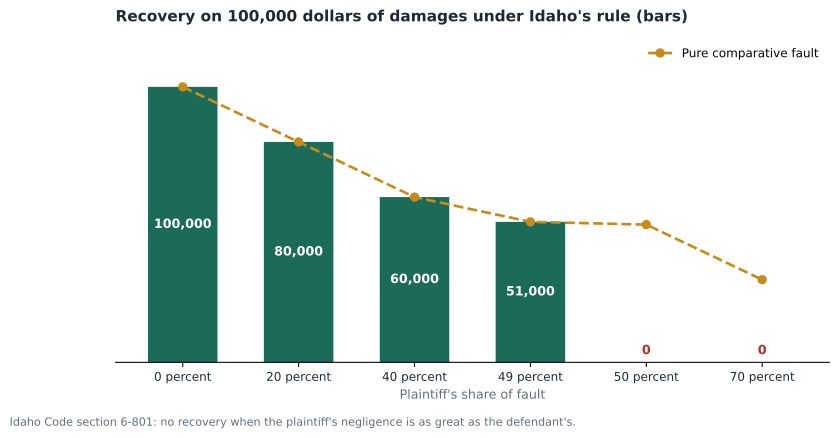
For the exam, the contrast matters. The NextGen exam may test pure comparative fault, modified comparative fault or contributory negligence, and it tells candidates which applies when the answer depends on it. A candidate who automatically applies Idaho's 50 percent bar will be wrong whenever the question adopts a different rule. Wes's pickup driver, found 30 percent at fault in a mock verdict exercise, would recover 70 percent of his damages in Idaho; at 50 percent he would recover nothing, while under pure comparative fault he would recover half.
Several liability
Idaho also changed the traditional rule of joint and several liability. Under the old rule, each defendant whose negligence contributed to an indivisible injury could be made to pay the whole judgment, leaving that defendant to seek contribution from the others. Idaho Code section 6-803 now provides, as a general rule, that each defendant is liable only for the share of damages that corresponds to its own percentage of fault. A plaintiff who sues two defendants found 60 and 40 percent at fault collects 60 percent from one and 40 percent from the other, and bears the risk if one of them cannot pay.
The statute keeps joint and several liability in narrow situations, such as where defendants acted in concert or where one party is legally responsible for another's conduct, as an employer is for an employee acting within the scope of employment. The exceptions matter in practice, and the statute should be read in full whenever several defendants are involved.
Caps on noneconomic damages
Idaho limits noneconomic damages in personal injury cases. Idaho Code section 6-1603 caps damages for pain, suffering, inconvenience, physical impairment, disfigurement and other nonpecuniary losses. The cap was set at 250,000 dollars when the current version was enacted in 2003 and is adjusted every year on July 1 to reflect changes in the average annual wage. The Idaho Industrial Commission publishes the adjusted figure; for claims arising on or after July 1, 2026, the cap is 538,425.04 dollars. The cap does not limit economic damages, such as medical expenses and lost wages, which remain recoverable in full.
The statute also contains exceptions. The cap does not apply to causes of action arising out of willful or reckless misconduct, or out of acts that would constitute a felony under state or federal law. Whether a case falls within an exception can be the most important question in it, because it determines whether the jury's award for pain and suffering stands or is reduced.
| Item | Idaho rule | Where |
|---|---|---|
| Comparative fault | Recovery only if plaintiff's negligence is not as great as the defendant's; damages reduced in proportion | Idaho Code section 6-801 |
| Several liability | Each defendant generally pays only its own share, with narrow exceptions | Idaho Code section 6-803 |
| Noneconomic damages cap | 538,425.04 dollars for claims arising on or after July 1, 2026; adjusted each July 1; exceptions for willful or reckless misconduct and felonies | Idaho Code section 6-1603 |
| Punitive damages | Require clear and convincing proof of oppressive, fraudulent, malicious or outrageous conduct; capped | Idaho Code section 6-1604 |
| Claims against government | Notice within 180 days; liability limited to 500,000 dollars per occurrence unless more insurance is bought | Idaho Tort Claims Act, Idaho Code sections 6-901 and following |
Punitive damages
Punitive damages in Idaho are governed by Idaho Code section 6-1604. A plaintiff may not include a claim for punitive damages in the original complaint; the plaintiff must ask the court for permission to amend and show a reasonable likelihood of proving facts sufficient to support the award. At trial, the plaintiff must prove by clear and convincing evidence that the defendant's conduct was oppressive, fraudulent, malicious or outrageous. Awards are capped at the greater of 250,000 dollars or three times the compensatory damages, with exceptions for certain criminal conduct. Because the procedure for adding the claim is distinctive, Idaho practitioners treat a motion to amend for punitive damages as a significant event in a case.
The Idaho Tort Claims Act
The Idaho Tort Claims Act, in Idaho Code sections 6-901 and following, waives the state's and local governments' immunity from tort suits, but on conditions. The first is notice. A claim against a political subdivision, such as a city, county, school district or highway district, or against one of its employees acting within the scope of employment, must be presented to and filed with the clerk or secretary of the entity within 180 days from the date the claim arose or reasonably should have been discovered, whichever is later. A parallel provision requires claims against the state to be filed with the secretary of state. A claimant who misses the notice deadline loses the claim, even if suit would otherwise be timely.
The second condition is a limit on liability. Under Idaho Code section 6-926, the combined liability of a governmental entity and its employees for damages, costs and attorney fees arising from a single occurrence may not exceed 500,000 dollars, no matter how many people are injured or how many claims are made. The limit rises if the entity has bought liability insurance with higher limits, in which case the available insurance becomes the ceiling, and courts must reduce judgments that exceed the applicable limit.
The third condition is a set of exceptions. The Act keeps immunity for certain kinds of government action, the best known being the discretionary function exception, which protects planning-level decisions about how to allocate resources and set policy, as opposed to operational decisions about carrying them out. Other exceptions cover specific activities. Government employees are generally protected from personal liability for acts within the scope of their employment unless they acted with malice or criminal intent.
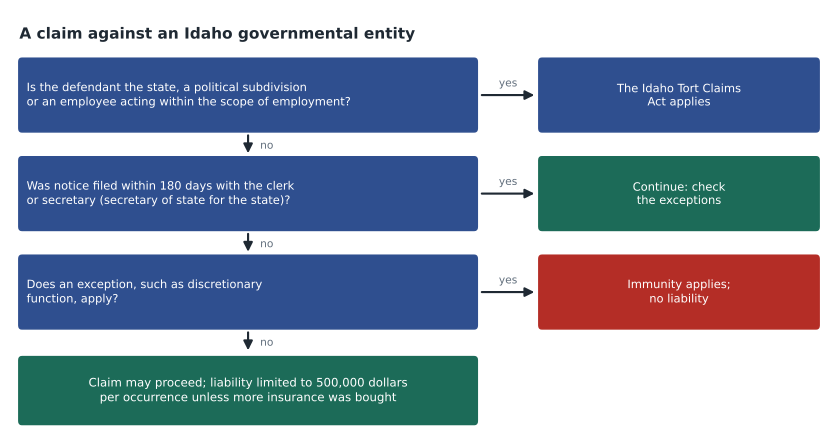
Wes's cyclist client illustrates the trap. Her accident happened in June 2026 when a city utility truck turned across a bike lane. Her two-year limitation period for personal injury runs to June 2028, but her notice of claim to the city was due within 180 days, in December 2026. When she came to the firm in November, Ruffing had Wes draft and file the notice that week, with the facts, the nature of the injuries and the damages claimed, and calendar the lawsuit separately.
Animals, fences and rural torts
Idaho's rural character shows up in its tort law. Livestock owners face distinctive rules about animals on roads and onto neighboring land, and Idaho has fence and estray statutes that can affect who bears the loss when livestock wander. Owners of land open to the public for recreation without charge have statutory protection under Idaho's recreational use statute, which limits their duty to people who use the land for recreation. The details of these statutes, and the cases interpreting them, are classic subjects for Idaho practice and for the Idaho substantive law courses. The ranch hand's case at Wes's firm turned on whether the neighbor's fence statute duties applied and whether the bull's owner knew of the broken fence.
Worked problem
Applying the Idaho rules
A jury finds that a plaintiff suffered 400,000 dollars in medical bills and lost wages and 700,000 dollars in pain and suffering in a car crash on August 1, 2026. It assigns 30 percent of the fault to the plaintiff and 70 percent to the defendant driver, who was not acting willfully, recklessly or criminally. What does the plaintiff recover in Idaho?
Show solution
- Comparative fault: 30 percent is not as great as 70 percent, so the plaintiff may recover, reduced by 30 percent.
- Noneconomic damages: the 700,000 dollars exceeds the cap of 538,425.04 dollars for claims arising after July 1, 2026, and no exception applies, so the award is reduced to the cap.
- Economic damages: 400,000 dollars, not capped.
- Total before reduction for fault: 400,000 plus 538,425.04, or 938,425.04 dollars.
- Reduced by 30 percent for the plaintiff's fault: about 656,897.53 dollars. (How the cap and the fault reduction interact can matter; check Idaho decisions on the order in which they apply.)
Answer: Roughly 656,900 dollars, subject to confirming how Idaho courts sequence the cap and the fault reduction.
Common mistakes
MistakeIdaho uses pure comparative fault.
InsteadIdaho bars recovery when the plaintiff's negligence is as great as the defendant's.
MistakeEvery defendant can be made to pay the whole judgment.
InsteadIdaho generally makes each defendant liable only for its own share, with narrow exceptions.
MistakeThe noneconomic cap is still 250,000 dollars.
InsteadIt is adjusted each July 1; for claims arising on or after July 1, 2026, it is 538,425.04 dollars.
MistakeA two-year limitation period protects a claim against a city.
InsteadThe Tort Claims Act requires notice within 180 days, separately from the limitation period.
Professional negligence and medical claims
Professional negligence claims follow the general Idaho rules with some additions. Medical malpractice claims in Idaho are subject to a prelitigation screening process: before filing suit against a physician or hospital, a claimant generally must submit the claim to a screening panel convened through the Idaho State Board of Medicine. The panel's proceedings are informal and confidential, and its conclusions are not binding, but the process must be followed, and it affects the timing of the lawsuit. Idaho also has a statutory standard of care for health care providers, which requires the plaintiff to prove a breach of the community standard of care through expert testimony from someone familiar with that standard. A new lawyer handling a medical claim should read the screening and standard of care statutes before advising the client on timing or evidence.
Workers' compensation and the exclusive remedy
Many of the injuries that come into a general practice happen at work. Idaho's workers' compensation law, administered by the Idaho Industrial Commission, generally makes compensation benefits the exclusive remedy against the employer for an injury arising out of and in the course of employment. The injured worker may still have a tort claim against a third party, such as the manufacturer of a defective machine or a driver from another company, and the employer's surety may have a right to be reimbursed from any recovery. Sorting out which claims belong in the Industrial Commission and which belong in district court is one of the first tasks in any workplace injury file.
Wrongful death and survival
When an injury causes death, Idaho's wrongful death statute allows the decedent's heirs or personal representative to bring a claim for the losses the death causes them. The statute identifies who may sue, and the damages available to the heirs, such as loss of support and companionship, are distinct from the claims the decedent could have brought personally. The noneconomic damages cap and the comparative fault rules apply to wrongful death claims as they do to other personal injury claims, subject to the same exceptions. Wrongful death cases also raise the two-year limitation period, which generally runs from the date of death, and the 180-day notice requirement if a governmental entity may be responsible.
Planning a tort case under the Idaho rules
Ruffing gives Wes a checklist for every new tort file, which he copies into his practice notebook. First, identify every potential defendant, including any government entity, and calendar the 180-day notice deadline if one is involved. Second, calendar the limitation period. Third, estimate the plaintiff's likely share of fault honestly, because a plaintiff near the 50 percent line faces a real risk of recovering nothing. Fourth, identify each defendant's ability to pay, because under several liability a judgment against an uninsured defendant may be worth little. Fifth, separate economic from noneconomic damages and consider whether an exception to the cap could apply. Sixth, consider whether the facts might support a later motion to add punitive damages, and preserve the evidence that would be needed.
The checklist reflects how the Idaho rules interact. Comparative fault, several liability and the noneconomic cap each reduce a plaintiff's recovery in a different way, and the Tort Claims Act adds its own notice requirement and limit. A lawyer who evaluates a case without all of them in view will misjudge its value, and a client who is given an unrealistic estimate at the first meeting is a client who will be disappointed later.
Keeping the exam answer separate
On the exam, none of these Idaho rules is tested. A torts question about apportionment will tell the candidate whether the jurisdiction uses pure comparative fault, modified comparative fault or contributory negligence, or it will test the general principles that apply under all of them. Joint and several liability, which Idaho has largely abolished, may be the rule assumed in an exam question. Damages caps are matters of state statute and are not part of the general law tested. Wes adds two more lines to his contrasts list: joint and several liability against Idaho's several liability, and uncapped damages against Idaho's noneconomic cap.
Summary and key terms
- Under Idaho Code section 6-801, a plaintiff recovers only if his or her negligence is not as great as the defendant's, with damages reduced proportionally.
- Idaho Code section 6-803 generally makes liability several rather than joint and several.
- Noneconomic damages are capped at 538,425.04 dollars for claims arising on or after July 1, 2026, with exceptions.
- Punitive damages require leave to amend, clear and convincing proof and are capped.
- The Tort Claims Act requires notice within 180 days and limits liability to 500,000 dollars per occurrence unless more insurance applies.
- Modified comparative fault
- A system in which a plaintiff's damages are reduced by his or her share of fault and recovery is barred at a set threshold.
- Several liability
- Liability limited to a defendant's own share of the damages.
- Noneconomic damages
- Damages for losses such as pain, suffering and impairment that have no direct monetary measure.
- Idaho Tort Claims Act
- The statute that waives Idaho governmental immunity for torts subject to notice, exceptions and limits.
- Discretionary function exception
- The Tort Claims Act exception protecting planning-level policy decisions by government.
Lesson quiz · 5 questions
Score 60% or more to complete this lesson.
Create a free account to save your progress, take quizzes and earn a certificate.