
BAR-213 · Lesson 11 of 12 · 15 min
Score transfer, experienced attorney admission and practice after admission
▶ Video coming soon A video version of this lesson is on the way.
Not everyone in Marchetti's study group plans to take the Idaho exam. Renata, a Utah lawyer with eleven years of practice, wants to open an office in Idaho Falls and assumes she will have to sit for the bar again. Jonah took the July 2026 NextGen exam in Washington and is moving to Coeur d'Alene for a clerkship. Odessa passed the UBE in Colorado in 2024 and has been working in Denver. Each of them asks the same question at the group's first meeting: do I need to take the exam at all? The answer depends on which path each of them qualifies for, and this lesson walks through those paths before turning to what every new Idaho lawyer must do after admission.
Idaho offers several routes to admission besides sitting for its own exam: admission by transferred score, experienced attorney admission, and limited forms of practice such as house counsel licensing, military spouse admission and pro hac vice admission for a single case. The rules are in the Idaho Bar Commission Rules, principally Section II, and the Idaho State Bar's admissions pages explain them. Each route has its own requirements, and an applicant who qualifies for more than one should compare the cost, timing and conditions of each before choosing.
Transferring a NextGen score
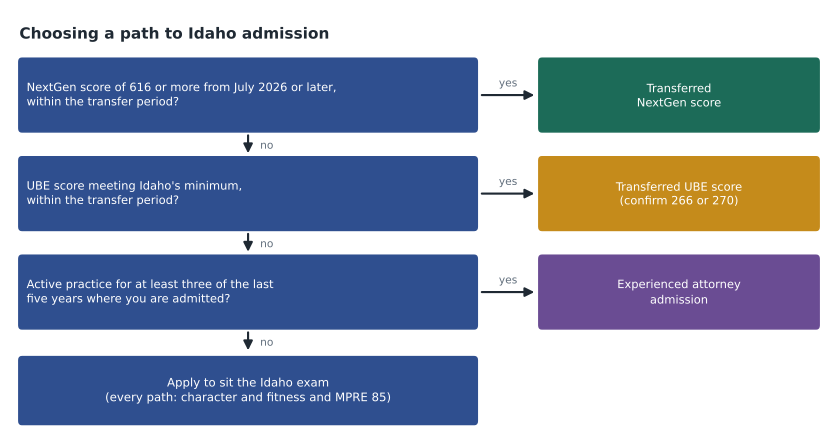
Idaho accepts transferred NextGen scores from exams given in other jurisdictions from July 2026 onward. Under Idaho's grading standards, a transferred NextGen score must meet Idaho's passing score of 616. The applicant must also satisfy Idaho's other requirements: education, character and fitness and an MPRE scaled score of at least 85. Jonah's July 2026 Washington score, if it is at least 616, can be transferred, and he will not have to sit for the Idaho exam. He asks NCBE to send his score to Idaho and files the transferred score application with the Admissions Office.
Timing matters. Idaho accepts transferred scores only for a limited period after the exam on which they were earned. Under the Idaho rules, the applicant must apply within the period the rules set, which has been stated as thirty-seven months from the date of the exam, and must be admitted within the time the rules allow. An applicant who waits too long loses the ability to transfer and must sit for the exam. Because the details of these windows can change, an applicant should confirm them on the Bar's current admissions pages before relying on them.
Transferring a legacy UBE score
Odessa's 2024 Colorado UBE score raises the issue discussed in Lesson 5. Idaho continues to accept transferred UBE scores within the transfer window, but the minimum score has been described inconsistently: Idaho's grading standards state a minimum of 266, while the text of Rule 217 and NCBE's jurisdiction information have shown 270. Odessa's score is 275, which meets either figure, so the conflict does not affect her. An applicant whose score falls between 266 and 270 should ask the Admissions Office to confirm the applicable minimum in writing before applying.
Idaho also has rules for applicants who earned an MBE score in another jurisdiction but did not take the UBE. Applicants in that situation should read the rules carefully and contact the Admissions Office, because the treatment of non-UBE scores is narrower than that of UBE and NextGen scores, and the transition to NextGen may affect it.
Experienced attorney admission
Idaho allows lawyers with substantial experience to be admitted without taking or transferring an exam. Under Rule 206 of the Idaho Bar Commission Rules, an applicant who has been admitted to practice in another jurisdiction and has actively practiced law for at least three of the five years immediately before the application may apply for experienced attorney admission. The rule defines what counts as the active practice of law, and the applicant must show the practice with documentation. Applicants must also meet the education requirement, pass the character and fitness review and have an MPRE score of at least 85.
Experienced attorney admission is more expensive than other routes; the application fee published by the Bar is 1,200 dollars, and the character and fitness review is often more detailed because the applicant has a longer professional history. But it saves months of preparation and the cost of an exam. Renata, with eleven years of Utah practice, is a strong candidate. Marchetti suggests that she request her certificates of good standing and assemble her practice documentation early, because those documents take time to obtain.
Idaho once limited admission on motion to lawyers from jurisdictions that granted reciprocal treatment to Idaho lawyers. A lawyer considering this route should rely on the current text of Rule 206 and the Bar's current forms, not on older descriptions or advice from colleagues admitted years ago, because the requirements have changed over time.
| Path | Main requirements | Notes |
|---|---|---|
| Idaho exam | Pass the NextGen exam with 616 or higher; education; character and fitness; MPRE 85 | February and July exams |
| Transferred NextGen score | Score of 616 or higher from a July 2026 or later exam, within the transfer period | No Idaho exam needed |
| Transferred UBE score | Score meeting Idaho's minimum, within the transfer period | Confirm the minimum (266 or 270) in writing |
| Experienced attorney | Admitted elsewhere; active practice for at least 3 of the last 5 years | Fee of 1,200 dollars; detailed documentation |
| House counsel | Employed by a single entity in Idaho; admitted elsewhere | Practice limited to the employer |
| Military spouse | Spouse of a service member stationed in Idaho; admitted elsewhere | Limited license with conditions |
| Pro hac vice | Associate with Idaho counsel for a single case | Court permission for that case only |
Limited forms of practice
Some lawyers need to practice in Idaho without full admission. A lawyer employed as in-house counsel by a business in Idaho may apply for a house counsel license, which allows the lawyer to advise the employer but not to represent other clients or, generally, to appear in Idaho courts. Idaho also has a rule for lawyers who are spouses of military service members stationed in Idaho, which allows them to practice under conditions while their spouses are assigned to the state. A lawyer admitted elsewhere who needs to appear in a single Idaho case may ask the court for permission to appear pro hac vice, in association with a member of the Idaho State Bar, who must remain responsible for the case. Each of these has its own application and rules.
The oath and admission
After passing the exam or qualifying by another route, and after the character and fitness review is complete, an applicant must take the attorney's oath. Idaho holds admission ceremonies before the Idaho Supreme Court in Boise, and the rules require the oath to be taken within a set time after the applicant is approved for admission. An applicant who cannot attend a scheduled ceremony should contact the Admissions Office about alternatives well in advance. After admission, the new lawyer pays license fees, registers with the Bar and receives a bar number.
Admission to the Idaho State Bar does not automatically admit a lawyer to federal court. The United States District Court for the District of Idaho has its own admission procedure, which requires membership in the Idaho State Bar and an application to the federal court. Many new Idaho lawyers apply soon after their state admission, especially if they expect any federal work.
Licensing and continuing education
Each Idaho lawyer must renew his or her license every year, paying annual license fees and reporting required information, including trust account information. Lawyers may hold active, inactive or other license categories, each with its own fees and privileges. Only active members may practice law in Idaho.
Idaho's mandatory continuing legal education rules require active lawyers to complete thirty credit hours every three years, including at least three hours in ethics or professional responsibility. No more than fifteen of the thirty hours may be earned through self-study. A new lawyer's first reporting period begins with admission, and the new admittee education requirement, covered in Lesson 6, must be completed within the first twelve months: ten approved credits, including four in Idaho substantive law. Those credits count toward the first reporting period. Lawyers who do not comply face late fees and, ultimately, suspension of their licenses.
Building a practice
New lawyers in Idaho have resources that larger states cannot always offer. The Idaho State Bar's sections, organized by practice area, offer seminars and contacts. District bar associations hold regular meetings. The Idaho Volunteer Lawyers Program connects lawyers with pro bono clients and often provides training and mentoring. The Bar's practice management resources help new solo practitioners set up trust accounts, conflict systems and malpractice insurance. Wes plans to join the water law and litigation sections after admission, take on one pro bono case through the volunteer program in his first year and keep a list of the questions he asks senior lawyers, which Ruffing says will become the beginning of his own practice manual.
Worked problem
Which path?
Renata has practiced in Utah for eleven years and has an MPRE score of 92. Jonah scored 622 on the July 2026 NextGen exam in Washington and has an MPRE score of 81. Odessa scored 275 on the 2024 Colorado UBE and has an MPRE score of 88. Which paths are open to each of them?
Show solution
- Renata: experienced attorney admission under Rule 206, since she has practiced for at least three of the last five years; her MPRE score meets 85.
- Jonah: his NextGen score of 622 meets 616 and can be transferred, but his MPRE score of 81 is below 85, so he must retake the MPRE and reach 85 before admission.
- Odessa: her UBE score of 275 meets either stated minimum, and her MPRE score meets 85, so she can apply by transferred UBE score if she is within the transfer period.
- All three must also meet the education requirement and pass character and fitness review.
Answer: Renata by experience; Jonah by transfer after retaking the MPRE; Odessa by UBE transfer within the window.
Common mistakes
MistakeAny lawyer admitted elsewhere can be admitted in Idaho without an exam.
InsteadExperienced attorney admission requires active practice for at least three of the last five years, among other requirements.
MistakeTransferred scores can be used at any time.
InsteadTransfers are limited to a set period after the exam.
MistakeIdaho admission includes federal court admission.
InsteadThe federal district court has its own admission procedure.
MistakeCLE begins after the first full year of practice.
InsteadThe new admittee requirement must be completed within twelve months of admission.
Planning an application from outside Idaho
Applicants who live outside Idaho often handle the entire admission process remotely until the oath. They request transcripts, certificates of good standing and score reports from other jurisdictions; complete the character and fitness application; and answer follow-up questions by email. The process works well, but it is slower when documents must come from several states. Renata makes a list of every jurisdiction in which she has been admitted or has applied, and requests certificates of good standing from each at the same time, because the Admissions Office will need all of them and each one can take weeks to arrive.
Applicants should also think about timing in relation to their work. A lawyer moving to Idaho for a new job may want to be admitted before starting work, or may be able to begin under a limited license or under supervision while the application is pending, depending on the rules and the job. House counsel and military spouse rules can bridge the gap for some applicants. A lawyer who starts advising Idaho clients before being authorized risks committing unauthorized practice of law, which can delay or prevent admission.
Score transfer in the other direction
An Idaho NextGen score can also be transferred out. A candidate who passes in Idaho and later moves to another NextGen jurisdiction may be able to use the Idaho score there, subject to that jurisdiction's passing score, transfer window and other requirements. Some jurisdictions have not set rules for accepting NextGen scores from the early administrations, and a few have said they will not accept NextGen scores from exams given before a later date, so a candidate who expects to move should check the receiving jurisdiction's rules before choosing where to sit. NCBE's jurisdiction information pages and the receiving jurisdiction's admissions office are the places to confirm current policy.
Keeping the license in good standing
After admission, the most common reasons Idaho lawyers lose good standing are administrative rather than ethical: failing to pay license fees on time, failing to complete continuing education by the deadline or failing to report required information. Each can lead to late fees and, if not cured, suspension. A suspended lawyer may not practice until reinstated. Wes sets calendar reminders for the license renewal deadline, the end of his new admittee year and the end of his first three-year reporting period, and tracks his credits as he earns them rather than waiting for the deadline.
Malpractice insurance is a related question. Idaho lawyers in private practice should consider whether to carry professional liability insurance, and a lawyer who does not carry it should check whether the Bar's licensing rules require disclosure of that fact. The Bar's practice management resources explain the options.
Summary and key terms
- Idaho accepts transferred NextGen scores of at least 616 from July 2026 or later exams, within the transfer period.
- Transferred UBE scores remain usable within the window; confirm whether the minimum is 266 or 270.
- Experienced attorney admission under Rule 206 requires active practice for at least three of the last five years.
- House counsel, military spouse and pro hac vice rules allow limited practice.
- Idaho MCLE requires 30 credits every three years, at least 3 in ethics and no more than 15 by self-study; new admittees complete 10 credits in their first year.
- Transferred score
- A bar exam score earned in one jurisdiction and used to seek admission in another.
- Experienced attorney admission
- Admission without an exam for lawyers who have actively practiced elsewhere for a required period.
- House counsel license
- A limited license for a lawyer employed by a single organization.
- Pro hac vice
- Permission for an out-of-state lawyer to appear in a single case.
- MCLE
- Mandatory continuing legal education.
Lesson quiz · 5 questions
Score 60% or more to complete this lesson.
Create a free account to save your progress, take quizzes and earn a certificate.