
BAR-213 · Lesson 2 of 12 · 16 min
Eligibility, education, deadlines and fees
▶ Video coming soon A video version of this lesson is on the way.
Wes's late filing was not a disaster, but it cost him two hundred dollars and a week of worry. When he finally sat down with the Idaho Bar Commission Rules, he found that most of the stress could have been avoided by reading three rules early: Rule 202 on qualifications, Rule 203 on filing and fees and Rule 204 on completing the application. This lesson walks through those rules in the order an applicant meets them.
'Bar admission rules are not hard,' Marchetti tells the group. 'They are unforgiving. Every date is a real date and every fee is a real fee. The people who get into trouble are the ones who assume the rule says what it said last year or what it says in another state.'
Who may sit
Rule 202 sets the basic qualifications. An applicant must be at least eighteen years old and must hold a J.D., LL.B. or equivalent degree from an approved law school, which for Idaho means a law school approved by the American Bar Association. The rule allows the Board to accept a transcript showing the degree has been completed when the diploma itself has not yet been issued, which matters for May graduates sitting in July. NCBE's information for Idaho states that an ABA-approved J.D. is required and that foreign law graduates are not eligible to sit for the Idaho exam. That is a narrower door than in some jurisdictions, such as New York, the District of Columbia or Washington, which offer routes for foreign-educated lawyers through additional study in the United States.
The rule also requires the MPRE score and good moral character and fitness, which Lesson 3 covers. And it contains a provision added by the Idaho Supreme Court in an order effective February 2, 2026: an applicant whose application has been denied on character and fitness grounds by a final order of the Board or the court may not be admitted for two years after that denial. That two-year waiting period is new, and it raises the stakes of the character and fitness process for anyone with a complicated history.
Categories of applicants
Rule 203 sorts applicants into categories, each with its own fee. A student applicant is someone who has not been admitted to practice anywhere; most recent graduates fall here. An attorney applicant is someone already admitted in another state, territory or the District of Columbia who is sitting the Idaho exam, perhaps because that lawyer does not yet have enough practice for experienced attorney admission. Experienced attorney applicants and house counsel applicants are separate categories with their own fees, and they do not sit the exam at all.
| Application | Fee under Rule 203 | When it may be filed |
|---|---|---|
| Student applicant (bar exam) | 600 dollars | By March 1 for July or October 1 for February |
| Attorney applicant (bar exam) | 800 dollars | Same deadlines as student applicants |
| Late filing (bar exam) | Additional 200 dollars | By April 15 for July or November 15 for February |
| Experienced attorney | 1,200 dollars | At any time |
| House counsel | 800 dollars | At any time |
| UBE score transfer | Set by the Bar (check the current schedule) | At any time |
The deadlines
The filing deadlines are simple to state. For the July exam, the application is due March 1. For the February exam, it is due October 1. A late application is accepted through April 15 for July and November 15 for February, with an additional fee of two hundred dollars. After the late deadline there is no further window; an applicant who misses it waits for the next exam.
Filing is only the first step. Rule 204 sets a separate completion deadline by which every document the application requires must be in the Bar's hands: January 15 for the February exam and June 15 for the July exam. An application that is still missing items after that date may be considered further only on payment of an additional one-hundred-dollar fee, and an applicant whose file remains incomplete may not be allowed to sit. In practice the items that cause delays are the ones the applicant does not control: letters from past employers, records from other jurisdictions, court records about old matters and the fingerprint card, which the applicant must request from the Bar, complete and return.
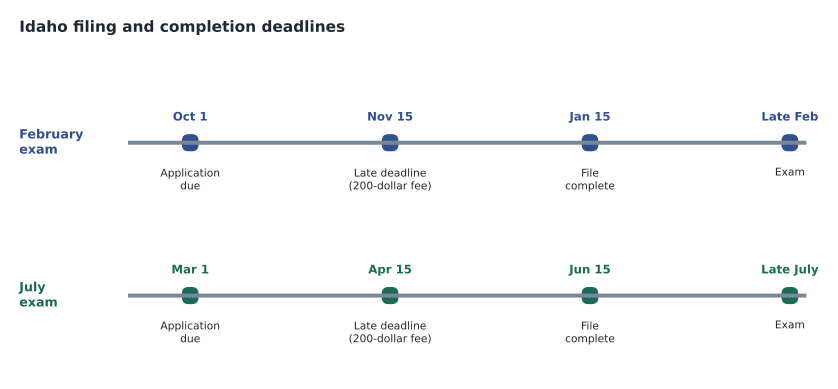
Wes's timeline is typical of a late filer. He filed on October 27, paying the 600-dollar student fee and the 200-dollar late fee. His fingerprint card went back to the Bar on November 3. By mid-November his only missing item was a letter from a summer employer in Boise who had retired. Marchetti's advice was to write to the former employer directly, explain the deadline and offer to send a stamped envelope, and to tell the Bar's admissions staff in writing that the letter was on its way. The letter arrived on November 19, well ahead of January 15.
Accommodations and the computer-based exam
The NextGen exam is given entirely on computer. Applicants who need testing accommodations because of a disability must request them through the process the Idaho State Bar sets out, with supporting documentation, and the request has its own deadlines that run ahead of the exam. Applicants who expect to need extra time, a separate room or assistive technology should read the accommodation instructions as soon as they decide which exam to sit, because documentation from a medical provider can take weeks to obtain.
Idaho also allows a deferral: an applicant who has filed for one exam can ask, using the Bar's deferral request form, to move to the next administration. Deferral rules and any fee are set by the Bar, and a deferral is not automatic. Wes considered a deferral in June 2026 when his family situation became clear, but he had not yet filed for July, so the question did not arise; he simply filed for February instead.
Where and when the exam is given
Idaho gives the bar exam twice a year, in late February and late July, on the national dates NCBE sets for the NextGen exam. The February 2027 NextGen exam is scheduled for February 23 and 24, 2027, and the July 2027 exam for July 27 and 28. The Idaho State Bar has reported that the University of Idaho College of Law is the primary testing site for the July exam. Applicants receive site information and admission instructions from the Bar before the exam.
Reexamination
Applicants who do not pass may sit again. Rule 218 sets the reexamination fees: two hundred dollars for each of the first three reexaminations and three hundred dollars for each one after that. The rule also limits repeated attempts: an applicant who has failed six or more bar examinations in any jurisdiction is not eligible to sit in Idaho without the Board's permission. A failure also matters later, because experienced attorney admission under Rule 206 is unavailable to anyone who has failed a bar examination in the five years before applying.
Worked problem
Wes's fees
Wes filed as a student applicant for the February 2027 exam on October 27, 2026. What has he paid, and what would he pay if he had to sit again in July 2027?
Show solution
- Application fee for a student applicant: 600 dollars.
- Late fee because he filed after October 1 but by November 15: 200 dollars.
- Total so far: 800 dollars, plus the cost of his fingerprinting.
- If he had to sit again in July 2027, the reexamination fee under Rule 218 for a first reexamination would be 200 dollars, filed by the July deadlines.
Answer: Wes has paid 800 dollars; a first reexamination would cost 200 more.
Common mistakes
MistakeFiling by the late deadline means the application is complete.
InsteadFiling and completion are separate; every document must arrive by January 15 or June 15, or an additional fee applies.
MistakeA foreign-trained lawyer can sit the Idaho exam after an LL.M.
InsteadNCBE's information for Idaho states that foreign law graduates are not eligible; Idaho requires an ABA-approved J.D.
MistakeAfter a character and fitness denial, an applicant can reapply right away.
InsteadSince February 2, 2026, Rule 202 bars admission for two years after a final denial on character and fitness grounds.
MistakeThere is no limit on attempts.
InsteadAn applicant who has failed six or more bar exams anywhere needs the Board's permission to sit again.
Reading the application before filling it in
The Idaho application is completed online, and the Bar gives practical advice that every applicant should follow. Draft the long answers in a separate word processor and paste them into the form, so that a timed-out session does not erase an hour of work. Do not leave a draft sitting in the system for more than about a week; the Bar recommends completing and submitting within seven days of starting. Gather documents before starting, not during. The application asks for a full history of residences, employment, education, licenses, court proceedings and financial matters, and each answer must match what the investigation will later find.
The application also requires several uploaded forms: an authorization and release form, which allows the Bar to obtain records about the applicant; a consent to release student records, which allows law schools and colleges to answer the Bar's questions; a verified statement, signed under penalty of perjury; and the attorney's oath. The fingerprint card is handled separately: the applicant requests a card from the Idaho State Bar, has fingerprints taken and returns the card, and the Bar uses it for a criminal history check. Bar exam applicants who might need to move to a later exam also find the deferral request form among the documents.
Marchetti suggests a simple routine. Before filing, make a list of every document the application requires and every person who must send something on the applicant's behalf. Next to each item, write the date it was requested and the date it was confirmed received. Check the list every week until the completion deadline. Wes adopted the routine in November and found that his only gap was the retired employer's letter; everything else was done within two weeks.
Why the rules are strict
Applicants sometimes ask why the deadlines are so rigid when the Bar is small and the staff is helpful. The answer is that the deadlines exist so that the investigation can finish before the exam results are released. An applicant who passes the exam but whose character file is still open cannot be recommended for admission, and must wait. The completion deadline gives the Bar about five weeks before the February exam and about five weeks before the July exam to review complete files, follow up on problems and schedule hearings where needed. An applicant who files late or leaves the file incomplete pushes that work into the period after the exam and may delay his or her own admission by months.
The same logic explains why the deadlines are firm in both directions. The Bar cannot waive the March 1 or October 1 deadline for one applicant without being unfair to everyone who paid the late fee, and it cannot let an applicant sit with an incomplete file without risking an admission that should not happen. The rules allow for genuine problems through the late window, the additional fee for further consideration and the deferral process. They do not allow for applicants who simply did not start in time.
Attorney applicants and the exam
Attorney applicants deserve a word of their own. A lawyer admitted in another jurisdiction who has not practiced for three of the last five years cannot use experienced attorney admission under Rule 206, and if that lawyer does not have a recent transferable score, the only route into Idaho is the exam. Attorney applicants pay the higher fee of 800 dollars, file by the same deadlines and must show their admission and good standing elsewhere, which means obtaining certificates of good standing and discipline histories from every jurisdiction where they are licensed. A lawyer who was admitted years ago may also face questions about old matters that a recent graduate does not, and should allow extra time for records.
Some attorney applicants are lawyers who moved to Idaho for a spouse's job or a family reason before they reached three years of practice. For them the choice is often between sitting the Idaho exam now and waiting until they have three years elsewhere. Waiting can make sense for a lawyer who can keep practicing remotely in the original jurisdiction; sitting now makes sense for one who wants to appear in Idaho courts soon. Lesson 11 returns to that choice.
A planning checklist
Putting the rules together, an applicant planning for an Idaho exam should do five things at least six months ahead: confirm eligibility under Rule 202, take or schedule the MPRE, open the online application and list every required document, request the fingerprint card and decide whether accommodations are needed. Three months ahead the applicant should file, ideally well before the regular deadline. One month before the completion deadline the applicant should confirm, in writing, that the file is complete. Following that schedule costs nothing and removes most of the risk that the process, rather than the exam, will delay admission.
Keeping copies and records
Every document filed with the Admissions Office should be saved in a personal file with the date it was sent and the confirmation received. Applicants often need the same information again: for a later application in another jurisdiction, for a score transfer request, for federal court admission or for a character and fitness follow-up. Wes keeps a folder with his submitted application, his payment receipts, his law school certification request, his MPRE score report and every email from the Admissions Office, named by date. When the office asked him in December to confirm an old address, he answered the same day because the information was already in the folder.
A good record also protects an applicant if something goes wrong. If a document is lost or a payment is not recorded, a dated confirmation resolves the question quickly. And because the application is made under oath, keeping a copy lets an applicant check later answers against earlier ones, which matters when the same questions are asked again on another state's application years later.
Summary and key terms
- Rule 202 requires age eighteen, an ABA-approved J.D., an MPRE score of 85 and good character and fitness.
- Applications are due March 1 for July and October 1 for February; late filing runs to April 15 or November 15 with a 200-dollar fee.
- Files must be complete by June 15 or January 15.
- Student applicants pay 600 dollars, attorney applicants 800 and experienced attorney applicants 1,200.
- Reexamination costs 200 dollars for each of the first three attempts and 300 after; six failures require Board permission.
- Student applicant
- An applicant for the Idaho exam who has not been admitted to practice in any jurisdiction.
- Attorney applicant
- An applicant for the Idaho exam who is already admitted in another US jurisdiction.
- Completion deadline
- The date by which every document required for an application must be received.
- Deferral
- A request to move a pending exam application to the next administration.
- Reexamination
- A later attempt at the bar exam after an unsuccessful one.
Lesson quiz · 5 questions
Score 60% or more to complete this lesson.
Create a free account to save your progress, take quizzes and earn a certificate.