
BAR-213 · Lesson 6 of 12 · 16 min
What the exam tests and how Idaho law appears
▶ Video coming soon A video version of this lesson is on the way.
Wes spent his first two weeks of study reading Idaho cases about water rights. It was interesting, and it was a mistake. 'Nothing on your February exam will ask about the priority of a water right,' Marchetti tells him gently. 'The NextGen exam tests general law. Idaho law matters enormously for your practice, and you will learn a lot of it in your first year as a lawyer. But for the exam, the law you need is the law NCBE tests.'
This lesson draws that line clearly. It explains what law the Idaho exam tests, why Idaho adds no local component, how Idaho instead teaches its own law after admission through the new admittee education requirement and how to find Idaho law when you need it. The four lessons that follow, on Idaho courts and procedure, torts, community property and family law, and water, property and professional conduct, are written for the second purpose: to prepare a new lawyer for practice and for the Idaho substantive law courses that follow admission, and to help candidates avoid confusing Idaho rules with the general rules the exam tests.
The exam tests general law
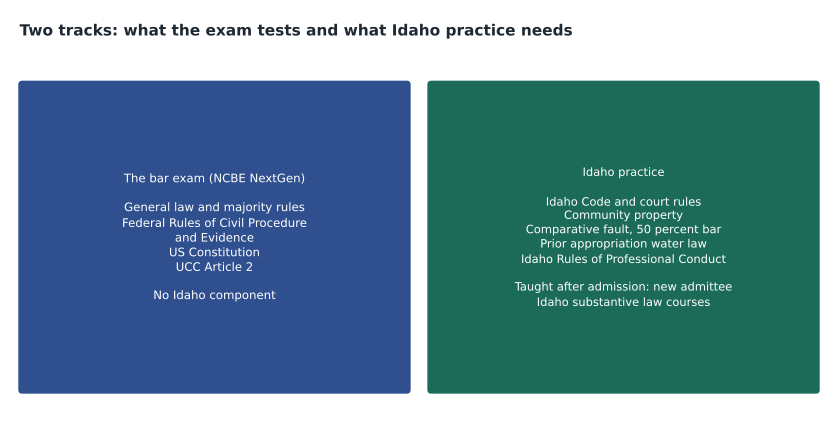
The NextGen exam is a national exam. Its multiple-choice questions, integrated sets and performance tasks are written by NCBE for every jurisdiction that gives it, and they test general principles: the rules followed by a majority of American jurisdictions, the Federal Rules of Civil Procedure and Evidence, the United States Constitution, the common law of contracts and torts as reflected in widely accepted sources, and Article 2 of the Uniform Commercial Code for sales of goods. Where a question depends on a particular rule, NCBE either tests the generally accepted rule or supplies the rule in the question.
That means the right answer on the exam can differ from the Idaho answer. Idaho is a community property state, but a real property question on the exam about a married couple's ownership will usually turn on general common-law concepts unless the question says otherwise. Idaho bars a negligent plaintiff whose fault is as great as the defendant's, but a torts question on the exam may test pure comparative fault if that is the rule NCBE's materials adopt or the question specifies. Idaho has its own Rules of Civil Procedure, but the exam tests the federal rules. A candidate who answers from Idaho law will sometimes be wrong.
Why there is no Idaho component
Some jurisdictions add a local component to the national exam: a short test, an online course or a set of essays on local law. Washington, Missouri and Maryland, which also gave the first NextGen exam, each have a local law component of some kind, and others plan to add one when they switch. Idaho has never done so. It added no Idaho law component when it gave the UBE, and NCBE's information for Idaho lists no jurisdiction-specific requirement for either the legacy UBE or the NextGen exam.
Idaho's approach reflects a judgment that local law is better learned in practice, close to the time a lawyer will use it, than crammed for an exam. It also preserves portability: because an Idaho NextGen score has no Idaho-only part, it can be transferred to other jurisdictions that accept NextGen scores, and scores from those jurisdictions can be transferred in. And it keeps the exam the same for everyone who sits in Idaho, whether they plan to practice in Boise or across the border in Spokane, Salt Lake City or Jackson.
The new admittee education requirement
Idaho teaches its own law after admission. Under Rule 402 of the Idaho Bar Commission Rules, a newly admitted lawyer must complete a new admittee education requirement within twelve months of admission: ten credits of continuing legal education in courses approved for new admittees, including four credits of Idaho substantive law courses. The Idaho State Bar describes it as a requirement for new Idaho lawyers generally; its admissions pages state it even for experienced attorneys admitted from other states, who may have practiced for decades elsewhere but have not practiced Idaho law.
The Idaho substantive law courses are meant to introduce the law a new Idaho lawyer is most likely to meet, and the areas where Idaho is distinctive, such as community property, water law and Idaho practice and procedure, are natural subjects for them. Course offerings change from year to year, so a new admittee should check the Bar's current list of approved courses rather than rely on an older description. The new admittee credits count toward the lawyer's first three-year continuing legal education reporting period, which Lesson 11 describes.
| Requirement | What it involves | When |
|---|---|---|
| New admittee education | 10 approved credits, including 4 in Idaho substantive law | Within 12 months of admission |
| Regular MCLE | 30 credits every three years, including at least 3 in ethics or professional responsibility | Each three-year reporting period |
| Self-study limit | No more than 15 of the 30 credits may be self-study | Each reporting period |
Using Idaho law to sharpen exam answers
Studying Idaho law is not a waste of time if it is done the right way. Comparing an Idaho rule with the general rule is one of the best ways to understand both. Marchetti asks the group to build a short list of contrasts, each one a single line: the general rule the exam tests on the left and the Idaho rule on the right. Writing the list forces a candidate to be precise about the general rule, and it protects against the most common error Idaho candidates make, which is answering an exam question with an Idaho rule they learned in law school or at work.
Wes's list starts with five lines. Pure or modified comparative fault, depending on the question, against Idaho's bar when the plaintiff's negligence is as great as the defendant's. Common-law marital property against Idaho community property. The federal rules against the Idaho Rules of Civil Procedure, which are modeled on them but differ in details. Riparian rights, which some exam questions may assume for eastern states, against Idaho's prior appropriation. And the ABA Model Rules against the Idaho Rules of Professional Conduct. He reviews the list once a week and adds a line whenever he catches himself reaching for an Idaho rule on a practice question.
Finding Idaho law
When you do need Idaho law, it is easy to find. The Idaho Code, the state's statutes, is published online by the Idaho Legislature, organized into titles and chapters; a section is cited by title, chapter and section number, such as Idaho Code section 6-801. Administrative rules appear in the Idaho Administrative Code, known as IDAPA. The Idaho Supreme Court and the Idaho Court of Appeals publish their opinions on the Idaho judiciary's website, and the court rules, including the Idaho Rules of Civil Procedure, the Idaho Rules of Evidence, the Idaho Appellate Rules, the Idaho Rules of Family Law Procedure and the Idaho Bar Commission Rules, are available from the courts and the Bar.
The Idaho State Bar's magazine, The Advocate, publishes practical articles on Idaho law written by Idaho lawyers, and the Bar's practice sections publish deskbooks and materials. For a new lawyer, these are often the fastest way to learn how Idaho practice actually works, because they explain local customs and procedures that no statute states.
Worked problem
Exam answer or Idaho answer?
A practice question describes a pedestrian who was 40 percent at fault and a driver who was 60 percent at fault, in an unnamed jurisdiction that the question says follows pure comparative negligence. The pedestrian's damages are 100,000 dollars. What does the pedestrian recover, and would the answer differ in Idaho?
Show solution
- The question supplies the rule: pure comparative negligence.
- Under pure comparative negligence, the pedestrian recovers damages reduced by 40 percent: 60,000 dollars.
- In Idaho, a plaintiff may recover if his or her negligence was not as great as the defendant's; 40 percent is less than 60 percent, so the Idaho result would also be 60,000 dollars.
- If the pedestrian were 50 percent at fault, the exam answer under pure comparative negligence would be 50,000 dollars, but in Idaho the claim would be barred.
Answer: Answer the exam question with the rule it gives: 60,000 dollars. Idaho's rule happens to match here but would not at 50 percent.
Common mistakes
MistakeThe Idaho exam tests Idaho law.
InsteadThe NextGen exam tests general law; Idaho adds no local component.
MistakeIdaho requires a course on Idaho law before admission.
InsteadIdaho law is taught after admission through the new admittee education requirement.
MistakeExam questions about married couples follow community property.
InsteadExam questions usually test general rules unless the question supplies a community property rule.
MistakeThe new admittee requirement can be done any time in the first reporting period.
InsteadIt must be completed within twelve months of admission.
Practicing across state lines
Idaho's geography makes the general-law focus of the exam especially sensible. The state borders six others and Canada, and many Idaho lawyers practice across a line. Lawyers in Coeur d'Alene and Lewiston often handle matters in Washington; lawyers in eastern Idaho deal with Utah, Wyoming and Montana; lawyers in the Treasure Valley see clients with property or family ties in Oregon and Nevada. A national exam with portable scores helps those lawyers become admitted in a second jurisdiction, and it means that the knowledge tested is useful no matter which side of the border a matter falls on.
Cross-border practice also raises the stakes of knowing when Idaho law differs. A lawyer who learned community property in Idaho will find similar but not identical rules across the border in Washington and Nevada, and a different system entirely in Utah and Montana, which are not community property states. A lawyer used to Idaho's comparative fault bar will find a different line in Washington, which uses pure comparative fault. Those differences are exactly the kind that a single contrasts list helps a lawyer keep straight.
How Idaho law can still appear on the exam
Although the exam tests general law, Idaho law can appear indirectly in three ways. First, the performance tasks supply a library of authorities that may be modeled on real state law, and a candidate who recognizes a familiar structure may work faster, though the library always controls. Second, many Idaho rules are the majority rule, so studying them is not wasted: Idaho's Rules of Civil Procedure track the federal rules closely, its Rules of Evidence are modeled on the Federal Rules of Evidence, and Idaho adopted the Uniform Commercial Code. Third, skills questions about client counseling and professional responsibility test judgment that applies everywhere.
The key is to let the exam question decide which rule applies. If a question supplies a rule, apply it. If it names a jurisdiction that follows a particular rule, apply that rule. If it is silent, apply the general rule. Only after the exam does Idaho law take over.
A study plan that respects both tracks
Marchetti suggests a simple division of time for Idaho candidates who also work in an Idaho practice, as Wes does. During study hours, the focus is the exam: the eight NextGen subjects, the seven skills and timed practice. During work hours, the Idaho law Wes meets on the job is learning for practice, not for the exam, and he keeps it in a separate notebook. On Sunday evenings he spends twenty minutes comparing the two notebooks and updating his contrasts list. The division keeps the two kinds of learning from blurring together, which is the real risk for a candidate who works in a law office while studying.
Wes's supervising attorney, Delia Ruffing, supports the plan. She reduced his hours in January and asked him to stop drafting water right transfer applications until after the exam, so that his attention would stay on the general law the exam tests. Not every employer is so generous, but Marchetti encourages every working candidate to ask for reduced hours or protected study time in the final six weeks, and to put the request in writing well ahead.
Idaho's appellate courts and citations
For readers who will later research Idaho law, a few conventions help. Idaho Supreme Court and Court of Appeals opinions are published in the Idaho Reports and the Pacific Reporter, and Idaho courts accept citations to both. Opinions on the judiciary's website are labeled with docket numbers and filing dates. Statutes are cited by section number, and the Idaho Code is updated after each legislative session, which usually ends in the spring; new laws generally take effect on July 1 unless the legislature provides otherwise. A new lawyer should always confirm that a statute has not been amended before relying on it.
Professional responsibility on the exam and the MPRE
Professional responsibility appears on the NextGen exam within the skills of client counseling and ethical judgment, and it is tested separately on the MPRE. Both use the ABA Model Rules of Professional Conduct as the basis for general principles, not the Idaho Rules of Professional Conduct. Idaho's rules are based on the Model Rules and are close to them, so a candidate who learns the Model Rules well is also learning most of what Idaho requires. The differences, which Lesson 10 describes, become important after admission, when a lawyer's own conduct is governed by the Idaho rules.
Wes adds this to his contrasts list as a reminder rather than a warning. On the exam and the MPRE, he applies the Model Rules. In practice, he will apply the Idaho rules, and he will check the Idaho rule and its comments whenever a question of ethics arises in a real matter.
Summary and key terms
- The NextGen exam tests general law and the federal rules, not Idaho law.
- Idaho adds no Idaho law component to the exam, preserving portability.
- New admittees must complete ten approved credits, including four in Idaho substantive law, within twelve months.
- A list of contrasts between general and Idaho rules prevents answering exam questions with Idaho law.
- Idaho law is found in the Idaho Code, IDAPA, Idaho appellate opinions and Idaho court rules.
- General law
- The rules followed by a majority of US jurisdictions or stated in widely accepted sources, as tested on national exams.
- New admittee education requirement
- Idaho's rule that new lawyers complete ten approved CLE credits, including four in Idaho substantive law, within twelve months.
- Idaho Code
- The statutes of Idaho, organized by title, chapter and section.
- IDAPA
- The Idaho Administrative Code, which contains state agency rules.
- Portability
- The ability to use a bar exam score earned in one jurisdiction to seek admission in another.
Lesson quiz · 5 questions
Score 60% or more to complete this lesson.
Create a free account to save your progress, take quizzes and earn a certificate.