
BAR-213 · Lesson 10 of 12 · 16 min
Idaho water law, real property and the Idaho Rules of Professional Conduct
▶ Video coming soon A video version of this lesson is on the way.
Before Wes stopped drafting water right transfer applications for the exam, he learned enough to see why Ruffing called water 'the oldest property in Idaho.' A ranch the firm represented had irrigated the same fields from the same creek since 1889. The ranch's water right was older than the state of Idaho itself, and in a dry year it meant the difference between a crop and a dry field, because the ranch's priority date put it ahead of almost every other user on the creek. A neighboring farm with a 1950s right sometimes had its headgate shut off by midsummer. Nothing in Wes's property class had prepared him for a world in which the date a right was first used mattered more than the size of the land it served.
This lesson covers three areas of Idaho law that new lawyers meet constantly: water law, Idaho real property practice and the Idaho Rules of Professional Conduct. Water law and real property are matters of Idaho law that the bar exam does not test. Professional conduct is different: the exam and the MPRE test the ABA Model Rules, and Idaho's rules are based on them, so this part of the lesson reinforces exam knowledge while pointing out what changes after admission.
Prior appropriation
Idaho follows the prior appropriation doctrine, the system of water rights used throughout the arid West. Its foundation is in the Idaho Constitution, article XV, section 3, which guarantees the right to divert and appropriate the unappropriated waters of natural streams to beneficial uses and provides that priority of appropriation gives the better right between those using the water. The doctrine is often summarized as 'first in time, first in right.' A water right is defined by elements such as its source, its priority date, the quantity of water, the purpose of use, the place of use and the point of diversion.
Priority matters most when there is not enough water for everyone. In a shortage, the holder of the senior right is entitled to receive the full amount of that right before a junior user receives any water. Junior users may be curtailed entirely in a dry year. This is very different from the riparian system used in much of the eastern United States, where landowners along a stream share the water reasonably and no one has an absolute priority based on when use began. The constitution also states preferences among uses in times of shortage, giving domestic purposes the first preference and agriculture a preference over manufacturing, subject to the limits stated in the constitution and the statutes.
Beneficial use and loss of rights
A water right exists only to the extent water is put to a beneficial use, such as irrigation, domestic use, stock watering, municipal supply, industry, power generation or, in some circumstances, recreation and fish and wildlife purposes. Beneficial use is both the basis and the measure of the right. A right that is not used can be lost. Under Idaho's forfeiture statute, a right that is not applied to beneficial use for a continuous period of five years is generally forfeited, subject to statutory exceptions and defenses. Water rights can also be abandoned through nonuse combined with intent to abandon. Because forfeiture can destroy a valuable right, lawyers who represent buyers of agricultural land check the history of use as carefully as they check title.
How rights are created and changed
Before 1971, many Idaho surface water rights were created simply by diverting water and putting it to beneficial use, without a permit. Since then, a new appropriation generally requires a permit from the Idaho Department of Water Resources, followed by proof of beneficial use and the issuance of a license. Ground water rights have a related history, with permit requirements beginning earlier for many uses. Changes to an existing right, such as moving the point of diversion, changing the place or purpose of use or separating the right from the land it serves, require an application to the Department for a transfer, which will be approved only if the change does not injure other water rights and meets other statutory criteria.
Water rights in Idaho are generally appurtenant to the land on which they are used and pass with a conveyance of that land unless they are expressly reserved or separately transferred. That rule makes water rights a part of almost every agricultural real estate transaction. A deed that is silent about water rights may carry them with the land, while a seller who wants to keep them must reserve them clearly. Purchase agreements for farm and ranch property routinely include detailed water right representations, and buyers' lawyers review the Department's records to confirm the rights' elements and status.
The Snake River Basin Adjudication
For much of Idaho's history, the existence and extent of many water rights were uncertain, because rights created by use were never recorded and many decrees were incomplete. The Snake River Basin Adjudication, commenced in 1987, was a general stream adjudication designed to determine every water right in the Snake River basin, which covers most of southern Idaho. Claimants filed claims for their rights, the Department investigated and reported on them, and a specially created district court decided objections and entered decrees. The adjudication resolved claims for about 158,000 water rights, including rights held by the United States and by Indian tribes, and the court entered its final unified decree in August 2014.
The decrees from the adjudication now define the water rights they cover, and a lawyer researching a right in the Snake River basin starts with the decree. The adjudication also laid the groundwork for conjunctive management, the administration of surface water and ground water as connected sources. Much of the Snake River's flow in southern Idaho is fed by the Eastern Snake Plain Aquifer, and pumping from the aquifer by junior ground water users can reduce spring flows that senior surface water users depend on. Disputes over conjunctive management, and settlements between surface water and ground water users, have been among the largest water law matters in Idaho in recent decades. Adjudications of other basins, including in northern Idaho, have followed.
| Concept | What it means in Idaho |
|---|---|
| Prior appropriation | Senior rights are satisfied first in a shortage; Idaho Constitution article XV, section 3 |
| Beneficial use | The basis and measure of a water right |
| Forfeiture | Generally after five continuous years of nonuse, subject to exceptions |
| Permits and licenses | New appropriations generally require a permit from the Idaho Department of Water Resources |
| Transfers | Changes to a right require Department approval and no injury to other rights |
| Snake River Basin Adjudication | Commenced 1987; final unified decree entered in 2014 |
| Conjunctive management | Administration of connected surface water and ground water sources together |
Real property practice
Idaho real property practice combines general common-law principles with Idaho statutes. Idaho's recording statute is a race-notice statute: a later purchaser in good faith and for value who records first generally prevails over an earlier unrecorded conveyance, but only if the later purchaser had no notice of the earlier one. Deeds and other instruments affecting real property are recorded with the county recorder in the county where the land is located, and title insurance is widely used in Idaho transactions. Title companies, rather than lawyers, close most residential sales in Idaho, so a new lawyer's role often involves reviewing title commitments, drafting or reviewing purchase agreements and resolving title problems rather than conducting closings.
Idaho also uses the deed of trust as a common security instrument for real property loans, which allows the trustee to sell the property without a court proceeding if the borrower defaults, following statutory notice and sale procedures. Mortgages, which are foreclosed judicially, are also used. Idaho's homestead exemption protects a debtor's interest in a primary residence from many creditors up to a statutory amount; the amount has been increased in recent years, so a lawyer should check the current figure. Community property rules, covered in Lesson 9, add a further layer: a conveyance or encumbrance of community real property generally requires both spouses to sign.
Rural property raises its own questions. Easements for irrigation ditches and canals are common, and Idaho statutes protect the rights of ditch owners to maintain their ditches across other people's land. Grazing rights on federal land, held under permits from federal agencies, are not real property in the usual sense but may be important to the value of a ranch. Boundary disputes, fences and access across neighboring land are frequent subjects of litigation in rural districts.
The Idaho Rules of Professional Conduct
Idaho lawyers are governed by the Idaho Rules of Professional Conduct, adopted by the Idaho Supreme Court. The Idaho rules are based on the ABA Model Rules and follow their numbering and structure, so a candidate who learns the Model Rules for the MPRE and the NextGen exam has already learned most of the Idaho rules. The court amends the rules and their commentary from time to time, sometimes following changes to the Model Rules and sometimes on its own initiative; in February 2026, for example, it amended the commentary to Rule 8.4. A lawyer should always consult the current version on the Idaho State Bar's website rather than rely on a printed copy.
Differences between the Idaho rules and the Model Rules are matters for practice, not for the exam. On the MPRE and the NextGen exam, candidates apply the Model Rules. Once admitted, an Idaho lawyer is bound by the Idaho rules, and when an Idaho rule or comment differs from the Model Rule, the Idaho version controls. A lawyer facing a difficult question can seek an informal ethics opinion or guidance from the Idaho State Bar, and the Bar publishes formal ethics opinions.
Several Idaho requirements outside the Rules of Professional Conduct affect daily practice. Lawyers who hold client funds must maintain trust accounts in accordance with Rule 1.15 and the Idaho Bar Commission Rules, and Idaho participates in an interest on lawyer trust account program, through which interest on pooled trust accounts funds legal services for people who cannot afford them. Lawyers must report their trust account information to the Bar as part of annual licensing. Discipline is handled through the Bar's Office of Bar Counsel and a Professional Conduct Board, with the Supreme Court having final authority over sanctions.
Worked problem
Senior and junior rights
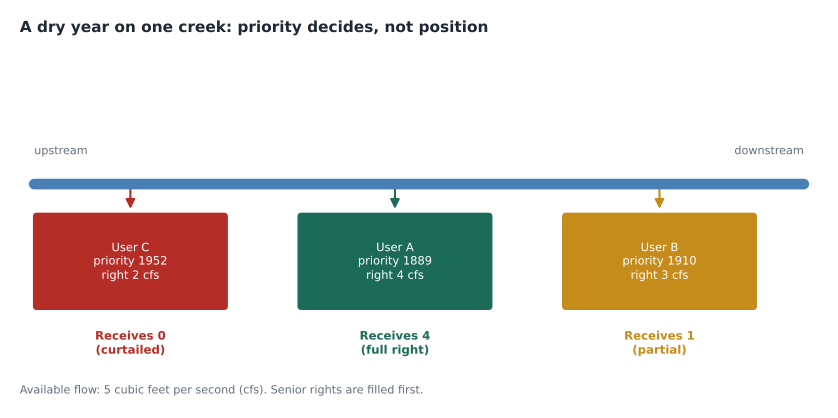
Three users divert from the same creek. User A has an 1889 right for 4 cubic feet per second; User B has a 1910 right for 3 cubic feet per second; User C, upstream of both, has a 1952 right for 2 cubic feet per second. In August, the creek carries only 5 cubic feet per second at the point where all three can be served. How is the water delivered?
Show solution
- Priority, not location, controls. User A, the most senior, receives its full 4 cubic feet per second first.
- User B, next in priority, receives the remaining 1 cubic foot per second, short of its full right.
- User C, the most junior, receives nothing, even though its headgate is upstream, and the watermaster may order it shut.
- If User A had not used its right for five continuous years, it might have been forfeited, which would change the order.
Answer: A takes 4, B takes 1, C is curtailed.
Common mistakes
MistakeIdaho landowners along a stream share the water reasonably.
InsteadIdaho uses prior appropriation; the senior right is satisfied first.
MistakeA water right lasts forever once created.
InsteadRights not used for five continuous years are generally forfeited, subject to exceptions.
MistakeA deed silent about water rights leaves them with the seller.
InsteadAppurtenant water rights generally pass with the land unless reserved.
MistakeThe MPRE tests the Idaho Rules of Professional Conduct.
InsteadThe MPRE and the NextGen exam test the Model Rules; the Idaho rules govern after admission.
Water law on the job, not on the exam
Water law is a specialty, but it touches general practice more often than new lawyers expect. A client buying a small acreage near Twin Falls needs to know whether the property comes with irrigation water and whether the water is delivered by a canal company whose shares must be transferred separately. A client building a house outside town needs to know whether a domestic well requires a permit and how much water it may use. A client inheriting a farm needs to know whether the water rights have been used recently enough to avoid forfeiture. Each of these questions can be answered by checking the Department's online records, the adjudication decrees and the documents of any canal company or irrigation district involved.
Irrigation districts and canal companies are a distinctive feature of southern Idaho. Many farms receive water not from their own diversion but through shares in a company or membership in a district that holds the water rights and delivers the water. The rights and obligations of a shareholder or district member depend on the entity's governing documents and on Idaho statutes, and a real estate transaction may require a separate transfer of shares. A purchase agreement that ignores these arrangements can leave a buyer with land and no water.
Ethics questions new lawyers meet first
The professional conduct issues that new Idaho lawyers face most often are the same ones that appear on the MPRE: conflicts of interest, confidentiality, competence, communication with clients, fees and the safekeeping of client property. In a small community, conflicts arise often, because a lawyer may know both sides of a dispute or may have represented the other party before. A new lawyer should run a conflict check before every new matter, even an informal consultation, and should document informed consent in writing when the rules require it. When in doubt, the Bar's ethics counsel can provide informal guidance, and a lawyer who asks before acting is far better placed than one who asks after.
Summary and key terms
- Idaho follows prior appropriation, rooted in Idaho Constitution article XV, section 3: priority gives the better right.
- Beneficial use is the basis and measure of a right; five years of continuous nonuse generally causes forfeiture.
- The Snake River Basin Adjudication, begun in 1987, ended with a final unified decree in 2014.
- Idaho has a race-notice recording statute; deeds of trust are common; community real property needs both spouses' signatures.
- The Idaho Rules of Professional Conduct follow the Model Rules' structure, with Idaho-specific differences that matter after admission.
- Prior appropriation
- The doctrine that the first person to put water to beneficial use has the better right in a shortage.
- Priority date
- The date that establishes a water right's seniority.
- Forfeiture
- Loss of a water right through continuous nonuse for the statutory period.
- Conjunctive management
- Administration of hydraulically connected surface water and ground water together.
- Race-notice statute
- A recording rule that protects a later good-faith purchaser without notice who records first.
Lesson quiz · 5 questions
Score 60% or more to complete this lesson.
Create a free account to save your progress, take quizzes and earn a certificate.