
BAR-212 · Lesson 9 of 12 · 13 min
Hawaiʻi property, water and family law
▶ Video coming soon A video version of this lesson is on the way.
Half of the matters on Kainoa's desk involve land, and none of them looks like a bar exam property question. A family on Maui wants to know whether a parcel their grandparents owned is registered in Land Court or recorded in the Regular System. A farmer on Hawaiʻi Island needs a permit to keep drawing water from a stream. A tenant in Kalihi wants her security deposit back. 'On the exam, property is estates, future interests and recording acts,' Nakamoto-Ige tells him. 'Here, property is title systems, water permits, the shoreline and the landlord-tenant code. Same subject, different job.'
This lesson covers the features of Hawaiʻi property law a new lawyer meets first: the two land title systems, land reform and leasehold, shoreline boundaries, the Residential Landlord-Tenant Code, the State Water Code and the public trust in water, and the basic shape of Hawaiʻi family property law. Native Hawaiian rights in land and water, which run through all of these subjects, are covered in Lesson 10.
Two systems for land records
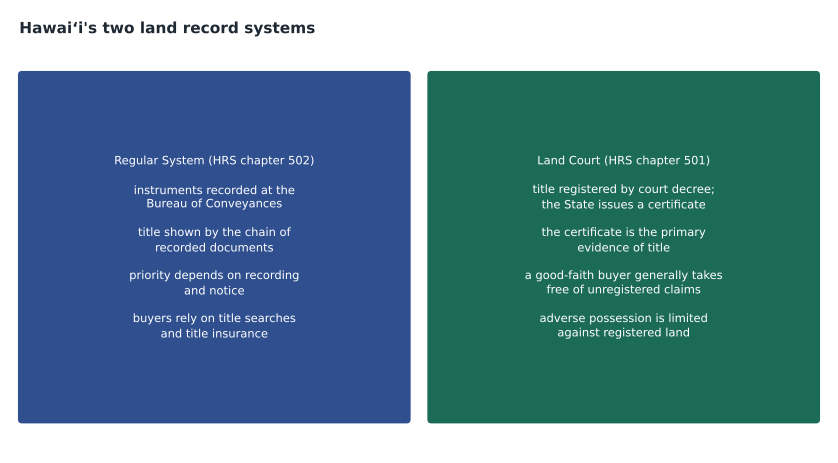
Hawaiʻi has two separate systems for recording interests in land, both administered by the Bureau of Conveyances within the Department of Land and Natural Resources. The Regular System, governed by chapter 502 of the HRS, works like recording systems in most states: deeds, mortgages and other instruments are recorded, and a buyer or lender searches the records to find the chain of title. Priority between competing claims depends on recording and notice, so a careful title search and title insurance protect the buyer.
The Land Court system, governed by chapter 501 of the HRS, is a Torrens system. Land registered in the Land Court has its title confirmed by a court decree, and the State issues a certificate of title that shows the owner and the interests that encumber the land. The certificate, rather than a chain of recorded deeds, is the primary evidence of title, and as a general rule a buyer in good faith takes title free of unregistered claims. Registration also limits claims such as adverse possession against registered land. Much of the land on Oʻahu, especially land developed in the twentieth century, is registered in Land Court, while other parcels remain in the Regular System. Lawyers must know which system a parcel is in, because the documents, the filing office procedures and the legal effect differ.
The two systems have been moving closer in practice. Over the years the Legislature has allowed many condominium and time share interests to be handled in the Regular System even when the underlying land is registered, and owners can apply to remove land from Land Court. A new lawyer should not assume anything about a parcel's status; the first step on any title question is to confirm which system holds the records.
Land reform and leasehold
For much of the twentieth century, a few large landowners, including trusts and estates established during the Kingdom era, owned much of the private land in Hawaiʻi, and many homeowners held long-term leases rather than fee simple title. In 1967 the Legislature passed the Land Reform Act, which allowed the State's housing authority to condemn the landowners' fee interest in residential lots and transfer it to the lessees. In Hawaii Housing Authority v. Midkiff, decided in 1984, the United States Supreme Court upheld the statute, holding that correcting the concentration of land ownership was a legitimate public purpose for the use of eminent domain. Midkiff remains a leading case on the public use requirement and is still taught alongside Kelo v. City of New London.
Leasehold still matters in Hawaiʻi practice. Some residential condominiums and many commercial properties sit on leased land, and lease rent renegotiation, lease expiration and lease-to-fee conversions are recurring issues. A buyer who assumes that a condominium in Honolulu comes with the land underneath it may be wrong.
The shoreline
Hawaiʻi law gives the public broad rights along the shore. In In re Ashford in 1968 and County of Hawaii v. Sotomura in 1973, the Hawaiʻi Supreme Court held that the boundary between private land and the public beach runs along the upper reaches of the wash of the waves, usually shown by the line of vegetation or debris, rather than along a mean high water line drawn by surveyors. The Legislature has codified the shoreline concept for regulatory purposes, and building near the shoreline is regulated through setbacks and permits. The public also has statutory and constitutional interests in access to the shoreline, and landowners and government must take those interests into account. These rules matter in a state where climate change and erosion are moving the shoreline itself.
The Residential Landlord-Tenant Code
Residential tenancies are governed by chapter 521 of the HRS, the Residential Landlord-Tenant Code. It sets the rules on rental agreements, the landlord's duty to keep the premises fit, the tenant's obligations, entry by the landlord, termination and remedies. The security deposit rules in HRS § 521-44 come up constantly. A landlord may require a security deposit of no more than one month's rent, plus a separate pet deposit of up to one month's rent if the tenant has a pet; no pet deposit may be charged for an assistance animal provided as a reasonable accommodation. Within fourteen days after the tenancy ends, the landlord must return the deposit or give the tenant written notice of the amounts retained, with reasons and supporting evidence such as invoices or receipts. A landlord who fails to send the notice within the fourteen days loses the right to keep any of the deposit.
Disputes over deposits go to the small claims division of the district court, which has exclusive jurisdiction over most of them. Under § 521-44, neither party may be represented by an attorney in that proceeding. If the court finds the landlord willfully and wrongfully kept the deposit, it may award the tenant up to three times the amount wrongfully retained, plus costs. A tenant must bring the claim within one year after the rental agreement ends.
| Rule | Requirement under HRS § 521-44 |
|---|---|
| Maximum security deposit | One month's rent |
| Pet deposit | Up to one month's rent, only if the tenant has a pet; none for an assistance animal |
| Deadline to return or account | Fourteen days after the tenancy ends, with written reasons and evidence |
| Failure to send notice | Landlord loses the right to keep any of the deposit |
| Willful wrongful retention | Up to three times the amount wrongfully retained, plus costs |
| Forum | Small claims division; no attorneys for either party |
| Time to sue | Within one year after the rental agreement ends |
Water: the State Water Code and the public trust
Water law in Hawaiʻi is unlike water law in any other state. Neither the eastern riparian system nor the western prior appropriation system fully describes it. The 1978 constitutional amendments declared that the State holds all public natural resources, including water, in trust for the benefit of the people, in article XI, section 1, and directed the State to protect, control and regulate the use of water resources for the benefit of its people, in article XI, section 7. The Legislature implemented these provisions in 1987 by enacting the State Water Code, chapter 174C of the HRS, administered by the Commission on Water Resource Management.
The Commission can designate water management areas where water resources are threatened. Within a designated area, users need permits from the Commission to withdraw water, and the Commission sets instream flow standards for streams and sustainable yields for aquifers. Outside designated areas, users must still register wells and stream diversions and comply with other Code requirements.
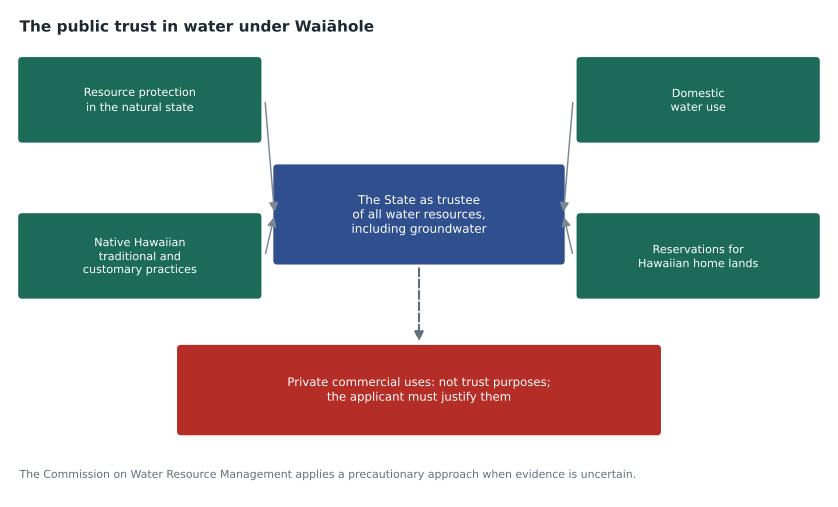
The leading case is In re Water Use Permit Applications, decided by the Hawaiʻi Supreme Court in 2000 and widely known as the Waiāhole case, after the irrigation ditch on windward Oʻahu at the center of the dispute. The court held that the public trust doctrine applies to all water resources in the state, including groundwater, and that it is not displaced by the Water Code. It identified public trust purposes, including protection of water resources in their natural state, domestic water use, the exercise of Native Hawaiian traditional and customary rights and reservations of water for Hawaiian home lands. It held that private commercial use is not a protected trust purpose, that applicants for such uses bear the burden of justifying them in light of the trust, and that the Commission must apply a precautionary approach when scientific evidence is uncertain. Later cases have applied the same principles to streams on Maui and elsewhere.
Family property
Hawaiʻi is not a community property state, but it is not a traditional common law title state either. At divorce, Hawaiʻi family courts divide property and debts under the marital partnership model developed in the case law. The model sorts property into categories, such as each spouse's net market value of property at the time of marriage, property acquired by gift or inheritance during the marriage, and property acquired during the marriage through the partnership, and starts from a presumption about how each category is divided before considering whether equitable reasons justify a deviation. The details are case law rather than statute, and they matter in nearly every divorce.
Hawaiʻi also recognizes tenancy by the entirety. In Sawada v. Endo in 1977, the Hawaiʻi Supreme Court held that property held by spouses as tenants by the entirety cannot be reached by the creditors of only one spouse. Hawaiʻi was also early to recognize relationships outside traditional marriage: it created reciprocal beneficiary relationships in 1997 and civil unions in 2011, and it has recognized same-sex marriage by statute since 2013.
Common mistakes
MistakeAll land in Hawaiʻi is recorded in one system.
InsteadHawaiʻi has the Regular System under chapter 502 and the Land Court Torrens system under chapter 501.
MistakeThe beach boundary is the mean high water line.
InsteadUnder Ashford and Sotomura, it runs along the upper reaches of the wash of the waves.
MistakeA landlord may keep a deposit if the tenant does not ask for it.
InsteadThe landlord must return the deposit or give written notice with reasons within fourteen days, or lose the right to keep any of it.
MistakeHawaiʻi uses prior appropriation for water.
InsteadHawaiʻi applies the State Water Code and a constitutional public trust that covers all water, including groundwater.
Researching a Hawaiʻi property question
Property questions in Hawaiʻi practice usually start with three pieces of information: the tax map key number that identifies the parcel, the land title system in which it sits, and any recorded or registered documents that affect it. The tax map key, usually shortened to TMK, is the identifier counties use for real property tax purposes, and it appears on many documents and permits. Knowing whether the parcel is in the Land Court or the Regular System tells the lawyer where to look and how documents must be filed. Many parcels have parts or histories in both systems, which adds work.
Beyond title, a lawyer should check land use classification and zoning, shoreline setbacks and any special management area rules for coastal land, water use permits or claims if water is involved, and whether any traditional and customary practices are exercised on or near the land. Each of these comes from a different source, and a problem in any one can stop a project.
| Question | Where to start |
|---|---|
| Who owns it, and subject to what? | Land Court or Regular System records at the Bureau of Conveyances, and title insurance |
| What may be built? | State land use district and county zoning |
| Is it near the shore? | Shoreline certification, setbacks and special management area rules |
| Is water involved? | Commission on Water Resource Management permits and the public trust |
| Are cultural practices affected? | The Ka Paʻakai analysis, discussed in Lesson 10 |
Kainoa's firm keeps a version of this checklist for every land use client. 'The bar examination tests property law as if land were a set of interests in the abstract,' Nakamoto-Ige tells him. 'In Hawaiʻi, every parcel has a history, a shoreline or a stream, and neighbors who have used it for generations. The checklist is how you avoid surprises.'
The same habit applies to family matters. Before advising a client about property division in a divorce, a Hawaiʻi lawyer gathers the dates of the marriage, any premarital or marital agreements, records of property each spouse brought into the marriage or received by gift or inheritance, and how and when property was titled. The partnership model described in this lesson depends on those facts, and a lawyer who collects them early can give much better advice about the likely result and the value of settling.
Summary and key terms
- Hawaiʻi records land interests in the Regular System and registers title in the Land Court Torrens system.
- The Land Reform Act of 1967, upheld in Hawaii Housing Authority v. Midkiff, let lessees acquire fee title to residential lots.
- The shoreline boundary runs along the upper reaches of the wash of the waves.
- Under HRS § 521-44, deposits are capped at one month's rent and must be returned or accounted for within fourteen days.
- The State Water Code and the public trust, as applied in Waiāhole, govern water; family property is divided under the marital partnership model.
- Torrens system
- A land title system in which a court decree registers title and the State issues a certificate of title.
- Certificate of title
- The document issued in the Land Court system showing the registered owner and encumbrances.
- Public trust doctrine
- The principle that the State holds certain natural resources, including all water in Hawaiʻi, in trust for the people.
- Water management area
- An area designated by the Commission on Water Resource Management in which water use requires a permit.
- Tenancy by the entirety
- A form of co-ownership between spouses that protects the property from creditors of only one spouse.
Lesson quiz · 5 questions
Score 60% or more to complete this lesson.
Create a free account to save your progress, take quizzes and earn a certificate.