
BAR-212 · Lesson 8 of 12 · 17 min
Hawaiʻi torts: comparative fault, joint liability and damages
▶ Video coming soon A video version of this lesson is on the way.
The firm's newest tort file lands on Kainoa's desk on a Monday. A tourist from Oregon, Bryce Lindqvist, was injured when the rental moped he was riding on Kauaʻi went off the road at a curve. He says the moped's brakes failed; the rental company says he was speeding and had been drinking; and a guardrail at the curve had been damaged in an earlier crash and never repaired. 'Write me a two-page memo on how Hawaiʻi divides fault and damages among the rider, the rental company, the moped maker and the county,' Nakamoto-Ige tells him. 'Not the bar exam rules. Ours.'
This lesson covers the Hawaiʻi tort rules a new lawyer uses most: modified comparative negligence, the partial abolition of joint and several liability, the cap on damages for pain and suffering and the main exceptions to each. On the bar examination, comparative fault questions follow the rule given in the question or NCBE's general approach. In Hawaiʻi practice, the statutes in chapter 663 of the HRS control.
Modified comparative negligence
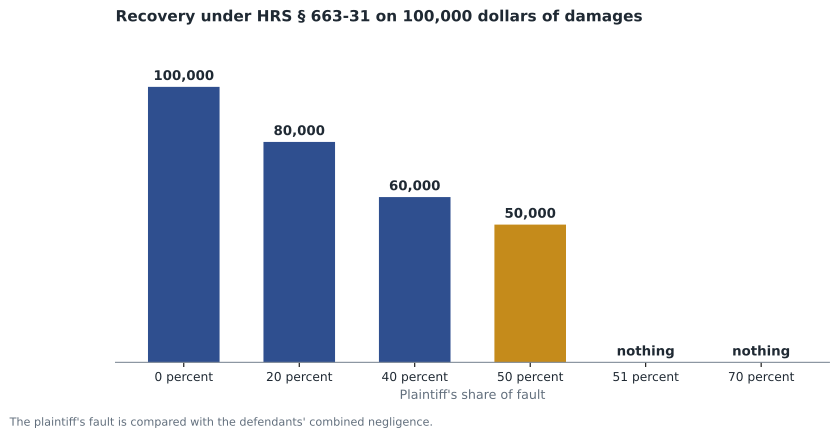
HRS § 663-31 governs a plaintiff's own negligence. Under it, contributory negligence does not bar recovery in an action for negligence causing death or injury to persons or property, as long as the plaintiff's negligence was not greater than the negligence of the person or persons against whom recovery is sought. Any damages the plaintiff recovers are reduced in proportion to the plaintiff's share of the total negligence. The jury, or the judge in a bench trial, returns a special verdict stating the total damages and the percentage of negligence attributable to each party, and the court then applies the statute.
Two features deserve emphasis. First, the comparison is between the plaintiff's negligence and the combined negligence of the defendants against whom recovery is sought, not each defendant separately. A plaintiff who is 40 percent at fault can recover against two defendants who are each 30 percent at fault, because 40 is not greater than their combined 60. Second, the threshold is 'not greater than,' so a plaintiff found exactly 50 percent at fault still recovers half of his or her damages, while a plaintiff found 51 percent at fault recovers nothing. States describe this as a 51 percent bar, and Hawaiʻi is one of them.
Joint and several liability, modified
Under traditional joint and several liability, each defendant whose negligence contributed to a single injury could be made to pay the plaintiff's entire damages, leaving that defendant to seek contribution from the others. Hawaiʻi abolished that rule for joint tortfeasors in HRS § 663-10.9, then restored it in specific situations. The result is a set of rules that every Hawaiʻi tort lawyer must know by heart.
For economic damages in actions for personal injury or death, such as medical expenses and lost earnings, joint and several liability is retained. For noneconomic damages, such as pain and suffering, the rule depends on each tortfeasor's share of fault: a tortfeasor whose individual negligence is 25 percent or more under § 663-31 remains jointly and severally liable for the noneconomic damages, while a tortfeasor below 25 percent pays noneconomic damages only in proportion to its own share. The statute then lists categories of torts in which joint and several liability applies to both economic and noneconomic damages regardless of the percentage: intentional torts, torts relating to environmental pollution, toxic and asbestos-related torts, torts relating to aircraft accidents, strict and products liability torts, and torts relating to motor vehicle accidents, subject to a special rule for highway design and maintenance claims.
That special rule matters in cases like Bryce's. In a motor vehicle accident involving a claim about highway maintenance or design, including guardrails, utility poles and signs, a public entity is jointly and severally liable for noneconomic damages only if it had reasonable prior notice of a similar earlier occurrence; otherwise the 25 percent rule applies. A damaged guardrail that the county knew about from an earlier crash could make a difference.
| Situation | Economic damages | Noneconomic damages |
|---|---|---|
| Ordinary negligence, tortfeasor 25 percent or more at fault | Joint and several | Joint and several |
| Ordinary negligence, tortfeasor below 25 percent at fault | Joint and several | Only its proportional share |
| Intentional, pollution, toxic and asbestos, aircraft, strict and products liability torts | Joint and several | Joint and several |
| Motor vehicle accident torts | Joint and several | Joint and several, except highway design and maintenance claims without prior notice |
| Highway design or maintenance claim, no prior notice of a similar occurrence | Joint and several | The 25 percent rule applies |
The cap on pain and suffering
HRS § 663-8.7 limits damages for pain and suffering, as defined in § 663-8.5, to a maximum of 375,000 dollars. The cap does not apply to the categories of tort actions listed in § 663-10.9(2): intentional torts, pollution, toxic and asbestos torts, aircraft accidents, strict and products liability, and motor vehicle accidents. In practice, then, the cap applies mainly to ordinary negligence cases outside those categories, such as premises liability and many professional negligence claims. The cap does not limit economic damages, and it applies to the category of damages for pain and suffering as the statute defines it, so lawyers must read the definitions carefully.
Medical negligence claims follow additional procedures. Hawaiʻi has long required many such claims to go through a pre-suit review process before a lawsuit is filed; the current conciliation program is set out in chapter 671 of the HRS. A new lawyer handling a medical claim should check the current chapter, because its requirements affect the limitation period and when suit can be filed.
Other rules worth knowing
Several other Hawaiʻi tort rules come up often. Claims against the State for the torts of its employees are governed by the State Tort Liability Act, chapter 662 of the HRS, which waives the State's immunity for many torts but keeps exceptions, such as for discretionary functions, and sets its own procedures. Claims against counties have their own notice and procedure rules. Hawaiʻi's recreational use statute limits the liability of landowners who open land to the public for recreation without charge, an important rule in a state where much recreation takes place on private and public land near the shore and in the mountains. And Hawaiʻi has adopted a version of the Uniform Contribution Among Tortfeasors Act, in sections beginning at HRS § 663-11, which governs how defendants share liability among themselves and how a good-faith settlement by one defendant affects the claims of the others.
Insurance law and liens can also shape a tort case. After the 2023 Maui wildfires, the Hawaiʻi Supreme Court held in February 2025 that insurers who had paid claims could recover only through the statutory lien process under HRS § 663-10 and § 431:13-103, not through separate subrogation suits against the defendants. The decision allowed a settlement of about four billion dollars to proceed and confirmed that § 663-10, which governs liens on tort recoveries for benefits paid, can limit how payers recover.
Worked problem
Bryce's moped crash
A jury finds Bryce's damages are 500,000 dollars, of which 300,000 is economic and 200,000 noneconomic. It assigns fault: Bryce 20 percent, the rental company 50 percent, the moped maker (on a negligence theory only) 10 percent and the county 20 percent for failing to repair a guardrail it had not been told about. How much can Bryce recover, and from whom?
Show solution
- Bryce's 20 percent is not greater than the defendants' combined 80 percent, so under § 663-31 he recovers 80 percent of 500,000, or 400,000 dollars (240,000 economic and 160,000 noneconomic).
- Economic damages are joint and several, so any defendant can be required to pay the full 240,000, subject to contribution.
- This is a motor vehicle accident tort, but the claim against the county involves highway maintenance and the county had no prior notice, so the 25 percent rule applies to the county's noneconomic damages.
- The county is below 25 percent, so it pays only its proportional share of noneconomic damages, 20 percent of 200,000, or 40,000 dollars.
- The moped crash is a motor vehicle accident, so the rental company and the moped maker remain jointly and severally liable for the noneconomic damages; the pain and suffering cap does not apply to motor vehicle accident torts.
Answer: Bryce recovers 400,000 dollars; the county's noneconomic share is limited to 40,000 dollars, while the other defendants remain jointly and severally liable.
The example is simplified, Marchetti notes. A real case would raise questions about whether a moped is a motor vehicle under the statutes involved, what the special verdict form should ask, how a settlement by one defendant changes the others' liability and whether the moped maker could be held strictly liable for a defect. 'But if you can do the arithmetic in that example,' she says, 'you understand the structure, and you will know which questions to research.'
Common mistakes
MistakeHawaiʻi follows pure comparative negligence.
InsteadHRS § 663-31 bars recovery when the plaintiff's negligence is greater than the defendants' combined negligence.
MistakeEvery defendant is jointly and severally liable for all damages.
InsteadFor noneconomic damages, a defendant below 25 percent at fault pays only its share unless an exception applies.
MistakeThe 375,000-dollar cap applies to all tort cases.
InsteadIt does not apply to the categories listed in § 663-10.9(2), including motor vehicle and products liability torts.
MistakeA plaintiff 50 percent at fault recovers nothing.
InsteadA plaintiff exactly 50 percent at fault is not more at fault than the defendants and recovers half.
A second worked example: an ordinary negligence case
Bryce's case falls within the motor vehicle category, which keeps joint and several liability for most defendants and removes the pain and suffering cap. Many Hawaiʻi cases fall outside the listed categories, and there the 25 percent threshold and the cap both matter. A premises case shows how they interact.
Worked problem
A fall at a shopping center
A shopper slips on a wet floor at a shopping center in Kāneʻohe. The jury finds total damages of 900,000 dollars: 300,000 economic and 600,000 for pain and suffering. It assigns fault: the shopper 10 percent, the shopping center owner 70 percent and the cleaning contractor 20 percent. The contractor's insurance is limited, and the owner wants to know its exposure. Apply the Hawaiʻi rules, assuming no special category applies.
Show solution
- Comparative negligence: the shopper's 10 percent is not greater than the defendants' combined 90 percent, so recovery is reduced by 10 percent.
- The pain and suffering cap: this is an ordinary negligence case, so pain and suffering damages are limited to 375,000 dollars before the court applies the other rules, subject to how the statute defines the covered damages.
- Economic damages after reduction are 270,000 dollars, and joint and several liability applies to them, so either defendant can be required to pay all of it, subject to contribution.
- Noneconomic damages: the owner, at 70 percent, remains jointly and severally liable for them; the contractor, below 25 percent, pays only its proportional share.
- If the contractor cannot pay its share of economic damages, the owner bears the shortfall; for noneconomic damages, the owner also bears it because it is at least 25 percent at fault.
Answer: The shopper recovers reduced damages, with pain and suffering capped; the owner is exposed to nearly all of the award if the contractor cannot pay.
The example simplifies several questions a real case would raise, such as the order in which the cap and the comparative fault reduction are applied and how a settlement by one defendant affects the others. Those questions turn on the precise wording of the statutes and the decisions interpreting them, and a new lawyer should read both before advising a client.
Exam answers versus Hawaiʻi answers
On the MBE, a torts question that involves a negligent plaintiff will usually state the jurisdiction's rule, such as pure comparative negligence, modified comparative negligence or contributory negligence. Candidates should apply the stated rule even when it differs from Hawaiʻi's. If a question states no rule, the MBE generally expects the candidate to know the majority approaches and to choose the answer consistent with the facts given. On an MEE question, the candidate should state the general rule and, where the facts make it relevant, note the main alternatives.
In practice, Hawaiʻi lawyers learn the chapter 663 rules by repetition. Marchetti suggests a short exercise: take three fact patterns, assign fault percentages and damages, and work out each defendant's exposure under the Hawaiʻi statutes, then check the answers against the table in this lesson. 'Ten minutes,' she says. 'Do it three times and you will never forget the 25 percent line.'
Common mistakes
MistakeHawaiʻi's rules apply to MBE questions about a negligent plaintiff.
InsteadThe MBE applies the rule stated in the question or the general approach, not Hawaiʻi's statutes.
MistakeA defendant at 20 percent fault never pays more than 20 percent of anything.
InsteadIt can still be jointly and severally liable for all economic damages.
Summary and key terms
- Under HRS § 663-31, a plaintiff recovers reduced damages unless the plaintiff's negligence is greater than the defendants' combined negligence.
- Joint and several liability is retained for economic damages in personal injury and death actions.
- For noneconomic damages, tortfeasors at 25 percent or more remain jointly and severally liable; those below 25 percent pay their share.
- Listed categories, including intentional, pollution, toxic, aircraft, products and motor vehicle torts, keep full joint and several liability, with a special rule for highway claims.
- Pain and suffering damages are capped at 375,000 dollars except in the listed categories.
- Joint and several liability
- Liability under which each responsible defendant can be required to pay the plaintiff's full damages.
- Economic damages
- Monetary losses such as medical expenses and lost earnings.
- Noneconomic damages
- Losses such as pain, suffering and emotional distress, which have no direct market value.
- Special verdict
- A verdict in which the jury answers specific questions, such as each party's percentage of fault.
Lesson quiz · 5 questions
Score 60% or more to complete this lesson.
Create a free account to save your progress, take quizzes and earn a certificate.