
BAR-212 · Lesson 10 of 12 · 18 min
Native Hawaiian rights and the Hawaiʻi Rules of Professional Conduct
▶ Video coming soon A video version of this lesson is on the way.
Kainoa's grandmother still gathers ʻopihi along the rocky coast near Keaukaha and picks lauaʻe ferns in the forest above Hilo, as her own grandmother did. When a developer proposed a resort on land near one of her gathering places, the county planning commission held a hearing, and Kainoa, then in college, watched lawyers argue about cases with names he did not know: Kalipi, PASH, Ka Paʻakai. 'Those cases are why the commission had to listen to people like your grandmother,' Marchetti tells him when he describes the hearing. 'Every land use lawyer in Hawaiʻi needs to know them. And every Hawaiʻi lawyer needs to know the other subject in this lesson, the Hawaiʻi Rules of Professional Conduct, because fifteen questions on your exam will test them.'
This lesson covers two subjects. The first is the protection of Native Hawaiian traditional and customary rights and the legal framework for lands and institutions created for the benefit of Native Hawaiians. The second is the Hawaiʻi Rules of Professional Conduct, focusing on the points where they differ from the ABA Model Rules tested on the MPRE.
The constitutional and statutory sources
Article XII, section 7 of the Hawaiʻi Constitution, added in 1978, provides that the State reaffirms and shall protect all rights, customarily and traditionally exercised for subsistence, cultural and religious purposes and possessed by ahupuaʻa tenants who are descendants of native Hawaiians who inhabited the islands before 1778, subject to the State's right to regulate those rights. An ahupuaʻa is a traditional land division, usually running from the mountains to the sea, within which communities historically gathered the resources they needed.
Two statutes reinforce the constitutional provision. HRS § 7-1, which traces back to a law of the Kingdom of Hawaiʻi enacted in 1850, protects the right of the people to take certain items, such as firewood, house timber, aho cord, thatch and kī leaf, from the land on which they live, for their own private use, along with rights to drinking water, running water and rights of way. HRS § 1-1, discussed in Lesson 6, preserves Hawaiian usage established before November 25, 1892 as a source of law. The Hawaiʻi Supreme Court has read the three sources together.
The leading cases
In Kalipi v. Hawaiian Trust Co., decided in 1982, the court held that lawful occupants of an ahupuaʻa may enter undeveloped lands within the ahupuaʻa to gather the items listed in § 7-1 for traditional practices, so long as no actual harm is done. In Pele Defense Fund v. Paty, decided in 1992, it held that traditional and customary rights may extend beyond the ahupuaʻa in which a native Hawaiian lives, where such rights have been customarily and traditionally exercised in that manner.
The most important case is Public Access Shoreline Hawaii v. Hawaii County Planning Commission, decided in 1995 and usually called PASH. The case arose from a resort development on the Kona coast. The court held that the State and its agencies have an obligation to protect the reasonable exercise of customarily and traditionally exercised rights of native Hawaiians to the extent feasible, that these rights can exist on private land that is not fully developed, and that Western concepts of exclusive property rights do not automatically extinguish them. It also confirmed that the rights are subject to reasonable regulation and that they do not authorize harm to property.
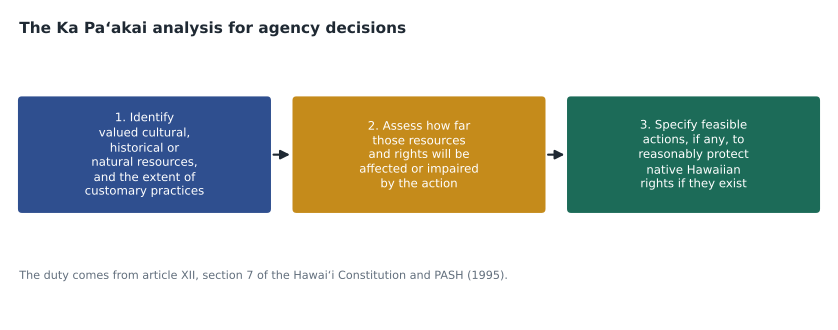
In Ka Paʻakai O Ka ʻĀina v. Land Use Commission, decided in 2000, the court turned those principles into a framework that agencies must follow when they decide land use applications. The agency must identify the valued cultural, historical or natural resources in the area, including the extent to which traditional and customary native Hawaiian rights are exercised there; assess the extent to which those resources and rights will be affected or impaired by the proposed action; and specify the feasible actions, if any, to be taken to reasonably protect native Hawaiian rights if they are found to exist. A decision that skips this analysis is vulnerable on appeal. In criminal cases, the court has held, in State v. Hanapi in 1998, that a defendant who claims a constitutionally protected practice as a defense must show that he or she is native Hawaiian, that the conduct is a constitutionally protected customary or traditional practice and that it occurred on undeveloped or less than fully developed property.
Lands and institutions
A separate body of law concerns lands and institutions established for the benefit of Native Hawaiians. Under the Hawaiian Homes Commission Act of 1920, Congress set aside about 200,000 acres for homesteading by native Hawaiians, defined in that act by a blood quantum of at least one-half; the State administers the program under a compact made at statehood. The lands ceded to the United States at annexation in 1898, most of which had been government and crown lands of the Kingdom, were largely returned to the State at statehood, and section 5(f) of the Admission Act lists five purposes for which those lands and their proceeds are held, one of which is the betterment of the conditions of native Hawaiians.
The 1978 constitutional convention created the Office of Hawaiian Affairs, governed by elected trustees, to manage resources for the benefit of Native Hawaiians, including a share of revenue from the ceded lands. Two decisions of the United States Supreme Court shaped this area. In Rice v. Cayetano in 2000, the Court held that limiting the vote in elections for the Office's trustees to Hawaiians violated the Fifteenth Amendment. In Hawaii v. Office of Hawaiian Affairs in 2009, the Court held that the 1993 congressional resolution apologizing for the overthrow of the Kingdom did not strip the State of its authority to sell ceded lands. Disputes over the Office's share of ceded land revenues, and over specific uses of ceded lands such as the summit of Mauna Kea, continue to come before Hawaiʻi courts and the Legislature.
| Source or case | Year | Holding or effect |
|---|---|---|
| HRS § 7-1 | 1850 (Kingdom law) | Protects gathering of listed items, water and rights of way for tenants |
| Kalipi v. Hawaiian Trust Co. | 1982 | Ahupuaʻa occupants may gather on undeveloped land for traditional practices, without harm |
| Pele Defense Fund v. Paty | 1992 | Rights may extend beyond one's ahupuaʻa where customarily exercised |
| PASH | 1995 | Agencies must protect customary rights to the extent feasible, including on less than fully developed private land |
| Ka Paʻakai O Ka ʻĀina | 2000 | Three-part analysis required for agency land use decisions |
| Rice v. Cayetano | 2000 | Race-based voting for OHA trustees violated the Fifteenth Amendment |
| Hawaii v. OHA | 2009 | The 1993 Apology Resolution did not limit the State's power to sell ceded lands |
The Hawaiʻi Rules of Professional Conduct
The Hawaiʻi Rules of Professional Conduct follow the structure and numbering of the ABA Model Rules. A broad set of amendments took effect on January 1, 2014, bringing Hawaiʻi's rules closer to the Model Rules in many places, adding rules such as Rule 1.18 on prospective clients and Rule 4.4(b) on inadvertently sent documents, and keeping or adding several Hawaiʻi variations. The supreme court summarized the most noteworthy changes when it adopted them. Those variations are the most likely subjects of the fifteen questions on the Hawaiʻi Legal Ethics Examination.
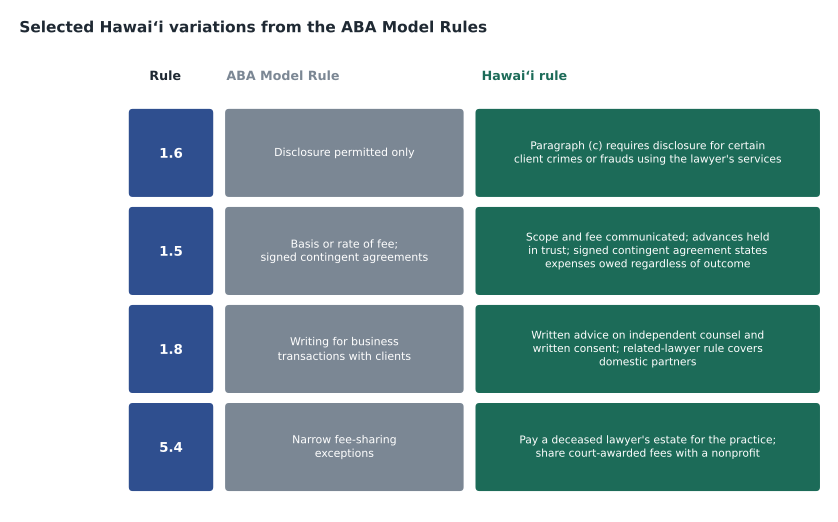
Confidentiality is the biggest difference. Model Rule 1.6 permits, but never requires, disclosure of confidential information to prevent or address client crimes and frauds. Hawaiʻi Rule 1.6 includes the familiar permissive exceptions in paragraph (b), including disclosure to obtain legal advice about the lawyer's own compliance with the rules, an exception added in 2014. But Hawaiʻi Rule 1.6(c) goes further: it requires disclosure, to the extent the lawyer reasonably believes necessary, in specified circumstances involving a client's criminal or fraudulent act in which the lawyer's services were used. A Model Rules answer that says disclosure is merely permitted can be wrong on a Hawaiʻi question.
Fees and client property are the second area. Hawaiʻi Rule 1.5(b) requires a lawyer to communicate the scope of the representation as well as the basis or rate of the fee, to tell the client of changes in fees or expenses, and to hold advance payments in a client trust account until they are earned. Contingent fee agreements must be in a writing signed by the client and must state the expenses the client will owe whatever the outcome. Rule 1.15 governs trust accounts, and lawyers must file a trust account verification; a lawyer who fails to file it can face an audit ordered under the supreme court's disciplinary rules.
Conflicts are the third. Hawaiʻi Rule 1.8 requires a lawyer entering a business transaction with a client to advise the client in writing of the desirability of seeking independent counsel and to obtain the client's written consent to the essential terms. It bars soliciting substantial gifts for the lawyer or persons related to the lawyer, requires written consent to aggregate settlements, requires written notice before settling a malpractice claim with an unrepresented client, extends the related-lawyer rule to domestic partners and restricts sexual relationships with clients unless the relationship predates the representation. Rule 5.4 permits two Hawaiʻi exceptions to the ban on sharing fees with nonlawyers: payment of the agreed price for a deceased, disabled or disappeared lawyer's practice to that lawyer's estate or representative, and sharing court-awarded fees with a nonprofit organization that employed, retained or recommended the lawyer. The advertising rules in Rules 7.2 and 7.3 were rewritten in 2014 to address email and social media and to drop older filing requirements.
Worked problem
A Hawaiʻi ethics question
A Honolulu lawyer prepared closing documents for a client's sale of a business. After closing, the lawyer learns facts that clearly establish that the client used the documents to commit a fraud on the buyer, causing substantial financial loss. Under the Model Rules, what may the lawyer do? Under the Hawaiʻi rules, what must the lawyer consider?
Show solution
- Model Rule 1.6(b)(3) permits, but does not require, disclosure to prevent, mitigate or rectify substantial financial injury from a client fraud in which the lawyer's services were used.
- Hawaiʻi Rule 1.6(b) contains similar permissive exceptions.
- Hawaiʻi Rule 1.6(c) adds a mandatory disclosure duty in specified circumstances involving client crimes or frauds that used the lawyer's services, to the extent the lawyer reasonably believes necessary.
- The lawyer must read Rule 1.6(c) and its comments carefully, because on these facts disclosure may be required rather than merely permitted.
Answer: Under the Model Rules disclosure is permitted; under the Hawaiʻi rules the lawyer must determine whether Rule 1.6(c) requires it.
Common mistakes
MistakeTraditional and customary rights exist only on public land.
InsteadPASH held that they can be exercised on private land that is not fully developed, subject to reasonable regulation.
MistakeAn agency may approve a project without addressing cultural practices.
InsteadKa Paʻakai requires a three-part analysis of resources, impacts and feasible protective actions.
MistakeThe Hawaiʻi confidentiality rule only permits disclosure, like the Model Rule.
InsteadHawaiʻi Rule 1.6(c) requires disclosure in specified circumstances.
MistakeAn oral contingent fee agreement is enough in Hawaiʻi.
InsteadHawaiʻi Rule 1.5 requires a writing signed by the client that states expenses owed regardless of outcome.
Studying the Hawaiʻi rules efficiently
The fifteen questions on the Hawaiʻi Legal Ethics Examination are worth studying well, because they draw on a short list of rules that a candidate who has passed the MPRE already mostly knows. The efficient approach is to study the differences rather than the whole code again. Marchetti suggests three steps. First, read the Hawaiʻi Supreme Court's summary of the most noteworthy changes made by the 2014 amendments. Second, read the text of the Hawaiʻi versions of Rules 1.5, 1.6, 1.8, 1.15, 5.4 and the advertising rules side by side with the Model Rules. Third, write each difference as a single line in the differences chart and practice timed sets of fifteen questions.
Candidates should use the current official text of the Hawaiʻi rules, available on the Judiciary's website, rather than a commercial outline that may be out of date. The Hawaiʻi rules have been amended several times since 2014, and a question will be written on the rules in force when the examination is prepared.
Worked problem
A quick check on Rule 1.8
A Hilo lawyer's domestic partner is an associate at the firm representing the opposing party in a contested case. The lawyer's client does not know. What should the lawyer do under the Hawaiʻi rules?
Show solution
- The Hawaiʻi related-lawyer rule extends to domestic partners, so the relationship is covered.
- The lawyer should not represent the client against a party represented by the partner's firm in that matter without the client's informed consent, as the rule requires.
- The lawyer should also consider whether the relationship creates a material limitation conflict under Rule 1.7.
Answer: Disclose the relationship to the client and obtain informed consent, or decline the matter.
Summary and key terms
- Article XII, section 7, HRS § 7-1 and HRS § 1-1 protect traditional and customary native Hawaiian rights, subject to regulation.
- Kalipi, Pele Defense Fund, PASH and Hanapi define the scope of the rights; Ka Paʻakai sets the agency analysis.
- The Hawaiian Homes Commission Act, the Admission Act's section 5(f) and the Office of Hawaiian Affairs govern lands and institutions for Native Hawaiians.
- The Hawaiʻi Rules of Professional Conduct follow the Model Rules' numbering, with broad amendments effective January 1, 2014.
- Key differences include mandatory disclosure under Rule 1.6(c) and writing requirements in Rules 1.5 and 1.8.
- Ahupuaʻa
- A traditional Hawaiian land division, usually running from the mountains to the sea.
- Traditional and customary rights
- Rights exercised for subsistence, cultural and religious purposes by descendants of native Hawaiians who lived in the islands before 1778.
- Ceded lands
- Lands of the Kingdom of Hawaiʻi transferred to the United States at annexation and largely returned to the State at statehood.
- Office of Hawaiian Affairs
- The state agency, created in 1978, that manages resources for the benefit of Native Hawaiians.
- Hawaiʻi Rules of Professional Conduct
- The ethics rules adopted by the Hawaiʻi Supreme Court, based on the ABA Model Rules with Hawaiʻi variations.
Lesson quiz · 5 questions
Score 60% or more to complete this lesson.
Create a free account to save your progress, take quizzes and earn a certificate.