
BAR-212 · Lesson 1 of 12 · 17 min
Becoming a lawyer in Hawaiʻi
▶ Video coming soon A video version of this lesson is on the way.
Kainoa Dela Cruz grew up in Hilo, on Hawaiʻi Island, and spent most of his childhood summers working at his uncle's farm stand near the Wailuku River. He finished law school in May 2026 and took a job as a law clerk at a small Honolulu firm that handles land use permits, water disputes and a steady stream of landlord-tenant cases. In late October 2026 he filed his application for the February 2027 Hawaiʻi bar examination, a few days before the November 1 deadline, and then joined Hollis Marchetti's study group. 'I assumed Hawaiʻi gave the Uniform Bar Exam like most states,' he tells her at their first session. 'Then a classmate told me my score would not transfer anywhere, and that nobody's score transfers in. I want to understand what I signed up for.'
'Your classmate was mostly right,' Marchetti says. 'Hawaiʻi uses the same national tests as UBE states, but it adds its own ethics test, grades on its own scale and keeps its own door. That is a choice the Hawaiʻi Supreme Court has made, and it shapes everything else: who can sit, how you prepare and what you can do with your result. Hawaiʻi also has more local law that a new lawyer actually uses on day one than almost any other place you could practice. If you understand who sets the rules and why the system looks the way it does, the rest makes sense.'
This lesson maps the whole process: the institutions involved, the routes to practice, the requirements for the examination route and the usual order of events. Later lessons take each step in detail and then turn to the Hawaiʻi law that matters most for new lawyers, from the State Water Code to the protection of Native Hawaiian traditional and customary rights.
Who controls admission
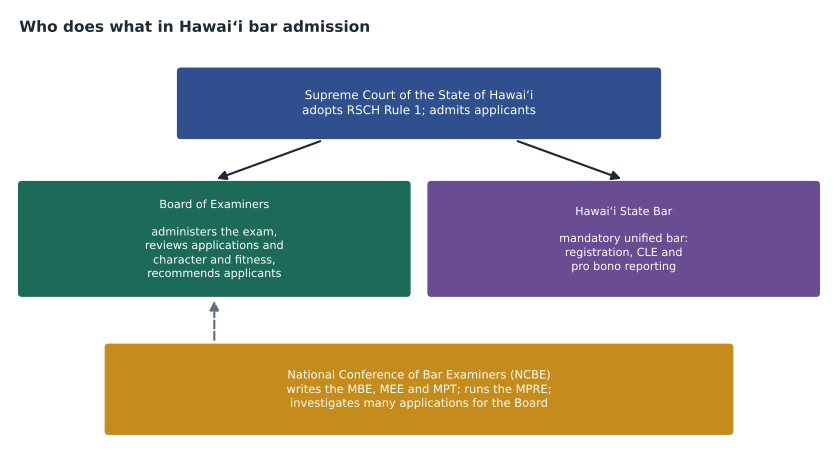
Admission to practice law in Hawaiʻi is controlled by the Supreme Court of the State of Hawaiʻi. The court's power to regulate the legal profession comes from its constitutional role as the head of the judicial branch, and it exercises that power through its own court rules. The central rule is Rule 1 of the Rules of the Supreme Court of the State of Hawaiʻi, usually cited as RSCH Rule 1. Rule 1.3 sets out the qualifications for admission, the requirement to pass the bar examination and the Multistate Professional Responsibility Examination (MPRE), the timing of examinations and the character and fitness standard. Other parts of Rule 1 govern limited forms of practice, such as pro hac vice appearances and special licenses for military lawyers and legal services attorneys. The court changes these rules by order, and its orders on bar admission are filed under a standing docket number, SCMF-12-0000538, which also carries the court's notices of passing applicants after each examination.
The court does its admissions work through the Board of Examiners, a body it appoints. The Board administers the written examination, reviews applications, decides character and fitness questions in the first instance and recommends applicants for admission. Its staff works in Aliʻiolani Hale, the historic judiciary building on King Street in downtown Honolulu, across from ʻIolani Palace. The Board has its own Rules of Procedure, adopted in 2003 and amended since, which set the filing deadlines, the documents applicants must submit, the factors used in the character and fitness review and the hearing procedure for an applicant who is recommended for denial.
After each examination, the Board files a notice with the supreme court listing the applicants who passed. The notice for the July 2026 examination, dated September 18, 2026, listed 116 successful applicants. It also reminded them of something every new passer must understand: passing the examination does not make you a lawyer. Under Rule 1.3, a successful applicant may not practice law in Hawaiʻi until every other requirement is met and the supreme court actually admits the applicant.
The Hawaiʻi State Bar
The second institution every Hawaiʻi lawyer deals with is the Hawaiʻi State Bar. Under RSCH Rule 17, everyone admitted to practice before the supreme court is a member of a single unified bar, which the rule describes as an independent, member-governed organization. Membership is mandatory. Each member files an annual registration statement that reports, among other things, the continuing legal education (CLE) completed in the prior year and the hours of pro bono service and related financial contributions. Individual pro bono reports are confidential; the bar publishes only totals. A member who fails to file, pay or meet the CLE requirement faces administrative suspension. Lesson 11 covers these duties in more detail, along with the Hawaiʻi Professionalism Course that every new lawyer must complete.
The role of NCBE
The National Conference of Bar Examiners (NCBE), a national nonprofit, plays a large supporting role. NCBE writes the Multistate Bar Examination (MBE), the Multistate Essay Examination (MEE) and the Multistate Performance Test (MPT), all of which appear on the Hawaiʻi examination. NCBE also runs the MPRE, which every Hawaiʻi applicant must pass, and it carries out character and fitness investigations for many Hawaiʻi applications, gathering records from schools, employers and courts and reporting to the Board. NCBE does not admit anyone, and it does not decide whether an applicant has the character to practice. The Board and the court make those decisions.
Why Hawaiʻi is different
Three features shape the Hawaiʻi system. The first is that Hawaiʻi is not a Uniform Bar Examination (UBE) jurisdiction. It gives all three UBE components, and its written score is scaled to the MBE in the same way, but it adds a fifteen-question Hawaiʻi Legal Ethics Examination and reports its own total on a 200-point scale. NCBE lists Hawaiʻi among the non-UBE jurisdictions. The practical consequences are large. Hawaiʻi does not accept transferred UBE scores from other jurisdictions, it does not accept transferred MBE scores, and a Hawaiʻi result is not a UBE score that another jurisdiction will accept as one. Lesson 4 explains the format and scoring; Lesson 11 explains what this means for mobility.
The second feature is that Hawaiʻi has no general admission on motion. In many states a lawyer with several years of practice elsewhere can be admitted without sitting another examination. In Hawaiʻi, NCBE's current jurisdiction information lists admission on motion as not available, and the court's rules instead provide a handful of limited licenses for specific roles. A lawyer who wants a full Hawaiʻi license, no matter how experienced, ordinarily sits the Hawaiʻi examination. Hawaiʻi does, however, let some experienced lawyers sit who would not otherwise be eligible: a lawyer admitted in another United States jurisdiction, or in a qualifying common-law country, who has actively practiced for five of the six years before applying may sit even without a degree from a law school accredited by the American Bar Association (ABA). Lesson 2 explains that route.
The third feature is the law itself. Hawaiʻi's legal system carries features found nowhere else in the country: a constitution that protects the traditional and customary rights of Native Hawaiians, a public trust in water that the state supreme court has applied in landmark cases, a separate Land Court that registers title to much of the state's land, an Office of Hawaiian Affairs created by constitutional amendment, and courts that still apply Hawaiian usage where it was established before 1892. Although the bar examination itself tests mostly general law, a new lawyer in Hawaiʻi meets these doctrines almost immediately. Lessons 7 through 10 are devoted to them.
The routes to practice
Hawaiʻi offers one main route to a full license and several narrow ones. The main route is admission by examination: you meet the education requirement, pass the Hawaiʻi bar examination with a scaled score of at least 132, pass the MPRE with at least 85 within the required time window, satisfy the character and fitness standard and are admitted by the supreme court. The narrow routes are limited licenses written for particular situations. They include limited admission for full-time military judge advocates to represent junior enlisted personnel and their families under Rule 1.7, pro tem membership for full-time faculty at the state's law school under Rule 1.8, a limited license for lawyers employed by qualifying nonprofit legal services providers under Rule 1.16, provisional admission for spouses of active-duty service members under Rule 1.17, and pro hac vice permission to appear in a particular case or arbitration under Rules 1.9 and 1.9A.
| Route | Rule | Who uses it | Key limit |
|---|---|---|---|
| Admission by examination | RSCH 1.3 | Graduates and experienced lawyers seeking a full license | Pass the Hawaiʻi exam (132) and the MPRE (85) |
| Military judge advocate | RSCH 1.7 | Full-time uniformed judge advocates | Represent enlisted personnel in grades E-1 to E-5 and dependents; four years, renewable once |
| Law faculty | RSCH 1.8 | Full-time faculty at the state's law school | Three-year pro tem membership |
| Legal services attorney | RSCH 1.16 | Employees of qualifying nonprofit providers | Two years, renewable once for two years |
| Military spouse | RSCH 1.17 | Spouses of active-duty service members | Provisional; ends no later than four years after issuance |
| Pro hac vice | RSCH 1.9, 1.9A | Out-of-state lawyers in a particular case or arbitration | Requires Hawaiʻi local counsel |
The requirements on the examination route
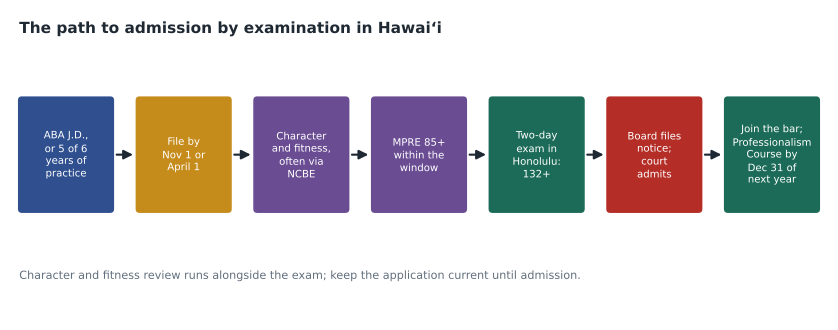
For an applicant seeking admission by examination, the requirements come down to five. You must be eligible, which usually means holding a J.D. or LL.B. from an ABA-accredited law school; a graduate degree such as an LL.M. does not substitute. You must file a complete application with the Board by the deadline, November 1 for the February examination and April 1 for the July examination, and pay the filing fee and the NCBE character report fee. You must pass the bar examination in Honolulu. You must pass the MPRE with a scaled score of at least 85, taken no earlier than two years before the bar examination and reported to the Board no later than one year after you are notified that you passed. And you must satisfy the Board and the court that you have the character and fitness to practice law.
Look at what is and is not on the list. There is no separate Hawaiʻi law course to complete before admission, and the examination does not include essays on Hawaiʻi law. The one Hawaiʻi-specific component of the current examination is the Hawaiʻi Legal Ethics Examination, fifteen multiple-choice questions on the Hawaiʻi Rules of Professional Conduct. After admission, every new lawyer must complete the Hawaiʻi Professionalism Course, which carries three ethics credits and must be finished by December 31 of the year after the lawyer first elects active status.
Two numbers to remember: 132 and 85
Hawaiʻi's passing score is 132 on a 200-point scale. The supreme court announced in January 2025 that the passing score would be 132 beginning with the February 2025 examination; before that, the passing score had been 133, a figure that still appears in some older study materials. Because Hawaiʻi reports its total on a 200-point scale rather than the UBE's 400-point scale, the number cannot be compared directly with a UBE passing score such as 266 or 270, even though the components are the same. Marchetti puts it simply: 'Do not try to convert. Hawaiʻi's number is Hawaiʻi's number, and the only score that matters for you is the one on the Hawaiʻi exam.'
The MPRE requirement of 85 is near the top of the national range, which runs from 75 to 86. Only California's 86 is higher. Hawaiʻi also sets a time window that many applicants overlook: the MPRE must be taken no earlier than two years before the bar examination you sit. An applicant who passed the MPRE in the first year of law school and then waited a few years before sitting in Hawaiʻi may have to take it again. Lesson 3 explains the window in detail.
The order of events
Most Hawaiʻi applicants move through the process in a predictable order. They take the MPRE during the third year of law school, close enough to the examination to stay inside the two-year window. In the final semester they gather the records the application asks for, including employment and residence histories, transcripts and documents for any matter that calls for a yes answer on the character questions. They file the application with the Board before the deadline, which for the July examination falls on April 1, often before final exams are over. They respond quickly to NCBE's investigators and to any request from the Board. They sit the examination in Honolulu during the week of the last Wednesday of February or July. Results follow some weeks later; the notice of passing for the July 2026 examination was filed on September 18, 2026. A successful applicant who has met every other requirement is admitted, joins the Hawaiʻi State Bar and completes the Professionalism Course.
Worked problem
Planning Kainoa's path
Kainoa graduated in May 2026 from an ABA-accredited law school and scored 101 on the MPRE in March 2026. He filed his application for the February 2027 examination in late October 2026. What must he still do before he can be admitted, and what must he do after?
Show solution
- Eligibility: his J.D. is from an ABA-accredited school, so he qualifies under Rule 1.3(b)(1).
- MPRE: 101 exceeds 85, and March 2026 is within two years before February 2027, so the score works if it is reported in time.
- Character and fitness: he must answer NCBE and the Board promptly and keep his application updated until admission.
- Exam: he must score 132 or more on the February 23 and 24, 2027 examination in Honolulu.
- After admission: he joins the Hawaiʻi State Bar and must complete the Professionalism Course by December 31 of the year after he first elects active status.
Answer: Kainoa still needs a passing examination score and character and fitness approval; his MPRE should be reported to the Board; the Professionalism Course follows admission.
Common mistakes
MistakeHawaiʻi gives the UBE, so a Hawaiʻi score transfers like any UBE score.
InsteadHawaiʻi gives the UBE components plus its own ethics test and is a non-UBE jurisdiction; it does not accept transferred UBE or MBE scores, and its result is not a UBE score.
MistakeAn experienced lawyer from another state can be admitted on motion.
InsteadHawaiʻi has no general admission on motion; experienced lawyers ordinarily sit the examination, with limited licenses for specific roles.
MistakeThe passing score is 133.
InsteadThe passing score has been 132 since the February 2025 examination.
MistakePassing the examination lets you start practicing.
InsteadUnder Rule 1.3 you may not practice until all requirements are met and the supreme court admits you.
Summary and key terms
- The Supreme Court of the State of Hawaiʻi controls admission through RSCH Rule 1 and acts on the Board of Examiners' recommendations.
- The Hawaiʻi State Bar is a mandatory unified bar under RSCH Rule 17 that handles registration, CLE and pro bono reporting.
- NCBE writes the MBE, MEE and MPT, runs the MPRE and investigates many applications, but does not admit anyone.
- Hawaiʻi is a non-UBE jurisdiction with no general admission on motion; it accepts no transferred UBE or MBE scores.
- The passing score is 132 on a 200-point scale and the MPRE score is 85, taken no earlier than two years before the examination.
- RSCH Rule 1
- The rule of the Supreme Court of the State of Hawaiʻi that governs admission to practice and limited licenses.
- Board of Examiners
- The court-appointed body that administers the Hawaiʻi bar examination and reviews applications for admission.
- Hawaiʻi State Bar
- The mandatory unified bar to which every lawyer admitted in Hawaiʻi belongs under RSCH Rule 17.
- Non-UBE jurisdiction
- A jurisdiction whose bar examination does not produce a Uniform Bar Examination score, even if it uses NCBE tests.
- Admission on motion
- Admission without examination based on practice experience elsewhere; not generally available in Hawaiʻi.
Lesson quiz · 5 questions
Score 60% or more to complete this lesson.
Create a free account to save your progress, take quizzes and earn a certificate.