
BAR-212 · Lesson 7 of 12 · 18 min
Hawaiʻi courts, civil procedure and the state constitution
▶ Video coming soon A video version of this lesson is on the way.
Kainoa's supervising attorney, Lynn Nakamoto-Ige, sends him to Kaʻahumanu Hale, the First Circuit courthouse in downtown Honolulu, one afternoon to watch a contested hearing in a land use appeal. Afterward she quizzes him over coffee. 'Which court was that?' 'Circuit court, First Circuit.' 'Where does the appeal go if we lose?' 'The Intermediate Court of Appeals,' he says, then hesitates. 'Unless someone asks the supreme court to take it directly.' Nakamoto-Ige nods. 'And if it were an environmental case, it might have been in a different courtroom altogether. Learn the map now. Clients assume you know it.'
This lesson covers the structure of the Hawaiʻi courts, how judges are selected, the basic rules of civil procedure a new Hawaiʻi lawyer uses and several features of the Hawaiʻi Constitution that set the state apart. None of this is tested directly on the current bar examination, which applies federal procedure and generally accepted rules, but it is the framework for everything a new Hawaiʻi lawyer does in court.
The court system
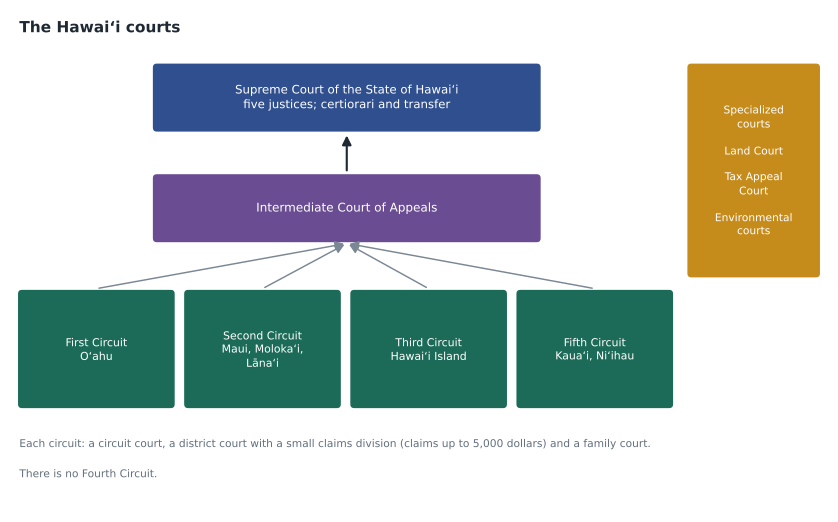
Hawaiʻi has a unified state court system headed by the Supreme Court of the State of Hawaiʻi, which consists of a chief justice and four associate justices. The supreme court hears appeals, answers questions of Hawaiʻi law certified by federal courts, regulates the legal profession and adopts the court rules. Below it is the Intermediate Court of Appeals, created in 1980 to share the appellate caseload. Most appeals go first to the Intermediate Court of Appeals; a party who loses there may apply to the supreme court for a writ of certiorari, which the court grants at its discretion. Some cases can be transferred to the supreme court before the intermediate court decides them.
The trial courts are organized into four judicial circuits based on the islands. The First Circuit covers Oʻahu. The Second Circuit covers Maui, Molokaʻi and Lānaʻi. The Third Circuit covers Hawaiʻi Island. The Fifth Circuit covers Kauaʻi and Niʻihau. There is no Fourth Circuit; it was merged into the Third in the 1940s, and the numbering was never changed. Each circuit has a circuit court, the court of general jurisdiction that handles felony cases, jury trials, larger civil cases and appeals from many agencies; a district court, which handles misdemeanors, traffic cases, landlord-tenant summary possession cases and civil cases below a statutory dollar limit; and a family court.
Several specialized courts complete the picture. The Land Court registers title to land under Hawaiʻi's Torrens system. The Tax Appeal Court hears property and other tax appeals. And since 2015 Hawaiʻi has had environmental courts, created by statute in 2014, which hear cases involving the state's environmental laws within the circuit and district courts, so that designated judges develop expertise in water, land use, pollution and natural resource disputes. Within the district courts, the small claims division hears money claims of up to 5,000 dollars, excluding interest and costs, and has exclusive jurisdiction over most disputes between residential landlords and tenants about security deposits under HRS § 633-27.
How judges are chosen
Hawaiʻi uses a merit selection system set out in its constitution. When a vacancy occurs, a Judicial Selection Commission screens applicants and sends a list of nominees to the appointing authority. For the supreme court, the Intermediate Court of Appeals and the circuit courts, the governor appoints from the list, subject to confirmation by the state Senate; for district and family court judges, the chief justice appoints from the commission's list, also subject to Senate confirmation. Appellate and circuit judges serve ten-year terms, and the commission decides whether to retain them for further terms. Hawaiʻi judges do not run in contested elections, and the constitution sets a mandatory retirement age of seventy.
Civil procedure
Civil cases in the circuit courts are governed by the Hawaiʻi Rules of Civil Procedure, which are modeled closely on the Federal Rules of Civil Procedure. The pleadings, motions to dismiss, discovery devices and summary judgment standards will look familiar to anyone who studied the federal rules for the MBE. Differences exist in the details, such as local practice rules, the circuit courts' own rules and the court annexed arbitration program, which sends many smaller tort cases to mandatory nonbinding arbitration before trial. The district courts have their own rules for the cases they hear. Evidence in Hawaiʻi courts is governed by the Hawaiʻi Rules of Evidence, codified in chapter 626 of the HRS, which also follow the federal model with Hawaiʻi variations.
A new lawyer needs a handful of deadlines immediately. The general limitation period for personal injury and property damage claims is two years under HRS § 657-7, and the period for most contract actions is six years under HRS § 657-1. Claims against the state for torts are brought under the State Tort Liability Act, chapter 662 of the HRS, which waives the state's immunity for many torts of its employees and sets its own procedures and limitation period. On appeal, the Hawaiʻi Rules of Appellate Procedure generally require a notice of appeal within thirty days after entry of the judgment or appealable order. Marchetti's warning to every new lawyer applies here: 'Never rely on a limitation period you learned in a class. Check the statute for your claim, every time.'
| Deadline or limit | Rule | Source |
|---|---|---|
| Personal injury and property damage claims | Generally two years | HRS § 657-7 |
| Most contract actions | Generally six years | HRS § 657-1 |
| Civil appeal: notice of appeal | Generally thirty days after entry of judgment | Hawaiʻi Rules of Appellate Procedure, Rule 4 |
| Small claims money claims | Up to 5,000 dollars, excluding interest and costs | HRS § 633-27 |
| Residential security deposit disputes | Small claims division, exclusive jurisdiction in most cases | HRS § 633-27 |
The Hawaiʻi Constitution
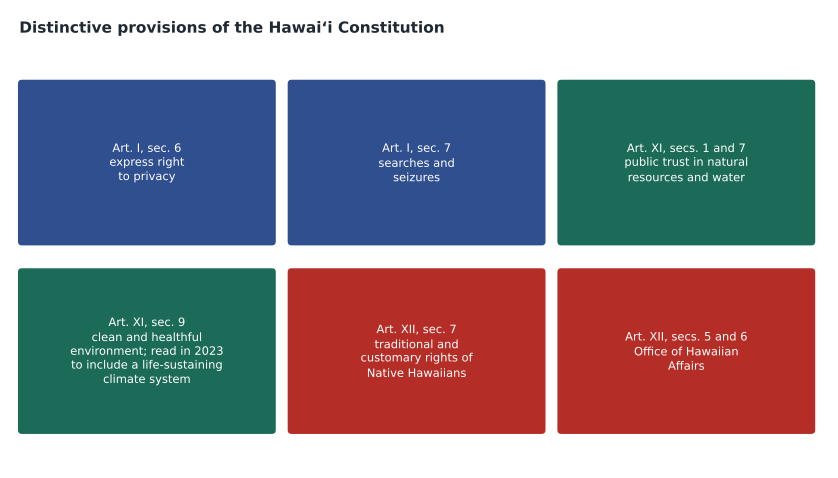
The Hawaiʻi Constitution protects some rights more broadly than the United States Constitution, and Hawaiʻi courts interpret it independently. Article I, section 6 expressly protects the right to privacy and directs the Legislature to implement it, and article I, section 7 protects against unreasonable invasions of privacy in the search and seizure context. Hawaiʻi courts have relied on these provisions to give greater protection than the federal Constitution in some criminal procedure cases. Hawaiʻi's constitution also played a central role in the national history of marriage equality. In Baehr v. Lewin in 1993, the Hawaiʻi Supreme Court held that denying marriage licenses to same-sex couples was sex discrimination subject to strict scrutiny under the state constitution; voters responded in 1998 with an amendment giving the Legislature the power to reserve marriage to opposite-sex couples, and the Legislature extended marriage to same-sex couples by statute in 2013.
Two recent lines of cases show how the state constitution continues to matter. In 2023, in a case about a utility's application before the Public Utilities Commission, the Hawaiʻi Supreme Court recognized that the right to a clean and healthful environment in article XI, section 9 includes a right to a life-sustaining climate system. In 2024, young plaintiffs who had sued the state Department of Transportation over climate impacts settled their case, Navahine F. v. Hawaiʻi Department of Transportation, in an agreement that committed the department to decarbonization planning. And in 2024, in State v. Wilson, the Hawaiʻi Supreme Court held that the state constitution's right to bear arms protects a right connected to service in a militia rather than an individual right, while acknowledging that the federal Second Amendment, as interpreted by the United States Supreme Court, still applies in Hawaiʻi. In June 2026, in Wolford v. Lopez, the United States Supreme Court held invalid a Hawaiʻi rule that barred carrying firearms onto private property open to the public unless the owner had given express permission.
Hawaiʻi's courts also handled one of the largest civil disputes in the state's history after the August 2023 wildfires on Maui. When defendants in the fire litigation agreed to a settlement of about four billion dollars, insurers that had paid claims sought to bring their own suits for reimbursement. In February 2025, answering questions certified by a state trial court, the Hawaiʻi Supreme Court held that the insurers' recovery was limited to the statutory lien process under HRS § 663-10 and § 431:13-103, clearing the way for the settlement. The decision is a reminder that Hawaiʻi statutes on liens and subrogation can decide the shape of large cases.
Worked problem
Where does the case go?
Kainoa's firm represents a homeowner on Maui who wants to challenge a county agency's decision under a state environmental statute, and a tenant on Oʻahu whose landlord kept a 1,500-dollar security deposit. Where should each matter be filed, and where would an appeal go?
Show solution
- The Maui matter arises under a state environmental law, so it belongs in the environmental court in the Second Circuit, within the circuit court.
- An appeal from the circuit court goes to the Intermediate Court of Appeals, and then by certiorari to the supreme court if the court grants review.
- The tenant's claim is a residential security deposit dispute of under 5,000 dollars.
- Under HRS § 633-27 the small claims division of the First Circuit district court has exclusive jurisdiction over most such disputes.
- Under HRS § 521-44, neither side may be represented by an attorney in a small claims security deposit dispute, so the firm can advise the tenant but the tenant must present the claim.
Answer: The Maui case goes to the Second Circuit's environmental court; the deposit dispute goes to small claims in the First Circuit district court, where the tenant appears without a lawyer.
Common mistakes
MistakeHawaiʻi has five numbered judicial circuits.
InsteadThere are four circuits, numbered First, Second, Third and Fifth; the Fourth was merged into the Third.
MistakeHawaiʻi judges are elected.
InsteadJudges are appointed from Judicial Selection Commission lists and confirmed by the Senate.
MistakeThe Hawaiʻi Rules of Civil Procedure are identical to the federal rules.
InsteadThey are modeled on the federal rules but differ in details and local practice.
MistakeThe Hawaiʻi Constitution's privacy protection is the same as the federal Constitution's.
InsteadArticle I, section 6 expressly protects privacy, and Hawaiʻi courts interpret their constitution independently.
Reading a Hawaiʻi opinion
A new lawyer spends much of the first year reading Hawaiʻi appellate opinions. They follow a familiar pattern, but a few features are worth knowing. Published opinions of the Hawaiʻi Supreme Court and the Intermediate Court of Appeals appear in the official reporters and in regional reporters, and both courts now post opinions on the Judiciary's website. The Intermediate Court of Appeals also decides many appeals by memorandum opinion or summary disposition order, which are not published in the same way. The Hawaiʻi Rules of Appellate Procedure govern when such unpublished dispositions may be cited and for what purpose, so a lawyer who wants to rely on one should check the current rule first.
When reading an opinion, Marchetti suggests a simple routine. First, identify the court and the date, because a later supreme court decision can overrule or limit an earlier one, and an Intermediate Court of Appeals decision can be reviewed on certiorari. Second, find the standard of review, which shapes everything that follows. Third, identify the holding and separate it from comments the court did not need to make. Fourth, check whether the Legislature has since changed the statute the court interpreted, a common event in areas such as torts and land use.
| Step | Question to ask |
|---|---|
| Court and date | Is this the highest court to decide the point, and is it still good law? |
| Standard of review | Did the court decide the question fresh or defer to the trial court or agency? |
| Holding | What did the court have to decide to resolve the case? |
| Later changes | Has a statute, rule or later case changed the result? |
Agency appeals
Much of Hawaiʻi's law on land and water is made in agency proceedings, before bodies such as the Land Use Commission, county planning commissions and the Commission on Water Resource Management. Appeals from those agencies follow the Hawaiʻi Administrative Procedure Act, chapter 91 of the HRS, and the specific statutes governing each agency, which can send an appeal directly to a particular court. Deadlines are short and strictly applied. A new lawyer handling an agency matter should identify, on the first day, which court hears the appeal, what record will be before it and when the appeal must be filed.
Worked problem
The land use hearing Kainoa watched
In the hearing Kainoa observed, a community group was challenging a county planning commission's approval of a permit. The group's lawyer argued that the commission had not made findings on cultural practices; the developer's lawyer argued that the group had not raised the issue before the commission. What procedural point was the developer's lawyer making?
Show solution
- Appeals from agency decisions are usually decided on the record made before the agency.
- Courts are often reluctant to consider arguments that a party did not raise before the agency.
- The developer's lawyer was arguing that the issue had been waived, an argument the group would answer by pointing to where in the record the issue was raised or by arguing the agency had an independent duty to address it.
Answer: He was arguing waiver; the lesson for new lawyers is to raise every issue before the agency, on the record.
The point applies far beyond land use. Whatever the forum, the record made at the first level often decides the appeal. Kainoa writes in his notes: 'If it is not in the record, it did not happen.'
Summary and key terms
- Hawaiʻi's courts are the supreme court, the Intermediate Court of Appeals and four circuits, each with circuit, district and family courts, plus specialized courts.
- Judges are appointed through a Judicial Selection Commission and confirmed by the Senate for ten-year terms on the appellate and circuit benches.
- The Hawaiʻi Rules of Civil Procedure and Rules of Evidence follow the federal model with Hawaiʻi variations.
- Small claims hears money claims up to 5,000 dollars and most residential security deposit disputes.
- The Hawaiʻi Constitution protects privacy, the environment and Native Hawaiian rights expressly and is interpreted independently.
- Intermediate Court of Appeals
- Hawaiʻi's intermediate appellate court, created in 1980.
- Writ of certiorari
- The discretionary order by which the Hawaiʻi Supreme Court agrees to review a decision of the Intermediate Court of Appeals.
- Judicial Selection Commission
- The constitutional body that screens candidates and nominates judges in Hawaiʻi.
- Environmental court
- A designated court within the circuit and district courts that hears cases under Hawaiʻi's environmental laws.
Lesson quiz · 5 questions
Score 60% or more to complete this lesson.
Create a free account to save your progress, take quizzes and earn a certificate.