
BAR-201 · Lesson 9 of 12 · 16 min
Alabama property and family law
▶ Video coming soon A video version of this lesson is on the way.
Avery's firm closes residential real estate transactions most weeks and handles a steady stream of divorces. Both practices depend on Alabama statutes that differ from the general rules taught in law school and tested on the bar exam. This lesson covers the Alabama rules a new lawyer is most likely to meet: the recording act, statutory adverse possession, foreclosure and the right of redemption, the grounds for divorce, the division of property, and the 2017 alimony statute. It closes with a note on mediation, which the online course covers in its alternative dispute resolution module.
The recording act
Alabama's recording statute is Code of Alabama section 35-4-90. It provides that conveyances of real property, deeds, mortgages, deeds of trust and instruments in the nature of mortgages to secure debts are inoperative and void as to purchasers for a valuable consideration, mortgagees and judgment creditors without notice, unless the instrument has been recorded before the accrual of the right of the purchaser, mortgagee or judgment creditor. Instruments are recorded in the office of the judge of probate of the county where the land is located.
Read the statute closely. It protects three groups: purchasers for value, mortgagees and judgment creditors. It protects them only if they are without notice of the earlier unrecorded instrument. And it asks whether the earlier instrument was recorded before the later party's right accrued. A later purchaser who pays value without notice of an earlier unrecorded deed takes free of it. A later purchaser who knew of the earlier deed, or who had constructive or inquiry notice, does not. In Alabama, as elsewhere, notice includes actual knowledge, the constructive notice given by recorded instruments in the chain of title, and inquiry notice arising from facts such as someone else's open possession of the land.
Bar candidates learn to classify recording acts as race, notice or race-notice statutes, and to apply each type mechanically. For Alabama, do not rely on a label. Apply the words of section 35-4-90 and Alabama cases interpreting it. On the MBE, by contrast, a question will usually quote the relevant statute, and you apply the language given. The same habit works for both: read the statute's words, then apply them.
Statutory adverse possession
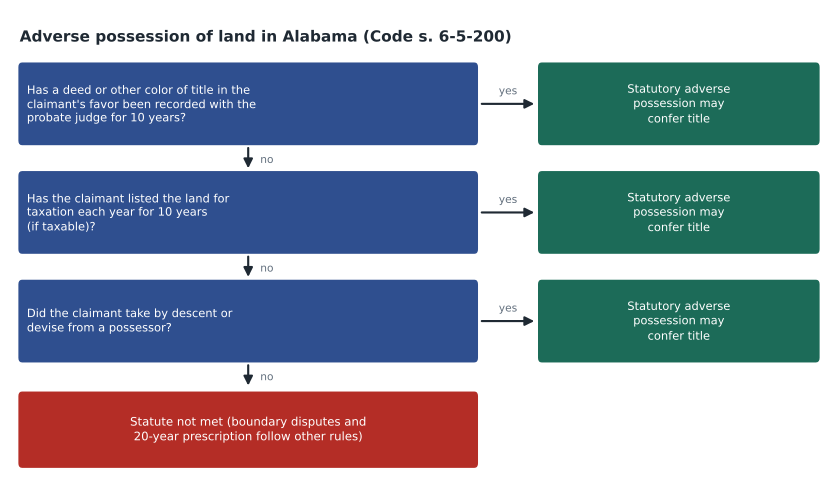
Alabama recognizes two kinds of adverse possession: statutory adverse possession under Code of Alabama section 6-5-200, and adverse possession by prescription, which requires twenty years of possession and comes from case law. Section 6-5-200 is the distinctive Alabama rule. It provides that adverse possession cannot confer or defeat title to land unless one of three conditions is met.
The first is recorded color of title: a deed or other color of title in the claimant's favor has been recorded in the office of the probate judge of the county where the land lies for ten years before the action begins. The second is tax listing: the claimant, and those through whom the claimant claims, have listed the land for taxation for ten years before the action, if the land is subject to taxation. The third is descent or devise: the claimant derived title by descent cast or devise from a predecessor in title who was in possession of the land.
Section 6-5-200 adds two important qualifications. An honest failure to list land for taxation, or an unintentional error in the assessment, does not prevent a claimant from relying on adverse possession. And the section does not apply to boundary disputes between coterminous landowners, which follow their own rules, generally requiring ten years of possession under the case law. Beyond the statute's conditions, the possession itself must still be actual, exclusive, open and notorious, hostile and continuous for the statutory period.
Foreclosure and the right of redemption
Most Alabama residential mortgages contain a power of sale, and foreclosure usually proceeds without a court action, by public sale after published notice, generally at the county courthouse. What sets Alabama apart from many states is the statutory right of redemption after foreclosure. Under Code of Alabama section 6-5-248 and related sections, the former owner and certain others may redeem the property after the foreclosure sale by paying the purchase price and other lawful charges. The general period has long been one year after the sale.
The legislature shortened the period for many homes. For a residential mortgage made on or after January 1, 2016, on property for which a homestead exemption was claimed in the year of the sale, the redemption period is 180 days after the foreclosure sale. The notice rules also matter. Under a 2018 amendment, the mortgagee must give notice of the right of redemption, and the period is tied to that notice, but in no event may redemption occur more than one year after the sale. These details matter to anyone buying at a foreclosure sale, financing a purchase of foreclosed property or advising a homeowner facing foreclosure.
| Topic | Alabama rule | Source |
|---|---|---|
| Recording | Unrecorded conveyances void against later purchasers for value, mortgagees and judgment creditors without notice | Code s. 35-4-90 |
| Where to record | Office of the judge of probate in the county where the land lies | Code ss. 35-4-90 and 6-5-200 |
| Statutory adverse possession | Ten years with recorded color of title, or tax listing, or by descent or devise | Code s. 6-5-200 |
| Prescription | Twenty years of adverse possession | Case law |
| Redemption after foreclosure | Generally one year; 180 days for homestead residential mortgages made on or after January 1, 2016 | Code s. 6-5-248 and amendments |
Grounds for divorce
Code of Alabama section 30-2-1 lists the grounds for divorce. Most divorces proceed on the two no-fault grounds: complete incompatibility of temperament, such that the parties can no longer live together, and irretrievable breakdown of the marriage, where further attempts at reconciliation are impractical or futile and not in the best interests of the parties or the family. Either spouse may apply on either ground.
The statute also keeps a long list of fault grounds, including adultery; voluntary abandonment for one year before filing; imprisonment for two years under a sentence of seven years or more; habitual drunkenness or drug addiction after marriage; confinement in a mental hospital for five successive years with incurable mental illness; and actual violence endangering life or health, or conduct creating a reasonable apprehension of it. A few grounds reflect the statute's age and apply only to one spouse, such as a husband's ground that the wife was pregnant at the time of marriage without his knowledge, and a wife's ground based on two years of separation without support while she resided in Alabama. Fault can still matter in Alabama because the alimony statute lists relative fault among the factors for whether an award is equitable.
Division of property
Alabama is not a community property state. It divides marital property on divorce by equitable division: the court divides the property the parties acquired during the marriage, and in some circumstances property used for the common benefit of the marriage, in a way that is fair under the circumstances, which is not necessarily equal. Courts consider factors such as the length of the marriage, each party's contributions, age, health, earning capacity, the parties' standard of living and, in some cases, fault. Property one spouse owned before the marriage or received by gift or inheritance is generally kept separate unless it was used regularly for the common benefit of the parties during the marriage.
The 2017 alimony statute
Alabama rewrote its alimony law in 2017. The governing statute, Code of Alabama section 30-2-57, sets out a structured approach. Before awarding rehabilitative or periodic alimony, the court must expressly find that the party seeking alimony lacks a separate estate sufficient to preserve the marital standard of living, that the other party has the ability to pay without undue economic hardship, and that the circumstances make an award equitable.
Rehabilitative alimony comes first. If rehabilitation is feasible, the court must award rehabilitative alimony for a limited duration, not to exceed five years absent extraordinary circumstances. Periodic alimony is available if rehabilitation is not feasible, a good-faith attempt at rehabilitation fails, or rehabilitation would only partly close the gap. A party's eligibility for periodic alimony is generally limited to a period no longer than the length of the marriage, measured to the filing of the complaint, unless the court expressly finds a deviation is equitably required; if the parties were married twenty years or more, there is no time limit. The statute lists detailed factors for the separate estate, ability to pay and equitableness, including the length of the marriage, the marital standard of living, relative fault, age and health, and contributions to the other spouse's education or earning ability.
If neither party has the means at the time of divorce, the court may reserve jurisdiction to award alimony later. If it neither awards alimony nor reserves jurisdiction, it loses jurisdiction to award alimony permanently. That rule makes the divorce judgment a critical document for a client who may need alimony in the future.
Worked problem
Can Sam receive periodic alimony, and for how long?
Sam and Jo were married for twelve years when Jo filed for divorce. Sam left a career to raise their children and has been out of the workforce for nine years. Jo earns a high salary. Sam could return to work after retraining, but it would take about three years. What does section 30-2-57 suggest?
Show solution
- The court must first find that Sam lacks a sufficient separate estate, that Jo can pay without undue hardship, and that an award is equitable. On these facts, those findings appear likely.
- Rehabilitation appears feasible, so the court must consider rehabilitative alimony first, for a limited duration not exceeding five years absent extraordinary circumstances. Three years of retraining fits within that limit.
- If retraining would only partly close the gap with the marital standard of living, periodic alimony may also be available.
- Because the marriage lasted twelve years, Sam's eligibility for periodic alimony is generally capped at twelve years unless the court finds a deviation equitably required; the twenty-year exception does not apply.
Answer: Expect rehabilitative alimony for about three years, with periodic alimony possible if a gap remains, generally limited to the twelve-year length of the marriage.
Mediation and ADR
Mediation is common in Alabama civil and domestic relations cases, and many circuit courts order parties to mediate before trial. The Alabama Supreme Court has rules governing mediation and maintains a roster of registered mediators through the Alabama Center for Dispute Resolution. A new lawyer should expect to prepare clients for mediation early in a case and to treat it as a likely point of resolution. The online course's alternative dispute resolution module covers the details.
Common mistakes
MistakeAlabama is a race-notice state, so I can apply the standard race-notice rule.
InsteadApply the words of Code section 35-4-90, which protects purchasers for value, mortgagees and judgment creditors without notice unless the earlier instrument was recorded first.
MistakeAdverse possession in Alabama always takes ten years of open, hostile possession.
InsteadStatutory adverse possession also requires recorded color of title, tax listing, or descent or devise; otherwise prescription takes twenty years.
MistakeAlabama divides marital property equally.
InsteadAlabama uses equitable, not necessarily equal, division.
MistakePeriodic alimony in Alabama can last for life after any marriage.
InsteadEligibility is generally capped at the length of the marriage unless the marriage lasted twenty years or more.
Closings and title in Alabama practice
A residential closing in Alabama brings these rules together. The buyer's lawyer or title agent searches the records in the probate office of the county where the land lies, examines the chain of title and the recorded mortgages, judgments and liens, and issues a title commitment and then a title insurance policy. Because section 35-4-90 protects purchasers and mortgagees without notice only if they record, the deed and the new mortgage are recorded promptly after closing. Possession by someone other than the seller is a red flag that may give inquiry notice of an unrecorded interest, so the buyer's lawyer asks who is living on the property.
Foreclosure work also brings in the redemption rules. A buyer at a foreclosure sale, or a lender financing the purchase of foreclosed property, must account for the former owner's right to redeem within the statutory period, which can affect the buyer's possession and title insurance. A homeowner facing foreclosure should be told about the right of redemption and the notice rules that affect its timing.
Child custody and support
Custody and support are also part of most Alabama divorces involving children. Alabama courts decide custody based on the best interests of the child, and they may award joint custody. Child support is calculated under the guidelines in Rule 32 of the Alabama Rules of Judicial Administration, which use the parents' combined income and the number of children to set a presumptive amount that the court may deviate from with findings. Domestic relations appeals go to the Court of Civil Appeals, which has developed a substantial body of Alabama family law.
Summary and key terms
- Code section 35-4-90 voids unrecorded conveyances against later purchasers for value, mortgagees and judgment creditors without notice; records are kept by the probate judge.
- Statutory adverse possession under section 6-5-200 requires ten years plus recorded color of title, tax listing, or descent or devise; prescription takes twenty years; boundary disputes follow other rules.
- Alabama allows statutory redemption after foreclosure: generally one year, 180 days for homestead residential mortgages made on or after January 1, 2016.
- Divorce grounds in section 30-2-1 include incompatibility and irretrievable breakdown; property is divided equitably.
- Under section 30-2-57, rehabilitative alimony comes first (up to five years), and periodic alimony is generally limited to the length of a marriage under twenty years.
- Recording act
- A statute deciding priority between competing interests in land; Alabama's is Code section 35-4-90.
- Color of title
- A document that appears to convey title but may be defective.
- Right of redemption
- The right to buy back property after a foreclosure sale within a statutory period.
- Equitable division
- Dividing marital property fairly in light of statutory and case-law factors, not necessarily equally.
- Rehabilitative alimony
- Support for a limited period, generally up to five years, to help a spouse become self-supporting.
Lesson quiz · 5 questions
Score 60% or more to complete this lesson.
Create a free account to save your progress, take quizzes and earn a certificate.