
BAR-201 · Lesson 4 of 12 · 15 min
The Alabama bar exam: format, scoring and passing score
▶ Video coming soon A video version of this lesson is on the way.
Three months before the exam, Avery asks Marchetti for the thing most candidates want and few get: a precise picture of the two days. 'I know it is the UBE,' she says. 'But what actually happens, and how do they turn my answers into a number?' This lesson answers both questions for the legacy UBE that Alabama gives through February 2028. Lesson 5 covers the NextGen exam that replaces it in July 2028.
Two days, three tests
The Alabama bar exam is the Uniform Bar Examination, prepared by NCBE and given by Alabama's Board of Bar Examiners. It has three parts. The Multistate Essay Examination (MEE) is six 30-minute essay questions, three hours in all. The Multistate Performance Test (MPT) is two 90-minute tasks in which the examinee works from a file of facts and a library of law to produce a lawyer's document, such as a memo, brief or letter. The Multistate Bar Examination (MBE) is 200 multiple-choice questions over six hours, in two three-hour sessions of 100 questions each. Of the 200 MBE questions, 175 are scored and 25 are unscored pretest items that are not labeled.
Alabama gives the written tests, the MEE and MPT, on Tuesday and the MBE on Wednesday. The Alabama State Bar says the MBE is given on the last Wednesday of February and July, with the essay portion on the Tuesday before. Examinees may write the essay portion on a laptop using approved software; the Admissions Office posts laptop instructions and deadlines before each exam.
The MEE's subject list changed in July 2026. NCBE removed conflict of laws, family law, trusts and estates, and secured transactions from the MEE, leaving business associations and the seven MBE subjects: civil procedure, constitutional law, contracts, criminal law and procedure, evidence, real property and torts. Family law and trusts and estates may still appear on the MPT through February 2028, with the law supplied in the library. This program's BAR-120 course covers the change.
How the score is built
A UBE score is built in three stages. First, NCBE scores the MBE and converts the raw number of correct answers into a scaled score through equating, a statistical process that adjusts for differences in difficulty from one exam to the next. The MBE scaled score runs on a scale of roughly 0 to 200. Second, Alabama's graders score the MEE and MPT answers using NCBE's grading materials. Graders rank answers against each other, so written scores are relative within the group taking the exam. Third, the raw written scores are scaled to the MBE: they are placed on the same scale as the MBE using the mean and spread of the group's MBE scores. That step makes written scores comparable across administrations, even though graders and questions change.
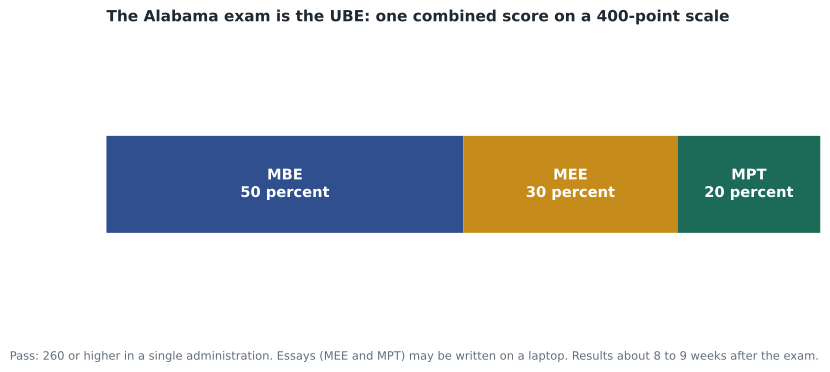
The scaled MBE score is then weighted at 50 percent, and the scaled written score at 50 percent, of which the MEE contributes 30 points and the MPT 20 points out of 100. The total UBE score is reported on a 400-point scale. Alabama's passing score is 260.
Because written scores are scaled to the MBE, the two halves of the exam support each other. A strong MBE raises the group's statistics and helps everyone's scaled written score a little, but more importantly, an individual examinee can pass with uneven performance, such as a modest MBE and strong essays, as long as the total reaches 260. There is no separate minimum for any one part.
| Component | Questions | Time | Weight | Who grades |
|---|---|---|---|---|
| MEE | 6 essays | 3 hours (30 minutes each) | 30 percent | Alabama graders using NCBE materials |
| MPT | 2 tasks | 3 hours (90 minutes each) | 20 percent | Alabama graders using NCBE materials |
| MBE | 200 (175 scored) | 6 hours in two sessions | 50 percent | NCBE (machine scored and equated) |
A single administration
Alabama's passing rule requires a total UBE score of 260 or higher from a single administration. An examinee cannot combine a strong MBE from February with strong essays from July to reach 260. Carried-forward or transferred component scores also cannot be used to earn a transferable UBE score in Alabama. Each attempt stands on its own, and since July 2026 each counts toward the five-attempt limit described in Lesson 2.
What 260 means in practice: on the 400-point scale, 260 corresponds to an average of 130 on the 200-point scale for each half. Many examinees think of it as needing roughly a 130 scaled MBE and a roughly equivalent written performance, though because scores combine, a stronger half can offset a weaker one. Other UBE jurisdictions set their passing scores between 260 and 270; Alabama's 260 is at the low end of that range. A score that passes in Alabama may not be high enough to transfer to a jurisdiction that requires 266 or 270.
Results and score reports
The Alabama State Bar releases results about eight to nine weeks after the exam. Examinees receive their scaled MBE score, their total scaled written score for the MEE and MPT combined, their total UBE score, and their raw scores for each MEE and MPT question. That breakdown is valuable. A candidate who fails can see which questions dragged the written score down and whether the MBE or the written half was the bigger problem.
Failing examinees may review their own essay answers along with the top three answers for each question. Alabama does not regrade answers. The review is for learning, not appeal. Marchetti recommends that anyone who fails use it: 'Put your answer next to the three best answers for that question. You will see in five minutes what you missed: issues, structure, facts, or time.'
Failing examinees who want to sit the next exam have 10 days from the release of results to apply. That window is short, and it falls before many candidates have finished processing a disappointment. Decide in advance what you will do if you need to retake, so you can file quickly.
Worked problem
Reading Avery's practice score
In a full simulated exam in December, Avery scores 128 scaled on the MBE portion, and her coach estimates her written work at about 134 on the same scale. Would that total pass in Alabama?
Show solution
- Each half is worth half of a 400-point total, so the UBE total is approximately the scaled MBE score plus the scaled written score, each on its 200-point scale.
- 128 plus 134 gives a combined score of about 262.
- Alabama requires 260 or more in a single administration.
- A simulated estimate is only an estimate; written scores on the real exam are scaled to the group's MBE performance.
Answer: At about 262, Avery is just over the line, which Marchetti calls the most dangerous place to be. She sets a goal of a 135 MBE by February, adding margin on the half that is most within Avery's control through practice questions.
How the exam days run
Exam days are long and tightly controlled. Examinees receive admission instructions from the Admissions Office before the exam with the location, arrival time, identification rules and the list of permitted and prohibited items. Expect security screening, assigned seating and strict rules on watches, phones and food. Laptop users must install and test the exam software before a deadline and bring a charged laptop on exam day.
On Tuesday, the MPT and MEE fill the day: typically the two MPT tasks in one session and the six MEE questions in the other. On Wednesday, the MBE fills two three-hour sessions. Time management matters on both days. On the MBE, the pace is 1.8 minutes per question. On the MEE, it is 30 minutes per question, and on the MPT 90 minutes per task, with roughly half of each MPT spent reading.
Studying for the Alabama UBE
Because the Alabama exam is the UBE, national bar review courses and NCBE's own study aids apply directly. There is nothing Alabama-specific to learn for the exam itself under the legacy format. The Alabama-specific learning comes after the exam, in the required online course on Alabama law, and in the substantive differences covered later in this course, which matter for practice and, from July 2028, for the state law component.
That creates a trap. Candidates who study Alabama law before the exam can confuse themselves. On the MBE and MEE, answer under the general rules that NCBE tests. In torts, for example, the MBE uses pure comparative negligence unless a question says otherwise, while Alabama applies contributory negligence. An answer built on Alabama law can be wrong on the UBE. Lesson 8 returns to this point.
Marchetti's study plan for Avery follows the pattern this program uses for all UBE candidates: about ten weeks of full-time study, daily MBE practice building to more than 1,500 questions, at least two timed MEE essays and one MPT a week in the second half, and two full simulated exams. The BAR-110, BAR-111, BAR-120 and BAR-121 courses in this program cover the content and methods in detail.
Common mistakes
MistakeAlabama adds its own state law questions to the UBE.
InsteadThrough February 2028 the Alabama exam is the UBE alone; Alabama law comes in the online course after the exam.
MistakeI can combine my best MBE and best essays from two exams.
InsteadAlabama requires 260 from a single administration.
MistakeIf I fail by a few points, I can ask for a regrade.
InsteadAlabama does not regrade; failing examinees may review their answers and the top three answers.
MistakeAnswer UBE torts questions using Alabama contributory negligence.
InsteadThe UBE tests general rules; the MBE assumes comparative negligence unless told otherwise.
What graders look for
Alabama's graders use NCBE's grading materials, which identify the issues each question raises and the analysis a strong answer should contain. Because grading is relative, a score depends on how an answer compares with others in the same group. Answers that score well share several features: they identify the issues the question asks about and do not wander; they state rules accurately and concisely; they use the facts specifically, explaining why each fact matters; and they reach conclusions. Headings that track the call of the question help a grader find the analysis quickly.
On the MPT, graders look first at whether the examinee did the task assigned in the task memo: the right document, for the right audience, in the right format, using the law in the library rather than outside knowledge. An objective memo that reads like a brief, or a brief that ignores unfavorable authority the library contains, loses points no matter how well it is written. This program's BAR-121 course covers the MPT in depth.
Timing and pacing on each day
On the written day, the most common mistake is borrowing time. A candidate who spends 40 minutes on the first MEE question has 20 minutes for one of the others, and the scaled written score suffers more from a weak answer than it gains from a polished one. Write to the clock: when 30 minutes are up, finish the sentence, write a conclusion and move on. On the MPT, spend about 45 minutes reading and organizing and about 45 minutes writing, and adjust only slightly.
On the MBE day, pace at 1.8 minutes per question, or about 33 questions per hour. Check the clock at the end of each hour. A question that has taken two minutes without a clear answer should get a best guess and a flag, and a return visit only if time remains. There is no penalty for wrong answers, so never leave a question blank.
If the result is a fail
A failing result is common: on any administration, a substantial share of examinees, including many who later practice successfully, do not pass. Marchetti's process for a retake starts with the score report. If the MBE was well below 130 and the written score was near passing, the next study period leans toward MBE practice. If the written score was the problem, the candidate reviews each answer against the top answers and rebuilds the essay and MPT method. Either way, the candidate must decide quickly, because the window to apply for the next exam is ten days from the release of results. Since July 2026, every attempt also counts toward Alabama's five-attempt limit, which makes a careful diagnosis more important than ever.
Study materials for the Alabama UBE
Candidates can choose among commercial bar review courses, NCBE's own study aids and law school bar programs. NCBE sells MBE practice questions and full practice exams drawn from released questions, along with released MEE and MPT questions and analyses, which are the best indication of how NCBE writes and grades. Alabama law schools offer bar support to their graduates, often free. Whatever the course, Marchetti insists on three habits: answering questions under timed conditions, reviewing every missed question until the reason is clear, and writing full essays rather than outlines. 'Reading about essays is not writing essays,' she says.
Avery's own plan for the last ten weeks follows that advice. She keeps a log of every missed MBE question with the rule she missed, writes two timed MEE answers and one MPT each week from December on, and compares each answer with NCBE's released analysis for that question. By late January her log shows that most of her misses come from a few evidence and real property topics, and she spends her final review days there.
Summary and key terms
- The Alabama exam is the UBE: MEE and MPT on Tuesday, MBE on the last Wednesday of February and July.
- Weights are MBE 50 percent, MEE 30 percent and MPT 20 percent; written scores are scaled to the MBE.
- Alabama's passing score is 260 from a single administration, at the low end of UBE passing scores.
- Results arrive about eight to nine weeks after the exam, with a detailed breakdown; there are no regrades, and failing examinees have 10 days to reapply.
- Answer UBE questions under general rules, not Alabama law.
- Scaling
- Placing written scores on the MBE's scale using the group's MBE statistics.
- Equating
- NCBE's statistical adjustment of MBE scores for differences in difficulty across exams.
- Relative grading
- Grading essays by comparing answers within the group of examinees.
- Pretest questions
- Unscored, unlabeled MBE questions used to test items for future exams.
- Single administration
- One sitting of the exam; Alabama requires the passing score to come from one.
Lesson quiz · 5 questions
Score 60% or more to complete this lesson.
Create a free account to save your progress, take quizzes and earn a certificate.