
BAR-201 · Lesson 6 of 12 · 15 min
The Alabama law course and the coming state-law essay
▶ Video coming soon A video version of this lesson is on the way.
'So when do I learn Alabama law?' Avery asks. It is a fair question for someone about to be licensed in Alabama after a bar exam that tests no Alabama law. Marchetti's answer has two parts. Under the current exam, Alabama teaches its law through a required online course that opens after the bar exam. From July 2028, it will also test Alabama law on exam day, through a three-hour state law essay component added to the NextGen exam. This lesson covers both: what the course contains and how to use it well, and how to prepare for an Alabama essay component whose details are still to come.
Why Alabama requires a course
A uniform exam has a cost. When a state adopts the UBE, it gives up testing its own law on exam day, because the point of the UBE is a portable score that every UBE jurisdiction accepts. States that care about local knowledge have responded in different ways. Some add a short state law test, as Texas does with its Texas Law Component, which combines an online course with an open-book multiple-choice test. Some require a course with no test. Alabama chose a course: a set of required online modules on Alabama law that every applicant must complete before admission.
The Alabama State Bar describes the UBE in Alabama as having no additional jurisdiction-specific testing component. The course is a requirement for admission, not a test. Its purpose is to make sure a newly admitted lawyer has at least seen the main ways Alabama law differs from the general rules tested on the UBE, and knows where to find Alabama authority.
The eight modules
The course has eight online learning modules. According to the Alabama State Bar, they cover the Alabama Constitution, alternative dispute resolution, civil litigation, criminal law, family law, real property, torts, and wills and trusts and probate. An applicant must complete all of them to be admitted.
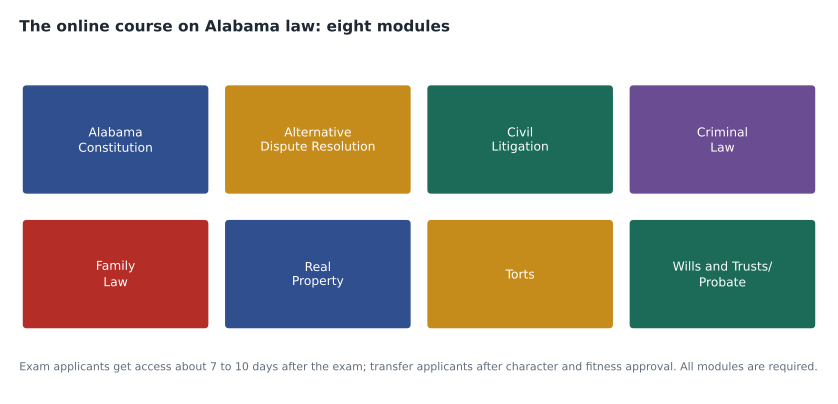
The list tells you a good deal about what the bar thinks new Alabama lawyers need. Five of the eight subjects are areas where Alabama law departs from the general rules in ways that matter in everyday practice: civil litigation, torts, real property, family law, and wills and probate. Criminal law covers Alabama's own criminal code and sentencing. The Alabama Constitution module covers a document that was recompiled in 2022 and is unusual among state constitutions. Alternative dispute resolution reflects how many civil and family cases in Alabama are resolved through mediation.
| Module | Examples of Alabama-specific content | Covered in this course |
|---|---|---|
| Alabama Constitution | The Constitution of 2022; local amendments by county; the Declaration of Rights | Lesson 7 |
| Civil litigation | Alabama Rules of Civil Procedure; court structure; limitations periods | Lesson 7 |
| Criminal law | Alabama Criminal Code (Title 13A); habitual offender sentencing; capital cases | Lesson 7 |
| Torts | Contributory negligence; wantonness; the AEMLD; wrongful death damages | Lesson 8 |
| Real property | Recording act; statutory adverse possession; foreclosure redemption | Lesson 9 |
| Family law | Divorce grounds; equitable division; the alimony statute | Lesson 9 |
| Wills, trusts and probate | Will execution; elective share; probate courts; the Alabama Uniform Trust Code | Lesson 10 |
| Alternative dispute resolution | Mediation in civil and domestic cases; arbitration | Lesson 9 and Lesson 12 |
When and how you take it
Exam applicants receive access to the course about seven to ten days after the bar exam. Applicants transferring a UBE score receive access after the Committee on Character and Fitness approves their application. That timing means most exam applicants take the course while waiting for results, which is a good use of the eight or nine weeks before results arrive.
Marchetti recommends finishing the course well before results are released. 'If you pass, you want nothing standing between you and admission,' she says. 'And if you do not pass, you want the course behind you so your next ten weeks are all exam.' Completion is tracked online; keep any confirmation you receive.
Using the course well
Because the course has no exam attached under the legacy format, it is tempting to click through it. That is a mistake for two reasons. First, the content is the starting point for practice in Alabama, and the differences it covers are exactly the ones that cause malpractice claims for lawyers trained on national rules. A lawyer who assumes comparative fault in an Alabama car-accident case, or who drafts a will with one witness, makes a serious error. Second, from July 2028 Alabama will test state law in essay form. Candidates who take the course seriously now are building the base they or their successors will need.
A practical method is to make a two-column sheet for each module: the general rule as tested on the UBE in one column, and the Alabama rule in the other, with the source. Lessons 7 through 10 of this course use that approach. Avery starts hers with torts, where the differences are most dramatic, and adds to it as she works through the modules.
The NextGen state law component
From July 2028, Alabama will add a three-hour state law essay component to the NextGen exam. As of November 2026, the Supreme Court of Alabama had not published the subjects, the number of essays, how the component will be scored or how it will combine with the NextGen score. The court has said it will set the NextGen passing score before July 2028, and further rules should follow.
Several features are likely in any state law essay component, based on how other jurisdictions have done it, but candidates should treat them as general expectations rather than Alabama rules. Essays will call for Alabama rules where they differ from the general rules, so a candidate who writes a fine answer under national law may miss the point. Questions will probably mix subjects, as bar essays usually do. And graders will reward clear structure: issue, rule, application and conclusion, with the Alabama rule stated precisely.
States that test local law usually draw on subjects where local law is distinctive and where new lawyers practice often. For Alabama, the online course's eight subjects are the most natural guide. Contributory negligence, wantonness, the AEMLD, the elective share and will formalities, adverse possession under the statute, foreclosure redemption, divorce grounds and alimony are all strong candidates for study. Lessons 7 through 10 cover them, and Lesson 12 includes an original practice essay.
Worked problem
Turning a UBE answer into an Alabama answer
A practice essay asks whether Pat, injured when his car was struck by Dana's truck, can recover from Dana. Pat was driving 10 miles per hour over the speed limit; Dana ran a red light while reading a text. A UBE answer would apply comparative negligence and reduce Pat's recovery. How does an Alabama answer differ?
Show solution
- Identify the claims: negligence and, because Dana was texting through a red light, wantonness.
- Negligence: Alabama applies contributory negligence. If Pat's speeding was negligence that proximately contributed to the collision, his negligence claim is barred, unless last clear chance applies.
- Wantonness: Alabama treats wantonness, meaning conduct with reckless or conscious disregard of the rights or safety of others, as a separate claim. Contributory negligence is not a defense to wantonness.
- Damages: punitive damages require clear and convincing evidence of wantonness or other qualifying conduct under Code section 6-11-20.
Answer: The Alabama answer reaches a different structure: the negligence claim may fail entirely, while a wantonness claim may succeed and support punitive damages. Lesson 8 covers each rule.
Preparing now for 2028
Candidates graduating in 2028 or later should plan for both the NextGen exam and the Alabama component. That means learning the NextGen formats, covered in BAR-130, and building Alabama rule sheets in the subjects above. Law school courses that cover Alabama practice, such as Alabama civil procedure or Alabama family law electives, will be worth more than before. Watch the Admissions Office's site for the component's rules and any sample questions the bar publishes.
For Avery, sitting in 2027, the component does not apply. She will take the course after the February exam. But she keeps her rule sheets anyway. 'If I am going to practice here,' she says, 'I would rather learn this now than from a client.'
Common mistakes
MistakeThe online Alabama law course has a test at the end.
InsteadUnder the legacy UBE it is a required course with no test; all eight modules must be completed.
MistakeI can take the course before the bar exam.
InsteadExam applicants get access about seven to ten days after the exam.
MistakeThe NextGen state law component will be multiple choice.
InsteadIt is described as a three-hour essay component; details were not published as of November 2026.
MistakeAlabama law on the UBE gets partial credit.
InsteadOn the UBE, answer under general rules; save Alabama rules for practice and the future state component.
A sample rule sheet
Avery's first rule sheet compares general rules with Alabama rules in torts. Its rows are short. Plaintiff's negligence: comparative fault reduces recovery on the UBE; contributory negligence generally bars a negligence claim in Alabama, softened by last clear chance. Reckless conduct: a factor in punitive damages on the UBE; a separate claim called wantonness in Alabama, to which contributory negligence is no defense. Products: strict products liability on the UBE; the AEMLD in Alabama. Wrongful death: compensatory damages for survivors under most states' statutes; punitive-in-nature damages under Code section 6-5-410 in Alabama, with a two-year limitations period. Punitive damages: clear and convincing evidence of oppression, fraud, wantonness or malice under section 6-11-20, with statutory caps.
Her real property sheet has rows for recording (section 35-4-90 protects later purchasers for value, mortgagees and judgment creditors without notice), adverse possession (section 6-5-200's three routes, with twenty-year prescription otherwise) and redemption (generally one year, 180 days for homestead residential mortgages made on or after January 1, 2016). Her family law sheet covers divorce grounds, equitable division and the alimony statute. Her wills sheet covers two witnesses, the choice-of-law rule in section 43-8-135, and the elective share formula. Each row cites its source so she can check it again later.
Where Alabama authority lives
Part of what the course teaches is where to look. The Code of Alabama is published by the Alabama Legislature, with free online access through the Legislature's website and through commercial services. Supreme Court of Alabama and Court of Civil Appeals and Court of Criminal Appeals opinions are available from the Alabama Judicial System's website and from commercial databases. The Alabama Rules of Civil Procedure, Appellate Procedure, Criminal Procedure and Evidence, along with the Rules Governing Admission and the Rules of Professional Conduct, are published by the Supreme Court of Alabama and the Alabama State Bar. The Alabama State Bar's Office of General Counsel issues ethics opinions. A new lawyer should know how to reach each source quickly.
Why local knowledge matters in Alabama
The stakes of Alabama's differences are high. A lawyer who misses contributory negligence may take an injury case that cannot be won in negligence and fail to plead wantonness. A lawyer who drafts a will with one witness may leave a client's estate to pass by intestacy. A lawyer who assumes a three-year limitations period may miss Alabama's two-year deadline for a personal injury claim. A lawyer who tells a foreclosed homeowner there is no right of redemption may give up a chance to keep the house. Each of these is a common source of malpractice claims, and each is covered in the online course and in this course's later lessons.
Course logistics
The course is online and self-paced. An applicant receives login information from the Admissions Office and works through the modules at home, in any order unless the course specifies one. Each module presents Alabama law in a structured way, and completion is recorded. The Admissions Office can tell an applicant whether all modules are recorded as complete. Because admission cannot happen until the course is finished, candidates should check their completion status before results are released and resolve any technical problem early.
Marchetti suggests a schedule of two modules a week, finishing in a month. She also suggests pairing each module with the related lesson in this course, so the rule sheets grow as the modules are completed: civil litigation and the constitution with Lesson 7, torts with Lesson 8, property, family law and ADR with Lesson 9, wills and probate with Lesson 10, and criminal law with the criminal procedure section of Lesson 7.
Avery's plan follows that schedule. She will start the week after the exam with the Alabama Constitution and civil litigation modules, then torts and criminal law, then real property and family law, and finish with wills and probate and alternative dispute resolution. 'If I pass,' she says, 'I want to walk into the swearing-in already knowing the things my firm will ask me on day one.'
Summary and key terms
- Alabama requires an online course on Alabama law instead of a state law test under the legacy UBE.
- The eight modules cover the Alabama Constitution, ADR, civil litigation, criminal law, family law, real property, torts, and wills, trusts and probate.
- Exam applicants get access about seven to ten days after the exam; transfer applicants after character and fitness approval.
- From July 2028, a three-hour Alabama state law essay component joins the NextGen exam; its details were still to be published.
- Build a general-rule versus Alabama-rule sheet for each subject.
- Online course on Alabama law
- Required modules on Alabama law that applicants complete before admission.
- State law component
- A jurisdiction's own test of local law alongside the national exam.
- Texas Law Component
- Texas's state law requirement, an online course plus an open-book multiple-choice test, cited here for comparison.
- Rule sheet
- A study tool comparing the general rule with the state rule and its source.
- Wantonness
- In Alabama, conduct carried on with reckless or conscious disregard of the rights or safety of others.
Lesson quiz · 5 questions
Score 60% or more to complete this lesson.
Create a free account to save your progress, take quizzes and earn a certificate.