
BAR-201 · Lesson 12 of 12 · 14 min
Capstone: Alabama practice questions and an exam-day plan
▶ Video coming soon A video version of this lesson is on the way.
Two weeks before the February 2027 exam, Marchetti gives Avery a final assignment in two parts. The first part is a set of original practice questions and an essay on Alabama law, the kind of material she will meet in the online course after the exam and that candidates from 2028 will meet in Alabama's state law component. The second part is a plan for exam week and the weeks after it. 'Part one is for the lawyer you are about to become,' Marchetti says. 'Part two is for getting through the next month.'
Everything in this lesson is original and written for the course. No question comes from a released bar exam. The facts are hypothetical. Work each question before reading the explanation.
Part A: ten questions on Alabama law
Question 1. A plaintiff tripped over a hose stretched across a store aisle. She saw the hose, understood it could trip her, and stepped over it while looking at her phone. Her claims against the store are pleaded in negligence only. What is the store's best defense? Answer: contributory negligence. Under Alabama law, a plaintiff who knew of the danger, appreciated it and failed to use reasonable care for her own safety is barred from recovering in negligence. Williams v. Delta International Machinery Corp. (Ala. 1993) declined to replace the rule with comparative fault. If the plaintiff had also pleaded wantonness, contributory negligence would not defeat that claim.
Question 2. In the same case, the plaintiff amends to allege that the store manager had been told three times that morning that the hose was a hazard and left it in place to save time. What claim does the amendment support, and what must she prove for punitive damages? Answer: wantonness, conduct carried on with a reckless or conscious disregard of the rights or safety of others. For punitive damages, Code section 6-11-20 requires clear and convincing evidence that the store consciously or deliberately engaged in wantonness, oppression, fraud or malice with regard to her.
Question 3. A forklift's brake failed because of a design flaw, injuring a warehouse worker who was using it as intended. Under what doctrine would the worker sue the manufacturer in Alabama, and is it strict liability? Answer: the Alabama Extended Manufacturer's Liability Doctrine, from Casrell v. Altec Industries (Ala. 1976). It is fault-based: a manufacturer that markets a product not reasonably safe for its intended use is treated as negligent as a matter of law. The worker must show the product was defective and unreasonably dangerous when it left the manufacturer's control, reached him without substantial change, and caused the injury.
Question 4. A driver killed a cyclist while driving drunk. The cyclist's widow asks what the jury will consider in setting damages in a wrongful death action. Answer: Alabama wrongful death damages under section 6-5-410 are punitive in nature. The jury considers the culpability of the defendant's conduct and the need to deter similar conduct, not the economic value of the cyclist's life or the family's loss. The personal representative must bring the action within two years of the death.
Question 5. A deed from Owen to Bea was signed and delivered in 2024 but never recorded. In 2026 Owen sold the same land to Cal, who paid full value, had no knowledge of the deed to Bea, saw no one in possession, and recorded promptly. Who prevails under Code section 35-4-90? Answer: Cal. The statute makes an unrecorded conveyance void as to purchasers for valuable consideration without notice unless it was recorded before their rights accrued. Bea's deed was not recorded before Cal bought, and Cal had no actual, constructive or inquiry notice.
Question 6. Dee has farmed a strip of land beyond her fence for eleven years, openly and without permission. She has no deed to the strip, has never listed it for taxes, and did not inherit it. The strip is not a boundary dispute between neighbors; it lies inside a tract owned by an absentee landowner. Can Dee claim title by statutory adverse possession? Answer: not under section 6-5-200, which requires ten years plus recorded color of title, tax listing, or descent or devise. Dee meets none of those. She would need twenty years for adverse possession by prescription.
Question 7. A homeowner's residential mortgage, made in 2019, was foreclosed in June 2026. The homeowner had claimed a homestead exemption that year. How long does the homeowner have to redeem? Answer: 180 days after the foreclosure sale, the period for homestead residential mortgages made on or after January 1, 2016, subject to the statute's notice rules and the overall one-year limit.
Question 8. After a fourteen-year marriage, a court finds that the wife cannot become self-supporting through retraining because of a disability. May it award periodic alimony, and for how long may she be eligible? Answer: yes, if the court makes the findings section 30-2-57 requires: she lacks a sufficient separate estate, her husband can pay without undue hardship, and an award is equitable. Because rehabilitation is not feasible, periodic alimony is available. Eligibility is generally capped at fourteen years, the length of the marriage, unless the court expressly finds a deviation is equitably required.
Question 9. A testator wrote and signed a will in his own handwriting at his Mobile home. His neighbor watched him sign it but did not sign it herself. Is the will valid? Answer: no. Section 43-8-131 requires at least two witnesses who sign the will. One observer who does not sign is not enough, and Alabama does not separately validate unwitnessed holographic wills made by Alabama domiciliaries in Alabama.
Question 10. A decedent's probate estate is 600,000 dollars. His will leaves nothing to his wife, whose separate estate, including life insurance on his life, is 500,000 dollars. What is her elective share? Answer: 100,000 dollars. Under section 43-8-70, it is the lesser of the estate minus her separate estate (600,000 minus 500,000 equals 100,000) or one-third of the estate (200,000).
| Question | Topic | Lesson |
|---|---|---|
| 1 to 2 | Contributory negligence; wantonness; punitive damages | Lesson 8 |
| 3 | AEMLD | Lesson 8 |
| 4 | Wrongful death damages and limitations | Lessons 7 and 8 |
| 5 to 7 | Recording act; adverse possession; redemption | Lesson 9 |
| 8 | Alimony | Lesson 9 |
| 9 to 10 | Will execution; elective share | Lesson 10 |
Part B: an Alabama essay
Facts. Rhonda Givens, an Alabama resident, was injured in a collision at an intersection in Tuscaloosa County on March 2, 2026. She was driving through a green light while eating a sandwich and admits she was not looking at the road for about two seconds. The other driver, Wade Pruett, was driving a delivery van for Pruett Produce LLC. Pruett had been told by his employer twice that week that the van's brakes were failing and needed repair; he kept driving it to finish his routes. The brakes failed, and the van ran the red light. A mechanic later found that a brake hose had been installed with a defective fitting by the van's manufacturer, Ardent Motors. Rhonda suffered a broken pelvis. Her passenger, her father, died at the scene. Rhonda asks what claims she and her father's estate have, against whom, and what defenses they should expect.
Write an answer in no more than 30 minutes, then compare it with the model answer below.
Model answer. Issue one: Rhonda's claims against Pruett and Pruett Produce. Rhonda may sue Pruett in negligence and wantonness, and Pruett Produce in negligence, wantonness and on agency principles for Pruett's conduct in the course of his employment. Negligence: Pruett breached the duty of care by running a red light in a van he knew had failing brakes. But Alabama applies contributory negligence. Pruett will argue that Rhonda's two seconds of inattention contributed to the collision. If the jury finds she knew of the danger, appreciated it and failed to use reasonable care, and that her inattention proximately contributed, her negligence claims are barred. She may respond that her inattention was not a proximate cause, because a van running a red light at speed could not have been avoided in two seconds, and in the alternative that last clear chance does not fit these facts because Pruett could not stop. Contributory negligence is a jury question unless the evidence allows only one conclusion.
Wantonness: Pruett was told twice that week that the brakes were failing and kept driving. That evidence supports a finding of conduct carried on with reckless or conscious disregard of the safety of others. Contributory negligence is not a defense to wantonness, so Rhonda's inattention does not bar this claim. Pruett Produce knew the brakes were failing and let Pruett keep driving; that supports a wantonness claim against the company directly. Punitive damages are available if Rhonda proves wantonness by clear and convincing evidence under section 6-11-20. Section 6-11-27 limits a principal's liability for punitive damages based on an agent's conduct, so Rhonda should prove the company's own knowledge and conduct, which the facts support. Punitive damages are generally capped under section 6-11-21; check the current limits.
Issue two: claims against Ardent Motors. Rhonda may sue Ardent under the AEMLD, created in Casrell v. Altec Industries (Ala. 1976). She must show Ardent manufactured the van, the brake hose fitting made it unreasonably dangerous when it left Ardent's control, the van reached the user without substantial change, and the defect caused her injuries. Ardent will argue lack of causal relation: that the company's decision to keep driving a van with known brake problems, not the original defect, caused the crash, or that the van was substantially changed by later repairs. It may also raise contributory negligence and assumption of the risk, but those defenses ordinarily concern the plaintiff's own knowing use of a defective product, and Rhonda did not use the van.
Issue three: the father's estate. A personal representative must be appointed for the father's estate by the probate court. The personal representative may bring a wrongful death action under section 6-5-410 against Pruett, Pruett Produce and Ardent, within two years of March 2, 2026, that is, by March 2, 2028. Damages are punitive in nature and turn on the defendants' culpability, so the evidence of Pruett's and the company's knowledge about the brakes is central. Rhonda's inattention is not attributable to her father as a passenger, so contributory negligence by Rhonda should not bar his estate's claims; any defense would have to show the father's own negligence. The recovery is distributed under the statute of distributions and is not subject to the father's debts.
Issue four: procedure. Rhonda's personal injury claims must be filed within two years under section 6-2-38, by March 2, 2028. The case belongs in circuit court, given the amount in controversy. Rhonda's lawyer should plead negligence and wantonness counts against each defendant, an AEMLD count against Ardent, and the wrongful death claim by the personal representative, and should preserve evidence of the brake warnings and the defective fitting.
Self-grading. Give yourself one point each for: identifying contributory negligence and its effect; explaining that contributory negligence is no defense to wantonness; applying the wantonness definition to the brake warnings; stating the clear and convincing standard for punitive damages; identifying the AEMLD and its elements; addressing causation as Ardent's defense; explaining that wrongful death damages are punitive in nature; and stating both two-year limitations periods. Six or more is a strong answer.
Part C: an exam-week plan
Marchetti's plan for Avery covers the week before the exam, the two exam days and the weeks after. In the week before, the work is light and timed: one MBE set a day, one MEE essay and one MPT, with the rest of the time for review sheets, sleep and logistics. Avery confirms her laptop software is installed and tested before the bar's deadline, reads the admission instructions from the Admissions Office, and checks the identification and permitted-items rules.
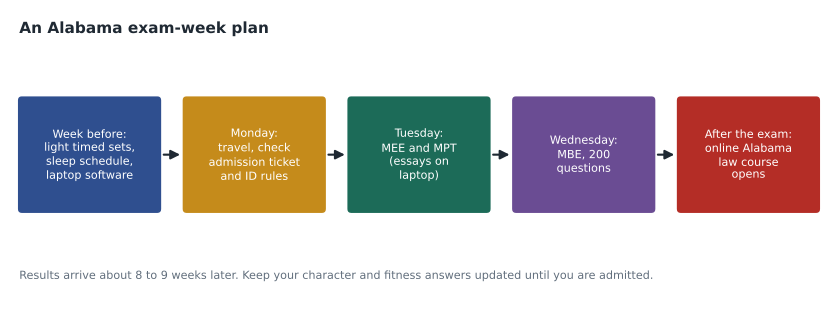
On Monday she travels to the exam city, finds the building and the nearest food, packs her bag with only permitted items and goes to bed early. On Tuesday she writes the MPT and MEE, managing time by the clock: 90 minutes for each MPT task, with about half spent reading, and 30 minutes for each essay, never borrowing time from the next question. On Wednesday she takes the MBE: 1.8 minutes per question, flagging and moving on rather than stalling.
After the exam, she rests for two days and then starts the online course on Alabama law as soon as access arrives, about seven to ten days later. She aims to finish all eight modules within three weeks. She takes the MPRE in March. She keeps her bar application current, reporting any change. If she passes when results arrive about eight to nine weeks after the exam, she will have nothing left but character and fitness certification and admission. If she does not, she has ten days to reapply, and a plan ready.
Common mistakes
MistakePractice Alabama law questions under UBE rules.
InsteadAlabama questions call for Alabama rules: contributory negligence, wantonness, the AEMLD and Alabama statutes.
MistakeLeave the online Alabama law course until after results.
InsteadStart it as soon as access arrives so nothing delays admission.
MistakeSpend the last week before the exam learning new material.
InsteadUse it for light timed practice, review sheets, sleep and logistics.
Using the results
After working Part A and Part B, Avery scores herself: nine of ten on the questions, missing only the redemption question, where she forgot the 180-day period for homestead residential mortgages, and seven of eight on the essay rubric, missing the point that contributory negligence by the driver does not bar the passenger's estate. She adds both points to her rule sheets. Marchetti suggests one more step: rewrite the essay's negligence section in ten minutes, focusing on how the facts about the two seconds of inattention bear on each element of contributory negligence. 'Rules get you started,' she says. 'Facts get you the points.'
Summary and key terms
- Alabama questions turn on Alabama rules: contributory negligence, wantonness, the AEMLD, punitive and wrongful death damages, the recording act, adverse possession, redemption, alimony, will execution and the elective share.
- In an Alabama essay, plead wantonness alongside negligence and analyze contributory negligence carefully.
- Exam week: light timed practice, tested laptop software, admission instructions and strict time management on both days.
- After the exam: start the online Alabama law course promptly, take the MPRE if needed, and keep the application current.
- Results arrive about eight to nine weeks later; a failing examinee has ten days to reapply.
- Model answer
- An example of a strong answer used for self-grading.
- Issue spotting
- Identifying every legal question raised by a set of facts.
- IRAC
- Issue, rule, application, conclusion: a common structure for legal analysis.
- Time management
- Allocating fixed time to each question and keeping to it.
- Admission instructions
- The Admissions Office's directions on location, arrival, identification and permitted items.
Lesson quiz · 5 questions
Score 60% or more to complete this lesson.
Create a free account to save your progress, take quizzes and earn a certificate.