
BAR-201 · Lesson 1 of 12 · 16 min
Becoming a lawyer in Alabama
▶ Video coming soon A video version of this lesson is on the way.
Avery Whitlock joins Hollis Marchetti's study group late in the fall of 2026 with a single goal: to be sworn in as a member of the Alabama State Bar in 2027. She finished law school in May 2026 at an Alabama law school, grew up in Dothan, and now works as a law clerk at a small firm in Montgomery that handles personal injury, real estate closings and probate. She is registered to sit the February 2027 Alabama bar exam. Marchetti, who has coached candidates for fifteen years and spent six of them grading bar essays, offers to walk her through the Alabama process from beginning to end. This course follows those conversations.
'Every jurisdiction does three things,' Marchetti tells her at their first session. 'It decides who may apply, it tests what you know, and it checks whether you can be trusted with other people's money and secrets. Alabama does all three, plus a fourth thing most people forget until the last minute: it makes you learn some Alabama law before it lets you in.'
This first lesson maps the whole process: the authorities involved, the requirements you must meet, the order in which you usually meet them, and the places where candidates most often go wrong. Later lessons take each step in detail and then turn to the Alabama law that sets the state apart.
Who controls admission
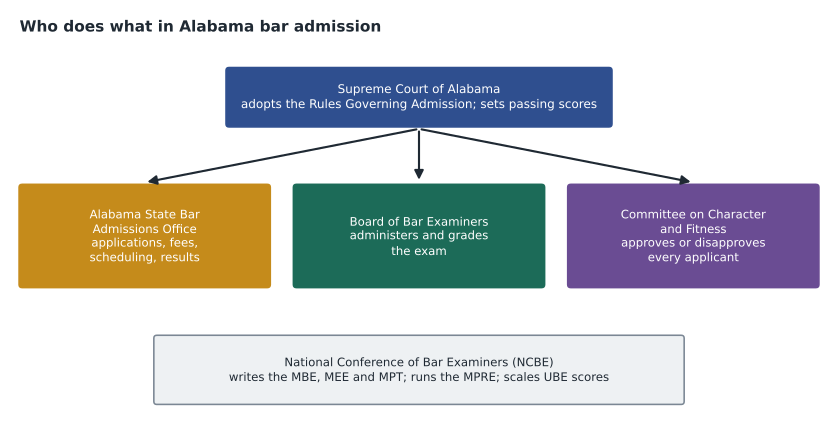
Admission to practice law in Alabama is controlled by the Supreme Court of Alabama. The court adopts the Rules Governing Admission to the Alabama State Bar, sets the passing score for the bar exam, and amends the rules by order. When the rules change, as they did twice in the spring of 2026, the change comes from the court, not from the bar association or the law schools. The court has said in its orders that it reserves the right to change the rules at any time, which is one reason this course keeps telling you to check the current rules rather than relying on summaries, including this one.
The day-to-day work is done through the Alabama State Bar, which in Alabama is a unified, or mandatory, bar: every lawyer licensed in the state is a member. The bar's Admissions Office in Montgomery receives applications, collects fees, schedules the exam, releases results and answers questions. Its address is 415 Dexter Avenue, and it can be reached at admit@alabar.org or 334-269-1515. Two bodies work under the court's rules. The Board of Bar Examiners administers and grades the examination. The Committee on Character and Fitness reviews every applicant and gives final approval or disapproval of each application.
The National Conference of Bar Examiners (NCBE), a national nonprofit based in Wisconsin, plays a supporting role. NCBE writes the three tests that make up the Uniform Bar Examination (UBE), scales and equates the scores, administers the Multistate Professional Responsibility Examination (MPRE), and prepares character reports for some applicants. NCBE does not admit anyone. 'NCBE builds the exam,' Marchetti says. 'Alabama decides what to do with your score and whether you get in.'
The requirements in one list
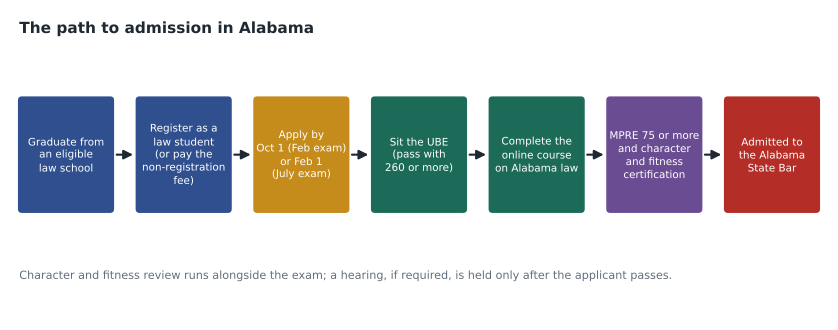
For an applicant seeking admission by examination, the Alabama State Bar lists the core requirements. You must pass the Alabama bar examination, which is the UBE, with a score of 260 or higher. You must complete the online course on Alabama law. You must score 75 or higher on the MPRE within the time the rules allow. And you must be certified by the Committee on Character and Fitness. Behind those requirements sit the eligibility rules: education, age and the other conditions in the Rules Governing Admission, which Lesson 2 covers.
| Requirement | What Alabama asks | Where this course covers it |
|---|---|---|
| Eligibility | An eligible legal education and the other conditions in Rule IV (changing January 1, 2027) | Lesson 2 |
| Application | Filed by October 1 for February or February 1 for July; no late filing | Lesson 2 |
| Character and fitness | Certification by the Committee on Character and Fitness | Lesson 3 |
| MPRE | Score of 75 or higher, generally within 36 months | Lesson 3 |
| Bar exam | UBE score of 260 or higher in one administration | Lesson 4 |
| Alabama law | Complete all modules of the online course on Alabama law | Lesson 6 |
| Admission | Final approval, then admission to the Alabama State Bar | Lessons 3 and 11 |
Avery reads the table twice and asks the obvious question: in what order do these happen? Marchetti draws the usual sequence. Most candidates register as law students during law school, apply for the exam a few months before it, take the MPRE during law school or soon after, sit the exam, complete the Alabama law course in the weeks after the exam, and receive character and fitness certification once their file is complete. Some of these steps overlap. The character and fitness review, for example, runs alongside the exam rather than after it.
Alabama and the Uniform Bar Examination
Alabama was one of the first jurisdictions to give the UBE. The Supreme Court of Alabama began administering it in July 2011, the year the UBE itself began. Today the Alabama bar exam is simply the UBE: the Multistate Bar Examination (MBE), the Multistate Essay Examination (MEE) and two Multistate Performance Test (MPT) tasks, combined into one score on a 400-point scale. Alabama gives the exam twice a year, in February and July, with the written tests on the Tuesday and the MBE on the last Wednesday of the month.
Because the exam is the UBE, Alabama's score travels. A UBE score earned in Alabama can be transferred to other UBE jurisdictions that accept it, subject to their own minimum scores and time limits, and a UBE score earned elsewhere can be transferred into Alabama if it meets Alabama's rules. Lesson 11 covers transfers in both directions.
There is no separate Alabama law test on exam day under the current exam. The Alabama State Bar describes the UBE in Alabama as having no additional jurisdiction-specific testing component. Instead, Alabama requires applicants to complete an online course on Alabama law before admission. That will change. Alabama plans to move to the NextGen bar exam in July 2028, and the Supreme Court of Alabama has directed the bar examiners to prepare a three-hour state law component for that exam. Lessons 5 and 6 explain both.
A state that is changing its rules
Candidates who studied Alabama's rules a few years ago, or who rely on an older guide, need to know that 2026 brought real changes. On April 30, 2026, the Supreme Court of Alabama amended Rule III, which covers admission without examination, and Rule IV, which covers admission by examination. The amendments take effect January 1, 2027, and govern who may sit for the exam beginning with the February 2027 administration. Among other things, they stop requiring graduation from a law school approved by the American Bar Association (ABA) as the gateway for out-of-state graduates, and they add a lifetime limit of five attempts at the exam, counted from July 2026.
Two weeks later, on May 14, 2026, the court adopted an interim rule allowing applicants who have taken the NextGen exam in another jurisdiction to transfer their score into Alabama, until the court sets its own NextGen passing score. Lessons 2 and 5 cover these orders in detail.
Avery sits the February 2027 exam, the first one governed by the new rules. Her education qualifies under both the old and new rules, so the change affects her mainly through the attempt limit. 'Five tries sounds generous,' she says. Marchetti agrees, but adds a warning: 'It counts every attempt from July 2026 on, for life. Treat every sitting as one you intend to pass.'
The Alabama law that matters
Alabama is a common-law state with its own constitution, its own court system and a body of law that differs in important ways from the majority rules tested on the UBE. A new Alabama lawyer who knows only the national rules will make mistakes in practice, and from July 2028 may lose points on the state law component. The second half of this course covers the areas where Alabama is most distinctive.
The headline example is negligence. Alabama is one of a handful of jurisdictions that still apply pure contributory negligence: a plaintiff whose own negligence contributed to the injury is generally barred from recovering for negligence. The MBE and MEE assume comparative fault unless a question says otherwise. Alabama also treats wantonness as a separate claim, measures wrongful death damages in an unusual way, and handles product liability through its own judge-made doctrine. Lesson 8 covers these.
Other areas where Alabama has its own rules include the structure of its courts and its 2022 recompiled constitution (Lesson 7), property and family law, including its adverse possession statute, recording act and alimony statute (Lesson 9), and wills, trusts and probate, including its elective share (Lesson 10).
Worked problem
Mapping Avery's next six months
Avery has graduated, is registered as a law student, and has filed her application for the February 2027 exam. She has not yet taken the MPRE. What remains, and in what order?
Show solution
- Her application was due by October 1, 2026 for the February exam. She filed it in September, so it is timely; Alabama has no late filing period.
- She needs an MPRE score of 75 or higher. She can take the MPRE before or after the bar exam. If she passes the bar first, she has 36 months from that exam to meet the MPRE requirement.
- She sits the UBE on the last Tuesday and Wednesday of February 2027 and needs 260 or more.
- About 7 to 10 days after the exam, she receives access to the online course on Alabama law and must complete all eight modules.
- The Committee on Character and Fitness must certify her. If it requires a hearing, the hearing is held only if she passes.
Answer: Avery plans to take the MPRE in March 2027, after the bar exam, giving her a clear month of MBE work before February. Her checklist: MPRE, exam, Alabama law course, character and fitness, then admission.
Common mistakes
Marchetti keeps a list of the errors that cost Alabama candidates months. The first is missing the filing deadline. Alabama's deadlines are fixed in the rules, and the bar has said it cannot grant waivers or exceptions. There is no late filing period and no late fee to buy more time. Miss October 1 and you sit in July, not February.
The second is treating the online Alabama law course as an afterthought. It is a requirement for admission. A candidate who passes the exam but leaves the modules unfinished is not admitted until they are done.
The third is letting the MPRE score expire. An MPRE score generally counts for Alabama only if it was earned within 36 months, measured from the administration in which it was earned. A score from early in law school can lapse before admission if the bar exam is delayed or retaken.
The fourth is forgetting that character and fitness is continuous. The committee keeps jurisdiction until admission, and applicants must disclose changes at all times before they are admitted. A new arrest, lawsuit or debt problem after the application is filed must be reported.
Common mistakes
MistakeAlabama has its own bar exam with a state law section.
InsteadAlabama gives the UBE; it requires an online course on Alabama law instead of a state law test, at least until NextGen in July 2028.
MistakeNCBE decides who is admitted.
InsteadThe Supreme Court of Alabama controls admission; NCBE only writes and scores the national tests.
MistakeThe bar can extend the filing deadline for a good reason.
InsteadThe deadlines are set by the court; the Alabama State Bar says it cannot grant waivers or exceptions.
MistakeThe 2026 rule changes take effect immediately.
InsteadThe April 30, 2026 amendments take effect January 1, 2027, starting with the February 2027 exam; attempts count from July 2026.
Avery leaves the session with a calendar and a short assignment: find the Rules Governing Admission on the Alabama State Bar's admissions site, read Rule IV on eligibility, and bookmark the April 30, 2026 order. 'You do not need to memorize the rules,' Marchetti says. 'You need to know where they are and read them yourself before every deadline.'
How to use this course
Each lesson ends with a short quiz, and the course ends with a twenty-question exam. Lessons 1 through 6 and 11 are about the admission process: who may sit, what the exam is, how it is scored and what comes after. Lessons 7 through 10 are about Alabama law itself. Lesson 12 pulls the substantive lessons together in original practice questions and an essay, and closes with an exam-week plan. Candidates sitting the legacy UBE can treat the substantive lessons as preparation for the online course and for practice. Candidates sitting from July 2028 should treat them as the start of their preparation for Alabama's state law component.
Throughout the course, facts about the admission process come from the Alabama State Bar's admissions site, orders of the Supreme Court of Alabama, and NCBE's published charts, as they stood in November 2026. Where a fact could not be confirmed from an official source, the course says so or describes it in general terms.
Summary and key terms
- The Supreme Court of Alabama controls admission; the Alabama State Bar Admissions Office runs the process; the Board of Bar Examiners gives the exam; the Committee on Character and Fitness approves applicants.
- Exam applicants must pass the UBE with 260 or more, complete the online course on Alabama law, score 75 or more on the MPRE and be certified for character and fitness.
- Alabama has given the UBE since July 2011 and plans to move to the NextGen exam, with a three-hour state law component, in July 2028.
- The April 30, 2026 order changes education eligibility and adds a five-attempt limit, effective January 1, 2027.
- Alabama law differs from UBE majority rules in key areas, including contributory negligence.
- Rules Governing Admission
- The Supreme Court of Alabama's rules on who may be admitted to the Alabama State Bar and how.
- Unified bar
- A bar association that every licensed lawyer in the state must join; the Alabama State Bar is one.
- Committee on Character and Fitness
- The body that gives final approval or disapproval of every application for admission in Alabama.
- Uniform Bar Examination (UBE)
- The NCBE exam made up of the MBE, MEE and MPT, given in Alabama since July 2011.
- Online course on Alabama law
- Eight required learning modules on Alabama law that applicants must complete before admission.
Lesson quiz · 5 questions
Score 60% or more to complete this lesson.
Create a free account to save your progress, take quizzes and earn a certificate.