
BAR-130 · Lesson 8 of 12 · 22 min
Client counseling and negotiation skills
▶ Video coming soon A video version of this lesson is on the way.
On Sunday morning, November 8, 2026, Marchetti opens with a role play. She plays a client, the owner of a small landscaping company whose former employee is demanding unpaid overtime. Tessa plays the lawyer. Within two minutes Tessa has explained the Fair Labor Standards Act, three defenses and the statute of limitations. Marchetti, still in character, asks: 'So what should I do?' Tessa pauses. 'That,' Marchetti says, stepping out of the role, 'is the question the NextGen exam keeps asking.'
Three of the seven foundational skills face the client directly: client counseling and advising, negotiation and dispute resolution, and client relationship and management. They appear mainly in integrated question sets, and they carry the selected Model Rules of Professional Conduct that NCBE tests from memory. This lesson gives practical frameworks for each skill and works through an original counseling and negotiation scenario.
Counseling: from analysis to advice
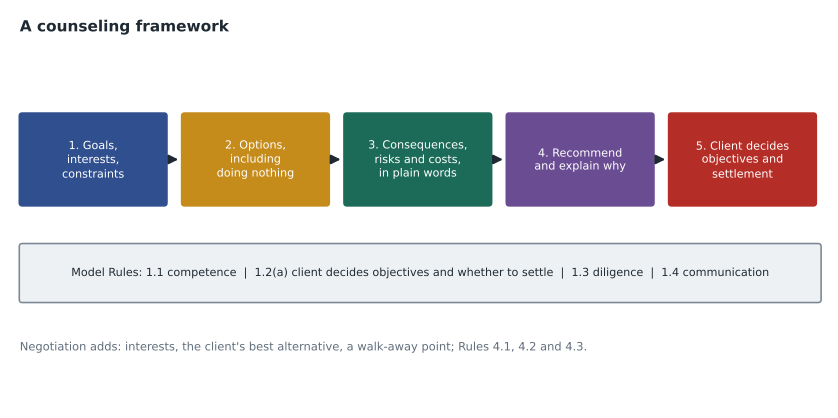
Counseling starts where analysis ends. Analysis tells you what the law is likely to do. Counseling helps the client decide what to do about it. A dependable framework has five parts.
First, understand the client's goals, interests and constraints. Goals are what the client says she wants. Interests are why she wants it: money, time, reputation, a relationship, peace of mind. Constraints are limits such as budget, deadlines, insurance or business needs. Second, identify the realistic options, including doing nothing. Third, explain the likely legal and practical consequences of each option, including risks and costs, in language the client understands. Fourth, give a recommendation if the client wants one, and say why. Fifth, respect the client's decision about the objectives of the representation.
The Model Rules frame that last step. Rule 1.2(a) provides that a lawyer shall abide by a client's decisions concerning the objectives of representation and shall consult with the client as to the means by which they are to be pursued; it also provides that the client decides whether to settle a matter. Rule 1.4 requires a lawyer to keep the client reasonably informed, to promptly comply with reasonable requests for information, and to explain a matter to the extent reasonably necessary to permit the client to make informed decisions. Rule 1.1 requires competence and Rule 1.3 requires reasonable diligence and promptness.
A counseling question rewards an answer that is honest about risk, specific to the client's situation and respectful of the client's choice. It penalizes answers that make the decision for the client, promise outcomes, or bury the advice in legal analysis.
Negotiation: preparing and proposing
Most negotiation questions are about preparation and judgment, not tactics. Before any negotiation, a lawyer should know the client's interests and priorities, the client's best alternative if no agreement is reached, the point at which the client would rather walk away, what the other side likely wants and why, and what information is still missing. The negotiation literature calls the best alternative to a negotiated agreement a BATNA; whatever you call it, a proposal is only worth accepting if it is better than the client's alternative.
Interest-based thinking often produces better questions. If two parties are fighting over a delivery deadline, the real interests might be one party's cash flow and the other's warehouse space. A proposal that staggers deliveries and adjusts payment terms may satisfy both better than splitting the difference on a single date. On the exam, the best answer to 'which proposal should the lawyer make' is usually the one that serves the client's stated interests and is realistic for the other side, not the most aggressive demand.
Ethics constrain how lawyers negotiate. Rule 4.1 provides that in representing a client a lawyer shall not knowingly make a false statement of material fact or law to a third person, or fail to disclose a material fact when disclosure is necessary to avoid assisting a criminal or fraudulent act by a client, unless disclosure is prohibited by Rule 1.6. Rule 4.2 prohibits communicating about the subject of the representation with a person the lawyer knows is represented by another lawyer in the matter, unless that lawyer consents or the communication is authorized by law or court order. Rule 4.3 governs dealing with a person who has no lawyer: the lawyer must not state or imply that the lawyer is disinterested, must correct a misunderstanding about the lawyer's role, and must not give legal advice other than advice to get a lawyer if the person's interests conflict with the client's.
Dispute resolution: choosing a process
Not every dispute should be litigated. A new lawyer should be able to compare processes. Negotiation is private, flexible and cheap but depends on both sides' willingness. Mediation adds a neutral who helps the parties reach their own agreement; it preserves relationships and confidentiality but produces no decision if the parties do not agree. Arbitration produces a binding decision from a private neutral, usually faster and more private than court, with limited appeal and sometimes significant fees; it generally requires an agreement to arbitrate. Litigation produces a binding, enforceable public judgment with full procedural protections and appeals, at the highest cost in time and money. The right choice depends on the client's goals: speed, privacy, precedent, cost, a continuing relationship, or the need for a court order.
| Process | Who decides | Strengths | Limits |
|---|---|---|---|
| Negotiation | The parties | Private, flexible, inexpensive | Needs willingness on both sides; no outside push |
| Mediation | The parties, helped by a neutral | Preserves relationships; confidential; creative solutions | No decision if the parties do not agree |
| Arbitration | A private arbitrator | Binding; often faster and private | Limited review; usually requires an agreement; fees |
| Litigation | A judge or jury | Enforceable public judgment; full procedure; appeals | Slowest and most expensive; public |
Client relationship and management
The relationship skill covers the structure of representation. Rule 1.2(d) prohibits a lawyer from counseling a client to engage, or assisting a client, in conduct the lawyer knows is criminal or fraudulent, though a lawyer may discuss the legal consequences of any proposed course of conduct. Rule 1.6(a) prohibits revealing information relating to the representation unless the client gives informed consent, the disclosure is impliedly authorized to carry out the representation, or an exception in the rule applies; Rule 1.6(c) requires reasonable efforts to prevent the inadvertent or unauthorized disclosure of, or unauthorized access to, that information. Rule 1.7 prohibits representing a client when the representation involves a concurrent conflict of interest, either direct adversity to another client or a significant risk that the representation will be materially limited, unless the conditions in the rule are met, including informed consent confirmed in writing.
Two related rules round out the list. Rule 3.1 prohibits bringing or defending a proceeding, or asserting or controverting an issue, unless there is a basis in law and fact that is not frivolous. Rule 3.3(a)(1) and (2) prohibit knowingly making a false statement of fact or law to a tribunal or failing to correct one, and failing to disclose directly adverse controlling authority in the jurisdiction that opposing counsel has not disclosed. Rule 1.0 supplies the definitions, such as informed consent and knowingly, that the other rules use.
Practice scenario: Pell Landscaping
The following scenario and questions are original and written for this course.
Scenario. Ray Pell owns Pell Landscaping, with six employees. A former employee, Jonah Ellis, has sent Ray a handwritten letter saying he was not paid overtime for about 80 hours last summer and wants 2,400 dollars or he will 'go to the labor department'. Ellis does not mention a lawyer. Ray tells you that some of Ellis's hours were travel between job sites, that Ray's timekeeping was informal, and that Ray mainly wants to avoid a government audit of his other employees' pay. He also says, 'Maybe we can just tell Jonah the overtime law doesn't apply to landscapers.'
Worked problem
Question 1: counseling
Identify Ray's goals, interests and constraints, and one option you would present.
Show solution
- Goal: resolve Ellis's claim.
- Interests: avoid a broader audit, limit cost, keep the matter quiet, keep his business running.
- Constraints: informal records that make the claim hard to defend; a small business budget.
- An option: investigate quickly, estimate the realistic exposure, and propose a prompt written settlement with a release, while reviewing pay practices for current employees.
Answer: Model answer: Ray's goal is to resolve the claim; his main interest is avoiding a wider audit, with cost and privacy close behind; his constraint is weak records. I would present an early, documented settlement after a quick review of the hours, alongside fixing timekeeping going forward, and let Ray decide.
Worked problem
Question 2: ethics in negotiation (multiple choice)
Ray suggests telling Ellis the overtime law does not apply to landscapers. Assume you know that statement is false. What should you do? (A) Make the statement, because Ellis is not represented. (B) Make the statement only if Ellis asks. (C) Decline to make it; a lawyer may not knowingly make a false statement of material fact or law to a third person. (D) Make it, but in writing so it is clear.
Show solution
- Rule 4.1 prohibits knowingly making a false statement of material fact or law to a third person.
- The statement is about the law and is material to Ellis's decision.
- Ellis's lack of a lawyer makes the duty no lighter.
Answer: The answer is C.
Worked problem
Question 3: dealing with an unrepresented person (short answer)
You call Ellis to discuss settlement. He asks, "You're not on either side, right? Can you tell me if I should take the money?" What must you say?
Show solution
- Rule 4.3: do not state or imply that you are disinterested; correct the misunderstanding.
- Do not give legal advice other than to secure counsel, because his interests conflict with Ray's.
Answer: Model answer: I must tell Ellis clearly that I represent Pell Landscaping, not him, and that I cannot advise him whether to accept; I may suggest that he consult a lawyer of his own.
Worked problem
Question 4: choosing a proposal (multiple choice)
Which proposal best serves Ray's interests? (A) Offer 500 dollars and threaten to report Ellis for leaving early. (B) Offer to pay the claimed amount after confirming the hours, in exchange for a written release, with payment promptly. (C) Refuse to pay and wait to see what Ellis does. (D) Ask Ellis to sign a statement that he was paid in full, without paying.
Show solution
- Ray's main interest is avoiding a wider audit, which a prompt, documented resolution serves.
- A threat to report is improper leverage and risks retaliation claims; refusing invites the audit Ray fears.
- Asking for a false statement is improper and would not protect Ray.
Answer: The answer is B, adjusted if the review shows some hours were not compensable.
Marcus points out that the scenario packed four skills into one client: counseling, negotiation, dealing with an unrepresented person and protecting the client from a harmful plan. 'That's what my July sets felt like,' he says. 'The law was never hard. The hard part was remembering that the client's goal wasn't winning the overtime argument. It was making the problem go away without making a bigger one.'
How to practice
These skills improve fastest by speaking and writing advice. When you finish a practice question on any subject, write two sentences of advice to the client in plain language. Practice a short negotiation plan for a fact pattern: interests on each side, the client's alternative, a first proposal and a walk-away point. And learn the twelve listed Model Rules from their text, since that is what NCBE tests, and their comments are outside the scope.
Common mistakes
MistakeThe lawyer decides whether a case should settle.
InsteadUnder Rule 1.2(a), the client decides whether to settle; the lawyer advises.
MistakeFalse statements are permitted when the other side has no lawyer.
InsteadRule 4.1 applies to statements to any third person.
MistakeA lawyer may present herself as neutral to an unrepresented person.
InsteadRule 4.3 forbids stating or implying disinterest and requires correcting the misunderstanding.
MistakeThe best negotiation answer is the most aggressive demand.
InsteadThe best answer serves the client's interests and is realistic for the other side.
Explaining risk in plain language
Many counseling questions turn on how advice is expressed. Clients make better decisions when risks are explained concretely: what could happen, how likely it is, what it would cost, and what the client can do about it. Avoid jargon or define it in passing. Compare options side by side. Be honest about uncertainty without hiding behind it; 'courts are split, and I think we have the stronger argument, but there is a real chance we lose' tells a client more than 'it depends'. And put the recommendation where the client will see it, usually at the beginning or the end, clearly labeled as a recommendation that the client is free to reject.
Tessa rewrote her answer to Marchetti's role play that way: 'Jonah's claim is small, your records make it hard to fight, and a government complaint could lead to a review of everyone's pay. I recommend we check his hours this week and, if they hold up, offer to pay in exchange for a signed release. It's your call.' Marchetti, back in character as the landscaping owner, says, 'That I can work with.'
Marcus remembers one more lesson from July: the client-facing questions often had more than one legally correct answer, and the best answer was the one that fit what the client actually wanted. 'A lawsuit might win,' he says, 'but if the client said she needed the supplier relationship to survive, the answer that preserved the relationship was the right one.'
Summary and key terms
- Counsel by identifying goals, interests and constraints, laying out options and consequences, recommending, and leaving objectives to the client.
- Prepare negotiations around interests, the client's best alternative and a walk-away point.
- Rules 4.1, 4.2 and 4.3 govern truthfulness and dealings with represented and unrepresented persons.
- Compare negotiation, mediation, arbitration and litigation against the client's goals.
- Rules 1.0 to 1.7, 3.1 and 3.3 shape the client relationship; learn the listed rules from their text.
- Client counseling
- Helping a client choose a course of action by explaining options, consequences and risks.
- BATNA
- Best alternative to a negotiated agreement: what the client will do if no deal is reached.
- Interests
- The underlying needs and concerns behind a party's stated position.
- Mediation
- A process in which a neutral helps the parties reach their own agreement.
- Concurrent conflict of interest
- Under Rule 1.7, direct adversity to another client or a significant risk of material limitation.
Lesson quiz · 5 questions
Score 60% or more to complete this lesson.
Create a free account to save your progress, take quizzes and earn a certificate.