
BAR-130 · Lesson 10 of 12 · 15 min
Scoring and score transfer
▶ Video coming soon A video version of this lesson is on the way.
At the regular Tuesday group session on November 17, 2026, Marchetti sets aside half an hour for a topic that touches everyone, whichever exam they sit: how NextGen scores work and where they can be used. Marcus brings his score report, which shows one number, 648, and the word PASS for Missouri. 'Here is my question,' he says. 'Kansas City is a two-state town. If I want to practice across the line in Kansas, what is 648 worth there?'
This lesson explains how the NextGen exam is scored, how passing scores are set, how scores are reported and verified, and how score transfer works between jurisdictions and between the legacy and NextGen exams.
One scaled score
The NextGen exam produces a single overall score on a scale from 500 to 750. Unlike the legacy UBE, there are no separate multiple-choice and written scores. NCBE describes the score as scaled, not a percentage of questions answered correctly, and as equated, meaning that small differences in difficulty between exam forms are adjusted so that a given score represents the same level of performance on any administration. NCBE also says scores are not curved: other examinees' performance does not affect your score.
Three groups do the work. NCBE scores the multiple-choice questions, including the multiple-choice parts of integrated sets and research tasks. Graders appointed by each jurisdiction score the written responses in integrated sets and performance tasks, using NCBE's rubrics. NCBE then performs the scaling, equating and final score calculation.
How the parts combine
NCBE says standalone multiple-choice questions make up 49 percent of the total score, integrated question sets 21 percent, and performance tasks 30 percent. Within each component, items carry the point values described in earlier lessons: up to one point for a select-one question and two for a select-two question; up to two points for each short answer in a counseling set; up to eight for each medium answer in a drafting set; up to 24 for a standard performance task; and, in a legal research task, double-weighted research questions followed by a writing assignment worth up to eight.
Unscored pretest items, 20 multiple-choice questions and one integrated set, do not count. All performance tasks count.
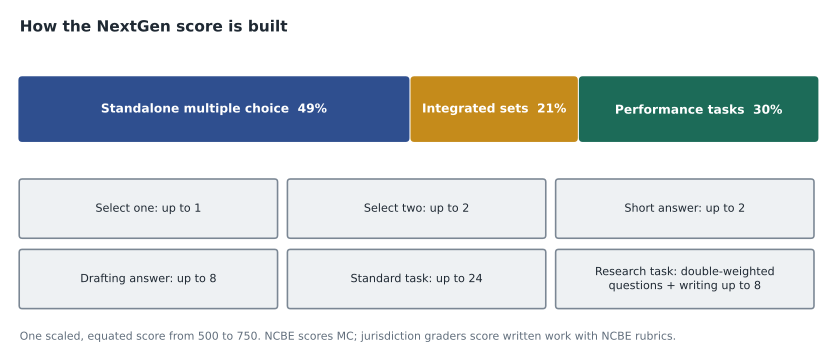
The practical consequence is that the written components, integrated sets and performance tasks together, are slightly more than half the score. A strong multiple-choice performance cannot carry an examinee who writes weak short answers and performance tasks, and the reverse is also true.
Passing scores
Each jurisdiction sets its own passing score. In November 2025, after a nationwide standard-setting study with a panel of more than 80 participants from 43 jurisdictions, NCBE recommended a passing-score range of 610 to 620. NCBE's guidance tied that range to the passing standards jurisdictions already used on the legacy UBE, where minimums range from 260 to 270: a jurisdiction with a 260 standard would set 610, and one with a 270 standard would set 620. That mapping is about standards, not scores. NCBE separately cautions that the two exams have different structures and scales, and that individual legacy and NextGen scores should not be compared numerically.
NCBE's list of NextGen minimum passing scores shows most jurisdictions within the recommended range. As of late 2026 it listed 610 for Iowa, Missouri, New Mexico, North Dakota and Washington; 612 for Guam and Palau; 614 for Indiana; 615 for the Northern Mariana Islands and for Oregon's July 2026 exam only; 616 for Connecticut, the District of Columbia, Idaho, Kentucky, Maryland, Montana and the US Virgin Islands; and 620 for a larger group including Alaska, Colorado, Illinois, Maine, Massachusetts, Nebraska, New Hampshire, North Carolina, Ohio, Pennsylvania, Rhode Island, Tennessee and Vermont. Oregon's score for exams after July 2026 is 620. Other jurisdictions had not yet announced. A jurisdiction's passing score for its own exam can differ from the minimum it accepts for transferred scores, so check both.
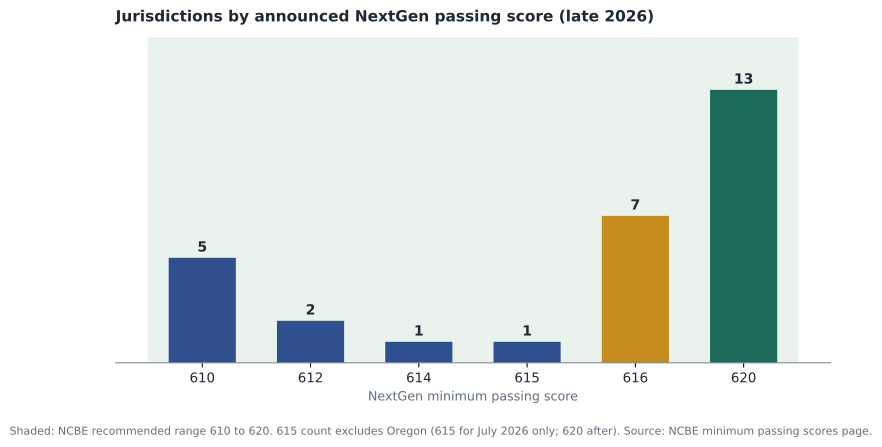
For Andre, the number that matters is Oregon's 620 for July 2027. For Tessa, it is Washington's 610 for February 2027. For context, the mean score on the first administration in July 2026 was 640.6 and the median 640.
Reporting and verification
NCBE reports scores automatically to the jurisdiction where the examinee tested. Examinees can see their scores in their NCBE account after the jurisdiction announces results and authorizes release. Jurisdictions release results on their own schedules; Missouri released Marcus's on October 2, 2026, a week after NCBE announced national results on September 25.
An examinee who doubts a score may request score verification from NCBE. NCBE describes it as a check that takes about 30 business days and costs 150 dollars, and says it does not include regrading of written responses or a review of the statistical scaling. For the July 2026 administration, requests had to be postmarked by February 23, 2027. Questions about regrading or appeals belong to the jurisdiction, under its own rules.
NCBE has also said it is not releasing the July 2026 written questions. Do not count on past NextGen exams for practice; use NCBE's official study aids and free samples.
Score transfer
Like the legacy UBE, the NextGen exam is designed to be portable. A NextGen score earned in one jurisdiction may be transferred to another jurisdiction that accepts it. The receiving jurisdiction decides whether to accept transferred scores, the minimum score it requires, how old a score may be, and what else an applicant must do, such as character and fitness review, the MPRE and any jurisdiction-specific component.
During the transition, transfer has extra wrinkles. NCBE's chart of NextGen decisions shows, for each jurisdiction, whether it accepts transferred NextGen scores and from when. Some jurisdictions that still give the legacy UBE have announced that they will accept transferred NextGen scores. Others will not until they adopt the new exam: Florida and New York, for example, will accept transferred NextGen scores only from exams given from July 2028. Hawaii has said it does not intend to accept transferred NextGen scores. And a jurisdiction that has switched may or may not accept transferred legacy UBE scores, and for how long.
| Situation | What to check | Where |
|---|---|---|
| NextGen score, moving to another NextGen jurisdiction | Acceptance, minimum score, score age limit, other requirements | Receiving jurisdiction's rules; NCBE's decisions chart |
| NextGen score, moving to a jurisdiction still on the legacy UBE | Whether it accepts NextGen transfers yet, and from which exams | NCBE's decisions chart; the jurisdiction's website |
| Legacy UBE score, moving to a NextGen jurisdiction | Whether legacy scores are still accepted, minimum and age limit | NCBE's UBE charts; the jurisdiction's website |
| Any transfer | Character and fitness, MPRE, local component, fees | The receiving jurisdiction |
Marcus's Kansas question
Back to Kansas City. NCBE's chart lists Kansas as giving its first NextGen exam in July 2028. Marcus has written to the Kansas board asking whether, and from when, it will accept a transferred July 2026 NextGen score, and what minimum it would require. He has not yet had an answer. Meanwhile he has looked at admission on motion, which Kansas offers to lawyers with a period of practice elsewhere, as a longer-term route. 'The lesson for everyone,' Marchetti says, 'is that a transferable score is not a promise. It's an option that each jurisdiction decides how to honor.'
Worked problem
Reading a transfer rule
Suppose a fictional jurisdiction's rule says: "The Board accepts transferred NextGen UBE scores of 616 or higher earned within three years before the application is filed." Tessa scores 632 in Washington in February 2027 and applies in that jurisdiction in March 2030.
Show solution
- The score, 632, exceeds the 616 minimum.
- The rule measures age from the exam to the filing of the application.
- February 2027 to March 2030 is more than three years.
- Even a qualifying score does not waive other requirements.
Answer: Tessa's score would be too old under this rule. Read the receiving jurisdiction's actual rule; age limits and measuring points differ.
What scores do not tell you
A single number has a cost: it does not tell you which component was weak. NCBE does not report NextGen subscores to examinees in the way some legacy jurisdictions released MBE and written scores. If you do not pass, your study plan must come from honest self-assessment and practice data, not from a score breakdown. Lesson 11 shows how to build that record before the exam, when it is most useful.
Common mistakes
MistakeA NextGen score is the percentage of questions answered correctly.
InsteadIt is a scaled, equated score on a 500 to 750 scale.
MistakeA legacy score of 270 equals a NextGen score of 620.
InsteadNCBE mapped passing standards, not individual scores; the exams should not be compared numerically.
MistakeEvery jurisdiction accepts NextGen transfers now.
InsteadAcceptance, timing, minimums and age limits are each jurisdiction's decision; some will not accept until they adopt.
MistakeScore verification means my essays are regraded.
InsteadNCBE's verification does not include regrading or a review of scaling; regrading questions go to the jurisdiction.
What a single score means for strategy
Because the score combines everything, there is no safe component to neglect. An examinee who expects to do well on multiple choice still needs solid written answers, since integrated sets and performance tasks together are slightly more than half the score. An examinee who writes well still needs the rules, since standalone multiple choice alone is almost half. The scoring also rewards partial credit: a committed short answer, a select-two choice with one correct option, or an outline that covers every issue of a performance task all earn points that a blank cannot.
Equating has one further consequence worth knowing. Because scores are adjusted for differences in difficulty between exam forms, and because NCBE says the exam is not curved, you are not competing with the people in the room. A strong group of examinees does not lower your score, and a weak one does not raise it. Your job is to meet the standard, not to beat your neighbors.
Planning around results dates
Results arrive months after the exam, and jurisdictions set their own release dates. The first NextGen results were announced nationally on September 25, 2026, roughly two months after the July exam, and individual jurisdictions released results on their own schedules after that. If you plan to transfer a score, or to start a job that depends on admission, build those dates into your plans. Employers who hire new graduates generally understand the calendar, but your own deadlines, such as a jurisdiction's application window for transfer applicants, will not move to fit a late result.
Marcus used the waiting period to start his Kansas inquiry and to complete the remaining Missouri admission steps, including the swearing-in. 'The score was the big moment,' he says, 'but the license took more paperwork than I expected. Start it early.'
Questions to ask your jurisdiction
Because so much depends on jurisdiction-specific choices, Marchetti gives the group a checklist of questions to answer from their own bar admission website. What is the NextGen passing score, and does it differ for transferred scores? Does the jurisdiction accept transferred NextGen scores, and from which administrations? Does it accept transferred legacy UBE scores, and until when? How long after the exam is a score valid for transfer, and from what date is that measured? Is there a jurisdiction-specific component, and when is it completed? When are results released, and how? What are the rules for score verification, regrading or appeal, if any? Tessa answers them for Washington in twenty minutes and discovers that one assumption she had made about transfer was wrong.
Interpreting the first statistics
The July 2026 numbers are useful but limited. The examinees came from ten jurisdictions, mostly small, and the group was much smaller than a typical national July administration. Repeat examinees had sat a different exam before. NCBE changed its definition of first-time examinees at the same time. And several sittings were disrupted, though NCBE found no consistent effect on scores. The headline pass rate, within a few points of recent national July rates, suggests the new exam is not dramatically harder or easier, but it is one administration. Treat it as a first data point, not a forecast for your own sitting.
A worked example of passing-score arithmetic
Suppose a fictional jurisdiction sets its NextGen passing score at 616 and accepts transferred NextGen scores of 616 or higher earned within two years. Andre scores 624 in Oregon in July 2027. He passes in Oregon, where the score needed after July 2026 is 620. If he applies to the fictional jurisdiction by July 2029, his score meets its minimum. If a different jurisdiction requires 620 for transfers but measures the two years from the exam date to admission rather than to application, he must be admitted, not just apply, within that window. The arithmetic is easy. The trap is the measuring point, so read each rule's exact words.
Marcus's case shows the opposite trap. His 648 clears every passing score NCBE has listed. But a high score does not help in a jurisdiction that does not yet accept NextGen transfers at all. Score size and score acceptance are separate questions, and both must be answered before you rely on a transfer.
Summary and key terms
- NextGen reports one scaled, equated score from 500 to 750, not curved.
- NCBE scores multiple choice; jurisdiction graders score written responses with NCBE rubrics; NCBE scales the result.
- Weights are 49 percent multiple choice, 21 percent integrated sets and 30 percent performance tasks.
- NCBE recommended passing scores of 610 to 620; most announced scores fall in that range.
- Transfer acceptance, minimums and age limits are set by each receiving jurisdiction and vary during the transition.
- Scaled score
- A score converted to a common scale so it means the same thing across administrations.
- Equating
- Statistical adjustment for small difficulty differences between exam forms.
- Passing score
- The minimum score a jurisdiction requires on its own exam.
- Score transfer
- Using a score earned in one jurisdiction to seek admission in another that accepts it.
- Score verification
- NCBE's check of a score's calculation, which does not include regrading.
Lesson quiz · 5 questions
Score 60% or more to complete this lesson.
Create a free account to save your progress, take quizzes and earn a certificate.