
BAR-130 · Lesson 3 of 12 · 16 min
Foundational lawyering skills
▶ Video coming soon A video version of this lesson is on the way.
On Sunday, October 4, 2026, Marchetti starts with a question. 'Name something a lawyer did for a client in your clinic or your summer job that the old bar exam never asked you to do.' Andre says he spent a week figuring out which documents to request before a mediation. Tessa says she rewrote a landlord's lease clause so it would actually do what the landlord wanted. Marcus says he had to tell a client, kindly, that her case was weaker than she thought. 'All three of those are on the NextGen exam,' Marchetti says. 'They're called foundational skills.'
The second half of the content scope lists seven foundational lawyering skills. NCBE's practice analysis found that new lawyers use them constantly, and the NextGen exam is built to test them directly. Every question tests at least one skill, usually while drawing on a foundational concept. This lesson explains each skill, how NCBE groups them, and what they look like in questions.
The seven skills
The seven skills are:
1. Legal research. 2. Legal writing. 3. Issue spotting and analysis. 4. Investigation and evaluation. 5. Client counseling and advising. 6. Negotiation and dispute resolution. 7. Client relationship and management.
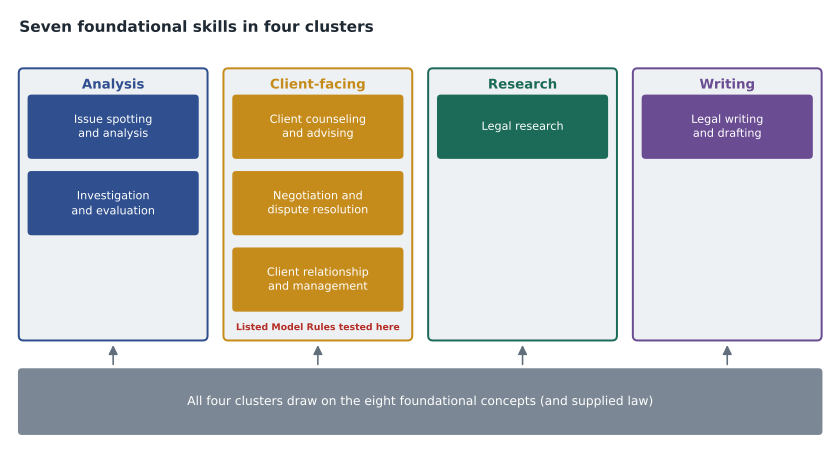
NCBE's content scope describes them in clusters. Issue spotting and analysis, and investigation and evaluation, concern applying legal principles to facts and judging what facts matter and how strong each side's position is. The three client-facing skills, client counseling and advising, negotiation and dispute resolution, and client relationship and management, concern choosing lawyering strategies that fit both the legal rules and the client's goals, interests and constraints. Legal research concerns identifying and carrying out a research strategy. Legal writing, which the outline describes as writing and drafting, concerns producing documents such as memos, briefs, letters or contract provisions that follow the governing rules and serve the client's objectives.
Issue spotting and analysis
This is the skill the legacy exam tested most. Given facts, identify the legal issues, state the governing rules, apply them and reach a reasoned conclusion. On the NextGen exam it appears everywhere: in standalone multiple-choice questions, in the short answers of integrated sets, and in the analysis section of a performance task. What changes is the setting. Instead of a law-school hypothetical that ends with 'What result?', a question may ask what issue a supervising lawyer should raise first, or which of several claims is strongest.
Investigation and evaluation
A new lawyer rarely gets complete facts. Investigation and evaluation ask what facts you would need, how you would get them, and how strong the client's position is with the facts you have. A question might give you a client interview and ask which additional document would best support an element of a claim, or which witness's account a court is most likely to credit, or what a discovery request should target. Andre's week of choosing documents before mediation is a perfect example.
The key move is connecting facts to elements. If a claim requires proof that the defendant knew of a danger, the most useful document is one that shows knowledge: an email, an inspection report, a prior complaint. Facts that are vivid but do not bear on an element are less valuable. Lesson 5 shows how integrated question sets test this.
Client counseling and advising
Counseling turns analysis into advice. The client wants something: to stay in business, to avoid a lawsuit, to keep a family relationship intact, to get paid. Good advice identifies the options, explains the legal risks and benefits of each in terms the client understands, and respects that the client makes the decisions about the objectives of the representation. Model Rule 1.2(a), one of the listed rules, says exactly that: the client decides the objectives, and the lawyer consults about the means.
Marcus's hard conversation is the hardest part of this skill. 'The question I remember from July,' he says, 'wasn't asking me what the law was. It was asking what I should tell the client, and the right answer was the one that was honest about the risk, not the one that made the client happy.'
Negotiation and dispute resolution
New lawyers negotiate constantly: settlement terms, contract provisions, deadlines, discovery disputes. This skill covers preparing for a negotiation, identifying the parties' interests behind their stated positions, generating options, evaluating proposals against the client's alternatives and goals, and choosing among ways of resolving a dispute, such as negotiation, mediation, arbitration or litigation. Ethics overlaps here too. Model Rule 4.1 forbids knowingly making a false statement of material fact or law to a third person, and Rule 4.2 forbids communicating about the subject of the representation with a person you know is represented by counsel, without that lawyer's consent or other authorization.
Client relationship and management
This skill concerns the relationship itself: defining the scope of the representation, keeping the client informed, protecting confidential information, recognizing conflicts of interest, managing expectations and handling a client who is unhappy or wants something improper. Most of the listed Model Rules live here: competence, diligence, communication, confidentiality and conflicts with current clients.
Legal research
Research on the NextGen exam does not mean typing into a database. It means knowing how to approach a research problem: framing the question, choosing which sources to consult first, recognizing which authorities are binding and which are only persuasive, reading statutes and cases carefully, and judging when the question has been answered. The exam supplies the research materials. Legal research performance tasks are devoted to this skill, and Lesson 7 covers it.
Legal writing and drafting
Writing appears in medium-answer questions in integrated sets and in every performance task. The documents vary: an objective memo, part of a brief, a client letter, a contract clause, a revision of someone else's draft. The skill is not elegant prose. It is producing a document that does its job for its reader and complies with the governing law. Tessa's lease clause is the drafting version: words that achieve the client's goal and will be read the way the client intends.
| Skill | What a question might ask | Where it usually appears |
|---|---|---|
| Issue spotting and analysis | Which claim is strongest; what result a court would reach | Multiple-choice questions, short answers, performance tasks |
| Investigation and evaluation | Which fact or document matters most; what to ask next | Integrated question sets, multiple-choice questions |
| Client counseling and advising | What to advise; how to explain a risk | Integrated question sets (counseling sets) |
| Negotiation and dispute resolution | Which proposal best serves the client; which process fits | Integrated question sets |
| Client relationship and management | Whether a conflict exists; what the lawyer may disclose | Integrated question sets, with the listed Model Rules |
| Legal research | Which source to consult; whether an authority is binding | Legal research performance tasks |
| Legal writing and drafting | Draft or revise a provision, memo section or letter | Drafting sets and performance tasks |
One concept, several skills
The same rule can be tested through different skills, and seeing that is the key to the new exam. Marchetti uses an original example built on negligence.
A customer slips on a puddle in Glenmore Hardware, a small store that a new lawyer's firm represents. Under the issue-spotting skill, a multiple-choice question might ask whether the store breached its duty to an invitee. Under investigation and evaluation, a question might ask which piece of evidence, such as the store's floor inspection log, a clerk's statement, or a photograph of the puddle, would most help the store show it acted reasonably. Under counseling, a short answer might ask how to explain to the owner the risk of going to trial. Under negotiation, a question might ask which settlement term best protects the store if the customer's injuries turn out to be worse than reported. Under writing, a drafting set might ask you to revise a response letter to the customer's lawyer that makes an admission it should not.
The rule of premises liability is the same in every question. What changes is what you are asked to do with it. 'If you only know the rule,' Marchetti says, 'you can answer one of those five. If you can use it, you can answer all five.'
Worked problem
Matching a question to a skill
Andre reads an original practice prompt: a client who owns a bakery has received a letter from a neighbor's lawyer complaining about early-morning delivery trucks. The prompt asks which of four statements the bakery's lawyer should make in a reply letter.
Show solution
- The task is a letter to a represented party's lawyer, so negotiation and writing skills are in play.
- The legal concept is private nuisance, from real property and torts.
- One answer choice promises that deliveries will stop entirely; another admits the trucks are unreasonably loud; a third proposes adjusting delivery times while reserving the bakery's position; a fourth threatens a counterclaim with no basis.
- Rule 4.1 and Rule 3.1 rule out misstatements and baseless claims; counseling principles rule out giving away the client's position without authority.
Answer: The best choice proposes a practical adjustment while preserving the client's legal position. The question tests negotiation and writing skills built on nuisance law.
How to train the skills
Skills improve with practice that mimics the task, not by reading about them. Marchetti suggests three habits. When you study a rule, ask how it would affect advice to a client, and say the advice out loud in plain language. When you read a fact pattern, list two facts you would want to know that the pattern does not give you. When you finish a practice question, name the skill it was testing. 'The point is not to label things for fun,' she says. 'It's that once you know what the question wants you to do, you stop answering the question you expected and start answering the one in front of you.'
Common mistakes
MistakeSkills questions are soft and do not require legal knowledge.
InsteadMost skills questions draw on a foundational concept; you must know the rule to use it.
MistakeLegal research on the exam means searching a database.
InsteadThe exam supplies research materials and tests strategy, authority and reading.
MistakeCounseling means telling the client what they want to hear.
InsteadGood advice is honest about risk and leaves the client's objectives to the client.
MistakeEthics is a separate subject on NextGen.
InsteadSelected Model Rules are tested within the client-facing skills.
What the skills look like in a performance task
The skills also combine inside a single performance task. A standard task might ask for an objective memo, which uses issue spotting and analysis, legal writing and, through the file, investigation and evaluation. A task asking for a client letter adds counseling. A task asking for a negotiation plan or a set of proposed contract terms adds negotiation. A legal research task puts research first. When Marcus read each task memo in July, he asked himself one question before anything else: which of the seven skills does this document mainly need? 'If it's a client letter, my analysis has to end in advice the client can use,' he says. 'If it's a memo to a partner, the analysis is the product. Same law, different finish.'
A self-check for each skill
Marchetti gives the group a quick self-assessment to run before deciding where to spend study time. For issue spotting and analysis: can you state the rule for each starred topic and apply it to a new fact pattern without notes? For investigation and evaluation: given a short client story, can you list the three facts you would most want to confirm and say why each matters to an element? For counseling: can you explain a legal risk to a non-lawyer in three sentences without jargon? For negotiation: can you name a client's interests, alternatives and walk-away point for a simple dispute? For client relationship: can you state the twelve listed Model Rules from memory in your own words? For research: can you rank five sources by authority in under a minute? For writing: can you produce a clear one-page memo section in 25 minutes? Each 'no' is a study target.
Tessa's answers surprise her. Her analysis is strong, but she struggles to explain risk without legal terms, and she has never ranked sources against a clock. Andre is the reverse: comfortable advising clients from his clinic work, unsure of his rules in business associations. 'Good,' Marchetti says. 'Now you know what to practice.'
Marcus adds one more observation from July. The skills questions rarely announced themselves. 'Nothing said this is a negotiation question,' he says. 'A client email just said the other side offered a deal, and the question asked which response was best. If you weren't thinking about interests and alternatives, all four answers looked reasonable.' Naming the skill, in other words, is something you do for yourself, quickly, before you choose an answer.
The clusters also explain why some skills appear more in certain question types. Integrated sets lean on the client-facing skills because they follow a client through changing facts; performance tasks lean on writing and research because they supply a library and ask for a product; and standalone multiple-choice questions lean on analysis because a short fact pattern suits a single analytical step. Knowing that pattern helps you anticipate what each part of a section will ask you to do.
Summary and key terms
- NextGen tests seven foundational skills: research, writing, issue spotting and analysis, investigation and evaluation, counseling, negotiation and client relationship management.
- NCBE groups them into analysis, client-facing, research and writing clusters.
- The client-facing skills carry the selected Model Rules of Professional Conduct.
- The same legal rule can be tested through several skills; knowing what a question asks you to do is essential.
- Train skills by practicing advice, fact investigation and naming the skill each question tests.
- Foundational lawyering skills
- The seven skills the NextGen exam tests directly.
- Investigation and evaluation
- Determining what facts to gather and how strong each side's position is.
- Client counseling and advising
- Turning legal analysis into advice that serves the client's goals and respects the client's decisions.
- Negotiation and dispute resolution
- Preparing for and conducting negotiations and choosing among ways to resolve disputes.
- Client relationship and management
- Managing scope, communication, confidentiality, conflicts and expectations in the lawyer-client relationship.
Lesson quiz · 5 questions
Score 60% or more to complete this lesson.
Create a free account to save your progress, take quizzes and earn a certificate.