
BAR-130 · Lesson 4 of 12 · 22 min
Multiple-choice questions on NextGen
▶ Video coming soon A video version of this lesson is on the way.
On Sunday, October 11, 2026, Marcus shares his screen and opens NCBE's free exam software preview. 'This is the closest thing to the real screen,' he says. 'Same layout, same question types, no security lockdown.' Tessa has been doing MBE questions from a commercial book for a month. She wants to know how different the NextGen versions are. 'Some of them you would not notice,' Marcus says. 'Then you hit one that says choose two, and you realize it's a different game.'
Standalone multiple-choice questions are the largest part of the NextGen exam by count and by weight. This lesson explains how they work, how they are scored and how to approach them, with original practice questions.
How many, how long, how much
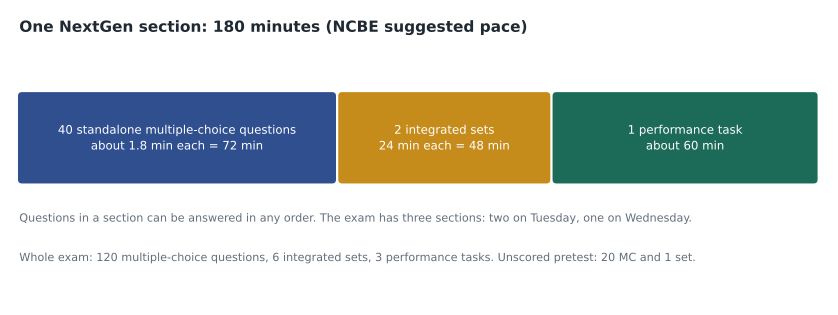
Each three-hour section contains 40 standalone multiple-choice questions, so the exam has 120. NCBE's blueprint suggests about 1.8 minutes per question, which comes to 72 minutes per section, a little less than half of the section's time. Twenty of the 120 are unscored pretest questions, so 100 count, but you cannot tell which ones they are.
NCBE says standalone multiple-choice questions make up 49 percent of the total score. That is almost the same weight the MBE carries on the legacy UBE, but it now comes from 100 scored questions instead of 175, so each one matters more. NCBE scores these questions itself; no jurisdiction grader is involved.
The questions cover the eight foundational concepts in approximately equal numbers, according to the blueprint. That is a change from the legacy MBE, which split its questions across seven subjects. Business associations now has its own share of multiple-choice questions.
Select one, or select two
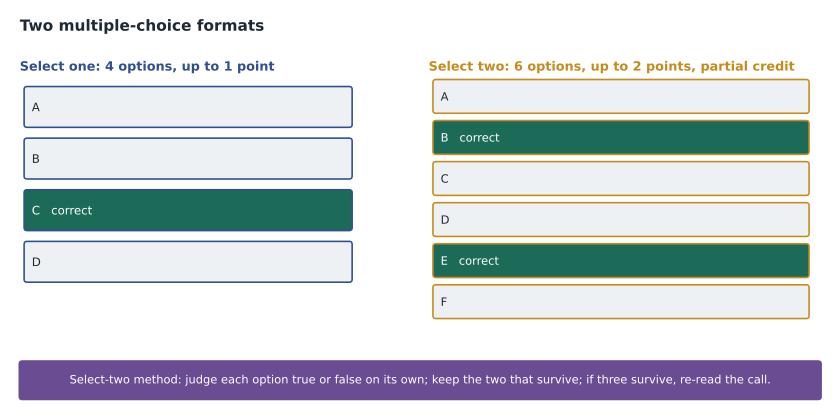
NextGen multiple-choice questions come in two formats. NCBE's preparation page describes them as having four to six answer options with one or more correct answers.
A select-one question has four options and one correct answer, like an MBE question. It is worth up to one point.
A select-two question has six options and asks you to choose the two correct ones. It is worth up to two points, and NCBE's blueprint says partial credit is available. If you choose one correct option and one incorrect option, you can earn part of the credit.
The select-two format changes how you read the options. On a select-one question, you compare options against one another and choose the best. On a select-two question, comparing is less useful, because two options are correct and four are not. The better method is to judge each option on its own: true or false, given the facts and the law. Most of the time, two options will survive and four will not. If three seem to survive, re-read the call of the question: it often contains a limiting word, such as 'most likely' or 'without further information', that eliminates one.
What the questions test
NCBE says early NextGen multiple-choice questions closely resemble MBE questions. Many are classic application questions: a short fact pattern, a call such as 'Is the court likely to grant the motion?', and options that combine an outcome with a reason. But because every question also tests a skill, some calls look different. A question may ask what a lawyer should do next, which fact would most strengthen a party's position, or which argument a supervising lawyer should lead with.
Starred topics will appear without any legal resources, so you must know the rule. Unstarred topics may also appear without resources, and then the question is testing whether you recognize the issue.
A method for each question
Marchetti teaches a four-step routine, the same one she uses for MBE drills, adapted for the new formats.
First, read the call of the question before the facts. Know whether it asks for a result, a reason, an action, or two correct statements. Second, read the facts actively, noting the parties, the procedural posture, and any fact that seems placed for a reason. Third, predict the answer, or at least the governing rule, before reading the options. Fourth, test each option: on a select-one question, look for the option that matches your prediction and eliminate the rest for specific reasons; on a select-two question, judge each option true or false on its own.
Two habits matter on the NextGen exam in particular. Because outcome-and-reason options are common, check the reason as carefully as the outcome. An option can reach the right result for the wrong reason, and that option is wrong. And because some calls ask about lawyering actions, remember that the best action is usually the one that serves the client's interests within the rules, not the one that wins the most aggressive way.
Practice questions
The following questions are original and written for this course. Try each before reading the explanation.
Worked problem
Question 1 (select one)
Patel, a citizen of Ohio, sues Brightline Logistics, a corporation incorporated in Delaware with its principal place of business in Ohio, in federal court in Ohio. Patel alleges only state-law negligence claims and seeks 200,000 dollars in damages. Brightline moves to dismiss for lack of subject-matter jurisdiction. How is the court likely to rule? (A) Deny the motion, because the amount in controversy exceeds 75,000 dollars. (B) Deny the motion, because Brightline is incorporated in Delaware. (C) Grant the motion, because there is no complete diversity of citizenship and no federal question. (D) Grant the motion, because Brightline waived the objection by not raising it in its answer.
Show solution
- A corporation is a citizen of its state of incorporation and the state of its principal place of business, so Brightline is a citizen of both Delaware and Ohio.
- Patel is a citizen of Ohio, so diversity is not complete.
- The claims arise under state law, so there is no federal question.
- Lack of subject-matter jurisdiction cannot be waived and may be raised at any time.
Answer: The answer is C. Option A states a real requirement but ignores complete diversity; B relies on only one of Brightline's citizenships; D misstates the rule on waiver.
Worked problem
Question 2 (select one)
Rourke agreed in writing to sell her used delivery van to Kaminski for 18,000 dollars, delivery in 30 days. Two weeks later Rourke emailed Kaminski: "A dealer offered me 22,000 dollars. I will not be selling the van to you." Kaminski wants to buy a similar van right away. Which statement best describes Kaminski's position? (A) Kaminski must wait until the delivery date before suing. (B) Kaminski may treat the email as a repudiation, buy a substitute van and seek the difference in price as damages. (C) Kaminski has no remedy because Rourke is not a merchant. (D) Kaminski's only remedy is specific performance.
Show solution
- The contract is a sale of goods, governed by Article 2 of the Uniform Commercial Code.
- An unequivocal statement that a party will not perform is an anticipatory repudiation.
- The aggrieved buyer may resort to remedies without waiting for the performance date, including cover.
- Cover damages are the difference between the cost of the substitute and the contract price, plus incidental and consequential damages, less expenses saved.
Answer: The answer is B. Article 2 applies whether or not the seller is a merchant, and specific performance is reserved for unique goods or other proper circumstances; a used van is readily replaced.
Worked problem
Question 3 (select two)
Officer Grant stopped Lee for speeding. While writing the ticket, Grant smelled marijuana coming from the car, in a state where possessing marijuana remains a crime. Grant searched the car and found a stolen laptop inside a closed backpack on the back seat. Lee moves to suppress the laptop. Which TWO statements are correct? (A) The search was invalid because Grant had no warrant. (B) The smell gave Grant probable cause to believe the car contained contraband. (C) Grant could search only the area within Lee's immediate reach. (D) Under the automobile exception, Grant could search containers in the car that might hold marijuana. (E) The laptop must be suppressed because it was not the item Grant was looking for. (F) The search was valid only if Lee consented.
Show solution
- A traffic stop supported by an observed violation is reasonable under the Fourth Amendment.
- Probable cause that a vehicle contains contraband permits a warrantless search under the automobile exception, so neither a warrant nor consent is required.
- That search extends to any part of the vehicle and any container that might hold the object of the search; the narrower reach-area limit belongs to searches incident to arrest.
- Evidence of another crime found during a lawful search may be seized.
Answer: The answer is B and D. Judge each option on its own: A and F misstate the warrant and consent rules for vehicles with probable cause, C borrows the wrong doctrine, and E ignores that evidence found in a lawful search can be seized.
Worked problem
Question 4 (select one, skills-focused)
A new associate represents Harlan, who was injured when a ladder he bought from Summit Supply collapsed. Harlan says the ladder "bent at the joint where it had a weird crack". The associate is preparing a products liability claim. Which item should the associate try to obtain first? (A) Harlan's medical records from five years ago. (B) The ladder itself, preserved in its current condition. (C) Summit Supply's annual revenue figures. (D) Reviews of Summit Supply's customer service.
Show solution
- A manufacturing defect claim turns on whether the product departed from its intended design.
- The ladder is the central physical evidence of a defect and can be lost or altered.
- Old medical records and the defendant's revenue are of limited use to prove the defect.
- Preservation of key evidence is an early priority in investigation.
Answer: The answer is B. This is an investigation and evaluation question: the item that bears most directly on an element, and is at risk of loss, comes first.
Question 3 shows why the independent method works. 'On my July exam I hit two select-two questions where three options looked right at first,' Marcus says. 'Both times I had missed a word in the call. One asked for the strongest argument for the defendant, not just a true statement. NCBE pretests and reviews its questions, so if three survive, the problem is almost always my reading, not the question.'
Pacing and the laptop
Because each section mixes multiple-choice questions with integrated sets and a performance task, pacing is a choice. NCBE's estimates are a guide, not a rule, and you may answer questions in any order within a section. Many examinees do the multiple-choice questions first, while their minds are fresh, then the integrated sets, then the performance task. Others start with the performance task so the longest piece of writing is not squeezed at the end. Marcus started with the performance task in two sections and regretted it in neither. Whatever you choose, practice it on timed sets and keep it.
The exam is delivered in a secure browser on your own laptop. NCBE's preview shows the tools available, and all examinees can adjust font size and color scheme and show or hide the timer. Practice with the preview until the interface is invisible to you. 'You do not want to learn where the flag button is on exam day,' Marcus says.
Common mistakes
MistakeNextGen multiple-choice questions are identical to MBE questions.
InsteadMany resemble MBE questions, but some are select-two items with six options and some test lawyering skills.
MistakeOn a select-two question, pick the best two by comparing all six options.
InsteadJudge each option true or false on its own; two should survive.
MistakeBusiness associations will appear only in essays.
InsteadIt is one of the eight concepts and gets about an equal share of multiple-choice questions.
MistakeI can skip questions that look like pretest items.
InsteadPretest items are unlabeled; treat every question as scored.
Reviewing multiple-choice practice
How you review matters as much as how many questions you do. For every question you miss, and every one you guessed, write one line: the rule that decides it, the fact that triggers the rule, and why your choice was wrong. Then classify the miss. Did you not know the rule, misread a fact, misread the call, or fall for an option with the right result and the wrong reason? A week of honest classification tells you whether you need more law, slower reading or better option-testing. For select-two items, also note whether you lost one point or two; consistently losing one point suggests that you know the core rule but miss a limiting detail.
Marcus adds one habit from July. After every block of practice questions, he picked three he got right and explained aloud why each wrong option was wrong. 'If I couldn't, I'd gotten lucky,' he says. 'On a new exam with partial credit and new formats, luck isn't a plan.'
When you do not know the rule
Some questions will test a rule you do not remember. Elimination still works. Remove options that misstate rules you do know, options whose reasoning does not match the call, and options that rely on facts not in the question. Between the survivors, prefer the one that applies a rule to the specific facts over one that states a broad generalization. Then commit and move on; a reasoned choice has a chance of credit, a blank has none, and lingering costs time you need for written work in the same section.
Summary and key terms
- Each section has 40 standalone multiple-choice questions, 120 in all, of which 100 are scored; together they are 49 percent of the score.
- Select-one questions have four options worth up to one point; select-two questions have six options worth up to two, with partial credit.
- The questions cover the eight concepts in roughly equal numbers and may test skills as well as rules.
- Read the call first, predict, and test each option; on select-two items judge options independently.
- You may answer in any order within a section; practice a pacing plan on NCBE's software preview.
- Standalone multiple-choice question
- A NextGen question with its own short fact pattern, in select-one or select-two format.
- Select-two question
- A question with six options and two correct answers, worth up to two points with partial credit.
- Call of the question
- The sentence that states what the question asks you to decide or do.
- Automobile exception
- The rule permitting a warrantless vehicle search, including containers, when there is probable cause that the vehicle holds contraband or evidence.
Lesson quiz · 5 questions
Score 60% or more to complete this lesson.
Create a free account to save your progress, take quizzes and earn a certificate.