
BAR-130 · Lesson 2 of 12 · 16 min
The NextGen content scope
▶ Video coming soon A video version of this lesson is on the way.
On Sunday, September 27, 2026, everyone on the call has the same document open: NCBE's NextGen content scope outline. Tessa has printed hers and filled the margins with question marks. Andre has turned his into a spreadsheet. Marchetti asks them both to put the details aside for a moment. 'Before you read a single topic line,' she says, 'understand the shape of the thing. Everything you study for this exam should map to a line in that document. If it doesn't, it's either outside the exam or something they will hand you on test day.'
The content scope is NCBE's official statement of what the NextGen exam tests. It has two halves. The first lists the foundational concepts and principles: the areas of law a new lawyer is expected to know. The second lists the foundational lawyering skills: what a new lawyer is expected to be able to do. Every question on the exam tests at least one skill and usually draws on at least one concept. This lesson covers the concepts and how to read the outline; Lesson 3 covers the skills.
The foundational concepts and principles
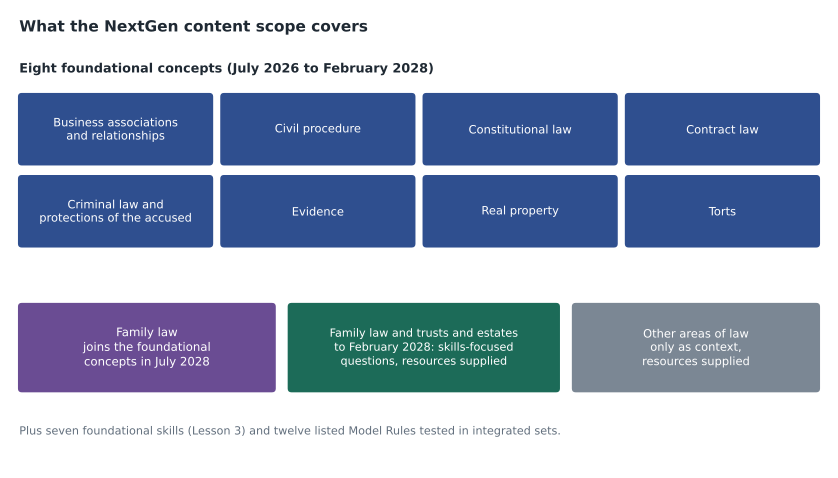
From July 2026 through February 2028, the content scope lists eight foundational concepts and principles:
1. Business associations and relationships, which covers agency, partnerships, corporations and limited liability companies. 2. Civil procedure. 3. Constitutional law. 4. Contract law. 5. Criminal law, including the constitutional protections of accused persons. 6. Evidence. 7. Real property. 8. Torts.
Seven of the eight are familiar from the MBE. The newcomer is business associations, which the legacy exam tested only on the MEE. Criminal procedure, an MBE subject, now sits inside criminal law as the constitutional protections of accused persons: searches and seizures, interrogation, the right to counsel and related rights.
NCBE's blueprint says the standalone multiple-choice questions cover the eight concepts in approximately equal numbers. With 100 scored multiple-choice questions, that is roughly a dozen per subject. Integrated question sets and performance tasks do not distribute the concepts equally; they draw on whatever the scenario requires.
Family law is scheduled to join the list starting with the July 2028 exam, making nine. NCBE has published a separate family law outline in advance, and its sourcebook series plans a family law volume in 2027 for that reason.
Areas that appear with materials supplied
The content scope also says what happens to areas of law outside the eight. From July 2026 through February 2028, family law and trusts and estates appear in skills-focused questions on every exam. You are not expected to know those subjects in advance; the exam supplies the legal resources you need, such as a statute, a regulation or a case, and the question tests a skill, for example drafting a provision, advising a client or researching an answer. Other areas of law appear only as context, again with the necessary legal resources supplied.
This is a real change from the legacy exam, where the MEE tested family law and trusts and estates from memory until July 2026. Ngozi, who made flashcards for both subjects before NCBE dropped them from the MEE, asks whether they were wasted. 'Not wasted,' Marchetti says. 'Knowing the vocabulary makes the supplied materials faster to read. But on NextGen you will never be asked to recite the rule against perpetuities from memory. You will be asked to use a statute they give you.'
Starred and unstarred topics
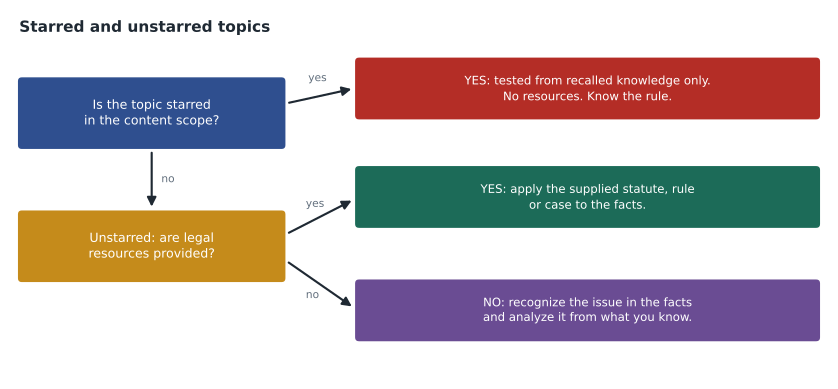
Within each foundational concept, the outline lists specific topics, and some topics carry a star. The star tells you how the topic can be tested.
A starred topic is tested only from recalled knowledge. No legal resources are provided. If a question raises a starred topic, you must know the rule.
An unstarred topic may be tested either way. Sometimes the question supplies legal resources, such as a statute or a case excerpt, and asks you to apply them. Sometimes it does not, and then you must recognize that the topic is at issue in the facts. NCBE's point is that a new lawyer should at least spot these issues, even if a careful lawyer would then look the rule up.
NCBE updated the outline in August 2025 for the July 2026 and February 2027 administrations. Some topics that were unstarred in earlier drafts became starred, and some topic descriptions gained more detail. NCBE later extended that content scope period through February 2028 and said the extension changed only the time frame, not the content or the testing expectations. Use the current version from NCBE's website, not a copy saved from a study guide.
Bar-prep providers who have studied the outline report broad patterns. In civil procedure, most core topics, such as subject-matter and personal jurisdiction, pleadings, joinder, discovery, motions to dismiss, summary judgment and judgments, are starred. In criminal law, nearly all of the constitutional procedure topics are starred, while some general principles of crimes and defenses are not. Evidence is heavily starred. In torts, intentional torts, negligence, strict liability and products liability are starred, while topics such as defamation and privacy are not. These are summaries; the outline itself is the authority, and a topic's star can decide whether you memorize it or simply learn to recognize it.
| Kind of topic | Tested how | How to study it |
|---|---|---|
| Starred topic in a foundational concept | From memory only | Learn the rule precisely and practice applying it |
| Unstarred topic in a foundational concept | With resources, or without them as an issue to spot | Know what the issue is and the main idea; practice reading supplied rules |
| Family law or trusts and estates (to February 2028) | In skills-focused questions, with resources supplied | Learn vocabulary and structure; practice using supplied statutes |
| Other areas of law | Only as context, with resources supplied | No memorization; practice reading unfamiliar law quickly |
Professional responsibility on the NextGen exam
Legal ethics appears too, but narrowly. The content scope lists selected rules of the American Bar Association's Model Rules of Professional Conduct that may be tested. They are treated like starred topics: you must know them from memory, and only the text of the rules, not the comments, is in scope. NCBE also says they are tested only within integrated question sets that focus on the client-facing skills: client counseling and advising, negotiation and dispute resolution, and client relationship and management. They do not appear in standalone multiple-choice questions.
The listed rules are 1.0 (terminology), 1.1 (competence), 1.2(a) and (d) (scope of representation and allocation of authority), 1.3 (diligence), 1.4 (communications), 1.6(a) and (c) (confidentiality), 1.7 (conflicts of interest with current clients), 3.1 (meritorious claims and contentions), 3.3(a)(1) and (2) (candor toward the tribunal), 4.1 (truthfulness in statements to others), 4.2 (communication with a person represented by counsel) and 4.3 (dealing with unrepresented persons).
That list is far shorter than the MPRE's scope. NCBE also says most jurisdictions will still require the Multistate Professional Responsibility Examination (MPRE) for applicants who take the NextGen exam. Marcus took the MPRE in 2025. 'The MPRE studying paid off,' he says. 'On NextGen the ethics showed up inside a client situation. A lawyer had a chance to talk to the other side, and the question was whether she could.'
How deep is deep enough?
A shorter list of subjects does not mean shallower questions. NCBE describes the new exam as testing a focused set of concepts in context. In practice, that means questions ask you to apply a rule to a realistic situation, often with several steps, rather than to recognize an obscure exception. The legacy MBE rewarded breadth: dozens of narrow rules in each subject. The NextGen exam rewards knowing the central rules well enough to use them while doing something else, such as advising a client or editing a document.
NCBE has also published a series of digital sourcebooks, produced with West Academic, as companions to the content scope. They explain the legal concepts and principles within the scope of each subject. The first two volumes, contract law and real property, appeared in September 2025, and the others followed through early 2026. They are sold in NCBE's store, and some law school libraries provide access through West Academic's collection. Andre's school library has them. 'They're not a commercial outline,' he reports. 'They're more like a statement of exactly which rules are in.'
Worked problem
Reading one topic line
Tessa reads a civil procedure topic in the outline that concerns personal jurisdiction, and sees that it is starred. In the same subject she finds a topic that is unstarred.
Show solution
- Starred: personal jurisdiction will be tested without resources. She must be able to state the minimum contacts test, specific and general jurisdiction, and consent, and apply them to new facts.
- Unstarred: she may be given the governing rule in a question, or asked to notice the issue in a fact pattern without it.
- She marks the starred topic for flashcards and timed practice, and the unstarred one for recognition practice: what facts signal the issue, and what would a lawyer look up?
- She checks the sourcebook for the scope of each topic so she does not over-study details outside the scope.
Answer: The star tells Tessa how to study, not just what to study. A starred topic needs a rule she can state; an unstarred topic needs an issue she can spot.
Building your own content checklist
Marchetti's homework for the week is mechanical but useful. Turn the outline into a checklist with one row per topic. Add three columns: starred or unstarred, your current confidence from one to five, and the source you will study from. Then sort by star and confidence. 'You will be surprised how much of your old MBE material is still on the list,' she says, 'and how much is not.'
Andre's spreadsheet already has the rows. He adds a fourth column for practice questions completed, because, as Marcus warns, the outline is necessary but not sufficient. 'Knowing the topics was half of it,' Marcus says. 'The other half was the skills. That's next week.'
Common mistakes
MistakeThe NextGen exam tests the same seven subjects as the MBE.
InsteadIt tests eight foundational concepts, adding business associations and folding criminal procedure into criminal law.
MistakeI need to memorize family law and trusts and estates for 2027.
InsteadThrough February 2028 they appear only in skills-focused questions with resources supplied; family law joins the concepts in July 2028.
MistakeAn unstarred topic will never be tested.
InsteadUnstarred topics can be tested with resources, or without them as issues you must spot.
MistakeProfessional responsibility can appear in any multiple-choice question.
InsteadThe selected Model Rules are tested from memory, only within integrated question sets on the client-facing skills.
Comparing the scope with the MBE
Ngozi, who has done hundreds of MBE questions, asks how much of that work carries over. Marchetti answers with a rule of thumb rather than a list. The core of each MBE subject, such as formation and breach in contracts, negligence in torts, hearsay in evidence, jurisdiction and pleading in civil procedure, and the major constitutional doctrines, sits squarely within the NextGen scope. The edges are where the scopes differ. Some narrow topics the MBE tested are outside the NextGen scope or appear only with materials supplied, and some topics are framed more practically, the way a new lawyer would meet them. The way to find out is the same for every subject: put the outline next to your MBE notes and mark each topic in, out or with materials.
That exercise also shows where the NextGen exam asks for more. Business associations is new to multiple choice. Professional responsibility now appears inside client scenarios. And because every question tests a skill, a topic you know well may appear in an unfamiliar form, such as a question about which fact to investigate rather than which party wins. Knowing the scope is the first step; the rest of this course covers the forms.
Using the content scope during practice
The outline is also a review tool after practice. When you miss a question, find the topic line it tested and check its star. A missed starred topic is a memory gap: make a flashcard and redo similar questions within a week. A missed unstarred topic where resources were supplied is a reading gap: practice applying supplied rules more carefully. A missed unstarred topic without resources is a recognition gap: list the facts that should have signaled the issue. Over a few weeks, Andre finds that his misses cluster in two places, starred evidence topics and unstarred property topics he did not recognize, and he adjusts his schedule accordingly.
Marchetti also warns against a common overcorrection. 'Some people read starred and unstarred and decide unstarred means skip,' she says. 'That's a mistake. You won't need every detail, but you need to know the issue exists and roughly how it works, or you won't recognize it when they hand you a fact pattern with no statute attached.'
Tessa's checklist, finished a week later, has a little over two hundred rows. About half are starred. 'It looked enormous at first,' she says. 'Then I realized I already knew most of the starred rows from my MBE practice, and the unstarred ones mostly needed recognition, not memorization. The list made the exam smaller, not bigger.'
Summary and key terms
- The content scope has two halves: eight foundational concepts and principles, and seven foundational skills.
- Family law joins the concepts in July 2028; until then family law and trusts and estates appear in skills questions with materials supplied.
- Starred topics are tested from memory only; unstarred topics may be tested with resources or as issues to spot.
- Twelve selected Model Rules are tested from memory within integrated question sets on client-facing skills; most jurisdictions still require the MPRE.
- NCBE's sourcebooks explain the rules within the scope of each subject.
- Content scope
- NCBE's official outline of the concepts and skills tested on the NextGen exam.
- Foundational concepts and principles
- The areas of law the NextGen exam expects new lawyers to know.
- Starred topic
- A topic tested only from recalled knowledge, without resources.
- Unstarred topic
- A topic that may be tested with resources supplied or as an issue to recognize without them.
- Sourcebook
- One of NCBE's digital companions to the content scope, explaining the rules within scope for a subject.
Lesson quiz · 5 questions
Score 60% or more to complete this lesson.
Create a free account to save your progress, take quizzes and earn a certificate.