
BAR-111 · Lesson 7 of 12 · 23 min
Estates, future interests and co-ownership
▶ Video coming soon A video version of this lesson is on the way.
Real property begins on Monday, November 2, with Sofia announcing that she has made 150 flashcards on future interests. 'Good,' Marchetti says, 'but the MBE does not ask you to recite definitions. It gives you a grant and asks what each person owns, now and later.' She explains that NCBE's outline divides Real Property into five areas, each producing about a fifth of the questions: ownership of real property, rights in real property, real estate contracts, mortgages and security devices, and titles. This lesson covers ownership: present estates, future interests, the Rule Against Perpetuities, co-ownership and a few related topics. Lessons 8 and 9 cover the rest.
Real property questions on the MBE follow generally accepted principles, and often supply the relevant statute, such as a recording act or a state's version of the Rule Against Perpetuities. If a statute is given, apply it exactly as written.
Present possessory estates
A fee simple absolute is the largest estate: potentially infinite duration, freely transferable, devisable and descendible. It is created by a grant 'to A' or, traditionally, 'to A and her heirs,' where 'and her heirs' are words of limitation that give the heirs nothing. A fee tail, created by 'to A and the heirs of her body,' has been abolished in most states and usually becomes a fee simple.
Defeasible fees can end on the occurrence of an event. A fee simple determinable uses durational language such as 'so long as,' 'while' or 'until': 'to the school so long as the land is used for school purposes.' It ends automatically when the condition is broken, and the grantor keeps a possibility of reverter. A fee simple subject to a condition subsequent uses conditional language such as 'but if' or 'provided that,' plus a right of reentry: 'to the school, but if the land is not used for school purposes, the grantor may reenter.' It does not end automatically; the grantor must exercise the right of entry. A fee simple subject to executory limitation passes the property to a third party, not the grantor, when the condition is broken: 'to the school, but if the land is not used for school purposes, to the church.' The third party holds an executory interest.
A life estate lasts for the life of a person, usually the grantee ('to A for life') or occasionally another person (a life estate pur autre vie, 'to A for the life of B'). The life tenant may use the land and take its ordinary profits but may not commit waste. Voluntary waste is affirmative damage, such as tearing down a building or exploiting natural resources, which is allowed only under the open mines doctrine or if the grant permits it. Permissive waste is failing to maintain the property or pay taxes and interest on a mortgage, up to the income the property produces or its reasonable rental value. Ameliorative waste, changing the property in a way that increases its value, is traditionally prohibited but is allowed by modern courts if the remaindermen are protected and the change reflects changed circumstances.
Future interests
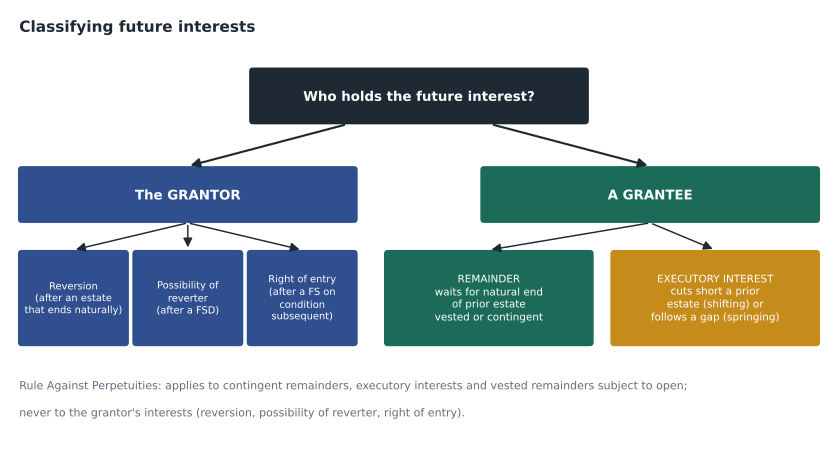
Future interests are classified by who holds them. Interests retained by the grantor are reversions, which follow an estate that will naturally end, such as a life estate; possibilities of reverter, which follow a fee simple determinable; and rights of entry, which follow a fee simple subject to a condition subsequent. Interests created in a grantee are remainders and executory interests.
A remainder is a future interest in a grantee that can become possessory only on the natural end of the prior estate, never by cutting it short. A vested remainder is created in an ascertained person and is not subject to a condition precedent. It may be indefeasibly vested, vested subject to complete defeasance (subject to a condition subsequent), or vested subject to open, when it belongs to a class, such as 'A's children,' that may gain members. A contingent remainder is either created in an unascertained person, such as the unborn or 'A's heirs' while A is alive, or subject to a condition precedent, such as 'to B if B graduates from law school.' The distinction matters because contingent remainders were destructible at common law and are subject to the Rule Against Perpetuities, while vested remainders are not, except vested remainders subject to open.
An executory interest is a future interest in a grantee that can become possessory only by cutting short a prior estate (a shifting executory interest) or by following a gap after the grantor's interest (a springing executory interest). 'To A, but if B returns from Rome, to B' gives B a shifting executory interest. 'To A when she marries' gives A a springing executory interest; the grantor keeps a fee simple subject to it.
| Grant (O is the grantor) | Present interest | Future interest |
|---|---|---|
| To A so long as used for a farm | A: fee simple determinable | O: possibility of reverter |
| To A, but if not used for a farm, O may reenter | A: fee simple subject to condition subsequent | O: right of entry |
| To A, but if not used for a farm, to B | A: fee simple subject to executory limitation | B: shifting executory interest |
| To A for life, then to B | A: life estate | B: indefeasibly vested remainder |
| To A for life, then to B if B reaches 25 (B is 20) | A: life estate | B: contingent remainder; O: reversion |
| To A for life, then to A's children (A has one child, C) | A: life estate | C: vested remainder subject to open |
Rules that limit future interests
Several old rules still appear. The Rule in Shelley's Case, abolished in most states, turned 'to A for life, then to A's heirs' into a fee simple in A. The Doctrine of Worthier Title, still followed as a rule of construction in some states, presumes that 'to A for life, then to O's heirs' gives O a reversion, not O's heirs a remainder. The destructibility of contingent remainders, also largely abolished, destroyed a contingent remainder that had not vested when the prior estate ended. Unless a question signals otherwise, assume these have been abolished, but know their effect.
The Rule Against Perpetuities says that no interest is good unless it must vest, if at all, not later than 21 years after some life in being at the creation of the interest. It applies to contingent remainders, executory interests, vested remainders subject to open, options to purchase not held by a current tenant, and rights of first refusal in many states. It does not apply to interests retained by the grantor, such as reversions, possibilities of reverter and rights of entry, or to indefeasibly vested remainders. The rule is a rule of logical proof: if there is any possible scenario, however unlikely, in which the interest vests too late, the interest is void from the start. The classic traps are the fertile octogenarian, the unborn widow, and the slothful executor or administrative contingency, such as 'to my descendants living when my estate is distributed.'
There is a charity-to-charity exception: a gift over from one charity to another on a condition is valid even if it might vest too remotely. Many states have reformed the rule through wait-and-see statutes, cy pres reformation, or the Uniform Statutory Rule Against Perpetuities, which validates an interest that actually vests within 90 years. If a question supplies a reform statute, apply it; if not, apply the common-law rule.
Restraints on alienation are also limited. A disabling restraint, which voids any attempt to transfer, is void for a fee simple. Forfeiture and promissory restraints on a fee simple are generally void too, but reasonable restraints, such as a right of first refusal, are valid. Restraints on life estates are more often upheld.
Co-ownership
A tenancy in common gives each co-tenant an undivided interest in the whole, with no right of survivorship; each share passes by will or intestacy. Modern law presumes a tenancy in common when a conveyance is to two or more people who are not married. A joint tenancy carries the right of survivorship: when one joint tenant dies, the survivors take the whole. At common law it required the four unities of time, title, interest and possession, and most states now also require clear language, such as 'as joint tenants with right of survivorship.'
A joint tenancy is severed, converting it into a tenancy in common as to the severing tenant's share, when a joint tenant conveys his interest to a third party during life. If A, B and C are joint tenants and A conveys to D, then D holds a one-third share as a tenant in common, while B and C remain joint tenants with each other as to two thirds. A joint tenant's will cannot sever, because the interest passes to the survivors at death before the will operates. Whether a mortgage severs depends on the state: in title-theory states it does; in lien-theory states, the majority, it does not, and in many lien-theory states the mortgage is extinguished when the mortgagor dies. A lease by one joint tenant may or may not sever, depending on the state.
A tenancy by the entirety is a joint tenancy between married persons, recognized in about half the states. Neither spouse alone can sever it or convey his or her interest, and creditors of only one spouse cannot reach the property. Divorce converts it into a tenancy in common.
Co-tenants each have the right to possess the whole property. One co-tenant in sole possession owes no rent to the others unless there has been ouster, meaning he excluded them, or an agreement to pay. A co-tenant who collects rent from third parties must account to the others for their shares of the net rents. Co-tenants must contribute to necessary carrying costs such as taxes and mortgage interest in proportion to their shares, but generally not to improvements, though the improver gets credit for added value on partition. Any co-tenant may seek partition, in kind if feasible or by sale.
Worked problem
Joint tenancy and severance
O conveys Blackacre "to A, B and C as joint tenants with right of survivorship." A conveys her interest to D. Then B dies, leaving a will giving everything to E. Who owns Blackacre, and how?
Show solution
- A's conveyance to D severed the joint tenancy as to A's one-third share. D holds one third as a tenant in common.
- B and C remain joint tenants with each other as to the other two thirds.
- When B dies, C takes B's interest by survivorship; B's will gives E nothing, because B's interest ended at death.
Answer: C owns two thirds and D owns one third, as tenants in common.
Other ownership topics: marital property and conversions
In community property states, property acquired during marriage by either spouse is generally owned equally by both, while property acquired before marriage or by gift or inheritance is separate property. Common-law states give a surviving spouse an elective share. Equitable conversion, covered with real estate contracts in Lesson 9, treats the buyer under a signed contract as the equitable owner of the land before closing.
Practice problems
Work each problem on paper first, then reveal the answer to check.
What future interest follows a fee simple subject to a condition subsequent?
Show answer
A right of entry (power of termination), retained by the grantor.
Is a remainder "to B if B survives A" vested or contingent?
Show answer
Contingent, because survival is a condition precedent.
Does the Rule Against Perpetuities apply to a possibility of reverter?
Show answer
No. Interests retained by the grantor are not subject to it.
One of three joint tenants mortgages her interest in a lien-theory state. Is the joint tenancy severed?
Show answer
No, under the majority lien-theory rule.
A co-tenant lives alone on the property. Must he pay rent to the other co-tenants?
Show answer
No, absent ouster or an agreement.
Can a creditor of one spouse reach property held by tenancy by the entirety?
Show answer
No.
Common mistakes
MistakeA fee simple determinable ends only when the grantor sues.
InsteadIt ends automatically; a fee simple subject to condition subsequent requires the grantor to act.
MistakeAn executory interest can follow a life estate naturally.
InsteadAn interest that waits for the natural end of a prior estate is a remainder; executory interests cut short or follow a gap.
MistakeA joint tenant can leave her share to someone by will.
InsteadSurvivorship operates at death, so a will cannot sever a joint tenancy.
MistakeThe Rule Against Perpetuities asks what will probably happen.
InsteadAt common law it asks whether vesting could possibly occur too late.
A method for perpetuities questions
Marchetti gives the group a four-step routine for any perpetuities question. First, classify every interest in the grant and set aside those the rule does not touch: interests retained by the grantor and indefeasibly vested remainders. Second, for each remaining interest, identify what must happen for it to vest, such as a person being born, reaching an age, or an event occurring. Third, look for a validating life: a person alive when the interest was created whose life, plus 21 years, will certainly see the interest vest or fail. For a will, the interest is created at the testator's death; for a deed, at delivery; for a revocable trust, when it becomes irrevocable. Fourth, try to kill everyone. Imagine that every person alive at creation dies the next day and that new people are born; if the interest could still vest more than 21 years later, it is void, and you strike it from the grant and reclassify what remains.
Sofia tries the routine on a grant 'to A for life, then to A\'s children for life, then to A\'s grandchildren.' A's children are measured by A's life, so their remainder is valid. But A could have another child after the grant, that child could have children decades after A and all existing children die, and so the grandchildren's remainder fails. Striking it leaves a reversion in the grantor after the children's life estates. 'That last step is where people lose points,' Marchetti says. 'When you strike a void interest, the grantor usually keeps what is left.'
Summary and key terms
- Identify the present estate from the language: fee simple, defeasible fees (determinable, condition subsequent, executory limitation) and life estates.
- Classify future interests by holder: grantor (reversion, possibility of reverter, right of entry) or grantee (vested or contingent remainder, executory interest).
- The Rule Against Perpetuities voids interests that might vest more than 21 years after a life in being; know its traps and exceptions.
- Tenancy in common is presumed; joint tenancy carries survivorship and is severed by inter vivos conveyance; entireties are for spouses.
- Co-tenants share possession; rent is owed only after ouster; carrying costs are shared and third-party rents accounted for.
- Fee simple determinable
- An estate that ends automatically when a stated condition occurs, leaving a possibility of reverter.
- Contingent remainder
- A remainder in an unascertained person or subject to a condition precedent.
- Executory interest
- A future interest in a grantee that cuts short a prior estate or follows a gap.
- Rule Against Perpetuities
- The rule that an interest must vest, if at all, within 21 years after a life in being at its creation.
- Severance
- An act, such as a conveyance by one joint tenant, that converts a joint tenancy into a tenancy in common.
Lesson quiz · 5 questions
Score 60% or more to complete this lesson.
Create a free account to save your progress, take quizzes and earn a certificate.