
BAR-111 · Lesson 4 of 12 · 22 min
Evidence: relevance and character
▶ Video coming soon A video version of this lesson is on the way.
Eddie Boudreaux logs in on Monday, October 12, for the start of the evidence weeks. Louisiana's Code of Evidence follows the federal rules closely, he explains, so he wants the same drills even though his exam has no MBE. Marchetti puts NCBE's instruction on the screen: all Evidence questions are answered according to the Federal Rules of Evidence as currently in effect. 'Not your state's rules, not the common law,' she says. 'And watch the date: the federal rules change more often than most people think.' She points out that a set of amendments took effect on December 1, 2024, and another, to the hearsay rule for prior inconsistent statements, takes effect on December 1, 2026. Lesson 5 covers that change.
According to NCBE's outline, about a quarter of Evidence questions come from presentation of evidence, a third from relevance and the reasons for excluding relevant evidence, a quarter from hearsay, and the rest from privileges and writings. This lesson covers relevance, Rule 403 and the character rules, the largest block.
Relevance: Rules 401 and 402
Evidence is relevant if it has any tendency to make a fact more or less probable than it would be without the evidence, and the fact is of consequence in determining the action (Rule 401). The standard is very low: evidence need not prove the point, only move the needle. Relevant evidence is admissible unless the Constitution, a statute, the rules or other Supreme Court rules provide otherwise, and irrelevant evidence is never admissible (Rule 402).
Conditional relevance under Rule 104(b) arises when relevance depends on whether a fact exists, such as whether a letter was actually received. The judge admits the evidence if there is enough proof for a reasonable jury to find the fact. By contrast, under Rule 104(a), the judge alone decides preliminary questions about admissibility, such as whether a hearsay exception applies or whether a privilege exists, by a preponderance of the evidence, and is not bound by the rules of evidence except privileges.
Rule 403
The court may exclude relevant evidence if its probative value is substantially outweighed by a danger of unfair prejudice, confusing the issues, misleading the jury, undue delay, wasting time or needlessly presenting cumulative evidence. The balance tilts toward admission: the danger must substantially outweigh the value. Unfair prejudice means a tendency to suggest decision on an improper basis, usually emotional, not simply that the evidence hurts a party's case. On the MBE, an answer that excludes evidence because it is 'prejudicial' is usually wrong unless the facts show unfair prejudice that substantially outweighs a modest probative value, such as gruesome photographs offered to prove an undisputed point.
Rule 105 requires the court, on request, to give a limiting instruction when evidence is admissible for one purpose or against one party but not another. Many MBE answers that say 'admissible, but only for the limited purpose of' are correct for this reason.
Character evidence: the general rule
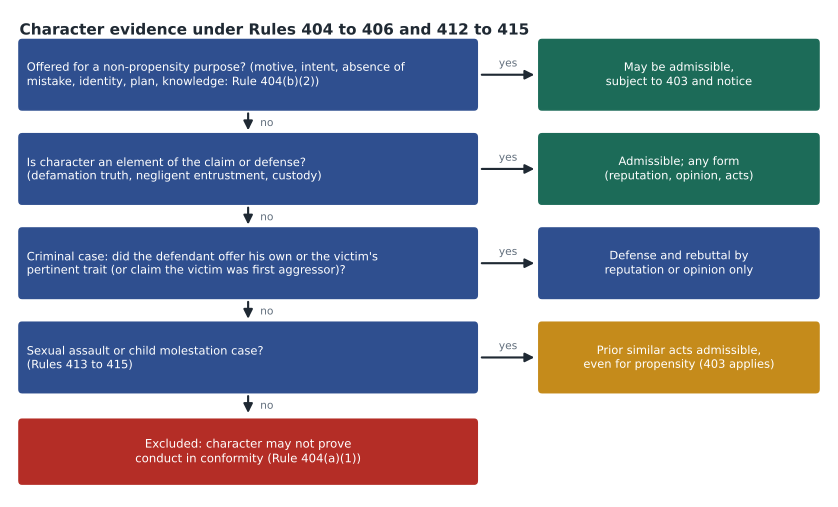
Rule 404(a)(1) bars evidence of a person's character or character trait to prove that on a particular occasion the person acted in accordance with it. This is the propensity ban, and it applies in civil and criminal cases. Rule 404(b)(1) applies the same ban to evidence of other crimes, wrongs or acts. The rules then create exceptions, and the MBE's character questions are mostly about which exception applies and what form the evidence must take.
Character evidence is admissible when character is itself an element of a claim or defense, such as truth in a defamation case where the plaintiff's character is the subject of the statement, negligent entrustment or hiring, or child custody. In those cases, under Rule 405(b), any form of proof is allowed: reputation, opinion and specific instances of conduct.
The criminal defendant's door
In a criminal case, the defendant may offer evidence of his own pertinent trait, such as peacefulness in an assault case or honesty in a fraud case (Rule 404(a)(2)(A)). That opens the door: the prosecution may rebut with evidence of the same trait. The defendant may also offer evidence of the alleged victim's pertinent trait, such as the victim's violence in a self-defense case, subject to the rape shield rule (Rule 404(a)(2)(B)). If he does, the prosecution may rebut with evidence of the victim's same trait and may also offer evidence that the defendant has the same trait. In a homicide case, the prosecution may offer evidence of the victim's peacefulness to rebut any evidence that the victim was the first aggressor (Rule 404(a)(2)(C)).
Form matters. When character is used circumstantially under Rule 404(a)(2), proof is limited to reputation and opinion on direct examination. On cross-examination of a character witness, the cross-examiner may inquire into relevant specific instances of conduct, phrased as 'Have you heard' or 'Did you know,' to test the witness's basis, but must have a good-faith basis and is stuck with the answer; extrinsic evidence of the specific act is not allowed (Rule 405(a)).
Other acts for non-character purposes: Rule 404(b)(2)
Evidence of other crimes, wrongs or acts is admissible when offered for a purpose other than propensity, such as motive, opportunity, intent, preparation, plan, knowledge, identity, absence of mistake or lack of accident. The usual memory aid is MIMIC: motive, intent, absence of mistake, identity and common plan. Identity through other acts requires a signature modus operandi, similar enough to mark the crimes as the work of one person. The court must still apply Rule 403, and the other act need be proved only by enough evidence for a jury to find, by a preponderance, that the defendant committed it (Huddleston v. United States, 1988). In a criminal case, the prosecution must give reasonable written notice before trial of any 404(b) evidence it intends to offer, stating the permitted purpose and the reasoning that supports it; the notice requirement was strengthened by a 2020 amendment.
Sexual assault and child molestation cases: Rules 412 to 415
Rule 412, the rape shield rule, bars evidence offered to prove that a victim engaged in other sexual behavior or to prove the victim's sexual predisposition, in civil and criminal cases involving alleged sexual misconduct. In criminal cases, three exceptions apply: specific instances offered to prove that someone other than the defendant was the source of semen, injury or other physical evidence; specific instances of sexual behavior with the defendant offered to prove consent or by the prosecution; and evidence whose exclusion would violate the defendant's constitutional rights. In civil cases, the court may admit such evidence if its probative value substantially outweighs the harm to the victim and unfair prejudice to any party, a balancing test reversed from Rule 403, and reputation evidence is admissible only if the victim placed it in controversy. The party offering Rule 412 evidence must file a motion at least 14 days before trial, and the court holds a hearing in camera.
Rules 413 and 414 go the other way. In a criminal case for sexual assault or child molestation, evidence that the defendant committed any other sexual assault or child molestation is admissible and may be considered on any matter to which it is relevant, including propensity. Rule 415 extends the same rule to civil cases based on sexual assault or child molestation. Rule 403 still applies.
Habit and routine practice: Rule 406
Evidence of a person's habit or an organization's routine practice is admissible to prove that on a particular occasion the person or organization acted in accordance with it, regardless of corroboration or the presence of an eyewitness. Habit is a regular response to a repeated specific situation, nearly automatic, such as always using a turn signal at a particular corner or a law office's routine practice of mailing letters at five each day. A general disposition, such as being a careful driver or a heavy drinker, is character, not habit.
Policy exclusions: Rules 407 to 411
Several rules exclude relevant evidence to encourage socially useful conduct. Under Rule 407, subsequent remedial measures, such as repairing a staircase or adding a warning after an accident, are inadmissible to prove negligence, culpable conduct, a product or design defect or the need for a warning. They are admissible for other purposes, such as impeachment or, if disputed, proving ownership, control or the feasibility of precautionary measures.
Under Rule 408, offers to compromise a disputed claim and statements made during compromise negotiations are inadmissible to prove or disprove the validity or amount of the claim or to impeach by prior inconsistent statement. There must be an actual dispute about validity or amount. The rule does not bar the evidence when offered for another purpose, such as proving a witness's bias, and statements made in negotiations with a public office in its regulatory or enforcement capacity may be used in a later criminal case.
Under Rule 409, offers to pay medical or similar expenses resulting from an injury are inadmissible to prove liability, but statements accompanying them, such as 'It was my fault,' are not protected. Rule 410 excludes withdrawn guilty pleas, pleas of nolo contendere, statements made during plea proceedings, and statements made during plea discussions with an attorney for the prosecuting authority that do not result in a guilty plea, when offered against the person who made the plea or participated in the discussions. Rule 411 excludes evidence of liability insurance to prove negligence, but allows it for other purposes such as proving agency, ownership, control or a witness's bias.
| Rule | What is excluded | To prove | Allowed for |
|---|---|---|---|
| 407 | Subsequent remedial measures | Negligence, culpable conduct, defect, need for warning | Impeachment; ownership, control or feasibility if disputed |
| 408 | Compromise offers and statements in negotiations | Validity or amount of a disputed claim; impeachment by inconsistency | Bias, undue delay, obstruction; some criminal uses |
| 409 | Offers to pay medical expenses | Liability | Accompanying admissions are not protected |
| 410 | Withdrawn pleas, nolo pleas, plea discussions with prosecutors | Against the defendant who made them | Limited: completeness; perjury prosecutions |
| 411 | Liability insurance | Negligence or wrongful conduct | Agency, ownership, control, bias |
Judicial notice and presumptions
Under Rule 201, a court may take judicial notice of an adjudicative fact not subject to reasonable dispute because it is generally known within the court's territorial jurisdiction or can be accurately and readily determined from sources whose accuracy cannot reasonably be questioned. In a civil case, the court instructs the jury to accept the noticed fact as conclusive; in a criminal case, the jury may, but need not, accept it. Judicial notice may be taken at any stage, including on appeal. In civil cases, Rule 301 provides that a presumption shifts the burden of producing evidence to the party against whom it operates, but not the burden of persuasion, unless a statute or rule provides otherwise; in diversity cases, state law governs the effect of a presumption on a claim or defense governed by state law (Rule 302).
Worked problem
Character in a self-defense case
A defendant charged with battery claims the alleged victim attacked first. The defendant calls a witness who testifies that the victim has a reputation for violence. In rebuttal, the prosecution calls a witness to testify that the defendant has a reputation for violence and offers evidence that the defendant was convicted of an assault five years ago. Which rebuttal evidence is admissible?
Show solution
- By offering evidence of the victim's violent character under Rule 404(a)(2)(B), the defendant opened the door to evidence of the same trait in himself under Rule 404(a)(2)(B)(ii).
- Under Rule 405(a), that rebuttal must be by reputation or opinion on direct examination, so the reputation witness is proper.
- The prior conviction is a specific instance offered for propensity; it is not admissible for that purpose on direct, although the prosecution could ask the defendant's character witnesses about it on cross-examination if any testify to the defendant's peacefulness, or use it to impeach the defendant under Rule 609 if he testifies and its conditions are met.
Answer: The reputation testimony is admissible; the conviction is not admissible as substantive propensity evidence.
Practice problems
Work each problem on paper first, then reveal the answer to check.
What is the standard for relevance under Rule 401?
Show answer
Any tendency to make a fact of consequence more or less probable.
In a criminal case, may the prosecution first offer evidence of the defendant's violent character?
Show answer
No. Only after the defendant opens the door, or under Rules 413 and 414 in sex offense cases.
Is evidence that a driver is generally careful admissible as habit?
Show answer
No. That is a character trait, not a specific, repeated response.
After an accident, a store installs a handrail. Can the plaintiff use that to prove negligence?
Show answer
No, under Rule 407; it may be admissible to prove feasibility if the store disputes it.
A driver says to the person he hit, "I'll pay your hospital bills; I was texting." What is admissible?
Show answer
The admission "I was texting." The offer to pay medical bills is excluded under Rule 409.
What form of character proof is allowed when character is an element of a claim?
Show answer
Reputation, opinion and specific instances of conduct (Rule 405(b)).
Common mistakes
MistakeEvidence is inadmissible whenever it is prejudicial.
InsteadRule 403 excludes only when unfair prejudice substantially outweighs probative value.
MistakeA character witness can describe specific good acts on direct.
InsteadCircumstantial character proof on direct is reputation or opinion only.
MistakeRule 404(b) evidence must be proved beyond a reasonable doubt.
InsteadHuddleston requires only enough evidence for a jury to find it by a preponderance.
MistakeRule 408 protects any apology for an accident.
InsteadThere must be a disputed claim and a compromise offer or negotiations.
Summary and key terms
- Relevance is a low bar; Rule 403 excludes only when dangers substantially outweigh probative value.
- Character cannot prove conduct in conformity, except through the criminal defendant's door, the homicide first-aggressor rule and Rules 413 to 415.
- On direct, circumstantial character proof is reputation or opinion; specific acts may be asked about on cross; any form is allowed when character is an element.
- Other acts are admissible for non-propensity purposes (MIMIC) with notice in criminal cases; habit is admissible to prove conduct.
- Rules 407 to 411 exclude remedial measures, compromises, medical payments, plea discussions and insurance for specific purposes only.
- Relevant evidence
- Evidence with any tendency to make a fact of consequence more or less probable.
- Unfair prejudice
- A tendency to suggest decision on an improper, usually emotional, basis.
- Propensity inference
- Reasoning that because a person has a trait, he acted in accordance with it on the occasion in question.
- Habit
- A regular, nearly automatic response to a repeated specific situation.
- Rape shield rule
- Rule 412, which generally excludes evidence of a victim's other sexual behavior or predisposition.
Lesson quiz · 5 questions
Score 60% or more to complete this lesson.
Create a free account to save your progress, take quizzes and earn a certificate.