
BAR-111 · Lesson 11 of 12 · 24 min
Intentional torts, strict liability and products liability
▶ Video coming soon A video version of this lesson is on the way.
The second Friday torts session, on October 23, covers everything in NCBE's torts outline outside negligence: intentional torts, strict liability and products liability, and a group the outline calls other torts, which includes nuisance, defamation, invasion of privacy, misrepresentation and interference with business relations. Sofia says she always mixes up the strict liability and negligence versions of products cases. 'That is exactly what the MBE wants,' Marchetti says. 'A products question can be framed in negligence, in strict liability or in warranty, and the answer often turns on which theory the plaintiff chose.' Together these areas produce about half of the torts questions.
Intent and the intentional torts to the person
Intent in tort means the defendant acted with the purpose of causing the consequence or knew with substantial certainty that it would result. Under the doctrine of transferred intent, if the defendant intends to commit assault, battery, false imprisonment, trespass to land or trespass to chattels against one person and instead commits any of those torts, or harms another person, the intent transfers. Motive is irrelevant, and children and mentally ill persons can form tortious intent; in Garratt v. Dailey (Wash. 1955), a five-year-old who pulled a chair away knowing with substantial certainty that the plaintiff would try to sit there could be liable for battery.
Battery is an intentional harmful or offensive contact with the plaintiff's person, including anything connected to it, such as a hat being worn or a plate being held. Offensive means it would offend a reasonable sense of dignity. The plaintiff need not be aware of the contact when it happens. Assault is an act intended to cause the plaintiff reasonable apprehension of an imminent harmful or offensive contact, which does cause that apprehension. Words alone are usually not enough, unless combined with conduct, and conditional threats ('If you weren't my friend, I'd hit you') may negate imminence. The plaintiff must be aware of the threat.
False imprisonment is an act intended to confine the plaintiff within fixed boundaries, which does confine the plaintiff, who is aware of the confinement or harmed by it. There must be no reasonable means of escape known to the plaintiff. Confinement can be by physical barriers, force, threats, invalid legal authority or failure to release when there is a duty to do so. Shopkeepers have a privilege to detain a suspected shoplifter for a reasonable time, in a reasonable manner, on reasonable belief.
Intentional infliction of emotional distress requires extreme and outrageous conduct, intentionally or recklessly causing severe emotional distress. Conduct that is merely insulting is not enough, but courts are more willing to find outrage when the defendant is a common carrier or innkeeper, the plaintiff is a known vulnerable person such as a child or elderly person, or the conduct is repeated. A bystander can recover if the defendant intentionally harms a close family member in the bystander's presence and the defendant knows the bystander is present. Public figures suing over speech about public matters must also prove actual malice (Hustler Magazine v. Falwell, 1988), and speech on matters of public concern at a public place may be protected even when it causes distress (Snyder v. Phelps, 2011).
Intentional torts to property
Trespass to land is an intentional physical invasion of the plaintiff's real property; the defendant need intend only to enter, not to trespass, so a reasonable mistake about ownership is no defense. Trespass to chattels is an intentional interference with the plaintiff's right of possession in personal property that causes actual damage or dispossession; the remedy is damages for the harm or loss of use. Conversion is an interference so serious that the defendant should pay the full value of the chattel, such as destroying it, selling it or using it for a long time; the plaintiff may recover the chattel's fair market value at the time of conversion, effectively forcing a sale, or replevin to get it back.
Defenses to intentional torts
Consent, express or implied by custom or conduct, is a defense, but not if obtained by fraud about the essential nature of the act or under duress, or if the plaintiff lacked capacity. Exceeding the scope of consent removes the defense. Self-defense, defense of others and defense of property follow the reasonable force rules from criminal law; deadly force may never be used to protect property alone, and a spring gun or similar device is not allowed when the owner could not use deadly force in person (Katko v. Briney, Iowa 1971). A person may reenter land or recapture a chattel by reasonable force when in hot pursuit after a wrongful taking.
Necessity allows interference with another's property to prevent a greater harm. Public necessity, acting to avert a public disaster, is a complete defense. Private necessity, acting to protect oneself or a few people, is a defense to trespass, so the owner may not expel the person, but the actor must pay for any actual damage; in Vincent v. Lake Erie Transportation Co. (Minn. 1910), a shipowner who kept his ship tied to a dock during a storm had to pay for damage to the dock. Ploof v. Putnam (Vt. 1908) held that a dock owner who untied a boat seeking shelter in a storm was liable for the resulting harm.
| Tort | Intent required | Key elements | Common trap |
|---|---|---|---|
| Battery | Intent to cause contact | Harmful or offensive contact | Plaintiff need not be aware at the time |
| Assault | Intent to cause apprehension or contact | Reasonable apprehension of imminent contact | Words alone and future threats usually insufficient |
| False imprisonment | Intent to confine | Bounded area, no known reasonable escape, awareness or harm | Shopkeeper's privilege |
| IIED | Intent or recklessness | Extreme and outrageous conduct; severe distress | Mere insults are not outrageous |
| Trespass to land | Intent to enter | Physical invasion | Mistake about ownership is no defense |
| Conversion | Intent to exercise control | Serious interference; full value | Minor interference is trespass to chattels |
Strict liability
Strict liability applies regardless of fault in three main settings. An owner of a wild animal is strictly liable for injuries caused by the animal's dangerous propensities. An owner of a domestic animal is strictly liable only if the owner knew or had reason to know of the animal's dangerous propensities beyond those normal for its species; the old 'one free bite' rule is less a rule than a description of how knowledge arises. Owners of trespassing livestock are strictly liable for foreseeable damage, though not in some western open-range states.
Abnormally dangerous activities give rise to strict liability for harm that results from the kind of danger that makes the activity abnormally dangerous. Courts consider whether the activity creates a foreseeable risk of serious harm even when reasonable care is used and whether it is uncommon in the community; blasting, crop dusting, storing explosives and transporting hazardous chemicals are typical examples. A plaintiff must still prove actual and proximate cause, and the harm must flow from the abnormal danger: a blaster is not strictly liable when a truck carrying dynamite runs over a pedestrian in an ordinary traffic accident. In most comparative fault states, a plaintiff's own fault reduces recovery even in strict liability cases, and a plaintiff who knowingly assumed the risk may be barred.
Products liability
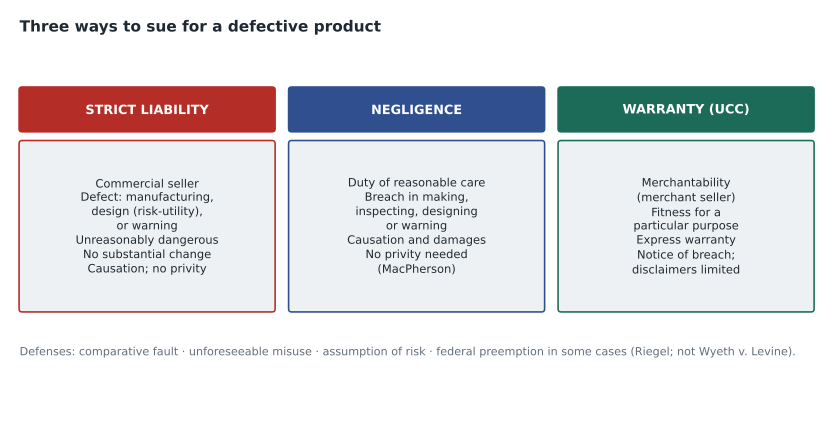
A plaintiff injured by a defective product may sue on several theories, and the MBE expects you to know the elements of each. The most common is strict products liability. A commercial supplier in the business of selling the product, including a manufacturer, distributor or retailer, is strictly liable if it sold the product in a defective condition unreasonably dangerous to users, the product reached the plaintiff without substantial change, and the defect caused the plaintiff's injury. The leading cases are Escola v. Coca-Cola Bottling Co. (Cal. 1944), where Justice Traynor first urged strict liability, and Greenman v. Yuba Power Products (Cal. 1963), which adopted it. Casual sellers, such as a person selling a used lawn mower at a garage sale, are not strictly liable. Privity is not required, so bystanders can recover.
There are three kinds of defects. A manufacturing defect exists when the product departs from its intended design, such as a soda bottle with a hairline crack. A design defect exists when the foreseeable risks of harm could have been reduced or avoided by a reasonable alternative design and the omission makes the product not reasonably safe; most courts now use this risk-utility test, as the Restatement (Third) of Torts: Products Liability (1998) does, though some states also allow the consumer expectations test, asking whether the product was more dangerous than an ordinary consumer would expect. An information defect, or failure to warn, exists when the foreseeable risks could have been reduced by reasonable instructions or warnings. In design and warning cases, the defendant is judged by what was knowable at the time of sale, which makes them close to negligence.
Defenses depend on the theory. Comparative fault reduces recovery. Misuse is a defense only if it was unforeseeable; foreseeable misuse can itself make a product defective if it was not designed or warned against. Assumption of risk, knowingly using a product with a known defect, may bar or reduce recovery. Compliance with government safety standards is evidence that a product is not defective but usually not conclusive. Federal law may preempt state products claims: claims against makers of certain medical devices approved through the FDA's premarket approval process are preempted (Riegel v. Medtronic, 2008), but state failure-to-warn claims against brand-name drug makers generally are not (Wyeth v. Levine, 2009), while such claims against generic drug makers are (PLIVA v. Mensing, 2011).
A plaintiff may also sue in negligence, which requires proof that the defendant failed to use reasonable care in making, inspecting, designing or warning; since MacPherson v. Buick Motor Co. (N.Y. 1916), privity is not required. Retailers who merely pass on sealed products usually are not negligent for failing to inspect. Finally, a plaintiff may sue for breach of warranty under the UCC. The implied warranty of merchantability, given by a merchant seller, promises goods fit for their ordinary purpose; the implied warranty of fitness for a particular purpose arises when the seller knows the buyer's particular purpose and that the buyer relies on the seller's skill; and an express warranty arises from an affirmation of fact or promise that becomes part of the basis of the bargain. Warranty claims require notice of breach within a reasonable time and can be limited by disclaimers, though limitations on consumer personal injury damages are prima facie unconscionable.
Other torts
Nuisance is an interference with the use or enjoyment of land. A private nuisance is a substantial and unreasonable interference with a plaintiff's use and enjoyment of her land, judged by an ordinary person in the community, not a hypersensitive one. A public nuisance is an unreasonable interference with a right common to the public, such as health, safety or morals; a private person may sue only if she suffers harm different in kind from that of the general public. Coming to the nuisance, moving next to an existing nuisance, is a factor but not a complete defense. Courts may award damages or an injunction and sometimes balance the hardships.
Defamation is a defamatory statement of fact about the plaintiff, published to a third person, causing damage. Libel, in written or permanent form, and slander per se, which accuses the plaintiff of a crime, of a loathsome disease, of conduct incompatible with a business or profession or, traditionally, of sexual misconduct, presume damages; other slander requires proof of special, pecuniary damages. The First Amendment adds requirements. A public official or public figure suing over a matter of public concern must prove falsity and actual malice, knowledge of falsity or reckless disregard for the truth, by clear and convincing evidence (New York Times Co. v. Sullivan, 1964). A private figure suing over a matter of public concern must prove falsity and at least negligence, and cannot recover presumed or punitive damages without actual malice (Gertz v. Robert Welch, Inc., 1974). Truth is a defense, and absolute privileges cover statements in judicial and legislative proceedings and between spouses, while qualified privileges, lost through abuse, cover statements made in a legitimate common interest such as an employment reference.
The four privacy torts are appropriation of the plaintiff's name or likeness for commercial advantage; intrusion upon seclusion, an intrusion highly offensive to a reasonable person into private affairs; false light, publicity placing the plaintiff in a false light highly offensive to a reasonable person; and public disclosure of private facts, publicity of private information that is highly offensive and not of legitimate public concern. Fraud, or intentional misrepresentation, requires a knowing false representation of material fact, intent to induce reliance, justifiable reliance and damages; negligent misrepresentation is generally limited to business or professional defendants who supply information to a limited group of foreseeable users. Intentional interference with contract or prospective economic advantage requires a valid contract or expectancy, the defendant's knowledge of it, intentional interference causing breach or termination, and damages, subject to privileges for legitimate competition.
Worked problem
Choosing the products theory
A buyer purchases a new electric space heater from a hardware store. Because of a wiring error at the factory, the heater overheats and burns the buyer's guest, who never bought anything. The store had no way to discover the defect. The guest sues the store in strict products liability. What result?
Show solution
- The store is a commercial seller in the business of selling heaters, so strict liability can apply.
- A wiring error departing from the intended design is a manufacturing defect, making the heater unreasonably dangerous.
- Privity is not required, so the guest can sue, and the store's inability to discover the defect is irrelevant in strict liability, though it would defeat a negligence claim. The store can seek indemnity from the manufacturer.
Answer: The guest wins against the store in strict products liability.
Practice problems
Work each problem on paper first, then reveal the answer to check.
Must the plaintiff be aware of a battery when it happens?
Show answer
No. Awareness is required for assault and false imprisonment, not battery.
A hunter shoots at a deer on land he reasonably but wrongly believes is his own. Is entering the land a trespass?
Show answer
Yes. Intent to enter is enough; mistake about ownership is no defense.
What must a public official prove to recover for defamation about her official conduct?
Show answer
Falsity and actual malice, by clear and convincing evidence.
Is a person who sells a used car once, privately, strictly liable for a defect?
Show answer
No. Strict products liability applies only to commercial sellers.
In private necessity, must the actor pay for damage caused?
Show answer
Yes, for actual damage, though the owner cannot expel him.
Which test do most courts use for design defects today?
Show answer
The risk-utility test with a reasonable alternative design.
Common mistakes
MistakeDeadly force may be used to protect valuable property.
InsteadDeadly force is never justified to protect property alone, including by spring guns.
MistakeA domestic dog's owner is strictly liable for any bite.
InsteadOnly if the owner knew or should have known of the dog's dangerous propensities, unless a statute provides otherwise.
MistakeA retailer who could not discover a defect is not strictly liable.
InsteadStrict liability does not depend on the seller's fault; that argument works only in negligence.
MistakeAll slander requires proof of special damages.
InsteadSlander per se presumes damages.
Summary and key terms
- Intentional torts require purpose or substantial certainty; intent transfers among the five trespass-based torts.
- Know battery, assault, false imprisonment, IIED, trespass to land, trespass to chattels and conversion, and the defenses of consent, self-defense and necessity.
- Strict liability covers wild animals, known dangerous domestic animals and abnormally dangerous activities, for harms within the abnormal risk.
- Products claims may be strict liability (manufacturing, design, warning defects), negligence or warranty; know each one's elements and defenses.
- Other torts: private and public nuisance, defamation with constitutional overlays, the four privacy torts, misrepresentation and interference with business relations.
- Transferred intent
- The doctrine applying the defendant's intent toward one person or tort to the harm actually caused.
- Conversion
- A serious interference with a chattel requiring the defendant to pay its full value.
- Abnormally dangerous activity
- An activity creating a serious risk even with reasonable care and uncommon in the area.
- Design defect
- A defect where a reasonable alternative design would have reduced the foreseeable risks.
- Actual malice
- Knowledge of falsity or reckless disregard for the truth in defamation.
Lesson quiz · 5 questions
Score 60% or more to complete this lesson.
Create a free account to save your progress, take quizzes and earn a certificate.