
BAR-111 · Lesson 12 of 12 · 56 min
Capstone: mixed MBE practice set
▶ Video coming soon A video version of this lesson is on the way.
At the end of the Monday, November 16 session, Hollis Marchetti sends the group the last assignment of the Monday series: a mixed set of 30 questions covering criminal law and procedure, evidence, real property and torts. Dana, Ngozi and Sofia will take it as a timed block before Friday, November 20. Marcus volunteers again to take it cold, and Eddie says he will try the evidence questions, since Louisiana tests evidence in its own way on its code articles. On Sunday, November 22, Marchetti emails everyone the results and her comments.
'Same rules as the Saturday set,' her assignment email says. 'Fifty-four minutes for 30 questions, about 1.8 minutes each, then review for at least twice as long. Write down every miss and why.' This lesson is that set. Every question is original and written for this course; none comes from NCBE's released questions. The questions are mixed and unlabeled on the real exam, so identify the subject and issue before you look at the choices.
How to take the set
Set a timer for 54 minutes and work through the set without notes. Use the five steps from BAR-110: read the call first, read the facts actively, predict the answer, eliminate wrong choices and choose. Answer every question; there is no penalty for wrong answers. Flag any question that takes more than three minutes, choose your best answer, and move on. When the time is up, note how far you got before you finish any remaining questions.
After the timed sitting, score yourself by subject. Then review every question, including the ones you got right. For each miss, write down the rule, the fact that triggered it, and the type of error: did not know the rule, misapplied the rule, misread the facts or the call, or fell for a trap. For every correct guess, write the rule too, because a lucky guess is a future miss.
What the questions test
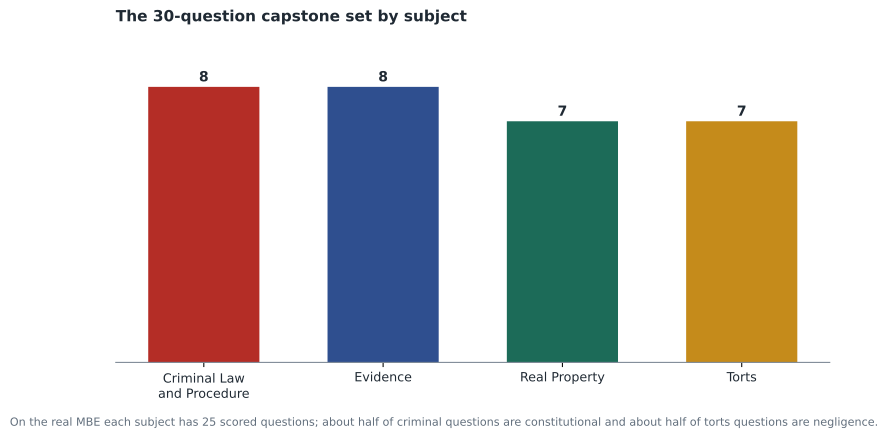
The set follows the emphases of NCBE's subject matter outline. Half of the criminal law questions involve constitutional protections, because about half of the real questions do. The evidence questions mix presentation of evidence, relevance and character, privileges, writings and hearsay with the Confrontation Clause. The real property questions spread across ownership, rights in land, contracts, mortgages and titles, roughly a fifth each as the outline provides. The torts questions lean toward negligence, which produces about half of the real torts questions, and include strict liability, products and defamation.
| Subject | Topics in this set |
|---|---|
| Criminal Law and Procedure | Conspiracy and withdrawal; factual impossibility; intoxication and larceny; felony murder theories; search incident to arrest; Edwards; Massiah; dual sovereignty |
| Evidence | Rule 608(b); character rebuttal; Rule 407 control exception; excited utterance and Crawford; medical diagnosis; Rule 609(a)(2); spousal privileges; original writing rule |
| Real Property | Contingent remainders; joint tenancy severance; assignment liability; easement by necessity; race-notice statutes; equitable conversion; junior foreclosure |
| Torts | Licensee duty; intervening causes; res ipsa loquitur; pure comparative fault with joint liability; wild animals; public figure defamation; retailer strict liability |
The practice set
Answer all 30 questions before reading the explanations. Each question is followed by the correct answer and a short explanation.
Practice problems
Work each problem on paper first, then reveal the answer to check.
A man and a woman agree to steal a car. The man buys a slim jim to open locks. The next morning, the woman tells the man she has changed her mind and goes home. That night the man steals the car alone. In a jurisdiction that follows the common law and Pinkerton, of which crimes is the woman guilty? (A) Conspiracy and larceny (B) Conspiracy only (C) Larceny only (D) No crime, because she withdrew
Show answer
(B). The agreement and the overt act (buying the slim jim) completed the conspiracy, and withdrawal is no defense to it. Her timely communicated withdrawal cuts off Pinkerton liability for the later larceny, and she gave no aid that remained effective.
A defendant intending to kill his business rival puts what he believes is cyanide in the rival's coffee. It is actually harmless sugar substitute that a pharmacist mislabeled. The rival drinks it and is unharmed. Of what is the defendant guilty? (A) No crime, because the substance was harmless (B) Assault only (C) Attempted manslaughter (D) Attempted murder
Show answer
(D). This is factual impossibility, which is no defense. He had the specific intent to kill and did everything he believed necessary.
A defendant, very drunk at a party, takes another guest's expensive coat, believing it is his own. He is charged with larceny. What is his best defense? (A) Voluntary intoxication negating the intent to steal (B) Necessity (C) Mistake of law (D) No defense is available because intoxication is voluntary
Show answer
(A). Larceny is a specific intent crime. Voluntary intoxication, and any honest mistake, can negate the intent to permanently deprive another of property.
During an armed robbery of a convenience store, the clerk pulls out a gun and fires at the robber, but misses and kills a customer. In a jurisdiction applying the proximate cause theory of felony murder, can the robber be convicted of murder? (A) No, because the clerk fired the fatal shot (B) No, because robbery is not inherently dangerous (C) Yes, because the death was a foreseeable result of the robbery (D) Yes, but only if he intended to kill
Show answer
(C). Under the proximate cause theory, felons are liable for deaths of innocent persons proximately caused by the felony, even if a victim fired the shot.
Police arrest a suspect at his home on a valid warrant for a burglary. While he is being handcuffed in the living room, an officer walks to an upstairs bedroom, opens a dresser drawer and finds stolen jewelry. The suspect moves to suppress. How should the court rule? (A) Deny, because the search was incident to a lawful arrest (B) Grant, because the search exceeded the area within the suspect's immediate control and no exception applies (C) Deny, because the jewelry would inevitably have been found (D) Grant, because police need a separate warrant to arrest someone at home
Show answer
(B). A search incident to arrest covers the arrestee and the area within his immediate control (Chimel); a protective sweep is limited to places a person could hide, not dresser drawers. Nothing suggests inevitable discovery.
A suspect in custody, after receiving Miranda warnings, says, "I want a lawyer." Two hours later a different detective, unaware of the request, gives fresh warnings and asks about the crime. The suspect waives and confesses. Is the confession admissible in the prosecution's case-in-chief? (A) Yes, because he waived after fresh warnings (B) Yes, because the second detective acted in good faith (C) No, because confessions are never admissible after a request for counsel (D) No, because police may not reinitiate questioning after an unambiguous request for counsel
Show answer
(D). Under Edwards v. Arizona, once a suspect clearly invokes counsel, police may not reinitiate interrogation without counsel present, regardless of fresh warnings or the officer's knowledge. The confession could still be used to impeach if voluntary.
After a defendant is indicted for fraud, the prosecution sends a co-worker wearing a hidden recorder to talk with him about the scheme. The co-worker asks questions and records incriminating answers. The recordings are offered at trial. What is the defendant's strongest objection? (A) The Sixth Amendment right to counsel, because the government deliberately elicited statements about the charged offense (B) The Fourth Amendment, because he had a reasonable expectation of privacy in his conversation (C) The Fifth Amendment, because he was not given Miranda warnings (D) Hearsay, because the statements were made out of court
Show answer
(A). Massiah: after indictment, deliberate elicitation by a government agent about the charged crime violates the right to counsel. There is no Miranda custody, no Fourth Amendment protection against a confidant who turns out to be an informant, and the defendant's own statements are not hearsay against him.
A defendant is convicted in state court of assault and sentenced to two years. Federal prosecutors then charge him under a federal statute for the same conduct. He moves to dismiss on double jeopardy grounds. How should the court rule? (A) Grant, because the conduct is the same (B) Grant, because the federal statute has the same elements (C) Deny, because separate sovereigns may each prosecute (D) Deny, because jeopardy did not attach in state court
Show answer
(C). Under the dual sovereignty doctrine, reaffirmed in Gamble v. United States (2019), a state and the federal government may each prosecute for the same conduct.
In a personal injury case, the plaintiff calls a witness who testifies that the defendant ran a red light. On cross, the defendant asks the witness, "Isn't it true that you were fired last year for falsifying time sheets?" The witness denies it. The defendant then offers the employer's termination letter. Is the letter admissible? (A) Yes, to impeach the witness's credibility (B) No, because extrinsic evidence of specific instances of conduct is not admissible to attack character for truthfulness (C) Yes, as a business record (D) No, because the question itself was improper
Show answer
(B). Rule 608(b) allows the question on cross if probative of truthfulness, but the examiner must take the answer; extrinsic proof is barred.
A defendant charged with arson calls a witness who testifies that the defendant has a reputation in the community as a law-abiding person. The prosecution then calls a witness to testify that, in her opinion, the defendant is not law-abiding. Is the prosecution's witness proper? (A) No, because the prosecution may never offer character evidence against a defendant (B) No, because only reputation evidence may rebut reputation evidence (C) Yes, but only if the prosecution also proves a specific prior crime (D) Yes, because the defendant opened the door and the rebuttal is in the form of opinion
Show answer
(D). Once the defendant offers evidence of a pertinent trait, the prosecution may rebut with reputation or opinion evidence of the same trait (Rules 404(a)(2)(A) and 405(a)).
A plaintiff sues a city for injuries from a fall on a broken sidewalk. Two days later, the city repaired the sidewalk. The city denies that it controlled that stretch of sidewalk, claiming it belongs to a private owner. Is evidence of the repair admissible? (A) Yes, to prove the city controlled the sidewalk (B) No, because subsequent remedial measures are never admissible (C) No, because the repair is irrelevant (D) Yes, to prove the city was negligent
Show answer
(A). Rule 407 bars subsequent remedial measures to prove negligence but allows them to prove ownership or control when disputed.
A bank robbery victim tells police, minutes after the robbery while still shaking and crying, "He had a red tattoo of a snake on his neck." The victim dies before trial of unrelated causes. Is the statement admissible against the defendant? (A) Yes, as an excited utterance, and the Confrontation Clause does not bar it (B) No, because the declarant is unavailable (C) Yes, as an excited utterance, but only if the statement is nontestimonial or the defendant had an earlier chance to cross-examine (D) No, because it is a dying declaration in a non-homicide case
Show answer
(C). The statement fits the excited utterance exception, but in a criminal case Crawford also applies. A statement to police describing a completed crime is likely testimonial, so it is admissible only if the defendant had a prior opportunity to cross-examine. The answer that states the condition is the correct one.
A plaintiff's doctor testifies that the plaintiff told her, "My back has hurt terribly since the forklift hit me." Is the statement admissible to prove the back pain and its cause? (A) Yes, but only to prove the pain, not its cause (B) Yes, under the exception for statements made for medical diagnosis or treatment (C) No, because the plaintiff is available to testify (D) No, because it is self-serving
Show answer
(B). Rule 803(4) covers statements of symptoms and their general cause reasonably pertinent to diagnosis or treatment; who was at fault would not be covered, but "the forklift hit me" describes the cause.
In a criminal trial, the prosecution seeks to impeach a testifying defendant with his conviction, six years ago, for misdemeanor making a false statement to a federal officer. How should the court rule? (A) Exclude it, because misdemeanors are never admissible for impeachment (B) Admit it only if its probative value outweighs its prejudicial effect to the defendant (C) Exclude it, because it is more than five years old (D) Admit it, because a crime of dishonesty or false statement must be admitted
Show answer
(D). Rule 609(a)(2) requires admission of any conviction whose elements required proving a dishonest act or false statement, regardless of punishment, with no balancing, within the ten-year limit.
A wife is called by the prosecution to testify against her husband in his federal tax fraud trial about a conversation in which he told her, privately, that he hid income. She is willing to testify. The husband objects. What is the likely ruling? (A) She may testify, but the husband can prevent disclosure of the confidential conversation under the marital communications privilege (B) She may testify about everything, because she holds the testimonial privilege (C) She may not testify at all, because the husband holds the testimonial privilege (D) She may testify because tax fraud is a crime against the spouse
Show answer
(A). Under Trammel, the witness-spouse holds the testimonial privilege and may choose to testify. But the marital communications privilege, held by both spouses, protects the confidential statement.
A plaintiff sues for breach of a written supply contract and testifies from memory about the contract's price term. The defendant objects. What is the best ruling? (A) Overruled, because the witness has personal knowledge (B) Overruled, because the defendant can produce the contract (C) Sustained, because the original writing is required to prove its contents unless an exception applies (D) Sustained, because the testimony is hearsay
Show answer
(C). The plaintiff is proving the content of the writing, so Rule 1002 requires the original or a duplicate unless Rule 1004 excuses it.
O conveys land "to A for life, then to B if B survives A." What interests do B and O hold? (A) B has a vested remainder; O has nothing (B) B has a contingent remainder; O has a reversion (C) B has an executory interest; O has a possibility of reverter (D) B has a vested remainder subject to complete defeasance; O has a right of entry
Show answer
(B). Survival is a condition precedent, so B's remainder is contingent, and O keeps a reversion in case B dies first.
A, B and C own land as joint tenants. A conveys her interest to D. B then dies, devising all her property to E. Who owns the land? (A) C, D and E as tenants in common in equal shares (B) C and D as joint tenants (C) C alone (D) C and D as tenants in common, C with two thirds and D with one third
Show answer
(D). A's conveyance severed her third, so D holds it as a tenant in common. B and C remained joint tenants as to two thirds, and C took B's share by survivorship; the devise to E fails.
A tenant leases an apartment for one year. Midway through, she assigns the rest of the term to a new occupant, who does not assume the lease. The new occupant pays rent for two months, then stops. From whom may the landlord recover the unpaid rent? (A) Either the original tenant, on privity of contract, or the new occupant, on privity of estate (B) Only the original tenant (C) Only the new occupant (D) Neither, because the landlord did not approve the assignment
Show answer
(A). The assignee in possession is in privity of estate; the original tenant remains liable on the contract.
A landowner sells the northern half of her land to a buyer. The only access to a public road from the northern half is across the southern half, which the landowner keeps. The deed says nothing about access. Ten years later, the county builds a new public road along the northern edge. What is the status of the buyer's easement across the southern half? (A) It continues, because easements are permanent (B) It never existed, because the deed did not mention it (C) It ends, because an easement by necessity terminates when the necessity ends (D) It ripens into a prescriptive easement
Show answer
(C). Severance of commonly owned land that left a parcel landlocked created an easement by necessity, which ends when the necessity ends.
A statute provides: "No conveyance of real property is effective against a subsequent purchaser for value and without notice whose conveyance is first recorded." O conveys to A, who does not record. O then conveys to B for value; B knows nothing of A. Before B records, A records. B then records. Who prevails? (A) B, because B paid value without notice (B) A, because A recorded first (C) B, because A failed to record before B bought (D) A, because the common law first-in-time rule applies
Show answer
(B). This race-notice statute protects a subsequent bona fide purchaser only if she records first. A recorded first.
A buyer and seller sign a contract to sell a house, with closing in 60 days. The contract does not address risk of loss. Two weeks later, lightning strikes and the house burns down. The seller has insurance. In a jurisdiction following the majority rule, what happens? (A) The contract is void, and the seller keeps the insurance proceeds (B) The seller must rebuild before closing (C) The buyer may rescind and recover damages from the seller (D) The buyer must still pay the price, but receives credit for the seller's insurance proceeds
Show answer
(D). Under equitable conversion the buyer bears the risk of loss, but receives credit for insurance proceeds the seller collects.
A bank holds a first mortgage on a property and a credit union holds a second mortgage. The owner defaults on both, and the credit union forecloses, joining all necessary parties. A buyer purchases at the foreclosure sale. What is the effect on the bank's mortgage? (A) It survives, and the buyer takes the property subject to it (B) It is extinguished, and the bank shares in the sale proceeds first (C) It is extinguished, and the bank receives nothing (D) It becomes a junior lien behind the buyer's title
Show answer
(A). Foreclosure of a junior mortgage does not affect senior interests; the buyer at the sale takes subject to the first mortgage.
A homeowner invites a neighbor over for dinner. The homeowner knows the third step on the back stairs is loose, but does not mention it. The neighbor, unaware, steps on it and is injured. What duty did the homeowner owe? (A) None, because social guests take the premises as they find them (B) A duty to inspect the premises for any dangerous conditions (C) A duty to warn of known dangerous conditions the guest was unlikely to discover (D) Strict liability for injuries on the premises
Show answer
(C). A social guest is a licensee in traditional jurisdictions; the owner must warn of known concealed dangers, but has no duty to inspect.
A truck driver negligently runs a red light and collides with a car. Thirty minutes later, while the car's driver is waiting by the road for an ambulance, an unrelated car negligently strikes her. She sues the truck driver for both injuries. Is he liable for the second injury? (A) No, because the second driver was an independent intervening cause (B) Yes, because the second injury was a foreseeable consequence of leaving her exposed at the roadside (C) No, because the second injury happened after the first accident ended (D) Yes, because truck drivers are strictly liable for highway accidents
Show answer
(B). Negligent acts of third persons that the defendant's conduct foreseeably made possible are not superseding causes.
A shopper sues a grocery store for injuries suffered when a jar fell from a high shelf. The shopper had touched nothing, and no one else was nearby. Store employees stock the shelves. The shopper has no evidence of how the jar fell. What is the shopper's best argument to reach the jury? (A) Negligence per se (B) Strict products liability (C) Assumption of risk (D) Res ipsa loquitur
Show answer
(D). Jars do not ordinarily fall from shelves without negligence, the store controlled the shelves, and the shopper did not contribute.
A plaintiff and two defendants are each found negligent in causing the plaintiff's injury, with total damages of 200,000 dollars. The jury assigns fault: plaintiff 50 percent, Defendant 1 25 percent, Defendant 2 25 percent. Under the default rules for the MBE, how much can the plaintiff collect from Defendant 1 alone? (A) 100,000 dollars (B) Nothing, because the plaintiff was at least as much at fault as each defendant (C) 50,000 dollars (D) 200,000 dollars
Show answer
(A). Pure comparative fault reduces the 200,000 dollars by 50 percent to 100,000 dollars, and joint and several liability lets the plaintiff collect all of it from Defendant 1, who can seek contribution.
A tenant keeps a pet tiger cub in a backyard pen, using the best enclosure available. The cub escapes and scratches a neighbor's child. Is the tenant liable without proof of negligence? (A) No, because the tenant used reasonable care (B) No, because the cub had never hurt anyone before (C) Yes, because owners are strictly liable for harm from the dangerous propensities of wild animals (D) Yes, but only if a statute bans keeping tigers
Show answer
(C). Strict liability applies to wild animals, regardless of care or prior incidents.
A tabloid publishes a false story that a well-known actor was arrested for drunk driving. The editor did not check the story with any source, though she had no reason to doubt the reporter. The actor sues for defamation. What must the actor prove to win? (A) That the story was false and published negligently (B) That the story was false and published with knowledge of falsity or reckless disregard for the truth (C) Only that the story was false and harmed his reputation (D) That the tabloid intended to harm him
Show answer
(B). A public figure must prove actual malice under New York Times v. Sullivan; failure to investigate, without serious doubts about truth, usually is not reckless disregard.
A retailer sells a sealed bottle of salad dressing that contains shards of glass from a defect at the factory. The retailer could not have discovered the glass. A customer is injured and sues the retailer in strict products liability. What result? (A) The customer loses, because the retailer was not negligent (B) The customer loses, because only manufacturers are strictly liable (C) The customer wins only if she can prove breach of an express warranty (D) The customer wins, because the retailer is a commercial seller of a product with a manufacturing defect
Show answer
(D). Every commercial seller in the chain is strictly liable for a manufacturing defect; the retailer may seek indemnity from the manufacturer.
Reviewing your results
Marchetti's Sunday email reports the scores. Dana gets 7 of 8 in criminal law and procedure, 6 of 8 in evidence, 5 of 7 in real property and 6 of 7 in torts. Her evidence misses are the excited utterance question, where she chose the unconditional 'admissible' answer and forgot Crawford, and the spousal privilege question, where she merged the two privileges. Ngozi scores 24 of 30, missing both recording act questions in her first attempt at the set; on review she realizes she read the race-notice statute as a pure notice statute because she skimmed the words 'first recorded.' Sofia scores 22 of 30, with three misses in real property, including the junior foreclosure question, and two in criminal procedure, both involving the right to counsel. Marcus, taking the set cold, scores 23. Eddie gets 6 of the 8 evidence questions.
Marchetti's comments are the same as for the Saturday set. A raw score in the range of 60 to 70 percent on hard, mixed practice questions is a reasonable sign of progress, because the real exam is scaled and mixes easy and hard questions, but one set proves little. The trend over hundreds of questions matters more, especially whether errors shrink in the areas you target. She gives each member a plan for the two weeks after Thanksgiving, which are plans for now: Dana will drill 40 hearsay and Confrontation Clause questions, writing out the Crawford step every time; Ngozi will do 50 real property questions, starting each one by circling the words of the statute; and Sofia will rewrite her criminal procedure outline around when each right attaches.
Common traps in this set
Several traps recur across the MBE. In the conspiracy question, the trap is to treat withdrawal as a defense to the conspiracy itself instead of only to later crimes. In the search question, the trap is assuming an arrest permits a search of the whole house. In the excited utterance question, the trap is stopping at the hearsay exception and forgetting the Confrontation Clause in a criminal case. In the Rule 609 question, the trap is applying a balancing test to a crime of dishonesty, which comes in automatically.
In property, the classic trap is reading a race-notice statute as a pure notice statute, and the second is forgetting that survivorship defeats a joint tenant's will. In torts, watch for answers that apply modified comparative fault when the MBE's default is pure comparative fault, and for answers that let a retailer escape strict liability because it was not negligent. Recognizing a correct rule applied in the wrong setting is one of the most common reasons strong candidates miss questions.
What comes next
With BAR-110 and BAR-111, you have reviewed all seven MBE subjects. BAR-120 covers the Multistate Essay Examination, including subjects beyond the MBE such as business associations, family law and trusts and estates. BAR-121 covers the Multistate Performance Test, BAR-130 covers the NextGen bar exam, and BAR-140 covers the MPRE. Your jurisdiction's course explains how it scores the MBE, its passing score and any local component. In the final weeks before the exam, take full-length timed practice, using NCBE's official practice materials where you can, and keep your error log going.
Marchetti signs off the Monday series with a reminder that applies to every subject. 'You have now seen every MBE topic at least once in this group,' she writes. 'The work from here is repetition and review. Read the call, predict, eliminate and choose. The rules will not change much before February, apart from the evidence amendment we talked about. What will change is how fast and how calmly you find them.'
Summary and key terms
- Take the 30 questions in 54 minutes, about 1.8 minutes each, then review for at least twice as long.
- Score by subject and classify every miss: unknown rule, misapplied rule, misread facts or call, or trap.
- Recurring traps: withdrawal from conspiracy, searches beyond the arrestee's reach, hearsay exceptions without Crawford, balancing crimes of dishonesty, misreading recording acts, and modified instead of pure comparative fault.
- Use trends across many sets, not a single score, to judge readiness, and finish with official timed practice.
- BAR-110 and BAR-111 together cover all seven MBE subjects; the essay, performance and NextGen courses come next.
- Mixed set
- A practice set that combines subjects in random order, as the real MBE does.
- Error log
- A record of each missed question's rule, triggering fact and error type.
- Trap answer
- A wrong choice built to attract test-takers who miss a key fact or rule.
- Raw score
- The number of questions answered correctly before scaling.
- Blind review
- Reworking flagged questions before checking answers, to separate knowledge from luck.
Lesson quiz · 5 questions
Score 60% or more to complete this lesson.
Create a free account to save your progress, take quizzes and earn a certificate.