
BAR-111 · Lesson 1 of 12 · 25 min
Criminal law: elements, homicide and other crimes
▶ Video coming soon A video version of this lesson is on the way.
On Monday evening, September 14, 2026, Hollis Marchetti opens a second drill series alongside the Saturday mornings. 'Saturdays are for civil procedure, constitutional law and contracts,' she tells the group on the video call. 'Mondays are for the other four MBE subjects: criminal law and procedure, evidence, real property and torts. Together they are more than half of the scored questions you will see in February.' Dana Whitfield, Ngozi Adeyemi and Sofia Reyes, the three members sitting the MBE in February 2027, have their question banks open. Marcus Bell, who passed Missouri's first NextGen exam in July, has again volunteered as a drill partner. Etienne 'Eddie' Boudreaux plans to join the evidence weeks, because Louisiana's Code of Evidence is modeled on the federal rules, and Camila Ortiz Rivera will join the criminal procedure sessions, because the federal constitutional rules apply in Puerto Rico as they do in every state.
This course follows those Monday sessions. Like BAR-110, it is a review course: it assumes you studied these subjects in law school and teaches the black-letter rules the way the Multistate Bar Examination tests them. Every practice question is original and written for this course; none is taken from NCBE's released questions. Each of the four subjects has 25 scored questions on the MBE, and the method from BAR-110 still applies: read the call first, read the facts actively, predict the answer, eliminate wrong choices and choose.
What the MBE tests in criminal law
NCBE's MBE Subject Matter Outline divides Criminal Law and Procedure into five areas: homicide; other crimes; inchoate crimes and parties; general principles such as the act and mental-state requirements and defenses; and the constitutional protection of accused persons. About half of the questions come from the constitutional area, which is the subject of Lesson 3. The other half come from substantive criminal law, covered in this lesson and Lesson 2.
The MBE answers questions according to generally accepted fundamental legal principles unless the question says otherwise. In criminal law that means the common law as most states have modified it, with the Model Penal Code appearing when a question invokes it or when a choice turns on a modern statutory approach. Questions often give you a statute and ask you to apply it. When they do, the statute controls, and your job is to read its words carefully: which mental state does it require, and does that mental state apply to every element?
The elements of a crime
Every crime has elements the prosecution must prove beyond a reasonable doubt. The core ones are a voluntary act or a legally required omission (actus reus), a culpable mental state (mens rea), concurrence of the two, and, for result crimes such as homicide, causation of the prohibited result. The MBE tests each element separately, often by building a question around a single missing piece.
The act must be voluntary. A reflex, a convulsion, or movement during sleep or unconsciousness is not a voluntary act. But criminal liability can rest on an earlier voluntary act: a driver who knows she is prone to seizures and chooses to drive may be liable for a crash caused by a seizure, because the voluntary act was getting behind the wheel. Possession counts as an act if the defendant knowingly possessed the item long enough to end possession.
An omission is a crime only when the defendant had a legal duty to act and could have acted. Duties arise by statute, by contract (a lifeguard or a hired caregiver), by a special relationship (parent and child, spouses in many states), by voluntarily assuming care and secluding the victim from other help, and by creating the peril. A bystander who watches a stranger drown, with no relationship to the victim and no role in the danger, commits no crime under the general rule, however morally wrong the failure.
Mental states
The common law used a variety of mental-state terms. Specific intent crimes require an intent to do something beyond the act itself or a particular purpose: solicitation, conspiracy, attempt, first-degree premeditated murder, assault with intent, larceny, robbery, burglary, forgery, false pretenses and embezzlement are the usual list. Malice crimes, common-law murder and arson, require at least reckless disregard of an obvious or high risk. General intent crimes, such as battery, rape, kidnapping and false imprisonment, require only that the defendant intend the act. Strict liability offenses, usually regulatory or public-welfare offenses and statutory rape, require no mental state as to at least one element.
The classification matters mainly for defenses. Voluntary intoxication and an unreasonable mistake of fact can negate specific intent, but they do not help against general intent or malice crimes. That is why so many MBE questions turn on whether the charged crime is specific intent.
The Model Penal Code replaces those terms with four culpability levels. A person acts purposely when it is his conscious object to engage in conduct or cause a result; knowingly when he is aware that his conduct is of a particular nature or practically certain to cause the result; recklessly when he consciously disregards a substantial and unjustifiable risk; and negligently when he should be aware of such a risk and his failure to perceive it is a gross deviation from the standard of care. If a statute is silent, the MPC reads in at least recklessness, and a culpability term that introduces a crime usually applies to every material element unless a contrary purpose plainly appears.
| Common law label | What it requires | Typical crimes | Model Penal Code nearest level |
|---|---|---|---|
| Specific intent | An intent or purpose beyond the act itself | Attempt, conspiracy, larceny, burglary, robbery, first-degree murder | Purposely (sometimes knowingly) |
| Malice | Reckless disregard of a high risk | Murder, arson | Recklessly (extreme recklessness for murder) |
| General intent | Intent to do the act | Battery, rape, kidnapping | Knowingly or recklessly |
| Strict liability | No mental state as to at least one element | Regulatory offenses, statutory rape | Violations only; MPC disfavors strict liability |
Causation and concurrence
For result crimes, the defendant's act must be both the cause in fact and the proximate cause of the result. Cause in fact is the but-for test: the result would not have happened without the act. Proximate cause asks whether the result was a natural and probable consequence, without an unforeseeable intervening cause. Ordinary medical negligence in treating the victim is foreseeable and does not break the chain; grossly reckless or intentional mistreatment usually does. A victim's pre-existing condition never helps the defendant, because you take your victim as you find him. And under the traditional year-and-a-day rule, which many states have abolished, a death more than a year and a day after the act could not be murder.
Concurrence means the mental state must actuate the act. A defendant who accidentally kills a rival on Monday and is glad of it on Tuesday has not murdered, because the malice came after the act.
Homicide: common-law murder
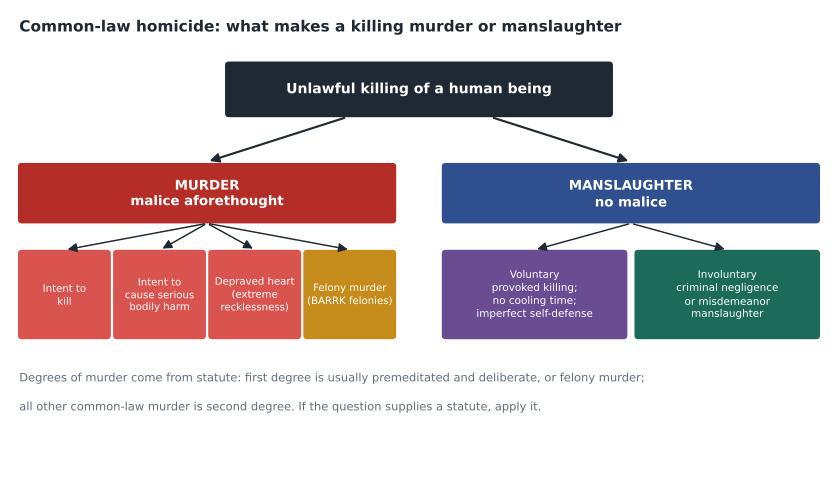
Murder at common law is the unlawful killing of another human being with malice aforethought. Malice is a term of art covering four mental states: intent to kill; intent to inflict serious bodily harm; a depraved heart, meaning reckless indifference to an unjustifiably high risk to human life; and felony murder. An intent to kill can be inferred from use of a deadly weapon aimed at a vital part of the body.
Most states divide murder into degrees by statute. The usual pattern makes first-degree murder a premeditated and deliberate killing, which requires that the defendant reflected on the killing, even briefly, while calm, and certain listed killings such as those by poison, lying in wait or torture. Felony murder during an enumerated felony is often first degree as well. Everything else that is murder at common law becomes second degree. If an MBE question gives you a statute defining degrees, apply it; if not, use the common-law categories.
Felony murder
Felony murder makes any killing, even an accidental one, committed during the commission or attempted commission of an inherently dangerous felony a murder. The traditional predicate felonies are burglary, arson, robbery, rape and kidnapping, remembered with the acronym BARRK, and many statutes add others. The defendant must be guilty of the underlying felony; if he has a defense to it, there is no felony murder. The felony must be independent of the killing, so an aggravated assault that causes death does not supply a predicate. The death must be a foreseeable result of the felony, and it must occur during the felony, which includes immediate flight until the felon reaches a place of temporary safety.
Two lines of cases decide who is liable when someone other than a felon does the killing. Under the agency theory, followed by most states, felons are liable only for killings committed by a felon or an agent of the felons; when a police officer or a victim kills a bystander, there is no felony murder. Under the proximate cause theory, felons are liable for any death proximately caused by the felony, including killings by police or victims. Under either theory, most courts hold that a felon is not liable for the death of a co-felon killed by a police officer or victim.
Voluntary manslaughter
Voluntary manslaughter is a killing that would be murder but is mitigated by adequate provocation. The traditional elements are that the provocation would arouse a sudden and intense passion in an ordinary person, causing loss of self-control; the defendant was in fact provoked; there was not enough time for an ordinary person to cool off; and the defendant did not in fact cool off. Classic adequate provocation includes a serious battery and discovering a spouse in the act of adultery. Words alone traditionally are not enough. The Model Penal Code's broader version, extreme mental or emotional disturbance for which there is a reasonable explanation, appears in some states.
Some states also recognize imperfect self-defense: a defendant who kills with an honest but unreasonable belief in the need to use deadly force, or who was the initial aggressor, may be guilty of voluntary manslaughter rather than murder.
Involuntary manslaughter
Involuntary manslaughter covers unintended killings in two main ways. Criminal negligence manslaughter requires more than ordinary tort negligence: a gross deviation from reasonable care, which many courts describe as recklessness. Misdemeanor manslaughter, the counterpart of felony murder, covers a death caused during a malum in se misdemeanor or a felony that does not qualify for felony murder. If the question asks you to choose the most serious crime, compare the defendant's mental state to these categories in order: intent to kill or seriously injure without provocation is murder; with provocation it is voluntary manslaughter; awareness of an extreme risk is depraved-heart murder; gross negligence is involuntary manslaughter.
Worked problem
Classifying a killing
At a crowded outdoor concert, a man fires a handgun into the air to celebrate. A falling bullet kills a spectator a block away. He testified that he thought bullets fired upward lose all their force. Which is the most serious homicide for which he can be convicted?
Show solution
- There was no intent to kill or injure, so the first two kinds of malice do not apply, and no felony is involved.
- The question is whether firing a gun upward in a crowded area shows a depraved heart: conscious disregard of an extremely high risk to life.
- His claimed belief about falling bullets may show he did not consciously appreciate the risk. A jury that believes him would find at least gross negligence; a jury that rejects his claim could find extreme recklessness.
- The best answer on the MBE would be depraved-heart murder if the facts stress the obvious danger and the crowd, and involuntary manslaughter if the facts stress his honest ignorance.
Answer: Depraved-heart murder if he consciously disregarded an extreme risk; otherwise criminal negligence manslaughter. Read the facts for evidence of awareness.
Other crimes against the person
Battery is the unlawful application of force to another resulting in bodily injury or an offensive touching. Assault is either an attempted battery or intentionally placing another in reasonable apprehension of an imminent battery. Kidnapping is the unlawful confinement of a person that involves either moving the victim or concealing the victim in a secret place. Rape at common law was unlawful sexual intercourse with a woman other than the defendant's wife, without consent, by force or threat; modern statutes are gender-neutral, have abolished the marital exemption and define lack of consent more broadly. Statutory rape is a strict liability offense in most states as to the victim's age.
Theft offenses
The property crimes are tested constantly, because their elements are close to one another and a single fact changes the answer. Larceny is the trespassory taking and carrying away of the personal property of another with intent to permanently deprive. The taking must be from someone with a better right to possession; a defendant who takes back property he honestly believes is his own lacks the intent, even if the belief is unreasonable. Larceny by trick occurs when the defendant obtains possession, but not title, by a misrepresentation.
Embezzlement is the fraudulent conversion of the property of another by a person in lawful possession of it, such as an employee entrusted with company funds. False pretenses is obtaining title to property by a knowing false representation of a past or present fact, intended to defraud. The key distinction is what passed: if the victim gave up only possession, the crime is larceny by trick; if the victim intended to transfer title, it is false pretenses. Robbery is larceny from the person or the person's presence by force or by threatening immediate harm. Receiving stolen property requires knowing the property is stolen. Many states now consolidate these offenses into a single theft statute, but the MBE still tests the distinctions.
| Crime | Defendant gets | How | Key test point |
|---|---|---|---|
| Larceny | Possession, by trespass | Taking without consent | Intent to permanently deprive at the time of taking |
| Larceny by trick | Possession only | Consent induced by lies | Victim did not intend to pass title |
| False pretenses | Title | Knowing false statement of past or present fact | Victim intended to pass title |
| Embezzlement | Converts property already lawfully held | Breach of trust | Defendant had lawful possession first |
| Robbery | Possession | Force or threat of immediate harm, from person or presence | Force used to take or to keep the property |
Burglary, arson and other crimes
Common-law burglary is the breaking and entering of the dwelling of another at night with intent to commit a felony inside. Breaking can be actual, such as opening a closed door, or constructive, such as entry by fraud or threat. The intent must exist at the time of entry; if the defendant forms the intent only after entering, it is not burglary. Modern statutes drop the nighttime and dwelling requirements and often cover any structure. Common-law arson is the malicious burning of the dwelling of another; slight charring of the structure is enough, but mere smoke damage or discoloration is not. Forgery, perjury, bribery and solicitation of a crime appear occasionally, usually as distractors.
Practice problems
Work each problem on paper first, then reveal the answer to check.
A defendant forms the intent to steal only after entering a house through an open door at night. Is he guilty of common-law burglary?
Show answer
No. There was no breaking, and the intent to commit a felony must exist at the time of entry.
Which kinds of malice support murder?
Show answer
Intent to kill, intent to inflict serious bodily harm, depraved-heart recklessness and felony murder.
Under the agency theory, is a robber liable for felony murder when a shopkeeper shoots and kills a bystander?
Show answer
No. The agency theory covers only killings by a felon or the felons' agent.
A buyer gives a seller a fake check and the seller hands over title to a watch. What crime?
Show answer
False pretenses, because title passed by a knowing misrepresentation.
Does voluntary intoxication defend against a battery charge?
Show answer
No. Battery is a general intent crime.
Is mere smoke damage enough for common-law arson?
Show answer
No. There must be at least slight charring of the structure.
Common mistakes
MistakeAn omission can always support liability if the defendant could easily have helped.
InsteadThere must be a legal duty to act; a stranger has none.
MistakeAny killing during any felony is felony murder.
InsteadThe felony must be inherently dangerous and independent of the killing.
MistakeWords alone are adequate provocation.
InsteadTraditionally, words alone are not enough to reduce murder to manslaughter.
MistakeLarceny by trick and false pretenses are the same.
InsteadLarceny by trick passes possession; false pretenses passes title.
Summary and key terms
- Crimes require a voluntary act or a duty-based omission, a mental state, concurrence and, for result crimes, causation.
- Classify the crime as specific intent, malice, general intent or strict liability; it controls which defenses apply.
- Murder needs malice: intent to kill, intent to seriously injure, depraved heart or felony murder; degrees come from statute.
- Voluntary manslaughter is a provoked killing without cooling time; involuntary manslaughter is criminal negligence or misdemeanor manslaughter.
- Distinguish theft crimes by what passes (possession or title), how, and when the intent arose.
- Malice aforethought
- The mental state for common-law murder: intent to kill, intent to cause serious bodily harm, depraved heart or felony murder.
- Felony murder
- A killing during an inherently dangerous felony, which is murder even if unintended.
- Specific intent
- An intent or purpose beyond the criminal act itself, which voluntary intoxication can negate.
- Larceny by trick
- Obtaining possession of property, but not title, by a misrepresentation.
- False pretenses
- Obtaining title to property by a knowing false representation of a past or present fact.
Lesson quiz · 5 questions
Score 60% or more to complete this lesson.
Create a free account to save your progress, take quizzes and earn a certificate.