
AUTO-410 · Lesson 5 of 12 · 18 min
Battery cells, modules and packs
Hal Osei's trial electric van arrives on a flatbed from the leasing company, because the delivery driver let its charge run down to almost nothing on the way. Marty plugs it into the shop's Level 2 charger and opens its service information to show Kiran the battery. "Two vehicles on our lot, two different batteries," he says, pointing out the window at Ines's hybrid. "Hers is nickel-metal hydride, about two hundred volts. This van is lithium iron phosphate, about four hundred. Dr. Singh's is a nickel-rich lithium-ion. They look like boxes from the outside, but they behave differently, and you'll be reading their data for the rest of your career."
This lesson works from the smallest part of a traction battery to the largest: the chemistry of a cell, the formats cells come in, how cells are joined into modules and packs, what the main numbers on a battery mean, how the state of charge is estimated, and how batteries age. The next lesson covers the electronics that look after them.
How a cell stores energy
A battery cell stores energy chemically. It has two electrodes, a negative and a positive, separated by a thin porous separator and soaked in an electrolyte. In a lithium-ion cell, lithium ions move through the electrolyte from the positive electrode to the negative one during charging, where they are stored in a graphite structure, and back again during discharge, while electrons flow through the external circuit and do the work. The cell's voltage depends on the chemistry of its electrodes, not on its size; its capacity, in ampere-hours, depends on how much active material it holds.
Lithium-ion cells come in several chemistries named after their positive electrode. Nickel manganese cobalt, or NMC, and nickel cobalt aluminum, or NCA, have high energy density and a nominal voltage around 3.6 to 3.7 volts per cell; they are used in most long-range electric vehicles, including Dr. Singh's. Lithium iron phosphate, or LFP, has a lower voltage, about 3.2 volts per cell, and stores less energy for its weight, but it is cheaper, contains no cobalt or nickel, tolerates being charged to 100 percent and resists thermal runaway better; it is increasingly used in standard-range cars and commercial vans like Hal's trial van. Many older and some current hybrids, Ines's among them, use nickel-metal hydride, or NiMH, cells at about 1.2 volts each, which are durable and tolerant of the constant shallow charging and discharging a hybrid imposes.
| Chemistry | Nominal cell voltage | Strengths | Typical use |
|---|---|---|---|
| NMC / NCA lithium-ion | 3.6 to 3.7 V | High energy density | Long-range electric vehicles |
| LFP lithium-ion | 3.2 V | Low cost, long life, thermal stability, can charge to 100 percent | Standard-range cars, vans, buses |
| Nickel-metal hydride | 1.2 V | Durability in shallow cycling | Older and some current hybrids |
| Sodium-ion (emerging) | about 3.0 V | No lithium; good cold performance | Early use in small vehicles |
Cell formats
Cells are made in three main shapes. Cylindrical cells, such as the 21700 size, 21 mm in diameter and 70 mm long, or the larger 4680 size, are made by winding long electrode strips into a roll; they are robust and cheap to make, but a pack needs thousands of them. Prismatic cells are flat rectangular cans, larger and fewer, with the electrodes stacked or wound inside. Pouch cells are flat stacks sealed in a flexible foil, light and space-efficient but needing support from the module around them. Some newer packs place cells directly in the pack without modules, a design called cell-to-pack, which saves weight and space but can make repairs harder.
Series, parallel and the pack
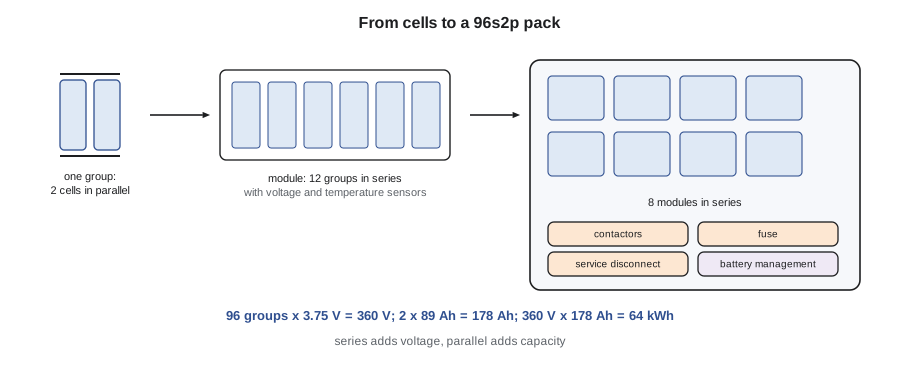
One cell cannot drive a vehicle, so cells are combined. Cells connected in series add their voltages; cells connected in parallel add their capacities. Engineers describe a pack by its arrangement, for example 96s2p: 96 groups in series, each group made of 2 cells in parallel. The pack's voltage is the number in series times the cell voltage; its capacity is the number in parallel times the cell capacity; its energy is the product of the two.
Cells are grouped into modules, each with its own voltage and temperature sensors, and the modules into the pack, which adds busbars, the contactors, fuses, the service disconnect, the battery management electronics, a cooling or heating system and a sealed, crash-resistant housing. A traction battery is the heaviest single component of an electric vehicle, often a quarter of its mass, and it is bolted under the floor where it lowers the center of gravity and stiffens the body.
# Pack arrangements: voltage, capacity and energy from the cell numbers
packs = [
    ("Dr. Singh's hatchback (NMC)", 96, 2, 3.75, 89.0),
    ("Hal's trial van (LFP)", 128, 1, 3.20, 202.0),
    ("Ines's hybrid (NiMH)", 168, 1, 1.20, 6.5),
]
for name, s, p, v_cell, ah_cell in packs:
    v = s * v_cell
    ah = p * ah_cell
    kwh = v * ah / 1000
print(f"{name:30} {s}s{p}p: {v:5.0f} V nominal, {ah:5.1f} Ah, {kwh:5.1f} kWh, {s * p:4} cells")Dr. Singh's hatchback (NMC) 96s2p: 360 V nominal, 178.0 Ah, 64.1 kWh, 192 cells Hal's trial van (LFP) 128s1p: 410 V nominal, 202.0 Ah, 82.7 kWh, 128 cells Ines's hybrid (NiMH) 168s1p: 202 V nominal, 6.5 Ah, 1.3 kWh, 168 cells
Ines's hybrid battery holds barely more than 1 kilowatt-hour, about the energy in one of Dr. Singh's daily commutes. A hybrid's battery is sized for power, not energy: it must accept and deliver large currents for a few seconds at a time, over and over. An electric vehicle's battery is sized for energy, to carry the vehicle hundreds of kilometers between charges.
The numbers on a battery
A battery's label and service information give several numbers. Nominal voltage is the average voltage during discharge. The actual voltage varies with the state of charge, from about 3.0 volts per NMC cell when nearly empty to 4.2 volts when full. Capacity, in ampere-hours, and energy, in kilowatt-hours, describe how much it holds, usually quoted as gross values; the usable energy is smaller, because the battery management system keeps a reserve at the top and bottom to protect the cells. Power, in kilowatts, is how fast energy can be taken out or put in, and it falls when the battery is cold, hot, nearly empty or nearly full.
The C-rate expresses current relative to capacity. A 1C current would fully charge or discharge the battery in one hour; 2C in half an hour; 0.5C in two hours. Dr. Singh's 178 ampere-hour pack at 1C carries 178 amperes. A DC fast charger delivering 100 kilowatts to her 360 volt pack pushes about 280 amperes, a rate of about 1.6C, which the battery accepts only when it is warm and not too full.
State of charge
The state of charge, or SOC, is the percentage of usable capacity remaining. It cannot be measured directly. The battery management system estimates it by counting the charge that flows in and out, called coulomb counting, and correcting the count from time to time using the cell's open-circuit voltage, its resting voltage after the current has stopped long enough for it to settle. For NMC cells, the open-circuit voltage changes steadily with state of charge, so a resting voltage gives a good estimate.
LFP cells are different. Their voltage stays almost flat across most of their state of charge, around 3.3 volts, so a resting voltage says little about how full they are. The battery management system relies on coulomb counting and recalibrates only when the cells reach the ends of their curve, near full or empty. That is why makers of LFP vehicles recommend charging to 100 percent regularly, often weekly, and why Hal's trial van showed a state of charge that drifted by several percent before the leasing company's driver ran it nearly flat.
# Estimating state of charge from resting cell voltage: why LFP is harder (illustrative curves)
nmc = [(3.30, 0), (3.50, 10), (3.60, 20), (3.68, 30), (3.75, 40), (3.82, 50), (3.90, 60), (3.97, 70), (4.05, 80), (4.12, 90), (4.18, 100)]
lfp = [(2.90, 0), (3.20, 10), (3.25, 20), (3.28, 30), (3.29, 40), (3.30, 50), (3.31, 60), (3.32, 70), (3.33, 80), (3.36, 90), (3.50, 100)]
def soc(curve, v):
    for (v1, s1), (v2, s2) in zip(curve, curve[1:]):
        if v1 <= v <= v2:
            return s1 + (s2 - s1) * (v - v1) / (v2 - v1)
    return 0 if v < curve[0][0] else 100
for name, curve, v in [("NMC", nmc, 3.80), ("NMC", nmc, 3.82), ("LFP", lfp, 3.300), ("LFP", lfp, 3.310)]:
    print(f"{name} resting at {v:.3f} V -> about {soc(curve, v):4.1f} percent")
print("a 10 mV meter error moves the NMC estimate about 1 point, the LFP estimate about 10 points")NMC resting at 3.800 V -> about 47.1 percent NMC resting at 3.820 V -> about 50.0 percent LFP resting at 3.300 V -> about 50.0 percent LFP resting at 3.310 V -> about 60.0 percent a 10 mV meter error moves the NMC estimate about 1 point, the LFP estimate about 10 points
How batteries age
Every battery loses capacity and power over time. Calendar aging happens even when the vehicle sits, faster when the battery is hot and kept at a high state of charge. Cycle aging comes from use: each charge and discharge causes small, permanent changes in the electrodes, faster with deep cycles, high currents, frequent DC fast charging and charging at low temperatures, which can plate metallic lithium onto the negative electrode. The battery's state of health, or SOH, compares its present capacity with its capacity when new. A typical electric vehicle battery loses a few percent in its first year or two, then ages more slowly; most makers warrant the battery for about 8 years and 100,000 miles to keep at least 70 percent of its capacity, and many batteries far outlast that.
Kiran checks Dr. Singh's battery health report on the scan tool as part of the inspection she will finish in the capstone. The tool reports the battery management system's own estimate, 93 percent, after 41,000 miles and three years. That is normal, and it explains only a small part of the winter range loss Dr. Singh has noticed.
# State of health from a capacity estimate, and what it means for range
new_kwh = 64.0
measured_kwh = 59.5       # usable energy from a full-to-low test or the BMS estimate
soh = measured_kwh / new_kwh * 100
cons = 27.4                # kWh per 100 miles, mild weather
print(f"state of health: {soh:.0f} percent")
print(f"range new: {new_kwh * 0.94 / cons * 100:.0f} miles; range now: {measured_kwh * 0.94 / cons * 100:.0f} miles (mild weather)")
print("within warranty" if soh >= 70 else "below the 70 percent warranty threshold: check the maker's battery warranty")state of health: 93 percent range new: 220 miles; range now: 204 miles (mild weather) within warranty
Handling, storage and recycling
Traction batteries are heavy and hazardous. Removing one uses a battery lift table rated for its weight and the maker's procedure, with the high-voltage system de-energized first. A removed pack is stored on a non-conductive surface, away from heat and water, labeled with its state and owner, and covered so nothing can fall across its connectors. Damaged packs are isolated outdoors as the safety lesson described. Lithium-ion batteries are shipped as dangerous goods under the US Department of Transportation's hazardous materials rules, with packaging and labeling that only trained shippers may prepare.
At the end of their vehicle life, batteries are repurposed for stationary storage or recycled to recover lithium, nickel, cobalt, copper and aluminum. Recycling plants have opened in North America in recent years, and makers and governments are building rules that make battery producers responsible for collecting their batteries. A shop never puts a traction battery or loose cells in ordinary waste.
Worked problem
Working out a pack
A van's pack is 108s3p of 3.65 V, 60 Ah cells. What are its nominal voltage, capacity and energy, and how many cells does it contain?
Show solution
- Voltage: 108 × 3.65 = 394 V.
- Capacity: 3 × 60 = 180 Ah.
- Energy: 394 × 180 ÷ 1,000 = 71.0 kWh.
- Cells: 108 × 3 = 324.
Answer: About 394 V, 180 Ah and 71 kWh, from 324 cells.
Common mistakes
MistakeReading an LFP battery's resting voltage as its state of charge.
InsteadLFP voltage is nearly flat; rely on the battery management system's estimate and its recalibration.
MistakeTreating a hybrid battery's small kilowatt-hour rating as a weakness.
InsteadHybrid batteries are sized for power, not energy.
MistakeQuoting gross capacity as range.
InsteadUsable energy is smaller; the system keeps reserves.
MistakeStoring a removed pack on a metal bench.
InsteadUse a non-conductive surface, covered and labeled.
MistakeTelling an owner the battery is failing after a normal first-years loss.
InsteadCompare state of health with normal aging and the warranty threshold.
Summary and key terms
- A cell's voltage depends on its chemistry; its capacity on its size.
- NMC and NCA store the most energy; LFP is cheaper and more stable; NiMH suits hybrids.
- Cells come as cylindrical, prismatic or pouch, grouped in modules or placed directly in the pack.
- Series adds voltage, parallel adds capacity; 96s2p describes the arrangement.
- The C-rate expresses current relative to capacity.
- State of charge is estimated by coulomb counting corrected by resting voltage; LFP needs regular full charges to recalibrate.
- Batteries age with time, heat, high state of charge, deep cycles and fast charging; state of health compares capacity with new.
- NMC
- Nickel manganese cobalt lithium-ion chemistry, with high energy density.
- LFP
- Lithium iron phosphate chemistry, with a flat voltage curve, low cost and long life.
- Module
- A group of cells with its own sensors, joined with others to form a pack.
- C-rate
- Current expressed as a multiple of the battery's capacity in ampere-hours.
- State of charge
- The percentage of usable capacity remaining.
- Coulomb counting
- Estimating state of charge by measuring the charge that flows in and out.
- State of health
- A battery's present capacity compared with its capacity when new.
Practice problems
Work each problem on paper first, then reveal the answer to check.
What does 96s2p mean?
Show answer
96 groups in series, each of 2 cells in parallel.
Why do LFP vehicles need regular full charges?
Show answer
Their flat voltage curve means the state of charge recalibrates only near the ends.
What current is 1C for a 178 Ah pack?
Show answer
178 amperes.
Name three things that speed battery aging.
Show answer
Heat, a high state of charge, deep cycles, frequent fast charging or charging in the cold.
Lesson quiz · 5 questions
Score 60% or more to complete this lesson.
Create a free account to save your progress, take quizzes and earn a certificate.