
AUTO-410 · Lesson 4 of 12 · 20 min
Hybrid architectures: series, parallel and power-split
Ines Moreau drives for a rideshare company, and her hybrid hatchback has now covered more ground than most cars do in a lifetime. She brings it in with a question rather than a fault. "In the cold, the engine runs the whole time I'm stopped at lights, even with the battery showing almost full. In summer it shuts off. My passengers ask me if something's wrong." Kiran connects the scan tool and drives with her for twenty minutes while the tool records engine speed, both motor-generator speeds, battery current and the vehicle's operating mode. Back at the shop, Marty pulls the recording onto the screen. "Before we can tell her whether it's normal, you need to know how this car decides what to do."
This lesson explains how hybrids combine an engine and electric machines. It covers the three basic arrangements, series, parallel and power-split, the positions where a motor can sit in a parallel hybrid, the operating modes all hybrids use, and how to read a hybrid's behavior from scan data. It ends with Ines's answer.
Why combine an engine and a motor
A gasoline engine is efficient only in a narrow band of speed and load, and it wastes energy at idle, at light load and when braking. An electric motor is efficient over a wide range and can run in reverse as a generator. A hybrid uses each where it is best: the engine runs near its most efficient load or is switched off, the motor fills in at low speeds and light loads, and braking energy is recovered into the battery instead of being turned into heat in the brake rotors. The battery is the buffer between them, absorbing energy when the engine makes more than is needed and supplying it when it makes less.
Most hybrid engines use the Atkinson cycle, which keeps the intake valve open into the compression stroke. It gives up some power for higher efficiency, which suits a hybrid because the motor can make up the power when it is needed. Ines's engine, an Atkinson-cycle 1.8 liter four, is one example.
Series hybrids
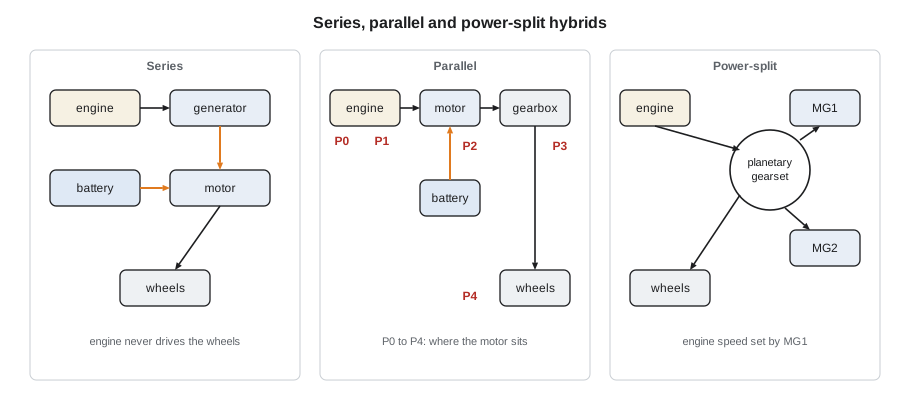
In a series hybrid, the engine is not connected to the wheels at all. It drives a generator that charges the battery or feeds the drive motor, and only the electric motor turns the wheels. The engine can run at its most efficient speed regardless of vehicle speed, and the drivetrain is simple. The cost is the energy lost in converting mechanical power to electrical power and back, which makes a series hybrid less efficient at steady highway speeds than a direct mechanical drive. Extended-range electric vehicles and some delivery trucks use the series layout, as do diesel-electric locomotives on a much larger scale.
Parallel hybrids and motor positions
In a parallel hybrid, the engine and the motor can both drive the wheels through the same driveline, alone or together. The industry describes where the motor sits with P numbers. A P0 motor is belt-driven at the front of the engine, replacing the alternator, as in most mild hybrids. P1 sits on the crankshaft. P2 sits between the engine and the transmission, usually with a clutch so the engine can be disconnected and the vehicle can drive electrically; several full-size hybrid pickups use this layout, which is why Gord asked whether his next truck should be one. P3 drives the transmission output, and P4 drives an axle that the engine does not, often the rear axle of a vehicle whose engine drives the front, giving electric all-wheel drive.
A parallel hybrid keeps the efficiency of a direct mechanical drive at highway speed, and the motor adds torque for acceleration and recovers energy when braking. It needs a transmission to match engine speed to road speed, and the control system must coordinate the engine, the motor and the clutch so that the driver feels one smooth power source.
The power-split hybrid
Ines's hatchback uses a power-split system, also called a series-parallel hybrid. It has an engine and two motor-generators joined by a planetary gearset, the power-split device, which Kiran met in the drivetrain course as the heart of an electric continuously variable transmission. The engine drives the planet carrier. Motor-generator 1, the smaller machine, is connected to the sun gear. The ring gear is connected to the wheels through a reduction gear and the differential, and motor-generator 2, the larger machine, also drives the ring gear side.
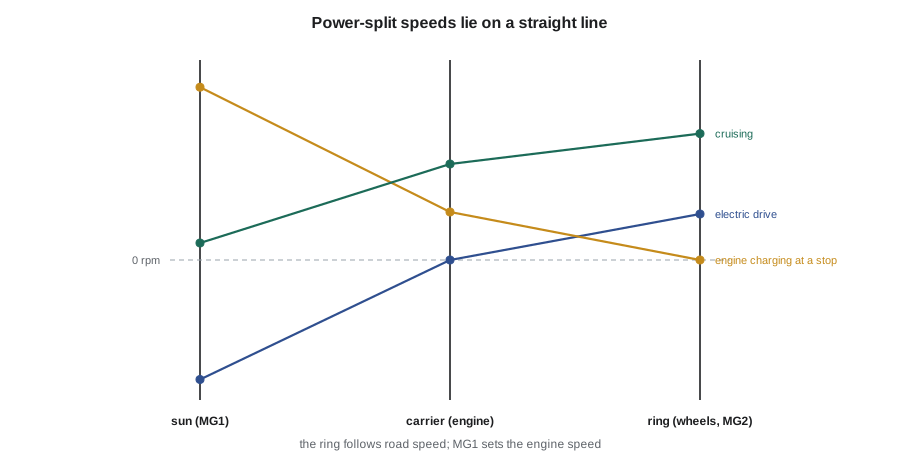
Because a planetary gearset links three speeds, fixing any two sets the third. The vehicle's speed sets the ring gear's speed. By controlling motor-generator 1's speed, the computer can hold the engine at whatever speed it chooses, independent of road speed. Part of the engine's power flows mechanically through the ring gear to the wheels, and part flows electrically: motor-generator 1 generates electricity that motor-generator 2 uses to drive the wheels, or that charges the battery. That split, mechanical and electrical, gives the system its name. There is no clutch, no gear shift and no torque converter.
# Power-split speeds: Willis equation for Ines's gearset (sun 30 teeth, ring 78 teeth)
zs, zr = 30, 78
final_ratio = 3.27         # ring gear turns per wheel turn (reduction and differential)
tire_rev_per_mile = 848
def mg1_speed(engine_rpm, vehicle_speed):
    wheel_rpm = vehicle_speed * tire_rev_per_mile / 60
    ring = wheel_rpm * final_ratio
    sun = (engine_rpm * (zs + zr) - ring * zr) / zs
    return ring, sun
for eng, spd in [(0, 25), (1200, 25), (1800, 50), (2400, 70), (0, 0)]:
    ring, sun = mg1_speed(eng, spd)
print(f"engine {eng:4} rpm at {spd:3} mph: ring {ring:5.0f} rpm, MG1 (sun) {sun:6.0f} rpm{' (MG1 spins backward)' if sun < 0 else ''}")engine 0 rpm at 25 mph: ring 1155 rpm, MG1 (sun) -3004 rpm (MG1 spins backward) engine 1200 rpm at 25 mph: ring 1155 rpm, MG1 (sun) 1316 rpm engine 1800 rpm at 50 mph: ring 2311 rpm, MG1 (sun) 472 rpm engine 2400 rpm at 70 mph: ring 3235 rpm, MG1 (sun) 229 rpm engine 0 rpm at 0 mph: ring 0 rpm, MG1 (sun) 0 rpm
The output shows the trick. With the engine stopped and the car moving, motor-generator 1 spins backward, freewheeling, because the ring is turning and the carrier is still. To start the engine, the computer brakes motor-generator 1 toward zero speed, which forces the carrier, and the engine, to turn. That is how a power-split hybrid starts its engine without a starter motor. At standstill with the engine running, the ring is stopped and the sun turns fast: the engine drives motor-generator 1 as a generator and charges the battery, which is exactly what Ines sees at red lights in the cold.
Operating modes
All full hybrids move between the same handful of modes, chosen many times a minute by the hybrid control module. In electric drive, the engine is off and the battery powers the motor, usually at low speeds and light loads. In engine drive, the engine powers the wheels and may also charge the battery. In blended or boost mode, the engine and the motor drive together for strong acceleration. In regenerative braking, the motor runs as a generator to slow the vehicle and charge the battery. And in charging at standstill, the engine runs only to charge the battery or to make heat.
The control module chooses the mode from the driver's demand, the vehicle speed, the battery's state of charge and temperature, and the engine's needs. That last item is the one Ines's question turns on. The engine must run to warm its catalytic converter after a cold start, to keep the coolant hot enough for the cabin heater, which on her car has no electric heater for the cabin, and to keep itself within its operating temperature. On a cold day, those needs override the wish to switch it off, even with a full battery.
| Mode | Engine | Motor-generators | Battery |
|---|---|---|---|
| Electric drive | Off | MG2 drives the wheels | Discharging |
| Engine drive | On, near its efficient load | MG1 generates, MG2 assists or generates | Steady or charging |
| Boost | On, high load | MG2 adds torque | Discharging |
| Regenerative braking | Off or idle | MG2 generates | Charging |
| Charging or heating at a stop | On | MG1 generates | Charging |
Reading the drive
Kiran's recording has a sample every half second. She runs the shop's mode classifier over it, which labels each sample by engine speed, battery current and vehicle speed, and adds the coolant temperature to explain why the engine was running when the car was stopped.
# Classify a hybrid drive recording into modes and explain engine-on-at-stop events
samples = [  # (seconds, speed mph, engine rpm, battery amps (+ = discharge), coolant F)
    (0, 0, 1050, -18, 106), (30, 14, 0, 35, 120), (60, 30, 1450, 8, 136), (90, 38, 2300, 42, 145), (120, 19, 0, -48, 147), (150, 0, 1100, -15, 151),
    (300, 32, 1500, 5, 172), (330, 11, 0, -40, 176), (360, 0, 0, 2, 176), (390, 15, 0, 30, 174)
]
def mode(spd, rpm, amps):
    if spd == 0: return "charging at stop" if rpm > 0 else "stopped, engine off"
    if rpm == 0: return "regen braking" if amps < -5 else "electric drive"
    if amps > 20: return "boost"
    return "engine drive"
for t, spd, rpm, amps, cool in samples:
    m = mode(spd, rpm, amps)
    why = f" (coolant {cool} F: below the heater threshold, engine kept running)" if m == "charging at stop" and cool < 158 else ""
print(f"{t:4}s {spd:3} mph {rpm:4} rpm {amps:5} A -> {m}{why}")0s 0 mph 1050 rpm -18 A -> charging at stop (coolant 106 F: below the heater threshold, engine kept running) 30s 14 mph 0 rpm 35 A -> electric drive 60s 30 mph 1450 rpm 8 A -> engine drive 90s 38 mph 2300 rpm 42 A -> boost 120s 19 mph 0 rpm -48 A -> regen braking 150s 0 mph 1100 rpm -15 A -> charging at stop (coolant 151 F: below the heater threshold, engine kept running) 300s 32 mph 1500 rpm 5 A -> engine drive 330s 11 mph 0 rpm -40 A -> regen braking 360s 0 mph 0 rpm 2 A -> stopped, engine off 390s 15 mph 0 rpm 30 A -> electric drive
The pattern is clear. For the first few minutes, with the coolant below the temperature the control module needs for cabin heat, the engine runs at every stop and charges the battery. Once the coolant passes that threshold, the engine shuts off at stops as it does in summer. The battery's state of charge never fell below the middle of its window, the motor-generator speeds follow the Willis equation, and there are no codes. The system is working as designed.
Kiran explains it to Ines in plain words: on a cold morning, the engine is the car's only source of cabin heat and the catalytic converter needs to warm up, so it keeps running until the coolant is hot. Ines asks if she can do anything about it. Kiran tells her the heater settings matter: running the heater at maximum with the fan high keeps the engine on longer, while a moderate setting with the seat heater lets it shut off sooner. She also checks the coolant level and the thermostat's warm-up rate against the specification, since a thermostat that opened early was this car's fault in the emissions course; this time it is fine.
Plug-in hybrids and other layouts
A plug-in hybrid uses the same architectures with a larger battery. A power-split plug-in can drive farther on electricity and at higher speeds, because its larger battery and motor can do the job without the engine. Some plug-in hybrids are parallel designs with a P2 motor and a conventional automatic transmission. Others use two motors and a clutch that locks the engine directly to the wheels at highway speed, combining series operation in town with a direct drive on the highway. The P numbers, the modes and the planetary relationships are tools for understanding any of them; the service information shows which layout a given vehicle uses.
Worked problem
Starting the engine in a power-split hybrid
A power-split hybrid with a 30 tooth sun and 78 tooth ring is moving with its ring gear at 1,500 rpm and the engine stopped. What is motor-generator 1's speed, and what must it do to start the engine?
Show solution
- With the carrier stopped, N_sun × 30 + 1,500 × 78 = 0.
- N_sun = −117,000 ÷ 30 = −3,900 rpm: motor-generator 1 spins backward.
- To turn the carrier, and the engine, the computer slows motor-generator 1 toward zero, which forces the carrier forward.
Answer: Motor-generator 1 spins at about −3,900 rpm; braking it toward zero cranks the engine through the carrier.
Common mistakes
MistakeTelling a hybrid owner the engine running at a stop is a fault without checking why.
InsteadLook at coolant temperature, battery charge and heater demand in the data first.
MistakeAssuming every hybrid has a conventional starter motor.
InsteadA power-split hybrid starts its engine through motor-generator 1.
MistakeConfusing a series hybrid with a parallel one.
InsteadIn a series hybrid the engine never drives the wheels directly.
MistakeTreating a mild hybrid's motor as able to drive the car.
InsteadA P0 belt-driven motor only assists the engine.
MistakeIgnoring the thermostat on a hybrid with a slow-warming engine.
InsteadCheck warm-up against the specification; an early-opening thermostat changes the engine's behavior.
Summary and key terms
- Hybrids run the engine where it is efficient, use the motor where it is better and recover braking energy.
- A series hybrid drives only through its motor; the engine drives a generator.
- A parallel hybrid lets the engine and motor drive together; P0 to P4 describe the motor's position.
- A power-split hybrid uses a planetary gearset and two motor-generators to set engine speed independently of road speed.
- The Willis equation links sun, carrier and ring speeds; motor-generator 1 starts the engine.
- Hybrids move between electric drive, engine drive, boost, regenerative braking and charging at a stop.
- Engine-on behavior in the cold is usually the control module meeting heat and emissions needs.
- Series hybrid
- A hybrid in which only the electric motor drives the wheels.
- Parallel hybrid
- A hybrid in which the engine and motor can both drive the wheels through the same driveline.
- Power-split device
- The planetary gearset that joins the engine and two motor-generators in a series-parallel hybrid.
- P2 hybrid
- A parallel hybrid with the motor between the engine and the transmission.
- Atkinson cycle
- An engine cycle with late intake valve closing that trades power for efficiency.
- Operating mode
- The combination of engine and motor use the hybrid control module chooses at a given moment.
Practice problems
Work each problem on paper first, then reveal the answer to check.
In a series hybrid, what turns the wheels?
Show answer
Only the electric motor.
Where does a P4 motor sit?
Show answer
On an axle the engine does not drive.
How does a power-split hybrid start its engine?
Show answer
Motor-generator 1 is slowed toward zero, forcing the carrier and engine to turn.
Why does Ines's engine run at stops on cold mornings?
Show answer
To make cabin heat and warm the engine and catalytic converter until the coolant is hot.
Lesson quiz · 5 questions
Score 60% or more to complete this lesson.
Create a free account to save your progress, take quizzes and earn a certificate.