
AUTO-410 · Lesson 1 of 12 · 20 min
Electrified vehicles: hybrids, plug-ins and battery electrics
On the first Monday of Kiran's final term, Bev Ostrowski calls a shop meeting before the bays open. Ridgeline has been sending its customers' hybrid and electric vehicles to the dealer for anything that touches the orange cables, and the number of those vehicles in the parking lot keeps growing. Ines Moreau's hybrid has 190,000 mi on it now and she drives it for a living. Dr. Amara Singh's electric hatchback needs more than tires and brakes. And Hal Osei has asked whether his courier fleet should replace its three gas vans with electric ones when their leases end. "We can keep sending that work away," Bev says, "or we can learn to do it safely. I've booked the training."
Marty Kowalchuk has already completed ASE's L3 Light Duty Hybrid/Electric Vehicle Specialist test and the vehicle makers' training for the brands we see most, and Dale Fenwick, the shop's safety lead, holds the same high-voltage training. Kiran will do the training this term, and until she has it, she works on high-voltage systems only beside one of them. This course follows her through it. It starts with the vehicles themselves: what makes a vehicle electrified, the families of hybrid and electric vehicles, the main components every technician must recognize, and the questions a shop and a fleet owner ask before they commit to them.
What makes a vehicle electrified
Every modern vehicle has a 12 volt electrical system, which Kiran studied in the electrical course. An electrified vehicle adds a second, separate system at a much higher voltage that stores energy in a traction battery and uses one or more electric machines to drive the wheels. In the industry, anything above 60 volts DC or 30 volts AC is treated as high voltage, because above those levels a shock can drive a dangerous current through the body. Electrified vehicles typically run between about 200 and 800 volts DC. The high-voltage system is isolated from the vehicle body: neither the positive nor the negative side is connected to the chassis, unlike the 12 volt system, where the negative side is the body itself.
The industry marks high-voltage cables in bright orange, a convention that most makers follow and that safety standards encourage. Orange cables, orange connectors and warning labels on covers tell anyone working on the vehicle that the parts beneath them can kill. A technician who sees orange stops and checks the service information before going further.
The families of electrified vehicles
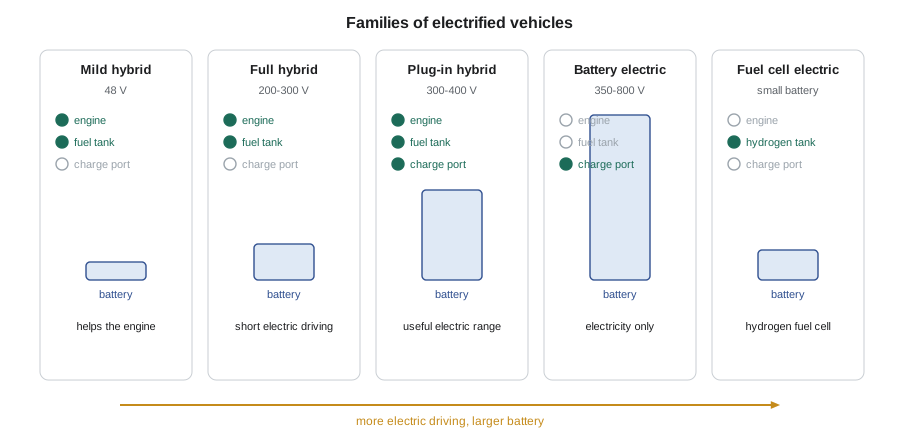
Electrified vehicles form a range from vehicles that use a little electric help to vehicles that run on electricity alone. The names are used loosely in advertising, so a technician should judge a vehicle by what its hardware does.
A mild hybrid adds a small motor-generator, often belt-driven or mounted between the engine and transmission, with a battery of about 48 volts. It restarts the engine smoothly after a stop, recovers some braking energy and adds a little torque, but it cannot drive the vehicle on electricity alone. Because 48 volts is below the 60 volt high-voltage threshold, these systems are not classed as high voltage, but a 48 volt battery can still deliver currents large enough to burn and arc, so the makers' procedures still apply.
A full hybrid, such as Ines's, has a larger traction battery, typically 200 to 300 volts, and one or two motor-generators powerful enough to move the vehicle on electricity at low speeds. The engine starts and stops as needed, and the system recovers braking energy. A full hybrid cannot be plugged in: all its energy comes from fuel, and the battery is a buffer that lets the engine run where it is most efficient.
A plug-in hybrid electric vehicle, or PHEV, has a still larger battery, perhaps 10 to 25 kilowatt-hours, which can be charged from the grid. It drives a useful distance on electricity, often 25 to 50 miles, before behaving like a full hybrid. An extended-range electric vehicle is a variation that drives on its electric motor at all times and uses a small engine only as a generator.
A battery electric vehicle, or BEV, such as Dr. Singh's, has no engine at all. A large battery, from about 40 to more than 100 kilowatt-hours, supplies one or more motors through an inverter. Energy comes only from charging. A fuel cell electric vehicle is the last family: it makes electricity from hydrogen in a fuel cell stack and stores a smaller amount in a battery. Fuel cell vehicles are rare in Colorado, and this course mentions them only in passing.
| Type | Typical battery | Plugs in? | Drives on electricity alone? |
|---|---|---|---|
| Mild hybrid | 48 V, under 1 kWh | No | No |
| Full hybrid | 200 to 300 V, about 1 to 2 kWh | No | Short distances at low speed |
| Plug-in hybrid | 300 to 400 V, 10 to 25 kWh | Yes | For a useful distance |
| Battery electric | 350 to 800 V, 40 to over 100 kWh | Yes | Always |
| Fuel cell electric | Small battery plus a hydrogen fuel cell | Refuels with hydrogen | Always |
The main high-voltage components
Whatever the family, the same components appear. The traction battery stores energy in many cells, grouped into modules and a pack, with a battery management system that monitors every cell and decides how much the pack may charge or discharge. The pack's contactors, heavy relays inside the pack, connect it to the rest of the vehicle only when the system is switched on. A service disconnect, a plug or switch that a technician removes before working on the system, breaks the pack's circuit in the middle.
The inverter, sometimes called the power electronics module, converts the battery's DC into the three-phase AC that drives the motor, and back again when the motor acts as a generator during regenerative braking. The motor-generator is usually a permanent-magnet synchronous machine, sometimes an induction machine. A DC-DC converter replaces the alternator: it steps the high voltage down to charge the 12 volt battery and run the vehicle's ordinary accessories. A plug-in vehicle adds an onboard charger that converts AC from the grid into DC for the battery, and a charge port with its own communication. Many electrified vehicles also have high-voltage accessories, such as an electric air conditioning compressor and a high-voltage coolant heater, which Kiran met in the climate control course.
Kiran's electrical course explained that a vehicle without an alternator still needs a 12 volt battery. Here is why: the 12 volt system powers the modules that wake the high-voltage system and close its contactors. A flat 12 volt battery leaves a hybrid or electric vehicle dead even with a full traction battery, which is why Dr. Singh's weak 12 volt battery in the spring was the cause of her warning lights and not the traction system.
Energy, power and range
Two measurements describe a battery: its energy, in kilowatt-hours, which sets how far the vehicle can go, and its power, in kilowatts, which sets how quickly energy can go in or out. A pack's energy is its voltage multiplied by its capacity in ampere-hours. A vehicle's consumption is measured in kilowatt-hours per 100 miles, and its range is roughly the usable energy divided by the consumption. Dr. Singh's hatchback has a 64 kilowatt-hour pack at a nominal 360 volts and uses about 27 kWh per 100 miles in mild weather.
# Battery energy and range for Dr. Singh's hatchback
v_nom = 360.0                      # nominal pack voltage
cap_ah = 178.0                     # pack capacity, ampere-hours
usable_share = 0.94                # the battery management system keeps a reserve at each end
energy = v_nom * cap_ah / 1000
usable = energy * usable_share
use = 27.4                         # kWh per 100 miles, mild weather
print(f"pack energy {energy:.1f} kWh, usable about {usable:.1f} kWh")
print(f"range at {use} kWh/100 mi: about {usable / use * 100:.0f} miles")pack energy 64.1 kWh, usable about 60.2 kWh range at 27.4 kWh/100 mi: about 220 miles
The range a driver sees varies with speed, temperature, terrain and accessory use, which Kiran will study in the battery lessons and the capstone. In Denver's winters, consumption rises sharply, because cold battery cells deliver less energy and the cabin needs heat that an engine's waste heat would otherwise provide.
The fleet question
Hal's question is practical: would electric vans cost him less over their life? Bev asks Kiran to build a simple comparison for the fleet meeting. The total cost of ownership adds the purchase price, energy, maintenance and other costs over the years the vehicle is kept, minus what it is worth at the end. Electric vans usually cost more to buy, less to fuel and less to maintain, because they have no oil changes, fewer brake jobs thanks to regenerative braking and far fewer moving parts. Whether they win depends on the prices and the distances, so the comparison must use the fleet's own numbers.
# Simple total cost of ownership: one courier van over five years (illustrative prices)
years = 5
dist_per_year = 25000
gas = {"price": 48000, "fuel_per_100": 15.2, "fuel_cost": 3.4, "maint_per_yr": 2400, "resale": 14000}
ev = {"price": 58000, "kwh_per_100": 48.0, "kwh_cost": 0.15, "maint_per_yr": 1100, "resale": 15000}
gas_total = gas["price"] + years * (dist_per_year / 100 * gas["fuel_per_100"] * gas["fuel_cost"] + gas["maint_per_yr"]) - gas["resale"]
ev_total = ev["price"] + 3500 + years * (dist_per_year / 100 * ev["kwh_per_100"] * ev["kwh_cost"] + ev["maint_per_yr"]) - ev["resale"]
print(f"gas van over {years} years:      {gas_total:10,.0f} USD")
print(f"electric van over {years} years: {ev_total:10,.0f} USD (includes a depot charger share)")
print(f"difference: {gas_total - ev_total:,.0f} USD ; the cheaper choice is the {'electric' if ev_total < gas_total else 'gas'} van")gas van over 5 years: 110,600 USD electric van over 5 years: 61,000 USD (includes a depot charger share) difference: 49,600 USD ; the cheaper choice is the electric van
The sample numbers point to the electric van, but Kiran notes in her summary what could change that: a lower resale value than expected, a battery or charger failure out of warranty, or routes too long for one charge in January. She also notes what the numbers leave out: time lost to charging if the depot chargers are slow, the training the shop needs, and the extra annual registration fee Colorado charges electric vehicles. Hal decides to lease one electric van for a year as a trial, and Ridgeline will service it. That van appears later in the course.
Incentives change often. The federal clean vehicle tax credits for new and used electric vehicles ended for vehicles acquired after September 30, 2025, so Kiran tells Hal to check any state or utility programs at the time of purchase.
What changes for the shop
Most of the work on an electrified vehicle is familiar: tires, alignment, suspension, brakes, cabin filters, wipers and 12 volt electrical faults. What changes is what surrounds the high-voltage system. The shop needs trained people, rated personal protective equipment, insulated tools, a rated meter and an insulation tester, a lockout procedure, a marked work area and a plan for a battery that is damaged or overheating. It needs access to each maker's service information, because de-energizing procedures differ between models. And it needs a rule, which Bev writes on the whiteboard and which Dale will enforce: nobody touches an orange component without the training, the equipment and the procedure for that vehicle.
Even routine jobs change a little. Hybrids and electric vehicles are heavy, and their battery packs sit where a lift's arms would usually go, so the lift points in the service information must be used exactly. Brake work on a vehicle with an electronic brake system may need the system put into a service mode first, as Kiran learned on Dr. Singh's car. Coolant service may involve separate loops for the battery, the inverter and the motor, bled with the scan tool. And an electric vehicle can move silently: a car that is ready to drive makes no engine noise, so it must be switched off and secured before anyone works under or in front of it.
Worked problem
Classifying a vehicle
A customer's crossover has a 48 volt belt-driven motor-generator and no charge port. Is it a high-voltage vehicle, and can it drive on electricity alone?
Show solution
- 48 volts DC is below the 60 volt high-voltage threshold.
- A belt-driven motor-generator helps the engine but cannot move the vehicle by itself.
- There is no charge port, so all its energy comes from fuel.
Answer: A mild hybrid: not classed as high voltage, and it cannot drive on electricity alone, though the maker's procedures for its 48 volt battery still apply.
Common mistakes
MistakeAssuming a vehicle with no engine noise is switched off.
InsteadCheck the ready indicator and switch the vehicle off before working near it.
MistakeTreating a 48 volt system as harmless.
InsteadIt is below the shock threshold but can still arc and burn; follow the procedure.
MistakeJudging a vehicle by its badge.
InsteadJudge it by its hardware: battery size, charge port and whether it drives electrically.
MistakeForgetting the 12 volt battery on an electric vehicle.
InsteadA flat 12 volt battery stops the high-voltage system from waking.
MistakeBuilding a fleet comparison on brochure numbers.
InsteadUse the fleet's own distances, prices and climate.
Summary and key terms
- Electrified vehicles add a high-voltage system, above 60 V DC, isolated from the body.
- Orange cables and warning labels mark high-voltage parts.
- Mild, full and plug-in hybrids, battery electric and fuel cell vehicles differ in battery size, charging and electric driving.
- The traction battery, contactors, service disconnect, inverter, motor-generator, DC-DC converter and onboard charger appear in most designs.
- Energy in kWh sets range; power in kW sets how fast energy moves.
- Total cost of ownership compares purchase, energy, maintenance and resale over the vehicle's life.
- High-voltage work needs training, equipment and the maker's procedure for that vehicle.
- High voltage
- In vehicles, above 60 V DC or 30 V AC.
- Full hybrid
- A hybrid that can drive short distances on electricity but cannot be plugged in.
- Plug-in hybrid
- A hybrid with a battery that can be charged from the grid.
- Battery electric vehicle
- A vehicle powered only by a traction battery charged from the grid.
- Contactor
- A heavy relay that connects the traction battery to the vehicle.
- DC-DC converter
- The device that steps the high voltage down to charge the 12 volt system.
- Total cost of ownership
- All the costs of owning a vehicle over its life, minus its resale value.
Practice problems
Work each problem on paper first, then reveal the answer to check.
Above what DC voltage is a vehicle system treated as high voltage?
Show answer
60 volts.
Why can a battery electric vehicle with a full traction battery fail to start?
Show answer
Its 12 volt battery is flat, so the modules cannot wake the system.
What does a PHEV have that a full hybrid does not?
Show answer
A larger battery that can be charged from the grid.
Name three costs in a fleet total cost of ownership comparison.
Show answer
Purchase price, energy and maintenance, minus resale value.
Lesson quiz · 5 questions
Score 60% or more to complete this lesson.
Create a free account to save your progress, take quizzes and earn a certificate.