
ARCH-230 · Lesson 5 of 12 · 22 min
Stress and strain
Szymańska brings three things to the fifth class: a thin steel wire, a stick of chalk and a long rubber band. She hangs a bucket from the wire and adds water a cupful at a time until the wire stretches visibly and then, quite suddenly, keeps stretching without more water before it finally snaps. She snaps the chalk between her fingers with a sharp crack. She stretches the rubber band to three times its length and lets it spring back. 'Three materials, three personalities,' she says. 'The wire warned us before it broke. The chalk gave no warning at all. The rubber band stretched so much it would be useless in a building even though it never broke. Forces tell you what a structure has to carry. Stress and strain tell you whether a material can carry it, and how it will behave on the way.'
From force to stress
The forces found in the last three lessons tell how hard a member is pulled, pushed or bent, but not whether it will break. A steel rod and a steel cable can carry the same force with very different safety, depending on how thick they are. What matters to the material is the force per unit of area over which it is spread. This is the stress, usually written with the Greek letter sigma, σ.
Stress is measured in pounds per square inch (psi), or for strong materials in kips per square inch (ksi), where one ksi is a thousand psi. A force in kips divided by an area in square inches gives a stress in ksi directly. A stress that pulls a material apart is a tensile stress; one that squeezes it is a compressive stress. When forces act parallel to a surface, as when a bolt is loaded across its shank or when the layers of a beam try to slide over each other, the stress is a shear stress, written with the Greek letter tau, τ, and also calculated as force divided by area.
A third kind of stress appears where one element presses on another: a beam on a wall, a column on a footing, a footing on the soil. This bearing stress is the contact force divided by the contact area. Bearing stresses can govern design where a strong material sits on a weak one, such as a steel column on concrete, a glulam beam on a narrow steel ledge, or any footing on soil. For this reason columns stand on base plates and footings are wider than the walls they carry: both spread a concentrated force over enough area to keep the stress below what the weaker material can bear.
Strain and stiffness
When a material is stressed it deforms. A rod pulled in tension gets longer; a column pushed in compression gets shorter. The change in length divided by the original length is the strain, written with the Greek letter epsilon, ε. Strain has no units, since it is a length divided by a length, and it is usually a very small number: a steel rod stressed to its working level stretches by about one thousandth of its length.
For most structural materials at working stresses, strain is proportional to stress. Doubling the load doubles the stretch, and removing the load returns the material to its original length. This linear, elastic behavior is described by Hooke's law, named after the seventeenth-century scientist Robert Hooke, and the constant of proportionality is the modulus of elasticity, or Young's modulus, written E. A material with a high modulus is stiff; one with a low modulus is flexible. Combining the definitions of stress, strain and modulus gives the stretch or shortening of a member under axial load, which engineers use to check how much a hanger, tie or column will move.
| Material | Modulus of elasticity, E | Typical strength |
|---|---|---|
| Structural steel | 29,000 ksi | Yield about 50 ksi |
| Aluminum | 10,000 ksi | Yield about 30 to 35 ksi |
| Concrete in compression | about 3,600 ksi | Specified compressive strength 3,000 to 6,000 psi |
| Softwood lumber, along the grain | about 1.2 to 1.8 million psi | Bending about 800 to 1,500 psi for design |
| Glulam, along the grain | about 1.6 to 2.0 million psi | Bending about 2,000 to 2,400 psi for design |
| Glass | about 10,000 ksi | Brittle; strength depends on surface flaws and heat treatment |
The table carries a lesson that surprises most students. Steel is about twenty times stiffer than wood and eight times stiffer than concrete. A steel beam and a wood beam of the same size and load will deflect in the ratio of their moduli, so the wood beam sags twenty times as much. Wood makes up for its low stiffness with its low weight and the ease of making it deep: a glulam beam is usually two to three times deeper than a steel beam carrying the same load. Stiffness, not strength, often decides the depth of timber floors.
Stress-strain curves
Testing a sample of a material to failure, while recording the load and the stretch, produces a stress-strain curve. Its shape describes the material's personality, and three shapes matter most for buildings.
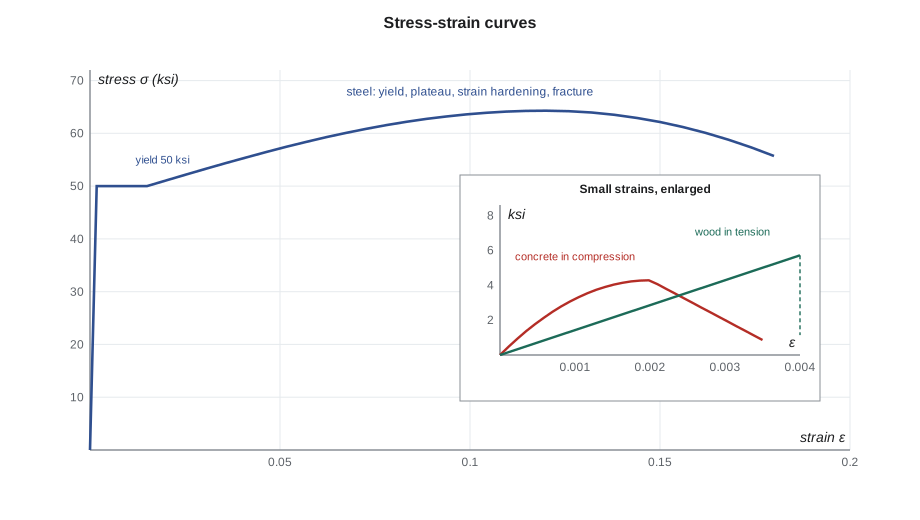
- Structural steel is linear and elastic up to its yield stress, then stretches a great deal at almost constant stress along the yield plateau, then strengthens again in strain hardening until it reaches its ultimate strength and fractures. It can stretch twenty or more times its yield strain before breaking. This ability to deform greatly without breaking is called ductility, and it is the most valuable property a structural material can have: a ductile structure sags, bends and warns before it fails, and it redistributes load from overstressed parts to others.
- Concrete is strong in compression and weak in tension, where it cracks at roughly a tenth of its compressive strength. In compression its curve bends over before a peak and then falls; it fails at small strains, by crushing. Concrete is therefore reinforced with steel bars placed where tension occurs, and the steel provides the ductility the concrete lacks.
- Wood is anisotropic: its properties depend on direction. Along the grain it is strong and fairly stiff; across the grain it is weak and soft, and it splits easily. In tension along the grain it is nearly linear and breaks suddenly, especially at knots; in compression it crushes more gradually. Wood is also affected by moisture, which reduces its strength and stiffness and makes it shrink and swell, and by the duration of load: it carries a brief load, such as a gust or a crowd, better than a permanent one, and it creeps under long-term loads.
Glass and stone are brittle, like chalk. They fail suddenly, with no yield, and their strength depends on microscopic flaws, so it varies widely between samples. Glass used structurally, for floors, stairs, balustrades and fins, is heat-strengthened or tempered and laminated in layers so that if one layer breaks, the others hold.
Safety and resistance
A structure must carry its loads with a margin of safety, because loads may be larger than expected and materials weaker. In limit states design, the loads are increased by load factors, as Lesson 2 showed, and the strengths of materials are reduced by resistance factors, written φ. A member is adequate when its factored resistance is at least its factored load effect. For steel in tension or bending, φ is 0.9; for concrete in compression it is about 0.65; for wood in bending it is about 0.85. The lower factors reflect greater variability and less warning before failure. Older design methods divided a material's strength by a single factor of safety and compared the result with stresses under unfactored loads; that approach, called allowable stress design, is still used for some wood and masonry design and in many textbooks.
# The library mezzanine hangs from the roof on four steel rods
import math
d = 0.75                                   # rod diameter (in)
A = math.pi * d ** 2 / 4                  # gross area (in2)
P_f, P_s = 9.0, 6.3                     # factored and service load per rod (kips)
Fy, E = 36, 29000                         # yield strength and modulus (ksi)
L = 156                                   # rod length (in)
stress = P_f * 1 / A
cap = 0.9 * Fy * A / 1
print(f"Rod area {A:.3f} in2; factored stress {stress:.1f} ksi (yield {Fy} ksi)")
print(f"Factored tensile resistance 0.9 Fy A = {cap:.1f} kips vs factored load {P_f} kips")
delta = P_s * 1 * L / (A * E)
print(f"Stretch under service load: {delta:.3f} in over {L} in (strain {delta / L:.5f})")

# Thermal movement of the exposed steel canopy beam
alpha, length, dT = 6.5e-06, 480, 130   # per degree, length (in), range (deg F)
move = alpha * length * dT
print(f"Canopy beam {length} in: free thermal movement {move:.2f} in over {dT} deg F")
print(f"Stress if fully restrained: E alpha dT = {E * alpha * dT:.1f} ksi")Rod area 0.442 in2; factored stress 20.4 ksi (yield 36 ksi) Factored tensile resistance 0.9 Fy A = 14.3 kips vs factored load 9.0 kips Stretch under service load: 0.077 in over 156 in (strain 0.00049) Canopy beam 480 in: free thermal movement 0.41 in over 130 deg F Stress if fully restrained: E alpha dT = 24.5 ksi
Two results stand out. First, a slender rod carries the mezzanine's load comfortably: a 3/4 in rod has a factored resistance of about 14.3 kips against a factored load of 9 kips, although the threaded ends, where the area is smaller, must be checked too. The rod stretches less than a tenth of an inch under service load, small enough that the mezzanine will not bounce noticeably, although the engineer will check that it does not tilt if the rods are loaded unevenly. Second, the canopy beam outside moves about 0.4 in between the coldest night and the hottest afternoon. If both ends were locked in place, the restrained movement would produce a stress of about 24.5 ksi, more than half the yield stress, before any load is applied. One end of the canopy must therefore be free to slide, or the beam must be designed to bend a little as it grows and shrinks.
Temperature and other movements
Materials expand when they warm and contract when they cool, by an amount equal to their coefficient of thermal expansion, α, times their length, times the change in temperature. For steel α is about 6.5 millionths per degree Fahrenheit, for concrete about 5.5 millionths, for aluminum about 13 millionths, and for wood along the grain only about 2 millionths. In Minneapolis the temperature of exposed elements can range from about −35 °F on a winter night to over 95 °F in summer sun, and dark surfaces in the sun get hotter still. A building whose inside is heated changes little, but its exposed parts, such as canopies, balconies, parking structures and long façades, move a great deal, and long buildings are divided by movement joints so that their parts can expand and contract without cracking.
Other movements are just as real. Concrete shrinks as it dries and creeps under sustained load, shortening columns in tall buildings by measurable amounts. Wood shrinks across the grain as it dries, much more than along it: a stack of wood floors in a six-story wood-frame building can shrink by an inch or more in total, which must be allowed for at elevator shafts, plumbing risers and where the wood frame meets a concrete or masonry stair core. Brick, in contrast, grows slightly as it absorbs moisture after firing. Movement joints and slip connections that let these materials move are part of the structural design, and the architect must show them on the drawings.
Worked problem
Bearing of a glulam beam on its column
A glulam beam in the hub's wing delivers a factored reaction of 22 kips to the top of a glulam column through a steel bearing plate. Wood is much weaker across the grain than along it, so the beam's underside must be checked for bearing perpendicular to the grain. If the factored bearing resistance of the beam's wood across the grain is about 610 psi, how long must the bearing be if the beam is 8.75 in wide?
Show solution
- Required bearing area: 22,000 lb ÷ 610 psi = 36.1 in².
- Required length of bearing: 36.1 ÷ 8.75 = 4.1 in.
- Provide a plate at least 4.5 in long, and more if the column and connection details need room for bolts or dowels.
- The same reaction on the column's end grain produces a stress of only about 22,000 ÷ (8.75 × 8.75) = 287 psi, far below the wood's compressive strength along the grain.
- The weak point is the beam's underside, where the load acts across the grain.
Answer: A bearing about 4.1 in long is enough for the wood across the grain; a plate of about 4.5 in or more is provided.
Exercise 5: stress and strain
- Calculate the stress in a column, a hanger rod and a footing from your studio project, and compare each with the strength of its material.
- Calculate how much a steel hanger rod of your choice stretches under service load.
- Calculate the thermal movement of an exposed steel or aluminum element on your project, and draw the joint or slip connection that allows it.
- Find a place in your project where wood is loaded across the grain, and check its bearing length.
Self-check
- Have I used consistent units for force, area and stress?
- Did I check bearing where a strong material sits on a weaker one?
- Have I shown how exposed elements can move with temperature?
Common mistakes
MistakeComparing forces rather than stresses with a material's strength.
InsteadDivide the force by the area to get a stress before comparing.
MistakeTreating wood as equally strong in every direction.
InsteadCheck bearing and tension across the grain separately; they are much weaker.
MistakeAssuming a strong material is also stiff.
InsteadCheck deflection and movement with the modulus of elasticity; wood is strong for its weight but flexible.
MistakeLocking both ends of an exposed steel member.
InsteadLet one end slide, or design for the restrained thermal stress.
MistakeIgnoring shrinkage in multi-story wood buildings.
InsteadDetail joints at cores, risers and cladding to allow the frame to shrink.
Summary and key terms
- Stress is force divided by area; it can be tensile, compressive, shear or bearing.
- Strain is change in length divided by original length; within the elastic range, stress equals the modulus of elasticity times strain.
- Steel is stiff, strong and ductile; concrete is strong in compression but weak and brittle in tension; wood is light, strong along the grain, weak across it and affected by moisture and load duration.
- Limit states design compares factored loads with factored resistances, using resistance factors below one.
- Temperature, shrinkage and creep make materials move, and the structure must allow for these movements.
- Stress
- Force per unit area within a material.
- Strain
- Change in length divided by original length.
- Modulus of elasticity
- The ratio of stress to strain in the elastic range; a measure of stiffness.
- Yield stress
- The stress at which steel begins to stretch without more load.
- Ductility
- The ability of a material to deform greatly before breaking.
- Anisotropic
- Having different properties in different directions, as wood does along and across the grain.
Practice problems
Work each problem on paper first, then reveal the answer to check.
A steel bar with an area of 0.8 in² carries 20 kips. What is its stress?
Show answer
20 ÷ 0.8 = 25 ksi.
How much does a steel rod 10 ft long stretch at a stress of 20 ksi?
Show answer
Strain = 20 ÷ 29,000 = 0.00069; stretch = 0.00069 × 120 = 0.083 in.
Why is concrete reinforced with steel?
Show answer
Concrete is weak and brittle in tension; steel bars carry the tension and add ductility.
How much does a 100 ft aluminum railing move over a temperature range of 110 °F?
Show answer
13 × 10⁻⁶ × 1,200 × 110 = 1.7 in.
What makes ductility valuable in a structure?
Show answer
A ductile structure deforms visibly and redistributes load before it fails, giving warning.
Lesson quiz · 5 questions
Score 60% or more to complete this lesson.
Create a free account to save your progress, take quizzes and earn a certificate.