
ARCH-230 · Lesson 4 of 12 · 24 min
Trusses
Szymańska brings a bag of drinking straws and a box of pins to the fourth class. She asks each student to pin four straws into a square and push on one corner. The squares collapse into diamonds at the lightest touch. Then she asks them to pin a fifth straw across one diagonal. The squares become rigid. 'A square needs its corners to be stiff to hold its shape,' she says. 'A triangle holds its shape even if every corner is a hinge. That is why half the bridges and roofs you have ever seen are made of triangles.' By the end of the class Joon-ho has built a straw truss a meter long that carries his textbook, and the students can say which straws are being pulled and which are being squeezed.
What a truss is
A truss is a framework of straight members connected at their ends to form triangles. The points where members meet are called joints or nodes. If the loads are applied only at the joints, and the joints behave like pins, each member carries only an axial force: it is either pulled along its length, in tension, or pushed along its length, in compression. There is no bending in the members. Because material is used most efficiently when it is stressed evenly through its section, a truss can carry long spans with very little material compared with a solid beam of the same depth.
The top members of a truss are called the top chord, the bottom members the bottom chord, and the members between them the web, made of verticals and diagonals. A truss supported at its ends and loaded from above acts like a deep beam with most of its material removed from the middle: the top chord is in compression, the bottom chord is in tension, and the web members carry the shear between them. Trusses are used for roofs, bridges, transfer structures, towers and the long-span floors of halls and gymnasiums. The community hub's hall in Design Studio III is spanned by glulam trusses, and that truss is the running example for this lesson.
Common truss types
Trusses are named for their patterns, many of them after nineteenth-century engineers who patented them for railway bridges. The names matter less than the behavior: under the same loads, different patterns put different members into tension and compression, and the best pattern for a given material puts the long members in tension, where they cannot buckle, and keeps the compression members short.
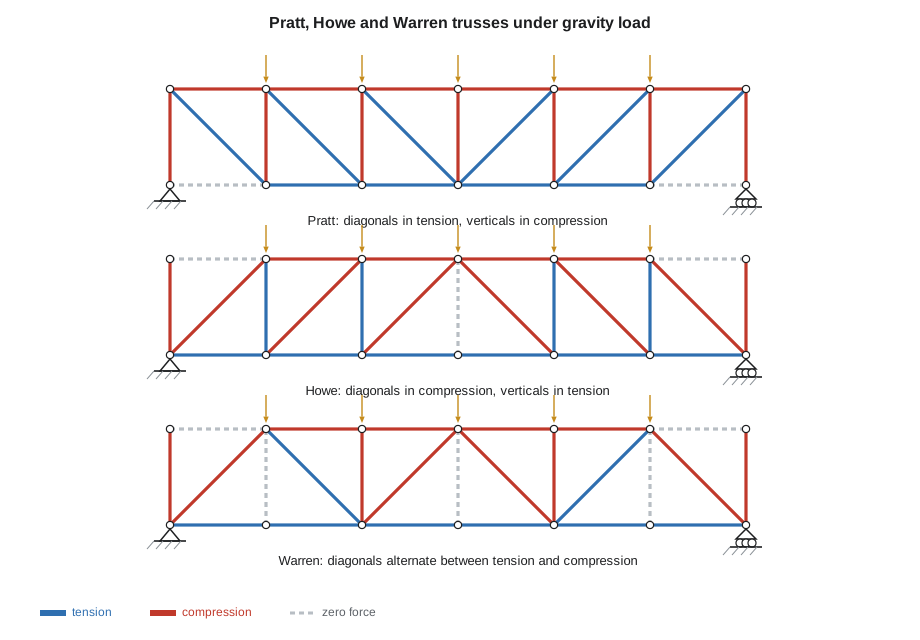
- The Pratt truss has verticals and diagonals that slope down toward the middle of the span. Under gravity loads the diagonals are in tension and the verticals in compression. Since the long diagonals are in tension, it suits steel, and with timber chords and steel rod diagonals it suits mixed construction.
- The Howe truss has diagonals that slope the other way, so under gravity loads the diagonals are in compression and the verticals in tension. It was popular in the nineteenth century for timber bridges with iron rod verticals, because timber is good in compression and the rods carried the tension.
- The Warren truss has diagonals that alternate direction, forming a row of triangles, often without verticals. Its diagonals alternate between tension and compression. It is economical and visually simple, and is common in steel roof joists and bridges.
- Pitched roof trusses, such as the Fink and the king post, have sloping top chords that follow the roof. The light timber trusses in houses are usually Fink trusses joined with steel nail plates.
- Bowstring trusses have a curved top chord, nearly matching the shape of the bending moment, so the web forces are small. They were common for warehouse and hangar roofs and have returned in glulam and steel.
Stability and determinacy
A truss made of triangles is stable as long as it is supported adequately. For a plane truss with j joints, m members and r reaction components, there are two equilibrium equations at each joint, so 2j equations in all, and m + r unknown forces. If m + r equals 2j, the truss is statically determinate and every force can be found by statics. If m + r is less than 2j, the truss is a mechanism and will collapse; if it is greater, the truss is indeterminate, with redundant members that share load according to their stiffness. Counting is necessary but not sufficient: the members must also be arranged in triangles, since a truss can have the right number of members and still contain a square panel that folds up.
The method of joints
Because each joint is a pin in equilibrium, the forces in the members that meet there, together with any load or reaction, must satisfy the two force equations at that joint. The moment equation gives nothing new at a point where all forces meet. The method of joints works through a truss one joint at a time, starting at a joint with no more than two unknown member forces, usually a support, and moving to joints where earlier results leave only two unknowns.
- Find the reactions first, from equilibrium of the whole truss.
- Draw a free body of a joint with at most two unknown members. Assume every unknown member is in tension, pulling away from the joint.
- Resolve the inclined members into horizontal and vertical components and solve the two equations.
- A positive result confirms tension; a negative result means the member is in compression.
- Move to the next joint, using the forces already found, and continue across the truss.
Some members carry no force at all under a given loading. At an unloaded joint where only two members meet and they are not in line, both members carry zero force. At an unloaded joint where three members meet and two are in line, the third carries zero force. Such zero-force members are not useless: they brace compression members against buckling, carry load under other load cases, and hold the truss's shape during construction.
The method of sections
To find the force in one particular member without working through every joint, the method of sections cuts the truss with an imaginary line through that member and no more than two others, and draws a free body of one side. Taking moments about the point where the other two cut members meet gives the force in the wanted member directly. For a truss with parallel chords, a cut near midspan shows a simple and very useful result: the forces in the top and bottom chords form a couple that resists the bending moment at that section, so each chord force is about equal to the moment divided by the depth of the truss.
This is the key to truss design for architects. The moment depends on the span and load; the chord force depends on the moment and the depth. A truss twice as deep has half the chord force and can have smaller chords, at the cost of more height, more web material and more building volume to heat. The span-to-depth ratio of span/10 to span/15 that the students used in Design Studio III comes from balancing these costs. The web members, meanwhile, carry the shear, which is largest near the supports, so the diagonals near the ends of a truss are heavier than those at midspan, while the chords are heaviest at midspan.
The hall truss
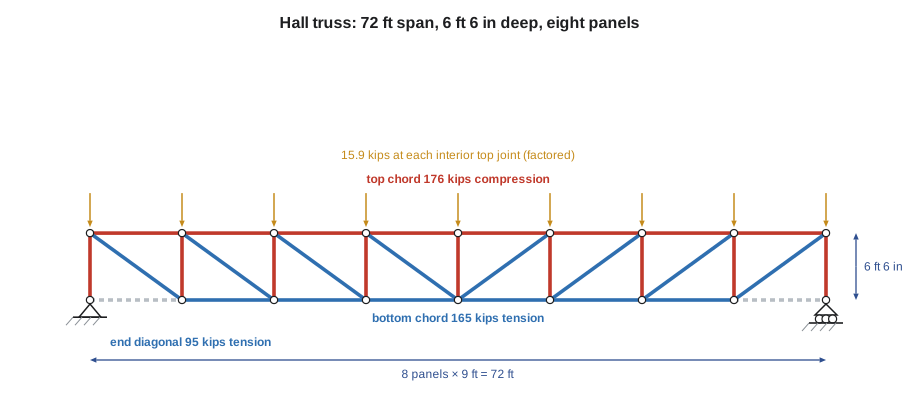
Callum's hall truss is a parallel-chord Pratt truss of glulam, spanning 72 ft between columns in the east and west walls, 6 ft 6 in deep, with eight panels of 9 ft. The roof structure bears on the top chord at the panel points, so the truss is loaded at its top joints. From Lesson 2, the factored roof load per truss is about 1.77 kip/ft, which gives about 15.9 kips at each interior top joint and half that at each end. The script below solves the whole truss by writing the two equations at every joint and solving them together, which is the method of joints done all at once, as a computer does it. It then compares the largest chord force with the quick estimate M/d.
# Pratt truss for the hub's hall, solved by the method of joints (all joints at once)
span, depth, n = 72.0, 6.5, 8                     # span and depth (ft), number of panels
p = span / n
w = 1.768                                           # factored line load (kip/ft)
P = w * p                                         # load at each interior top joint
nodes = [(i * p, 0.0) for i in range(n + 1)] + [(i * p, depth) for i in range(n + 1)]
B = lambda i: i                                   # bottom joint i
T = lambda i: n + 1 + i                           # top joint i
members = [(B(i), B(i + 1)) for i in range(n)] + [(T(i), T(i + 1)) for i in range(n)]
members += [(B(i), T(i)) for i in range(n + 1)]   # verticals
for i in range(n):                                # Pratt diagonals slope down towards midspan
    members.append((T(i), B(i + 1)) if i < n // 2 else (B(i), T(i + 1)))
loads = {T(i): (P if 0 < i < n else P / 2) for i in range(n + 1)}
# unknowns: one force per member (tension positive) + reactions Ax, Ay at B(0) and Ay at B(n)
nu, J = len(members) + 3, len(nodes)
A = [list([0.0] * nu) for _ in range(2 * J)]
rhs = [0.0] * (2 * J)
for k, (a, b) in enumerate(members):
    (xa, ya), (xb, yb) = nodes[a], nodes[b]
    Lm = ((xb - xa) ** 2 + (yb - ya) ** 2) ** 0.5
    cx, cy = (xb - xa) / Lm, (yb - ya) / Lm
    A[2 * a][k] += cx; A[2 * a + 1][k] += cy      # tension pulls joint a towards b
    A[2 * b][k] -= cx; A[2 * b + 1][k] -= cy
m = len(members)
A[0][m] = 1; A[1][m + 1] = 1; A[2 * B(n) + 1][m + 2] = 1
for j, f in loads.items():
    rhs[2 * j + 1] += f                           # applied loads act downward
# Gaussian elimination with partial pivoting
for c in range(nu):
    r = max(range(c, 2 * J), key=lambda i: abs(A[i][c]))
    A[c], A[r], rhs[c], rhs[r] = A[r], A[c], rhs[r], rhs[c]
    for i in range(2 * J):
        if i != c and A[i][c]:
            f = A[i][c] / A[c][c]
            A[i] = [x - f * y for x, y in zip(A[i], A[c])]; rhs[i] -= f * rhs[c]
F = [rhs[i] / A[i][i] for i in range(nu)]
print(f"Joints {J}, members {m}, reactions 3: m + r = {m + 3}, 2j = {2 * J}")
print(f"Reactions: {F[m + 1]:.1f} and {F[m + 2]:.1f} kips (total load {w * span:.1f})")
kinds = ["bottom"] * n + ["top"] * n + ["vertical"] * (n + 1) + ["diagonal"] * n
for kind in ("top", "bottom", "vertical", "diagonal"):
    fs = [F[k] for k in range(m) if kinds[k] == kind]
    big = max(fs, key=abs)
    print(f"  largest {kind:<9} force {abs(big):7.1f} kips {'tension' if big > 0 else 'compression'}")
M = w * span ** 2 / 8
print(f"Quick check: M = wL^2/8 = {M:.0f} kip-ft, M/d = {M / depth:.0f} kips")Joints 18, members 33, reactions 3: m + r = 36, 2j = 36 Reactions: 63.6 and 63.6 kips (total load 127.3) largest top force 176.3 kips compression largest bottom force 165.2 kips tension largest vertical force 63.6 kips compression largest diagonal force 95.1 kips tension Quick check: M = wL^2/8 = 1146 kip-ft, M/d = 176 kips
The solver confirms the count, m + r = 2j, so the truss is determinate. The largest top chord force, in the panels at midspan, matches the quick estimate M/d almost exactly, about 176 kips of compression. The bottom chord peaks a little lower, about 165 kips of tension, because its most heavily loaded panels meet the diagonals one panel away from the center, where the moment is slightly smaller. The largest diagonal force, about 95 kips, occurs in the end panels, where the shear is greatest, and it is in tension, as expected for a Pratt truss. The verticals are in compression, the largest at the ends.
These numbers drive the design. The top chord must carry a large compression without buckling sideways out of the plane of the truss, so it needs bracing from the roof deck or purlins at close intervals. The bottom chord carries a large tension, which is easy for the glulam itself but hard at the joints, where the force must pass through bolts, dowels or steel plates. In timber trusses the connections, not the members, usually govern the design. Szymańska shows photographs of glulam trusses with slotted-in steel plates and rows of steel dowels, and of an older truss with exposed bolts and side plates. 'The connection is where a timber truss becomes architecture,' she says. 'Draw it at full size before you fall in love with it.'
Worked problem
Chord force by the method of sections
A flat roof truss spans 60 ft, is 5 ft deep, and carries a factored load of 1.4 kip/ft. Estimate the force in the top and bottom chords at midspan, and say what happens to the force if the truss is made 7.5 ft deep instead.
Show solution
- Midspan moment: M = wL²/8 = 1.4 × 60² ÷ 8 = 630 kip-ft.
- Chord force at depth 5 ft: 630 ÷ 5 = 126 kips, compression in the top chord and tension in the bottom chord.
- At depth 7.5 ft: 630 ÷ 7.5 = 84 kips.
- Making the truss half as deep again reduces the chord force by a third; the chords can be smaller, but the web members are longer and the building is taller.
- The span-to-depth ratio changes from 12 to 8.
Answer: About 126 kips at a depth of 5 ft, falling to about 84 kips if the truss is 7.5 ft deep.
Trusses in architecture
Trusses have shaped some of the most memorable interiors in architecture: the iron roof trusses of nineteenth-century railway stations, the timber trusses of medieval barns and churches, the steel space frames of exhibition halls, and the glulam trusses of contemporary prairie arenas and schools. A truss reads as a pattern of lines, and its character depends on its type, its depth, the spacing of its panels and above all its joints. A Pratt truss with slender steel rods for its tension diagonals and stocky timber verticals for its compression members tells the story of its forces; a Warren truss of identical tubes hides it. Neither is wrong, but the designer should choose deliberately.
Trusses also have practical consequences. Their depth gives a ceiling zone in which ducts, lights and catwalks can run, which is why the hub's mechanical engineer was pleased with a two-meter-deep truss. Their open web lets light through from clerestories. They can be prefabricated in a shop and lifted into place in a day. Against these advantages, they need fire protection or enough timber mass to char safely, they collect dust, and their many joints cost labor. A truss is a good choice when the span is long, the depth is available, and the pattern is wanted as part of the space.
Exercise 4: trusses
- Build a straw or balsa truss with at least six panels, load it at the top joints, and mark which members you expect to be in tension and compression.
- Check that your truss satisfies m + r = 2j, and identify any zero-force members.
- Solve the support joint and the next two joints of your truss by the method of joints.
- Estimate the chord force at midspan of a roof truss in your studio project by M/d, for two different depths, and draw both.
- Draw one joint of the truss at full size, showing how the member forces pass through the connection.
Self-check
- Are all my truss loads applied at joints? If not, which members also bend?
- Are my long members in tension and my compression members short and braced?
- Have I left room in the section for the truss's real depth?
Common mistakes
MistakeApplying loads between the joints of a truss and ignoring the bending they cause.
InsteadLoad trusses at the panel points, or design the chord for bending as well.
MistakeAssuming the direction of a member force before solving.
InsteadAssume tension in every unknown member and let the sign tell you the answer.
MistakeMaking a truss too shallow to save height.
InsteadKeep the span-to-depth ratio near span/10 to span/15, or accept much larger chords.
MistakeForgetting to brace the compression chord.
InsteadBrace the top chord laterally with the roof deck, purlins or bracing at close intervals.
MistakeTreating timber connections as an afterthought.
InsteadDesign and draw the joints early; they usually govern timber truss design.
Summary and key terms
- A truss is a triangulated frame whose members carry only axial tension or compression when loads are applied at the joints.
- Under gravity loads the top chord is in compression and the bottom chord in tension; the web carries the shear.
- Pratt, Howe and Warren trusses distribute tension and compression differently among their web members.
- The method of joints solves each joint with two equations; the method of sections cuts through a few members and uses moments.
- The chord force at a section is about the moment divided by the truss depth, so depth trades directly against member size.
- Truss
- A frame of straight members joined at their ends in triangles.
- Chord
- A top or bottom member of a truss.
- Web
- The verticals and diagonals between the chords of a truss.
- Panel point
- A joint along a chord where web members meet and loads are applied.
- Zero-force member
- A truss member that carries no force under a particular loading.
- Method of sections
- A way of finding member forces by cutting through a truss and using moments.
Practice problems
Work each problem on paper first, then reveal the answer to check.
A truss has 12 joints, 21 members and 3 reactions. Is it determinate?
Show answer
Yes: m + r = 24 = 2j.
A parallel-chord truss has a midspan moment of 900 kip-ft and a depth of 8 ft. What is the chord force?
Show answer
900 ÷ 8 = 112.5 kips.
In a Pratt truss under gravity load, are the diagonals in tension or compression?
Show answer
Tension; the verticals are in compression.
Where in a simply supported truss are the web forces largest?
Show answer
Near the supports, where the shear is greatest.
Why is a Howe truss suited to timber diagonals with iron rod verticals?
Show answer
Its diagonals are in compression, which timber carries well, and its verticals in tension, which rods carry well.
Lesson quiz · 5 questions
Score 60% or more to complete this lesson.
Create a free account to save your progress, take quizzes and earn a certificate.