
APT-320 · Lesson 7 of 12 · 23 min
Power transmission: belts, chains and couplings
▶ Video coming soon A video version of this lesson is on the way.
On Monday, September 28, as Dunmarrow Farms started its soybean harvest, Bram Vandersluis came to the equipment counter with a cardboard box. Inside were three V-belts from the drive of the farm's grain leg, the bucket elevator that lifts grain into the bins, and a short length of roller chain from the leg's backstop drive. Two of the belts were glazed and cracked; one was almost new. "We replaced one last month when it broke," Bram said. Joelle Strand measured the belts' top width and checked their printed numbers: three B-section belts, each B75. She sold him a matched set of three, explained why the newer belt had to go too, and laid the chain on the counter beside a new length to show him how far it had stretched. She checked the sheave grooves with a groove gauge from the photos on his phone and suggested he look at the sprockets before fitting a new chain. Her binder note said the leg ran through both harvests without stopping.
Power transmission at the counter
Power transmission (PT) parts carry rotation from a motor or engine to the machine it drives: belts and sheaves, chain and sprockets, couplings, gearboxes, shafts, keys and bushings. They are found in every sector of this course, from a plant's conveyors to a combine's drives and a quarry's crusher. Industrial distributors sell them together with bearings, which is why the trade often groups them as bearings and power transmission.
V-belts
A V-belt grips the sides of a V-shaped groove in a sheave (pulley). Its size is described by its cross-section and its length.
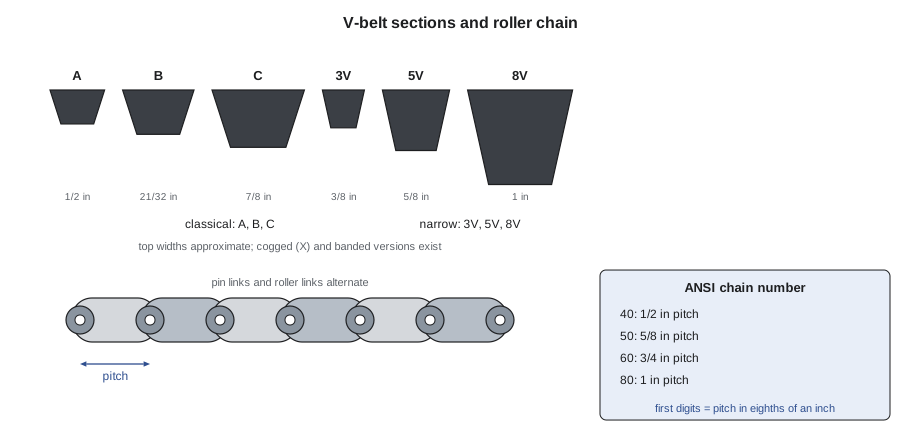
Classical V-belt sections, for general industrial and agricultural drives:
- A section, about 1/2 in wide across the top.
- B section, about 21/32 in wide.
- C section, about 7/8 in wide, plus the larger D and E sections.
Narrow (wedge) sections carry more power in less space:
- 3V, 5V and 8V, about 3/8, 5/8 and 1 in wide, in North American inch sizing.
- SPZ, SPA, SPB and SPC, the metric narrow sections to ISO 4184, common on European machines.
Light-duty belts, such as 3L, 4L and 5L, are sized for single-belt drives on small equipment like lawn mowers and shop fans; a 4L belt is close in size to an A belt but is not built for industrial multi-belt drives, and should not replace one.
Cogged or notched versions, marked with an X such as AX, BX or 5VX, bend more easily around small sheaves and run cooler. Banded belts join several belts with a tie band across the top, so they cannot roll over or jump the grooves on drives with shock loads, such as crushers or vibrating screens. Agricultural drives also use double-V (hexagonal) belts, which drive from both sides, and many machine-specific belts listed by the maker's number.
Length is coded differently by section. A classical B75 belt has an inside length of about 75 inches; a narrow 5V1000 belt has an effective length of 100.0 inches; a metric SPA1250 belt has a datum length of 1,250 mm. When a belt's number is worn off, measure its top width and depth to identify the section, and measure its length with a belt measuring tape or by the sheave method in the supplier's catalog.
Matched sets, sheaves and tension
On a drive with two or more belts, the belts share the load only if they are the same length. A new belt beside two stretched belts is tighter than they are and carries most of the load, so it wears out quickly, while the old belts slip. That is why Joelle sold Bram three belts. Replace multi-belt drives as a matched set from one maker, and never mix new and used belts. Most modern belts are made to tight length tolerances and are sold as matched without special coding, but the rule stands.
Sheaves wear too. A worn groove becomes dished, letting a new belt ride low and slip. A groove gauge shows the wear. Sheaves are mounted on the shaft with a tapered bushing, such as the QD or taper-lock types, which clamp the sheave to the shaft and allow one sheave to fit many shaft sizes. The bushing is identified by its type, size and bore, and the bore by its size and keyway.
Tension and alignment decide belt life. Too little tension causes slipping and glazing; too much overloads the bearings. Misaligned sheaves wear the belt's sides and turn belts over in the grooves. The counter sells belt tension gauges and laser alignment tools, and passes on the belt maker's tensioning method.
Synchronous belts
Synchronous or timing belts have teeth that mesh with toothed pulleys, so they do not slip. They drive camshafts on engines and run many conveyors, machine tools and agricultural drives. They are identified by pitch (the distance between tooth centers), tooth profile, length and width. A belt labeled 1200-8M-30 has a pitch length of 1,200 mm, an 8 mm pitch in the curved-tooth profile family often called HTD, and a width of 30 mm. Older inch-pitch belts use letters: XL, L and H. Tooth profiles that look similar, such as two curvilinear profiles of the same pitch, are not always interchangeable, so match the profile to the pulleys.
Worked problem
Driven speed and belt speed
A conveyor motor turns at 1,750 rpm with a 5.0 in pitch diameter sheave. The driven sheave on the conveyor's head shaft is 12.0 in. How fast does the head shaft turn, and what is the belt speed?
Show solution
- Driven speed:
- \[1{,}750 \times \frac{5.0}{12.0} \approx 729 \text{ rpm}\]
- Belt speed (circumference of the driver × speed):
- \[\pi \times \frac{5.0}{12} \times 1{,}750 \approx 2{,}291 \text{ ft/min}\]
Answer: About 729 rpm at the head shaft and a belt speed of about 2,290 ft/min. Speed ratio questions come up when a customer wants a machine to run faster or slower; changing sheave sizes changes the speed, but the belt supplier's tables also check that the belt section and the number of belts can carry the power at the new speed.
Roller chain
Roller chain is made of alternating roller links (two inner plates, two bushings and two rollers) and pin links (two outer plates and two pins). Its key dimension is the pitch, the distance from one pin center to the next.
North American chain is identified by ANSI numbers, which follow a simple rule: the digits before the last give the pitch in eighths of an inch, and the last digit describes the type.
- 40 chain has a 4/8 = 1/2 in pitch; 50 is 5/8 in; 60 is 3/4 in; 80 is 1 in; 100 is 1-1/4 in.
- A final 0 means standard roller chain. 35 chain (3/8 in pitch) is a rollerless bushing chain, and 41 is a narrow lightweight 1/2 in pitch chain.
- Suffixes add detail: H for heavy series with thicker plates, and -2 or -3 for double and triple strand, such as 60-2.
European machines often use British Standard chain such as 08B, which also has a 1/2 in pitch but different roller diameter and width from ANSI 40. The two are not interchangeable even though they look alike. Agricultural machines add their own families, such as CA series agricultural roller chain and double-pitch conveyor chains such as 2060, with twice the pitch of 60 chain and longer plates for conveyors and elevator buckets.
Chain is sold by the foot or meter, by the box, or cut to length with connecting links (master links, held by a spring clip or cotter pins) and, for an odd number of pitches, an offset link. Count the pitches on the old chain, or measure it, and ask how it is joined.
Chain wear shows as elongation: the pins and bushings wear, and the chain gets longer. Elongated chain rides up the sprocket teeth, jumps and breaks. A common rule is to replace standard roller chain at about 3 in 100 elongation, less on precise or high-speed drives; the chain maker's figure governs. Elongation is measured over a number of pitches with the chain under light tension.
Worked problem
Measuring chain stretch
Bram's leg uses 60 chain, which has a pitch of 3/4 in. Joelle measures 24 pitches of his old chain under light tension and gets 18.36 in. How much has the chain elongated?
Show solution
- New length of 24 pitches:
- \[24 \times 0.75 = 18.00 \text{ in}\]
- Elongation:
- \[\frac{18.36 - 18.00}{18.00} = 0.0200\]
Answer: About 2 in 100. The chain is not yet at a typical 3 in 100 replacement limit, but it is well worn and will be replaced at the next shutdown. Joelle added the sprockets to the quote, because a new chain on hooked, worn sprocket teeth wears out quickly.
Sprockets are identified by chain number, number of teeth, number of strands, bore, keyway and hub style, or by bushing type. Worn sprocket teeth look hooked or pointed. Replace badly worn sprockets with the chain, and replace both sprockets on a drive together when practical.
Couplings
A coupling joins two shafts end to end, such as a motor to a pump or a gearbox, and allows for a little misalignment and shock. Common types:
- Jaw couplings: two metal hubs with interlocking jaws and an elastomer spider or insert between them. Cheap, simple and common on pumps and small drives. The spider is the wear part, available in different materials for stiffness and temperature.
- Gear couplings: toothed hubs inside a toothed sleeve, lubricated with grease, for high torque.
- Grid couplings: a spring-steel grid in slotted hubs, absorbing shock, common on conveyors and crushers.
- Tire couplings: a flexible rubber or urethane tire between two hubs, forgiving of misalignment.
- Disc couplings: thin flexible steel discs, for precise, high-speed drives.
- Universal joints and drivelines, such as the PTO drivelines on farm equipment.
Couplings are identified by type, size and the bore and keyway of each hub; the two hubs may have different bores. A coupling does not fix poor alignment: shafts should still be aligned within the coupling maker's limits, and a coupling that keeps wearing out its insert is often a sign of misalignment.
Shear bolts and slip clutches protect farm and industrial drivelines from overload. A shear bolt is designed to break at a set load. Replace a shear bolt only with the specified bolt of the same size and grade. A customer who fits a harder bolt because the original keeps breaking has removed the protection, and the next overload breaks a gearbox or a shaft instead. The real question is why the bolt keeps shearing.
Keys, bushings, shafts and gearboxes
Shafts, sheaves, sprockets and coupling hubs are joined by keys in keyways, held with set screws. Inch keys and keyways are sized by width in fractions of an inch; metric keys by width and height in millimeters. Key stock is sold by the length and cut to fit. Shaft collars, bushings, and speed reducers (gearboxes) and electric motors complete the PT line. Gear reducers are identified by type, ratio, input and output shaft sizes, mounting and the maker's model number, and need the specified gear oil. Motors are identified from their nameplate: power, speed, voltage, phase, frame size and enclosure.
Reading failed belts and chain
A failed belt or chain is evidence, and the counter can read it before selling a replacement:
- Glazed, shiny sides and cracked undersides on a V-belt usually mean slipping from low tension, a worn sheave or an overloaded drive.
- Wear on one side of the belt points to misaligned sheaves.
- A belt turned over in its groove suggests misalignment, a damaged belt or a worn sheave; on multi-belt drives with shock loads, a banded belt is the cure.
- Cracks across a belt's underside come from age, heat or a sheave that is too small for the belt section.
- A synchronous belt with sheared teeth often had too little tension or a pulley that was too small; one with edge wear has a misaligned pulley or a flange problem.
- Roller chain with tight joints or rust has run without lubrication; chain with cracked plates has been overloaded or fatigued; chain that climbs the sprocket is elongated or the sprocket is worn.
When a customer brings back a belt that failed early, ask about tension, alignment and the condition of the sheaves before treating it as a warranty problem. Most belt and chain failures are caused by the drive, not by the belt or chain itself, and a replacement on the same drive will fail the same way.
Common mistakes
MistakeReplacing one belt on a multi-belt drive.
InsteadReplace the whole set from one maker; never mix new and used belts.
MistakeSubstituting a 4L light-duty belt for an A belt on an industrial drive.
InsteadUse the belt section and construction built for the drive.
MistakeSelling ANSI 40 chain to replace 08B chain.
InsteadThey share a pitch but are not interchangeable; match the standard.
MistakePutting new chain on hooked sprocket teeth.
InsteadReplace worn sprockets with the chain.
MistakeSelling a harder bolt to stop a shear bolt breaking.
InsteadUse the specified shear bolt and find the cause of the overload.
Summary and key terms
- V-belts are classical (A, B, C), narrow (3V, 5V, 8V; SPZ to SPC) or light-duty, with cogged and banded versions; lengths are coded by section.
- Multi-belt drives use matched sets; sheaves, tension and alignment decide belt life.
- Synchronous belts are identified by pitch, profile, length and width.
- ANSI roller chain numbers give pitch in eighths of an inch; British Standard chain is not interchangeable; replace chain at the maker's elongation limit, often about 3 in 100.
- Couplings join shafts and need alignment; shear bolts are replaced only with the specified bolt.
- Sheave
- A grooved pulley for V-belts.
- Matched set
- Belts of equal length supplied together for a multi-belt drive.
- Tapered bushing
- A split, tapered sleeve that clamps a sheave or sprocket to a shaft, such as a QD or taper-lock bushing.
- Pitch (chain)
- The distance between adjacent pin centers in a chain.
- Elongation
- Growth in chain length from internal wear of pins and bushings.
- Jaw coupling
- A coupling with interlocking jaws and an elastomer spider.
- Shear bolt
- A bolt designed to break at a set load to protect a drive.
Practice problems
Work each problem on paper first, then reveal the answer to check.
What is the pitch of 80 chain?
Show answer
8 eighths of an inch, or 1 in.
A 1,750 rpm motor with a 4 in sheave drives a 14 in sheave. What is the driven speed?
Show answer
1,750 × 4 ÷ 14 = 500 rpm.
Why do two belts of a three-belt drive get replaced along with a broken one?
Show answer
The new belt would be shorter than the stretched ones and carry most of the load.
What does 1200-8M-30 describe?
Show answer
A synchronous belt with 1,200 mm pitch length, 8 mm pitch and 30 mm width.
Ten pitches of 50 chain (5/8 in pitch) measure 6.40 in. What is the elongation?
Show answer
New 6.25 in; (6.40 − 6.25) ÷ 6.25 = 0.024, about 2.4 in 100.
Lesson quiz · 5 questions
Score 60% or more to complete this lesson.
Create a free account to save your progress, take quizzes and earn a certificate.