
APT-320 · Lesson 3 of 12 · 24 min
Construction and mining equipment
▶ Video coming soon A video version of this lesson is on the way.
On Thursday, September 17, Joelle Strand drove out to Pellmore Excavating's yard with a tape measure, a large caliper, a depth gauge and a clipboard. Dougal Pellmore wanted a price on a new undercarriage for his larger excavator, which had about 6,800 hours on it, and he wanted to know whether he could get one more season out of the old one. Joelle spent an hour on her knees beside the tracks, measuring pitch over four links, bushing diameters, link height, roller treads and the idlers, and photographing the sprocket teeth. Back at the branch she compared her numbers with the maker's wear limits. The chains and bushings had perhaps a season left; the sprockets were close to their limit; two bottom rollers had worn through their treads unevenly. Her quote offered three choices, from replacing only the rollers and sprockets to a full undercarriage, with the hours each option would likely give. "He picked the middle one," Joelle wrote in the binder. "He'd have picked the cheapest if I'd only sent a price."
The machines and what wears on them
Construction and mining equipment comes in many shapes, but most of the parts business falls into a few groups:
- Excavators, tracked or wheeled, which dig with a boom, stick and bucket and swing on a large slewing bearing. Their parts include undercarriage, bucket teeth, pins and bushings, hydraulic hoses and cylinders, swing drives and final drives.
- Dozers, tracked machines with a blade at the front and often a ripper at the back. Undercarriage and blade cutting edges are their biggest wear items.
- Wheel loaders, which load trucks and stockpiles with a large bucket. Tires, bucket edges and teeth, brakes and transmission parts dominate.
- Skid steer loaders and compact track loaders, small machines with dozens of attachments. Compact track loaders run on rubber tracks with their own undercarriage parts.
- Loader backhoes, graders and compactors, each with their own edges, blades, drums and drivetrain.
- Haul trucks, articulated or rigid, used in quarries, mines and large earthmoving jobs, with large off-the-road tires, brakes, suspension struts and body liners.
All of them run diesel engines with filters changed on an hour schedule, hydraulic systems with filters and hoses, and pins and bushings at every joint. A machine's service schedule, typically listing work at 10, 50, 250, 500, 1,000 and 2,000 hours, is the counter's best guide to what the customer will need next, and service kits built for those intervals sell the same way PM kits do for trucks.
Undercarriage
On a tracked machine, the undercarriage carries the machine and drives it, and it wears constantly. It is often described as the largest single maintenance cost of a tracked machine over its life. The main parts:
- Track chain: links joined by pins and bushings, forming two endless chains. Most modern chains are sealed and lubricated, with oil sealed inside each pin joint to slow internal wear.
- Track shoes (pads) bolted to the links: single-grouser for dozers that need traction, triple-grouser for excavators that turn often, and wide or flat shoes for soft ground.
- Track rollers (bottom rollers), which carry the machine's weight on the chain; single-flange and double-flange types alternate along the frame.
- Carrier rollers (top rollers), which support the upper run of the chain.
- Front idlers, which guide the chain at the front, and sprockets or bolt-on sprocket segments, which drive it at the rear from the final drive.
- The track adjuster and recoil spring, which set the track tension and absorb shocks.
- Guards that keep rocks out of the rollers.
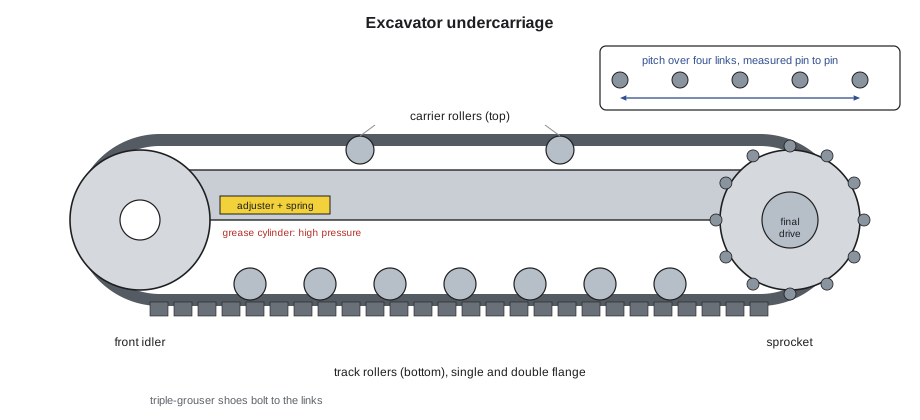
Undercarriage wear is measured, not guessed. A trained parts or service person measures:
- Pitch, the distance from one pin center to the next, usually measured over four or five links with the chain tight. As pins and bushings wear internally, pitch grows, and the chain stops meshing properly with the sprocket.
- Bushing outside diameter, which wears where the sprocket teeth drive it.
- Link height, worn down by the rollers running on the rails.
- Roller and idler tread diameters and flange condition.
- Sprocket tooth profile, often checked with a gauge or photograph.
Each measurement is compared with the maker's or the undercarriage supplier's new dimension and wear limit, giving a figure for how much of the usable life each part has used. The results guide the choice of what to replace now and what to plan for. Some suppliers turn pins and bushings at mid-life on dry chains to put a fresh wear surface against the sprocket, though this is less common with sealed and lubricated chains.
Track tension and safety. The track adjuster is a grease-filled cylinder that pushes the idler forward; the grease inside can be under extremely high pressure. Tension is released only through the relief valve, by the method in the maker's manual, and never by removing the grease fitting or the valve body. Recoil springs store very high force and are serviced only by trained technicians with the right fixtures. Parts staff who measure tracks stay out from in front of the idler and away from moving tracks.
Worked problem
How worn is the chain?
A new chain for Dougal's excavator has a pitch of 7.48 in per link, so 29.92 in over four links. The wear limit is reached at 30.55 in over four links. Joelle measures 30.40 in. How much of the chain's usable pitch extension has been used?
Show solution
- Usable extension:
- \[30.55 - 29.92 = 0.63 \text{ in}\]
- Extension so far:
- \[30.40 - 29.92 = 0.48 \text{ in}\]
- Fraction used:
- \[\frac{0.48}{0.63} \approx 0.76\]
Answer: About 76 in 100 of the pitch life is used. Wear is not perfectly linear, and conditions change, but at Dougal's rate of use the chain likely has about one season left. The dimensions here are teaching values, not a published specification for any machine.
Rubber tracks
Compact track loaders and mini excavators run on rubber tracks with steel cords and embedded steel cores. They are identified by width × pitch × number of links, such as 450 × 86 × 55, where width and pitch are given in millimeters even in the US market, plus the guide type (the pattern of the guide lugs that run between the rollers) and the tread pattern. Two tracks with the same size but different guide types will not fit the same machine. When a customer cannot read the size molded into the old track, the counter measures the width, counts the lugs or links around the track and measures the pitch between them, and checks the machine's serial number.
Rubber tracks wear on the tread and fail from cuts, broken cords and lost cores. Running them loose or with worn sprockets and rollers shortens their life, so a track sale is a good moment to ask about the rollers, idlers and sprockets on a compact machine too.
Ground engaging tools
Ground engaging tools (GET) are the replaceable wear parts that touch the material: teeth, adapters, cutting edges, end bits and side cutters. They protect the bucket or blade, which is far more expensive to repair.
- Teeth (tips) fit over adapters that are welded or bolted to the bucket lip. Each tooth system has its own pin and retainer, or a hammerless locking design that is turned with a tool. Systems are not interchangeable between makers unless the will-fit maker says so.
- Tooth profiles suit the work: general-purpose teeth for mixed digging, penetration teeth for hard-packed material, abrasion teeth with extra wear material for sand and gravel, and twin-point teeth for rock or frost.
- Cutting edges run along the bucket lip or blade. Bolt-on reversible edges can be turned over to use both sides; weld-on base edges form the bucket lip itself. Edges are sold by length, width, thickness, bolt hole spacing and hole size, and by the bevel.
- End bits protect the corners of a blade, and side cutters the sides of a bucket.
- Plow bolts and nuts fasten bolt-on edges. They have countersunk heads in standard shapes, are hardened to a high grade, and should be replaced with the edge rather than reused.
GET are made from hardened alloy steel, often a boron steel through-hardened to a high Brinell hardness. Harder steel wears longer but can be more brittle; a supplier's premium edge may last much longer in abrasive sand and gravel but chip on rock. The counter asks what material the machine is working in.
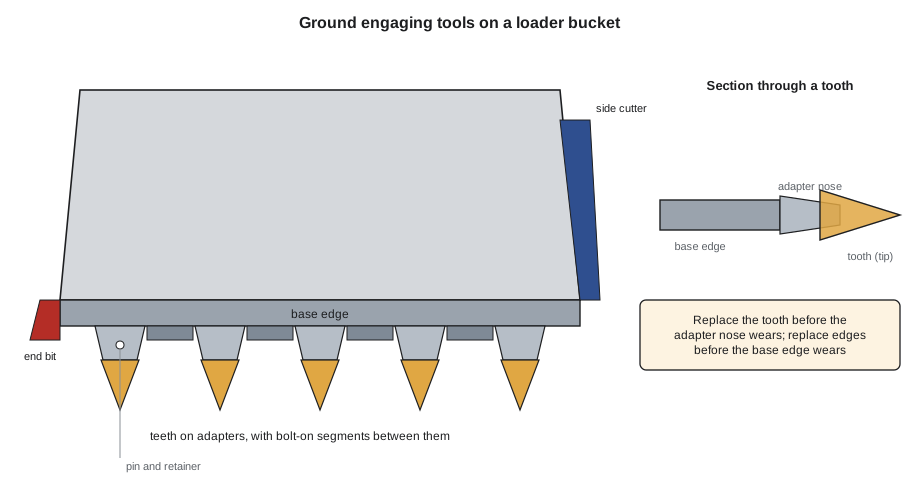
Timing matters. A tooth worn past its limit exposes the adapter nose, and a worn adapter no longer holds new teeth securely. A worn edge exposes the bucket's base edge. The cheapest part to replace is always the outermost wear part, replaced on time. Kessock Aggregates replaces loader teeth on a schedule based on hours and inspects them every shift, and Faisal Rahimi keeps a full set of teeth, pins and retainers in his crib for each loader.
Worked problem
Cost per hour of a cutting edge
Faisal compares two cutting edges for his loader. A standard edge costs 1,240 dollars and lasts about 600 hours in his quarry. A premium edge costs 1,860 dollars and lasts about 1,100 hours. Labor to change either edge is the same. Which costs less per hour of work?
Show solution
- Standard edge:
- \[\frac{1{,}240}{600} \approx 2.07 \text{ dollars per hour}\]
- Premium edge:
- \[\frac{1{,}860}{1{,}100} \approx 1.69 \text{ dollars per hour}\]
Answer: The premium edge costs about 0.38 dollars an hour less, and it needs fewer changes, so the loader stops less often. For a contractor working in softer material, where the standard edge might last much longer, the comparison could go the other way. The prices and hours are teaching values.
Pins, bushings, cylinders and big components
Every joint on a boom, stick, bucket and loader arm turns on a pin in a bushing. Pins and bushings wear, especially when the machine is not greased on schedule, and the bucket starts to move loosely. They are sold by the machine's serial number or by measured dimensions: pin diameter and length, bushing inside and outside diameters and length, and the lock bolt or retainer type. Shims and thrust washers often come with them.
Hydraulic cylinders need seal kits (Lesson 6), sometimes rechromed or replaced rods, and occasionally complete cylinders. Larger components, such as final drives, swing drives, slewing bearings, hydraulic pumps, transmissions and engines, are sold new or remanufactured on exchange. They are heavy (Lesson 10) and expensive, and a wrong one is costly to return, so the counter confirms the serial number, the component's own plate and the technician's diagnosis before ordering.
Emissions rules on machines
Off-road diesel engines are covered by their own emission standards. Engines in most current machines meet the US EPA's Tier 4 Final standards. Like on-road trucks, many use a DPF, an SCR system with DEF, or both, along with exhaust gas recirculation. Off-road machines therefore use DEF and DEF filters, DPF service and the same sensors as trucks, and the same rule applies: parts that remove or disable emission controls are not sold. In 2025 and 2026 the EPA also encouraged makers to update DEF system software on existing equipment and said owners may repair their equipment's DEF systems in the field.
Mining and quarry customers
Mines and quarries run machines harder and longer than most contractors, often two or three shifts a day and more than 5,000 hours a year. Their maintenance departments plan component replacements by hours, keep critical spares on site, and track the cost per metric ton of every wear part. They usually buy through purchase orders against blanket agreements with set prices, and they expect deliveries to meet the site's safety rules: a site orientation, protective equipment, designated routes and check-in at the scale house. A delivery driver who does not know the site's radio channel or traffic pattern can be a danger near haul trucks whose operators sit high above the ground and cannot see a pickup.
Kessock's loaders and haul trucks also need large off-the-road (OTR) tires, which are usually supplied by tire dealers rather than parts counters, and body liners, bucket liners and wear plate made of abrasion-resistant steel, which an equipment parts counter often sells by the sheet or cut to shape by a supplier.
Big components at the counter
Final drives, swing drives and travel motors arrive at the counter as some of the most expensive orders a contractor places. Joelle's habits for them:
- Confirm the diagnosis. A final drive that leaks oil may need only a floating seal (the pair of hardened metal rings with rubber toric rings that seal a final drive) rather than a complete drive. A travel motor that is weak may have a worn case drain or a valve problem. Ask what the technician found and whether oil analysis or a pressure test was done.
- Identify by the component. Read the drive's own plate, or count the bolt holes and measure the bolt circle and sprocket mounting, and check the machine's serial number range.
- Offer new, remanufactured and repair options with prices, lead times and warranties, and explain the core rules before the order is placed.
- Include the small parts: mounting bolts, which are often single-use, gaskets, O-rings, gear oil and the sprocket segments if they are worn.
Getting these details right the first time matters more on big components, because a wrong one costs a freight bill each way and days of downtime.
Common mistakes
MistakeQuoting a full undercarriage from the hours alone.
InsteadMeasure pitch, bushings, links, rollers, idlers and sprockets and compare with wear limits; give the customer options.
MistakeReleasing track tension by removing the grease fitting.
InsteadUse only the relief valve and the maker's procedure; the grease is under very high pressure.
MistakeOrdering a rubber track by width and pitch alone.
InsteadConfirm the number of links, guide type and machine serial number.
MistakeLetting teeth wear until the adapters are damaged.
InsteadReplace teeth on time; they protect the adapters and the bucket.
MistakeSelling the hardest edge without asking about the material.
InsteadAsk what the machine works in; harder steel can chip in rock.
Summary and key terms
- Construction and mining parts follow hour-based service schedules and heavy wear in undercarriage, GET, pins and bushings.
- Undercarriage includes the chain, shoes, rollers, idlers, sprockets and adjuster; wear is measured against limits.
- Track adjusters and recoil springs store dangerous energy; tension is released only through the relief valve as specified.
- Rubber tracks are identified by width, pitch, links and guide type.
- GET protect buckets and blades; the outermost part should be replaced on time, and the choice depends on the material.
- Undercarriage
- The track chain, shoes, rollers, idlers, sprockets and adjuster of a tracked machine.
- Pitch
- The distance between pin centers in a track chain; it grows as pins and bushings wear.
- Sealed and lubricated track
- A track chain with oil sealed inside each pin joint.
- Ground engaging tools (GET)
- Replaceable wear parts that touch the material, such as teeth, adapters, edges and end bits.
- Adapter
- The part welded or bolted to a bucket lip that holds a replaceable tooth.
- Cutting edge
- A hardened steel wear strip along a bucket lip or blade.
Practice problems
Work each problem on paper first, then reveal the answer to check.
New pitch over four links is 27.56 in and the limit is 28.20 in. You measure 27.88 in. How much of the usable extension is used?
Show answer
(27.88 − 27.56) ÷ (28.20 − 27.56) = 0.32 ÷ 0.64 = 0.5, or half.
What three things identify a rubber track besides the machine?
Show answer
Width × pitch × number of links, plus the guide type.
Why replace teeth before they wear through?
Show answer
Worn teeth expose and damage the adapters, which cost more and hold new teeth poorly.
A tooth costs 60 dollars and lasts 300 hours. What is its cost per hour?
Show answer
60 ÷ 300 = 0.20 dollars per hour.
Who should service a recoil spring?
Show answer
Only trained technicians with the right fixtures, following the maker's procedure.
Lesson quiz · 5 questions
Score 60% or more to complete this lesson.
Create a free account to save your progress, take quizzes and earn a certificate.