
APT-320 · Lesson 10 of 12 · 24 min
Large and heavy part handling
▶ Video coming soon A video version of this lesson is on the way.
On Friday, October 30, two deliveries arrived at Linmore Truck and Equipment within an hour of each other. The first was a remanufactured final drive for Pellmore's excavator, bolted to a steel skid and weighing about 840 lb. The second, on a flatbed, was a new loader bucket for Kessock Aggregates: about 2,425 lb, nearly 10 ft wide and awkwardly balanced. Marek Dunsford took the final drive off the truck with the branch's forklift in two minutes. The bucket took forty, because Hamish would not let anyone touch it until they had worked out where its center of gravity was, which sling hitch to use on the yard's jib crane and how to set it down on cribbing without trapping a hand. "Nothing at this branch is in a hurry when it's hanging," Hamish wrote in the binder. "The machine-down customer gets the part faster if nobody gets hurt."
Why heavy parts are different
APT-110 covered safe lifting, forklifts and racking for an automotive warehouse, where most parts can be carried by one person. On the heavy side, many parts cannot: final drives, track groups, cutting edges, buckets, drums, transmissions, engines, large bearings, crusher parts and hose reels. Handling them safely and without damage takes planning, the right equipment and trained people. Damage matters too: a dropped final drive or a gouged cylinder rod may not be usable, and a bent cutting edge cannot be returned.
Heavy parts arrive in many forms: on skids and pallets, in wooden crates, banded to steel stillages, loose on a flatbed, or as remanufactured components on exchange stands. Before anything is moved, the receiver checks the paperwork for the weight, looks for lifting points marked by the shipper, and notes any damage before signing, as APT-220 described. Lifting points on a crate or component are there for a reason; lifting a component by a pipe, a hose or a sensor can break it.
Forklifts and heavy loads
A forklift's capacity plate gives its rated capacity at a stated load center, the horizontal distance from the fork face to the load's center of gravity, commonly 24 in. A load whose center of gravity is further out than that reduces the truck's capacity, because the load has more leverage over the front wheels. The plate, or the maker's charts, gives the actual capacities at other load centers and with attachments such as fork extensions or side shifters fitted; attachments add weight and usually lower capacity.
Worked problem
How far out is too far?
The branch's forklift is rated 5,000 lb at a 24 in load center. The Kessock bucket's center of gravity, carried on the forks, would sit about 36 in from the fork face. As a rough check, capacity at a longer load center is about rated capacity × rated load center ÷ actual load center. Can the forklift carry the 2,425 lb bucket this way?
Show solution
- Approximate capacity at 36 in:
- \[5{,}000 \times \frac{24}{36} \approx 3{,}330 \text{ lb}\]
Answer: About 3,330 lb on this rough estimate, so the weight is within capacity, but the bucket is nearly 10 ft wide and could tip sideways off the forks. The rough formula is only a check; the truck's own plate and charts govern, and an awkward load like this is better lifted by crane or with an attachment designed for it, as Hamish chose.
Other forklift rules for heavy parts: spread the forks as wide as the load allows, tilt back slightly, travel with the load low, never lift people on the forks, never let anyone walk under a raised load, and block or band loads that could shift. Long items such as cutting edges, track chain on a skid or bar stock need extra care at corners and in aisles.
Rigging and overhead lifting
Many heavy-side branches have a jib crane, an overhead crane or a hoist at the receiving dock and the counter. Lifting with them is called rigging, and only trained people do it. The equipment:
- Slings: alloy chain slings (marked with a grade, such as 80 or 100), wire rope slings, and synthetic web slings and round slings. Every sling carries a tag with its working load limit (WLL) for each type of hitch. A sling with a missing or unreadable tag is taken out of service.
- Hardware: shackles, hooks with safety latches, eyebolts and lifting lugs, each with its own rated load. Plain eyebolts are for straight vertical pulls; angled lifts need shoulder eyebolts or swivel hoist rings rated for the angle.
- Hitches: a vertical hitch hangs the load straight below the hook; a choker hitch wraps the sling around the load and through itself, which reduces its capacity; a basket hitch cradles the load. The sling tag gives the WLL for each.
Rigging rules are set out in OSHA's sling standard, 1910.184, which requires slings to be identified, inspected before each shift and removed when damaged, and in the overhead crane standard, 1910.179. In practice: inspect slings and hardware before each use, know the load's weight and center of gravity, keep everyone clear of the load and out from under it, use a tag line to control swing, and set the load down on cribbing or blocks so that slings can be removed without trapping hands.
Sling angles
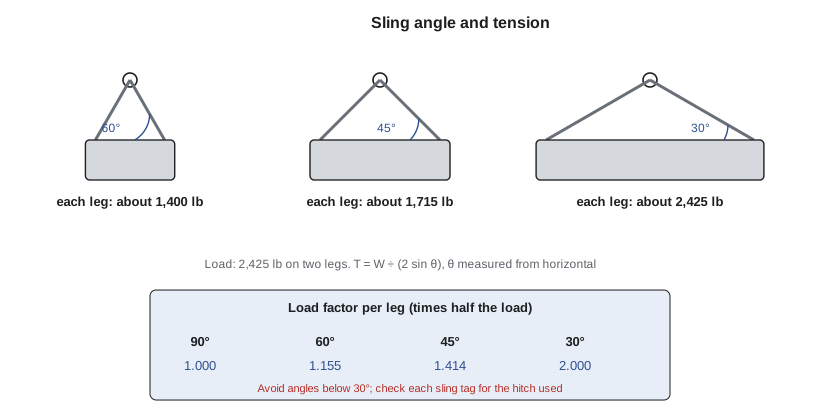
When a load is lifted with two or more sling legs at an angle, each leg carries more than its share of the weight. The flatter the angle, the greater the tension. For a load shared equally by two legs, the tension in each leg is:
where W is the load's weight and θ is the angle between each leg and the horizontal. At 90° (straight up) each leg carries half the load. At 60° the tension is about 1.15 times that; at 45° about 1.41 times; at 30°, twice. Below 30°, tension climbs very quickly, which is why riggers avoid flat sling angles.
Worked problem
Tension in a two-leg lift
Hamish's crew lifts the 2,425 lb bucket with a two-leg chain sling, each leg at 45° to the horizontal. What does each leg carry? (sin 45° ≈ 0.707.)
Show solution
- Tension per leg:
- \[T = \frac{2{,}425}{2 \times 0.707} \approx 1{,}715 \text{ lb}\]
Answer: About 1,715 lb in each leg, well over half the bucket's weight. The two-leg sling's tag gave a WLL of 9,200 lb at 45°, comfortably more than needed, and the jib crane's rating was 4,000 lb. The bucket was also unbalanced, so the crew adjusted the leg lengths to bring the hook over the center of gravity before lifting it clear.
Storing heavy and awkward parts
Storage decisions on the heavy side follow the APT-110 rules with more at stake:
- Heavy items low. Final drives, pumps, drums and gearboxes go on the floor or the lowest beam levels, within the rack's rated capacity, which is posted on the rack.
- Cantilever racks hold long items: cutting edges, bar stock, hose on long reels and track chain sections.
- Reel racks hold bulk hydraulic hose, chain and cable, so the counter can pull and cut lengths without lifting reels.
- Floor zones for crates, buckets and components, marked on the floor and kept clear of aisles and exits.
- Protection: cylinder rods and machined surfaces stay covered; open ports on pumps, valves and final drives stay capped (Lesson 5); big bearings lie flat in their wrapping.
- Drums and totes of oil, DEF and coolant sit on spill pallets, with the safety data sheets on file.
Shipping and cores
Heavy parts usually travel by less-than-truckload (LTL) freight, flatbed, or the branch's own vehicles. LTL rates depend on weight, distance and the freight's density or class; US carriers use the National Motor Freight Classification, in which dense, sturdy freight has a lower class and a lower rate. Good packaging, a solid skid and accurate weights and dimensions prevent damage and billing disputes.
Heavy cores, such as final drives, transmissions, pumps and engines going back to the remanufacturer, have their own rules. Most remanufacturers require the core to be drained of oil, with ports plugged, bolted to a skid or returned in the new unit's crate, and complete with its major parts. A core leaking oil on a carrier's trailer is a spill and may be refused. Large truck batteries returned for recycling travel under the hazardous materials rules for lead-acid batteries covered in APT-220.
Securing loads on the branch's own vehicles
When Kip delivers a final drive or a bucket on the branch's pickup and trailer, he secures it to the cargo securement rules: the FMCSA cargo securement rules in 49 CFR Part 393. Two of the basic requirements:
- The aggregate working load limit of the tie-downs must be at least half the weight of the cargo. (A tie-down attached to the vehicle at both ends and passing over the load counts at its full WLL; one attached to the cargo itself counts at half.)
- A minimum number of tie-downs depending on the article's length and weight: one for an article 5 ft or shorter weighing 1,100 lb or less; two for a short article heavier than that, or for one longer than 5 ft up to 10 ft; and one more for each additional 10 ft or part of it. Articles must also be blocked or braced against moving forward.
Worked problem
Tie-downs for the bucket
Kip delivers the 2,425 lb, 9.5 ft wide bucket to Kessock on the branch's trailer, loaded lengthwise across the deck. What minimum aggregate WLL do his tie-downs need, and how many tie-downs at least?
Show solution
- Aggregate WLL:
- \[\frac{2{,}425}{2} \approx 1{,}213 \text{ lb}\]
- Number: longer than 5 ft but not more than 10 ft:
- \[2 \text{ tie-downs}\]
Answer: At least 1,213 lb of aggregate WLL and at least two tie-downs. Kip used four grade 70 chains with binders, each with a WLL far above the minimum, because a bucket can slide and its edge can cut a strap; he also blocked it against the headache rack. Using more than the minimum is normal practice.
The vehicle itself may bring rules too. A truck or combination with a gross vehicle or combination weight rating of 10,001 lb or more used in business is a commercial motor vehicle under FMCSA rules for interstate trips, and Ohio applies its own rules within the state. A parts runner driving a pickup with a loaded trailer may cross that line, with the inspection, record-keeping and driver requirements that follow. Linmore's safety lead checks each vehicle and trailer combination.
Moving mid-weight parts by hand
Not every heavy part needs a crane, but many are too heavy for one person to lift safely. APT-110 used the NIOSH lifting equation, with a load constant of 51 lb under ideal conditions, to show how quickly safe lifting weights fall when a load is far from the body, low, high or twisted. On the heavy side, brake drums, starters for big diesels, hydraulic pumps, pails of grease and cases of filters are all close to or over that limit.
The branch's rules for them:
- Use a cart, a lift table or a hoist whenever one is available. Brake drums go on a drum dolly; pumps on a cart at counter height.
- Two-person lifts for awkward or heavy items, with one person calling the lift.
- Store at waist height the heavy items that are picked often, so nobody lifts them from the floor or above the shoulders.
- Use the forklift for drums and totes. A drum of oil weighs about 400 to 440 lb and is moved with a drum handler or on a pallet, never rolled off a truck by hand.
- Protect hands and feet: cut-resistant gloves for cutting edges and GET, steel-toed boots, and care around the pinch points of skids and crates.
Most handling injuries at heavy-side branches are not dramatic crane accidents but strained backs and crushed fingers from moving mid-weight parts in a hurry. The planning Hamish applied to the bucket applies, on a smaller scale, to every drum and pump.
Common mistakes
MistakeLifting a component by a hose, pipe or sensor bracket.
InsteadUse the marked lifting points or the shipper's instructions.
MistakeAssuming the forklift's rated capacity applies to any load.
InsteadCheck the capacity at the actual load center and with attachments on the plate or charts.
MistakeUsing a sling with a missing tag.
InsteadRemove it from service; the WLL must be known.
MistakeLifting with flat sling angles to save headroom.
InsteadKeep angles at or above 30°, preferably 45° or more, and allow for the extra tension.
MistakeShipping a final drive core full of oil.
InsteadDrain, plug and skid it as the remanufacturer requires.
Summary and key terms
- Heavy parts need planned handling, the right equipment and trained people; damage and injuries both cost time.
- Forklift capacity falls as the load center moves out; the capacity plate and charts govern.
- Rigging uses tagged slings and rated hardware; tension per leg rises as sling angles flatten, T = W ÷ (2 sin θ) for two legs.
- Heavy items are stored low, long items on cantilever racks, bulk on reel racks, with machined surfaces and ports protected.
- Loads on the branch's vehicles are secured with tie-downs whose aggregate WLL is at least half the cargo weight, in the required number.
- Load center
- The horizontal distance from the fork face to the load's center of gravity.
- Working load limit (WLL)
- The maximum load a sling, tie-down or fitting is rated to carry in use.
- Choker hitch
- A sling hitch that wraps around the load and through itself, with reduced capacity.
- Tag line
- A rope attached to a load to control its swing from a safe distance.
- Cribbing
- Blocks placed under a load so it can be set down and slings removed safely.
- Aggregate working load limit
- The combined WLL of all tie-downs securing an article.
Practice problems
Work each problem on paper first, then reveal the answer to check.
A two-leg sling lifts 1,760 lb with legs at 60° (sin 60° ≈ 0.866). What is the tension in each leg?
Show answer
1,760 ÷ (2 × 0.866) ≈ 1,016 lb.
A 1,300 lb crate 4 ft long is loaded on a trailer. How many tie-downs are needed at least?
Show answer
Two: it is short but heavier than 1,100 lb.
A forklift is rated 4,000 lb at 24 in. Roughly what is its capacity at 30 in?
Show answer
4,000 × 24 ÷ 30 = 3,200 lb; the plate governs.
Why are plain eyebolts not used for angled lifts?
Show answer
They are rated for straight pulls; angled loads can bend or break them.
What must be done to a hydraulic pump core before shipping?
Show answer
Drain it, plug the ports and secure it as the remanufacturer requires.
Lesson quiz · 5 questions
Score 60% or more to complete this lesson.
Create a free account to save your progress, take quizzes and earn a certificate.