
APT-320 · Lesson 6 of 12 · 23 min
Bearings and seals in industry
▶ Video coming soon A video version of this lesson is on the way.
On Tuesday, October 27, Renata Szabo, maintenance supervisor at Quellmont Packaging, walked into Linmore Truck and Equipment holding a bearing in a plastic bag. It came from a conveyor on the plant's corrugator line, it was the third one from the same position in two months, and she wanted to know why. Hamish Corrigall, who looks after the branch's industrial accounts himself, tipped it onto a clean cloth. The number etched on the outer ring was still readable: 6310-2RS C3. The rubber seals were swollen and torn, and inside, the grease had turned to a dark paste with a fine gray grit in it. "Someone's washing this line down with a pressure washer, aren't they?" Hamish asked. They were, every Friday night. He sold Renata three bearings, a set of protective covers for the conveyor's bearing positions, and a recommendation for a bearing with a better seal design for wet washdown. He also asked her to show the cleaning crew where not to aim. The binder note added that the next failure at that position came five months later, at the end of the bearing's expected life.
What bearings do
A bearing lets a shaft turn, or a part slide, with as little friction and wear as possible. Rolling-element bearings, the kind this lesson is mostly about, put balls or rollers between an inner ring and an outer ring. They carry two kinds of load:
- Radial load, at right angles to the shaft, such as the weight of a conveyor belt pressing down on a pulley.
- Axial or thrust load, along the shaft, such as the push of a helical gear or a vertical pump shaft.
The main bearing types and what they are good at:
- Deep groove ball bearings: the most common type, for moderate radial loads with some thrust in both directions, at high speeds. Electric motors, fans, conveyor rollers and small gearboxes use them.
- Angular contact ball bearings, for combined radial and thrust loads, often in pairs.
- Cylindrical roller bearings, for heavy radial loads at high speeds.
- Spherical roller bearings, for heavy loads with some shaft misalignment, common in heavy conveyors, crushers and vibrating screens at a quarry.
- Tapered roller bearings, for heavy combined radial and thrust loads, used in pairs: wheel hubs, axles, gearboxes.
- Needle roller bearings, for radial loads where space is tight.
- Thrust bearings of balls or rollers, for loads mainly along the shaft.
Plain bearings and bushings, with no rolling elements, are also common, especially at the pivots of construction equipment (Lesson 3).
Reading a bearing number
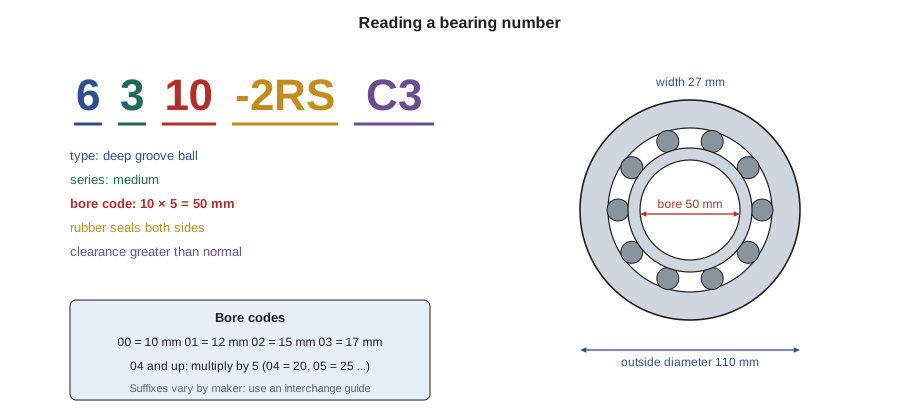
Most metric rolling bearings follow a basic numbering system set out in ISO and used by all the major makers, with each maker adding its own prefixes and suffixes. The number on Renata's bearing reads like this:
- 6: the bearing type, here a single-row deep groove ball bearing. A 7 means angular contact; an N or NU means a cylindrical roller; 2 at the start of a five-digit number, such as 22210, usually means a spherical roller; 3 usually means tapered roller.
- 3: the dimension series, which sets how heavy the bearing is for its bore. A 62xx bearing is a light series; a 63xx is medium, with a larger outside diameter and width for the same bore.
- 10: the bore code. For codes from 04 upward, multiply by 5 to get the bore in millimeters: 10 × 5 = 50 mm. The small sizes have their own codes: 00 is 10 mm, 01 is 12 mm, 02 is 15 mm and 03 is 17 mm.
- 2RS: rubber seals on both sides. Other common suffixes: ZZ or 2Z for metal shields on both sides, a single RS or Z for one side, N for a snap-ring groove in the outer ring and NR with the snap ring fitted. Makers spell these differently, such as 2RS, 2RSR, 2RS1 or DDU, which is why the counter uses an interchange guide.
- C3: internal clearance larger than normal, for bearings that run hot or are fitted tightly on the shaft, as in many electric motors and conveyors. C2 is smaller than normal; normal clearance is often unmarked or marked CN.
A 6310 bearing is 50 mm bore, 110 mm outside diameter and 27 mm wide. A 6210, light series, has the same 50 mm bore but is 90 mm outside and 20 mm wide. The two are not interchangeable even though they fit the same shaft.
Worked problem
Decoding two bearings
Renata also asks about two other bearings on the line: a 6206-ZZ on a fan motor and a 6312-2RS C3 on a larger conveyor. What are their bores, and what do the suffixes mean? (1 in = 25.4 mm.)
Show solution
- 6206 bore:
- \[06 \times 5 = 30 \text{ mm} \approx 1.18 \text{ in}\]
- 6312 bore:
- \[12 \times 5 = 60 \text{ mm} \approx 2.36 \text{ in}\]
Answer: The 6206-ZZ is a light series deep groove ball bearing with a 30 mm bore and metal shields on both sides. The 6312-2RS C3 is a medium series bearing with a 60 mm bore, rubber seals on both sides and greater than normal internal clearance. Both are metric bearings; they fit metric shafts even in plants built with inch-sized equipment.
Inch bearings, tapered bearings and mounted units
North American equipment also uses inch bearings. Small inch ball bearings are often numbered in an R series, in which the number is the bore in sixteenths of an inch: an R8 has a 1/2 in bore. Many agricultural bearings have special inch bores, square or hex bores for disc gangs, or round bores with locking collars, and are listed by the machine maker's number and by the bearing maker's interchange.
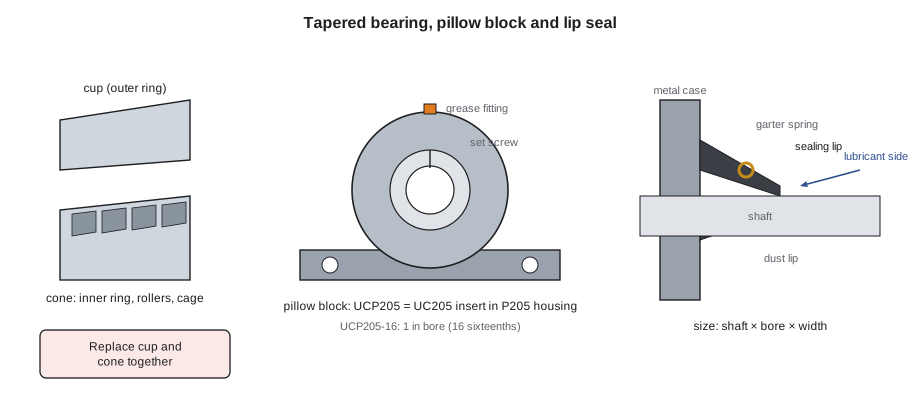
Tapered roller bearings have two separate parts: the cone, which is the inner ring with the rollers and cage, and the cup, the outer ring. Inch tapered bearings are numbered by an industry system in which the cone and cup have separate numbers, such as LM11949 for a cone and LM11910 for its matching cup; metric tapered bearings usually have one number, such as 30206, for the assembly. Cones and cups are sold separately or as sets. When a tapered bearing is replaced, the cup and cone are replaced together, because a new cone running in a worn cup wears quickly.
Mounted bearings combine a bearing insert with a housing, ready to bolt to a frame. Common styles are the pillow block (a housing that bolts to a flat surface parallel to the shaft), the flange unit with two or four bolts, and the take-up unit that slides to tension a conveyor belt. A widely used numbering style gives the insert and housing together: a UCP205 is a UC205 insert, with a 25 mm bore and set screws, in a P205 pillow block housing. Inch-bore versions add a suffix for the bore in sixteenths: a UCP205-16 has a 1 in bore. Inserts lock to the shaft with set screws, an eccentric collar or an adapter sleeve; the counter matches the locking method as well as the bore.
Why bearings fail
Bearings that are chosen, fitted and lubricated correctly usually wear out at the end of a predictable life. Most bearings that fail early fail for a few reasons, and the counter can help find them:
- Lubrication: too little grease, the wrong grease, mixing incompatible greases, or too much grease, which overheats the bearing and can push out seals.
- Contamination: dirt, water and process material getting past the seals. Renata's washdown is a classic case.
- Mounting damage: hammering a bearing on by its outer ring, heating it with a torch, or fitting it on a worn shaft. Bearings should be fitted with the right tools: sleeves, presses, induction heaters, and pullers for removal.
- Misalignment between shafts or housings, which overloads one side of the bearing.
- Overload or the wrong bearing for the load or speed.
- Electrical damage in motors driven by variable frequency drives, where current passing through the bearing etches it in a washboard pattern, called fluting. Insulated or hybrid ceramic bearings and shaft grounding solve it.
Looking at a failed bearing, as Hamish did, often tells the story. Bring the failed part back when possible and keep it for warranty or for the customer's reliability engineer.
Lubrication
Grease is sold by NLGI consistency grade, with grade 2 the most common for bearings, and by its base oil and thickener. Thickeners are not all compatible; mixing a lithium complex grease with a polyurea grease, for example, can soften the mix and let it run out of the bearing. Plants should stay with one grease per application, and the counter should ask what is in the bearing now before selling a different grease. Food and beverage plants use greases registered for incidental food contact. Oil-lubricated bearings in gearboxes and pumps use the oil the equipment maker specifies.
Worked problem
How much grease?
Bearing makers often give a rule of thumb for the grease to add when relubricating a bearing from the side: quantity in ounces = 0.114 × outside diameter × width, with dimensions in inches. How much grease is that for Renata's 6310 bearing (4.33 in OD, 1.06 in wide)?
Show solution
- Grease quantity:
- \[G = 0.114 \times 4.33 \times 1.06 \approx 0.52 \text{ oz}\]
Answer: About half an ounce per relubrication. A typical grease gun stroke delivers roughly 0.04 to 0.05 oz, so that is about ten to fifteen strokes, but guns vary and the gun should be checked by weighing its output. Sealed 2RS bearings are lubricated for life and are not regreased this way. The rule of thumb is a common maker's guideline, not a substitute for the equipment maker's schedule.
Measuring an unknown bearing
When the number has worn off, measure the bore, the outside diameter and the width with a caliper, note the type (ball or roller, one row or two), and look for shields, seals and snap-ring grooves. Bearing catalogs and interchange tools can search by dimensions. If the dimensions are metric, it is almost certainly a metric bearing; if they are round inch figures, look in the inch series. Measure twice: a worn bore or a bearing that has spun on its shaft may measure slightly wrong.
Seals
Seals keep lubricant in and dirt and water out. The counter sees three main kinds.
Radial lip seals, also called oil seals or shaft seals, are the round seals around turning shafts in gearboxes, axles, pumps and motors. A seal has an outer case of metal or rubber-covered metal that presses into the housing bore, a sealing lip that rides on the shaft, usually held tight by a garter spring, and often a second dust lip facing outward. Lip seals are sized by shaft diameter × bore diameter × width, such as 40 × 62 × 8 mm on a metric machine or 1.500 × 2.000 × 0.250 in on an inch machine, and identified by their lip design and material. The main lip faces the fluid it holds.
Lip materials suit different conditions. Nitrile (NBR) is the general-purpose choice for oil and grease at moderate temperatures. Fluoroelastomer (FKM) handles much higher temperatures and many chemicals at a higher price. PTFE lips handle dry running, high speed and aggressive fluids. The typical temperature limits printed in seal catalogs are the place to check; the counter should ask about temperature, speed and fluid before substituting a material.
When a shaft has a groove worn by the old seal, a new seal on the same spot will leak. A wear sleeve, a thin steel sleeve pressed over the shaft, gives the new seal a fresh surface without machining the shaft.
O-rings are sized by inside diameter and cross-section. In North America, standard inch sizes follow AS568, with dash numbers such as -214; metric O-rings follow ISO 3601 or are given as inside diameter × cross-section, such as 20 × 2.5 mm. They are made from nitrile for petroleum oils, FKM for heat and chemicals, and EPDM for water, steam and brake fluid; EPDM swells and fails in mineral oil. Hardness, given in Shore A, is usually 70 for general use and 90 for higher pressures. O-ring kits for ORFS and ORB fittings are high-volume counter items.
Hydraulic cylinder seals come as seal kits for a specific cylinder: the piston seal, rod seal, buffer seal, wiper (which scrapes dirt off the rod as it retracts), wear rings or bands, and static O-rings and backup rings. They are ordered by the cylinder maker's number, the machine's serial number, or measured dimensions of the bore, rod and grooves. A seal kit installed on a scored rod or a scratched bore will leak quickly; the technician should inspect them.
Common mistakes
MistakeSelling a 6210 for a 6310 because the bore is the same.
InsteadMatch the full number: type, series and bore set the outside diameter and width.
MistakeReplacing a tapered cone without its cup.
InsteadReplace the cup and cone together.
MistakeSelling a different grease without asking what is in the bearing.
InsteadCheck thickener compatibility, or advise a full purge and change.
MistakeFitting an EPDM O-ring in a hydraulic oil system.
InsteadUse nitrile or FKM for petroleum oils; EPDM is for water, steam and brake fluid.
MistakeSelling only a new bearing for repeated failures at one position.
InsteadLook at the failed bearing and find the cause: lubrication, contamination, mounting, alignment or load.
Summary and key terms
- Bearings carry radial and thrust loads; ball, cylindrical, spherical, tapered, needle and thrust types each suit different work.
- In a metric number such as 6310-2RS C3, the digits give type, series and bore code; suffixes such as 2RS, ZZ, N and C3 vary by maker.
- Tapered bearings have a cone and cup replaced together; mounted bearings combine an insert and housing, such as UCP205.
- Most early failures come from lubrication, contamination, mounting damage, misalignment, overload or electrical damage.
- Lip seals are sized shaft × bore × width; O-rings by AS568 or ISO 3601; materials are chosen for fluid, temperature and speed.
- Bore code
- The two digits in a bearing number that give the bore; from 04 up, multiply by 5 for millimeters.
- Internal clearance (C3)
- Looseness between the rings and rolling elements; C3 is greater than normal.
- Cone and cup
- The inner ring assembly and the outer ring of a tapered roller bearing.
- Pillow block
- A mounted bearing housing that bolts to a surface parallel to the shaft.
- Radial lip seal
- A shaft seal with a flexible lip, often spring-loaded, sized shaft × bore × width.
- Wear sleeve
- A thin sleeve pressed onto a grooved shaft to give a new seal a fresh surface.
- AS568
- The North American standard for inch O-ring sizes, identified by dash numbers.
Practice problems
Work each problem on paper first, then reveal the answer to check.
What is the bore of a 6008 bearing?
Show answer
08 × 5 = 40 mm.
What does ZZ mean on a ball bearing?
Show answer
Metal shields on both sides (makers may write it as 2Z).
What is the bore of a UCP206-18?
Show answer
18 sixteenths of an inch, which is 1-1/8 in.
Name two causes of early bearing failure the counter can ask about.
Show answer
Lubrication, contamination, mounting method, misalignment, overload, electrical current.
A gearbox seal leaks on a grooved shaft. What part can help without machining the shaft?
Show answer
A wear sleeve under a new seal.
Lesson quiz · 5 questions
Score 60% or more to complete this lesson.
Create a free account to save your progress, take quizzes and earn a certificate.