
APT-310 · Lesson 8 of 12 · 23 min
Electric vehicle batteries and components
▶ Video coming soon A video version of this lesson is on the way.
In the first week of November, with the Marlo EV launch a month away, Rolf, Sasha and Talia spent an afternoon marking out the high-voltage battery area at the back of the warehouse. Tessaro's dealer guide set the rules: a fenced, signed area on a concrete floor, away from exits, flammable stock and the other hazardous materials; clear space around each battery crate; a separate quarantine spot for any battery that arrived damaged; and a written plan shared with the local fire department. Sasha measured the crate footprint from Tessaro's drawing, Talia chalked the lines, and Rolf took photos for Clementine Kesterton's readiness checklist. "We may not see a pack for a year," Rolf said. "But the day one turns up on a truck, nobody's going to be guessing where it goes."
From cell to pack
An electric vehicle's traction battery is built in layers, and the layers decide what can be serviced and what must be replaced.
- Cells are the basic units, each about 3.2 to 3.7 V for common lithium-ion chemistries. They come in three formats: cylindrical (metal cans, like large flashlight cells), prismatic (rectangular hard cases) and pouch (flat, foil-wrapped). Common chemistries include NMC (nickel manganese cobalt), with high energy for its weight, and LFP (lithium iron phosphate), heavier for the energy but long-lived and more stable.
- Modules group cells, usually with their own sensing wires and a frame. Some packs can be repaired by replacing a module.
- The pack holds the modules (or, in cell-to-pack designs, the cells directly, with no modules), the battery management system (BMS), the contactors that connect and disconnect the pack, fuses (often including a pyrotechnic fuse that cuts the circuit in a crash), cooling plates, heaters, and a sealed, crash-resistant enclosure that usually forms part of the vehicle's floor.
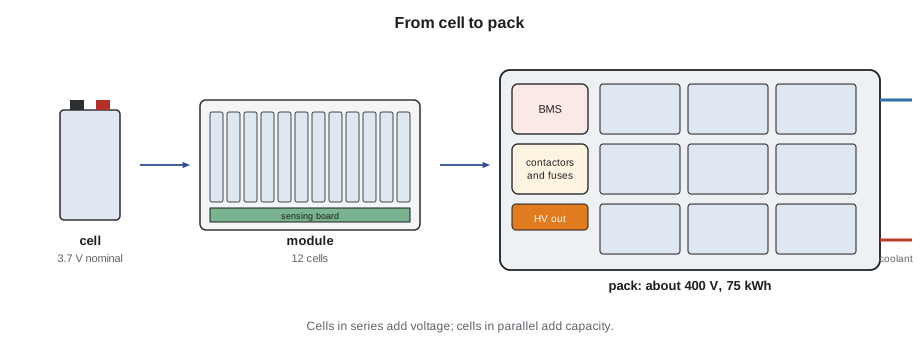
The 2027 Marlo EV uses a pack of about 400 V nominal and 75 kWh, under the cabin floor, with liquid cooling. Its pack weighs roughly 990 lb. Tessaro sells the pack as a service assembly and, for some faults, the BMS, contactor box and a few modules separately. The service parts catalog is clear about one thing: only a technician certified by Tessaro for HV battery work removes, opens or repairs a pack.
Worked problem
Pack voltage and energy
A pack has 108 cells connected in series, each 3.7 V nominal, and each cell (or group of cells in parallel) has a capacity of 188 Ah. What is the pack's nominal voltage and energy?
Show solution
- Voltage of cells in series:
- \[108 \times 3.7 = 399.6 \approx 400 \text{ V}\]
- Energy is voltage times capacity:
- \[400 \times 188 = 75200 \text{ Wh}\]
- In kilowatt-hours:
- \[75200 \div 1000 = 75.2 \text{ kWh}\]
Answer: About 400 V and 75 kWh, the figures for the Marlo EV's pack. Cells in series add voltage; cells in parallel add capacity. Those numbers are why a pack is handled only by trained people, with equipment rated for the job.
Keeping the pack at the right temperature
Lithium-ion cells work best, last longest and charge fastest within a narrow temperature band, roughly room temperature. Too cold and they charge slowly and lose range; too hot and they age quickly and, in the worst case, can enter thermal runaway. The thermal management system keeps them in range:
- Cooling plates under or between the modules carry a coolant, usually a low-conductivity coolant specified by the maker. Never sell an ordinary engine coolant for a battery loop.
- A chiller, a heat exchanger linked to the A/C system, cools the battery coolant on hot days and during fast charging.
- A coolant heater or heat pump warms the pack in the cold, so the battery can accept a charge and deliver power.
- Electric coolant pumps and multi-way coolant valves direct coolant among the battery, the drive unit, the cabin heater and the radiator.
For the parts counter, the thermal system brings new service parts and fluids: battery coolant, coolant pumps and valves, the chiller, cabin filters and A/C parts. Many EVs also use a heat pump for cabin heat, so A/C service on an EV keeps the battery and the cabin comfortable.
The rest of the EV drivetrain
- Drive unit (often called an e-axle): the electric motor, the inverter and a single-speed reduction gear with a differential, in one housing. Drive units are sold new or remanufactured, often with a core charge, and have their own gear oil.
- Onboard charger (OBC): converts AC from a wall charger into DC for the pack, typically 7 to 11 kW or more on current vehicles. Lesson 9 covers charging.
- Charge port and inlet: the socket, its locking actuator, its temperature sensors and its door.
- DC-DC converter, electric A/C compressor and HV junction box, as on hybrids.
- 12 V battery: small, often AGM, increasingly lithium. It wakes the vehicle and closes the contactors; an EV with a flat 12 V battery will not go into ready mode even if the pack is full. It is the EV part the counter will sell most.
- Brakes: regenerative braking does much of the work, with an electric brake booster; pads last a long time but rotors and calipers can corrode from light use.
- Tires: EVs are heavy and have instant torque; many specify tires with higher load ratings and noise-reducing foam, marked for EV use.
Receiving and shipping HV batteries
HV packs, hybrid packs and modules travel as hazardous materials. A lithium-ion pack on its own is UN3480, lithium ion batteries, Class 9; a battery installed in a vehicle travels under the vehicle's own entry. Packs come from the maker in a purpose-built crate, often returnable, with labels, handling marks and, frequently, tilt and shock indicators that change color if the crate has been tipped or dropped. Rules you learned in APT-220 apply, with stricter limits for large batteries:
- Only trained staff sign for, move, store and ship them. At Linmore, Sasha receives HV shipments, with Imani and Talia as the trained parts staff once their training was complete (lesson 10).
- Inspect the crate before signing. Look for damage, tilt or shock indicators tripped, leaks, heat, smell or noise. Note any problem on the delivery receipt, photograph it, and call the maker's battery hotline before opening anything.
- Move packs with the right equipment. At 990 lb or more, a pack needs a forklift or a rated lift table, operated as APT-110 described.
- Ship returns in the maker's packaging, with the maker's documents. The maker's return program arranges the carrier, usually a hazardous materials freight carrier.
Damaged or defective batteries are a separate, stricter case. Under 49 CFR 173.185(f), damaged, defective or recalled lithium batteries are fully regulated, must be packed individually in non-conductive, cushioned inner packaging inside Packing Group I outer packaging, and must be marked "Damaged/defective lithium ion battery". They are forbidden on aircraft. Very large damaged batteries may need a special permit or approved packaging. Never ship one by regular courier or air.
For any damaged pack, the maker's instructions decide the packaging, the carrier and often the state of charge, and the maker's battery hotline is the first call.
Storing HV batteries
A lithium-ion battery that is healthy, cool and undamaged is stable. A damaged one can overheat, vent flammable and toxic gases, and catch fire hours or even days later. A lithium-ion fire is hard to put out, can reignite, and needs large amounts of water. Storage rules are built around keeping healthy batteries healthy and keeping damaged ones away from everything else.
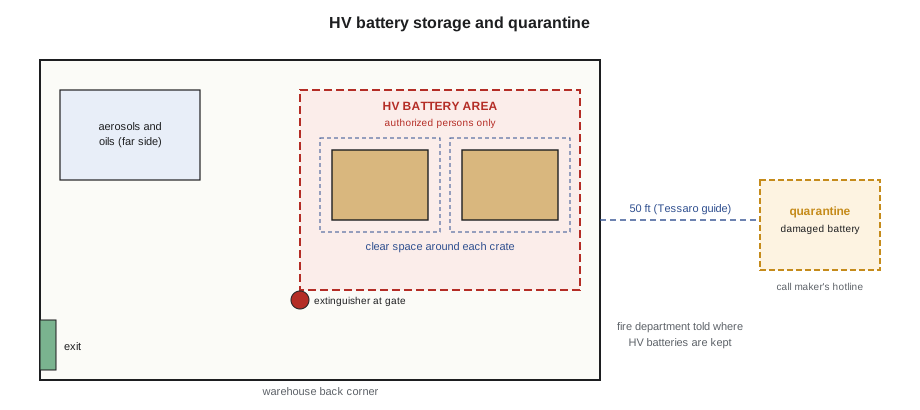
- A designated, signed area, fenced or marked, on a non-combustible floor, with access for trained staff only.
- Away from exits, ignition sources, heat and other flammable or hazardous materials, such as aerosols, oils and fuel.
- Clear space around each battery, as the maker's guide requires, so a problem with one cannot spread easily and staff can inspect each crate.
- In the maker's packaging, upright, within the maker's temperature range, out of direct sun.
- Checked on a schedule, logged, with the crate's indicators and labels intact.
- A quarantine spot for damaged batteries, outdoors or in an isolated area at a distance from the building set by the maker and the fire department, monitored until the maker collects the battery.
- A fire plan: the right extinguisher at the entrance for an early fire in packaging, an evacuation plan, and the fire department told where HV batteries are kept. Staff do not fight a battery fire; they evacuate and call the fire department, as APT-110 taught for lithium fires.
Worked problem
Planning floor space
Tessaro's crate for the Marlo EV pack measures 87 in by 63 in. The dealer guide calls for 36 in of clear space on every side. How much floor area does one stored pack need?
Show solution
- Add the clear space to both sides of each dimension:
- \[87 + 2 \times 36 = 159 \text{ in}\]
- \[63 + 2 \times 36 = 135 \text{ in}\]
- Multiply and convert to square feet (144 square inches in a square foot):
- \[\frac{159 \times 135}{144} = 149 \text{ ft}^2\]
Answer: About 149 square feet for one pack. Two packs side by side can share the clearance between them, but Rolf's plan kept a full clear space around each crate. The crate size and clearance are the course's example; the maker's guide and the fire code set the real figures.
Signs of a damaged battery
Every trained parts person should know the warning signs, whether on a crate, a module in a box or a 12 V lithium battery on the shelf:
- Dents, punctures, cracks or a deformed case or crate; tripped tilt or shock indicators.
- Swelling or bulging.
- Leaking liquid, which may be coolant or electrolyte; a sweet or chemical smell.
- Heat you can feel, smoke, hissing, popping or crackling sounds.
If any appear, do not move the battery further, keep people away, follow the maker's emergency procedure and, if there is heat or smoke, evacuate and call the fire department. A battery that may be damaged is treated as damaged until the maker says otherwise.
EV service parts the counter will actually sell
An EV has far fewer service parts than a gasoline vehicle: no oil, oil filters, spark plugs, air filters for the engine, fuel filters, exhaust parts or timing belts. Dealers that have sold EVs for a few years report that the parts counter's EV sales concentrate on a short list:
- Tires, often EV-specific with higher load ratings and noise-reducing foam inside, and tire repair kits, since many EVs carry no spare.
- 12 V batteries, the single most common EV electrical part.
- Cabin air filters, wiper blades and washer fluid.
- Brake parts, mostly rotors, caliper slides and fluid, because of corrosion from light use.
- Coolants for the battery and drive unit loops, and A/C service parts for the heat pump or chiller.
- Suspension parts, since EVs are heavy, and alignment-related parts.
- Charging accessories: cords, adapters, wall units and holders (lesson 9).
- Collision parts, including sensors, lamps and body panels, some of them large and costly.
The big HV parts, such as packs, drive units and onboard chargers, are rare orders but very high value, and each is a project: a VIN-specific order, a hazardous materials shipment for packs, a core return and a warranty claim. Rolf's plan was to stock the short list for the Marlo EV and order the big parts as needed.
The weight of an EV also matters on the shelf and in the shop. Lifting points on an EV are specific, because a jack or lift arm under the wrong place can damage the pack. Shops buy lift pads and adapters made for EVs, and the parts department added Tessaro's lift pad set to the launch order.
One more item belongs on every EV parts person's list: the emergency response guide. Makers publish a guide for first responders for each electrified model, showing where the pack, the HV cables and the cut points are. Linmore kept a printed copy of the Marlo EV's guide in the HV storage area's emergency folder, beside the fire plan.
Common mistakes
MistakeSigning for an HV battery crate without inspecting it.
InsteadCheck for damage, tripped indicators, leaks, heat, smell and noise; note and photograph problems, and call the maker.
MistakeStoring a pack among general stock or near aerosols.
InsteadUse the designated, signed area with clear space, away from exits and flammables.
MistakeShipping a damaged battery by courier like an ordinary part.
InsteadDamaged batteries need special packaging and the maker's instructions; never regular courier or air.
MistakeSelling engine coolant for a battery cooling loop.
InsteadUse the maker's specified low-conductivity battery coolant.
MistakeTrying to put out a battery fire.
InsteadEvacuate and call the fire department; lithium-ion fires can reignite and need large amounts of water.
Summary and key terms
- EV packs are built from cells (cylindrical, prismatic or pouch; NMC or LFP) into modules or directly into packs, with BMS, contactors, fuses, cooling and a sealed enclosure.
- Cells in series add voltage, in parallel add capacity; energy is voltage times capacity.
- Thermal management uses cooling plates, chillers, heaters or heat pumps, pumps and valves, with special coolant.
- Other EV parts include the drive unit, onboard charger, charge port, DC-DC converter, electric A/C compressor and the 12 V battery.
- HV batteries are UN3480 Class 9 when shipped alone; damaged ones follow stricter rules; storage needs a designated area, clearance, a quarantine spot and a fire plan.
- Cell
- The basic unit of a battery, about 3.2 to 3.7 V for common lithium-ion chemistries.
- Module
- A group of cells assembled with sensing and a frame, inside a pack.
- Cell-to-pack
- A pack design in which cells are mounted directly in the pack without modules.
- Thermal runaway
- A self-heating chain reaction in a damaged or overheated cell that can spread to others and cause fire.
- Drive unit
- The EV motor, inverter and reduction gear in one housing, also called an e-axle.
- Onboard charger
- The unit in an EV that converts AC from a charger into DC for the battery.
Practice problems
Work each problem on paper first, then reveal the answer to check.
A pack has 96 cells in series at 3.7 V and 150 Ah. What are its voltage and energy?
Show answer
96 × 3.7 = 355 V; 355 × 150 = 53,280 Wh, about 53 kWh.
Why will an EV with a full pack sometimes fail to start?
Show answer
Its 12 V battery is flat; the 12 V system wakes the vehicle and closes the contactors.
Name four signs that a battery may be damaged.
Show answer
Dents or punctures, swelling, leaks or smell, heat, smoke or noise, tripped indicators (any four).
What should staff do if a stored battery starts to smoke?
Show answer
Evacuate, keep people away and call the fire department; do not fight the fire.
What is the shipping identity of a lithium-ion pack shipped on its own?
Show answer
UN3480, lithium ion batteries, Class 9.
Lesson quiz · 5 questions
Score 60% or more to complete this lesson.
Create a free account to save your progress, take quizzes and earn a certificate.