
APT-310 · Lesson 1 of 12 · 21 min
Vehicle electrical systems for parts technicians
▶ Video coming soon A video version of this lesson is on the way.
Near the end of September, Rolf Ingvaldsen stopped Talia Brankovic at the battery display with a clipboard in his hand. "From now until the new year, the electrical wall is yours," he said. "Batteries, bulbs, fuses, connectors, the sensor drawers, all of it. You keep it stocked, you keep it straight, and you learn it well enough to answer the questions that come with it." Two weeks later an email from Clementine Kesterton, the Tessaro district parts manager, made the job bigger. Tessaro was bringing back the Marlo name for its first battery electric vehicle, the 2027 Marlo EV, with first deliveries planned for early December 2026. Every Tessaro dealer needed an electrified-vehicle parts plan: at least two parts staff trained in high-voltage parts awareness, a storage area for high-voltage batteries, and a written procedure for receiving and shipping them. Rolf put Talia's name on the list beside Imani Grantham's.
This course follows Talia through that fall. It covers the electrical and electronic parts a parts technician sells every day, from a 12 V battery to a key fob, and then the hybrid and electric vehicle parts that are arriving at every counter. You studied electrical theory, meters and diagnosis in AUTO-220. Here the view is from the parts counter: what the part is, how it is identified, how it is stored, shipped and returned, and which questions keep the wrong part from leaving the building.
Why electrical parts are different
A water pump either fits the engine or it does not. Electrical and electronic parts are harder in several ways, and the rest of the course keeps coming back to them:
- They often look alike and are not alike. Two oxygen sensors, two body control modules or two key fobs can share a housing and a connector but differ inside. The part number, the vehicle identification number (VIN) and the option codes decide, not the shape.
- Many are damaged by handling. A module can be ruined by static electricity before it is ever installed, and a battery can be ruined by sitting on the shelf discharged.
- Many need software. A growing share of modules, keys and even batteries must be programmed, coded or registered to the vehicle before they work.
- Many cannot be returned once used. A programmed module is tied to one VIN. An opened static-shielding bag cannot be resealed with confidence. Store policies, which you met in APT-130, treat electrical parts strictly for these reasons.
- Some are dangerous. Lead-acid batteries hold acid and can give off hydrogen. Lithium-ion batteries can catch fire. High-voltage hybrid and electric vehicle parts can hold enough energy to kill. You met battery hazards in APT-110 and battery shipping rules in APT-220; this course builds on both.
The 12 V system in one walk around
Almost every vehicle on the road, including hybrids and electric vehicles, still has a 12 V system. It runs the lights, the modules, the infotainment, the power windows and, on a gasoline or diesel vehicle, the starter. Its parts, roughly in the order a parts person meets them:
- Battery. Stores energy for starting and supplies the vehicle when the engine is off. Lessons 2 and 11 cover types, ratings, testing and warranty.
- Starter. An electric motor that turns the engine to start it. Lesson 3.
- Alternator. Driven by the engine's belt, it recharges the battery and supplies the vehicle while the engine runs. Lesson 3. On hybrids and electric vehicles, a DC-DC converter usually takes its place. Lesson 7.
- Cables and grounds. Heavy positive and negative cables, and ground straps between engine, body and frame. Corroded or loose grounds cause many hard-to-find faults.
- Fuses, fusible links and relays. Fuses protect circuits from too much current; relays let a small current switch a large one. Lessons 4 and 5 touch on these.
- Wiring harnesses and connectors. The nerves of the vehicle. Lesson 4.
- Lighting. Headlamps, signal lamps, interior lamps. Lesson 4.
- Sensors, actuators and modules. The electronic layer that measures, decides and acts. Lessons 5 and 6.
Most of the vehicle's modules talk to one another over networks such as the CAN bus, which AUTO-220 covered. For the parts counter, the important consequence is that one failed part can set codes in several modules, and a technician's parts request may name a module that is only reporting a problem somewhere else. When a request seems strange, it is fair to ask whether the diagnosis is finished.
Voltage classes: 12 V, 48 V and high voltage
Vehicles now come with up to three electrical systems at once, and the parts for each are handled differently. The industry groups them by voltage. In vehicle work, anything up to 60 V DC is treated as low voltage, because it is below the level considered a shock hazard to a dry, healthy person in normal conditions. Anything above 60 V DC, up to 1,500 V DC, is high voltage (HV) in vehicle terms and is handled only by trained people with the right equipment.
| System | Typical nominal voltage | Found in | Main parts | Who works on it |
|---|---|---|---|---|
| 12 V | 12 V (about 12.6 V at rest, 13.5 to 14.7 V charging) | Every vehicle, including hybrids and EVs | Battery, starter, alternator or DC-DC output, lights, modules | Any trained technician |
| 48 V mild hybrid | 48 V (lithium-ion, about 36 to 52 V in use) | Many newer cars and trucks with mild hybrid systems | 48 V battery, belt starter-generator, 48 V to 12 V DC-DC converter | Trained technicians; still below 60 V, but large currents and lithium-ion fire risk |
| High voltage | About 200 to 800 V DC | Full hybrids, plug-in hybrids, electric vehicles | HV battery, inverter, motors, orange cables, onboard charger, electric A/C compressor | Only technicians trained and equipped for HV work |
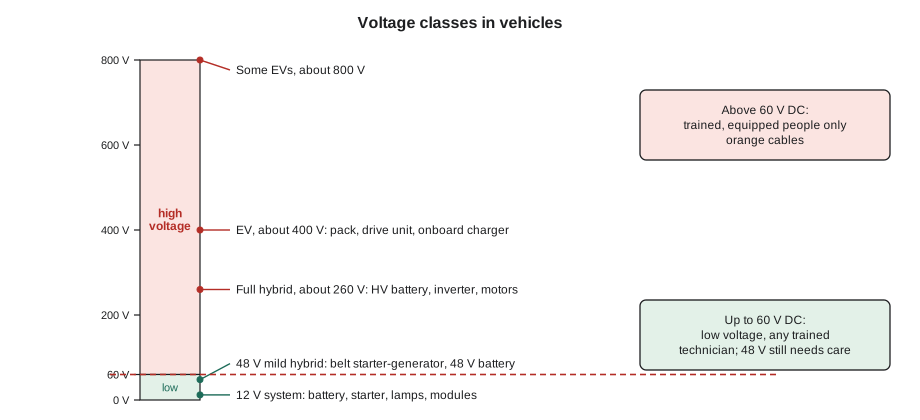
Tessaro's own lineup now has all three. The Vela with the 2.0 L turbo engine is a conventional 12 V vehicle with an AGM battery and an alternator. The Arden offers a 48 V mild hybrid from the 2026 model year, option code MH4, with a belt starter-generator in place of the alternator. The Vela Hybrid, sold since the 2025 model year, is a full hybrid with a lithium-ion HV battery under the rear seat at about 260 V. And the 2027 Marlo EV has a pack of about 400 V under the floor. A parts person who sells a "Vela battery" now has to ask which Vela.
Current, voltage and power at the counter
You do not need to design circuits at the parts counter, but three quantities come up constantly in part listings and customer questions, and one relationship ties them together. Voltage (V) is the electrical push. Current (A, amperes) is how much electricity flows. Power (W, watts) is the rate at which energy is used. Power equals voltage times current:
This one relationship answers many counter questions. Why does a 48 V system exist? Because for the same power, four times the voltage means a quarter of the current, so the cables, connectors and motors can be smaller and lighter. Why does a headlamp bulb listing give watts? Because at a known voltage the watts tell you the current, and the current tells you whether the wiring and the fuse will cope. Why are high-voltage cables so thick if the current is low? Because they still carry very large power, and because their insulation must withstand hundreds of volts.
Energy is power over time. Electrical energy in vehicles is counted in watt-hours (Wh) or kilowatt-hours (kWh), and battery capacity in ampere-hours (Ah). Multiply ampere-hours by nominal voltage and you get watt-hours. A 70 Ah 12 V battery holds roughly 840 Wh. The Marlo EV's pack holds about 75 kWh, roughly ninety times as much. That comparison is a quick way to explain to a new hire why the two batteries are handled so differently.
Worked problem
Same power, different voltage
An electric power-steering motor or a belt starter-generator needs 3,000 W. How much current would it draw from a 12 V system, and how much from a 48 V system?
Show solution
- Current on the 12 V system:
- \[I = \frac{P}{V} = \frac{3000}{12} = 250 \text{ A}\]
- Current on the 48 V system:
- \[I = \frac{3000}{48} = 62.5 \text{ A}\]
- Ratio:
- \[\frac{250}{62.5} = 4\]
Answer: 250 A on 12 V, 62.5 A on 48 V. Four times the voltage needs a quarter of the current for the same power, which is why mild hybrids use 48 V for their starter-generators and why their cables are smaller than a 250 A cable would have to be.
Reading the electrical side of a parts listing
Electrical parts in an electronic catalog carry more qualifiers than most mechanical parts. Before selling, read each one:
- Option and equipment codes. Heated seats, premium audio, LED or halogen headlamps, start-stop, towing package and the MH4 mild hybrid all change electrical parts.
- Production date or VIN split. Modules and harnesses change mid-year more often than hard parts. The catalog may say "up to VIN …" or "from 04/26 production".
- Electrical ratings. Battery group size and cold cranking amps, alternator output in amperes, bulb number and wattage, fuse rating and style.
- Connector details. Number of pins, connector color and shape, terminal type. A sensor with the wrong connector will not plug in, however good it is.
- Software notes. "Requires programming", "must be coded to vehicle", "battery registration required" or "VIN required to order". These are not small print; they change what the customer must do after buying the part.
- Hazard and shipping notes. Lithium content, hazardous materials class, "ship ground only", "core required".
Imani's habit, which Talia copied, was to read the notes aloud to the technician or customer when they mattered. "This one needs programming at the dealer" said at the counter saves an argument later.
Which counter questions to ask
For any electrical part, a short set of questions separates the right part from its neighbors. They are the same questions you learned in APT-120 and APT-130, aimed at electrical details:
- What is the VIN? Electrical parts depend on build options more than most. Decode it every time.
- Which powertrain? Gasoline, diesel, 48 V mild hybrid, full hybrid, plug-in hybrid or electric. The same model name can be all of these.
- What does the old part say? The number on the label, the bulb's base markings, the battery's group size and ratings, the connector's pin count.
- Has it been diagnosed? For sensors and modules especially, ask what test or code led to the part. A part bought to "see if it fixes it" is often the wrong part and usually cannot be returned.
- Will it need programming, coding or registration? If so, can the customer or their shop do it?
- Is there a core? Batteries, starters, alternators and many modules carry core charges.
Hazards in the electrical aisle
Electrical stock carries more hazards than most parts aisles, and the controls are simple when they are habits. Lead-acid batteries are heavy, hold sulfuric acid and give off hydrogen when charging; lift them with a carrier, keep them upright, charge them only in the ventilated charging area, and keep sparks and flames away. Lithium-ion batteries, from a 12 V lithium starter battery to a key fob coin cell, must be protected from short circuits, crushing and heat. Damaged lithium batteries, as you learned in APT-110 and APT-220, are isolated and never shipped by regular courier. Modules and sensors are protected from static. And high-voltage parts, covered in lessons 7 to 10, are received, stored and shipped by trained people following the maker's procedure, and never opened by the parts department.
The dealer's electrified-vehicle readiness plan
Clementine's checklist for the Marlo EV launch gives a good outline of this course. Before the first delivery, each Tessaro dealer had to show:
- Parts staff trained in electrified-vehicle parts awareness, at least two per store (lesson 10).
- A designated storage area for high-voltage batteries and modules, separate from general stock, and a quarantine area for damaged ones (lesson 8).
- Written receiving and shipping procedures for HV batteries, including hazardous materials documentation and the maker's return program (lessons 8 and 11).
- Stock of the first-year service parts: 12 V auxiliary batteries, cabin filters, wiper blades, tire repair kits, charging cords and adapters, and the coolant used in the battery and drive unit loops (lessons 7 to 9).
- A technician trained and equipped for HV work in the service department. At Linmore Tessaro this was Dario Pellicano, who began Tessaro's HV technician course in October.
Rolf's reply to Clementine listed Imani and Talia as the two trained parts staff, named Sasha Esparza as receiving lead for HV shipments, and set aside a fenced area at the back of the warehouse beside the core pallet. The rest of this course follows how that plan came together.
Common mistakes
MistakeSelling a 12 V part by model name alone.
InsteadDecode the VIN; the same model may be gasoline, mild hybrid, full hybrid or electric.
MistakeIgnoring catalog notes such as "requires programming".
InsteadRead the notes and tell the customer what the part will need after installation.
MistakeTreating 48 V parts as if they were high voltage, or high-voltage parts as if they were 12 V.
InsteadUp to 60 V DC is low voltage; above that is high voltage and only trained, equipped people work on it.
MistakeSelling a sensor or module before the problem is diagnosed.
InsteadAsk what test or code led to the part; electrical parts are often non-returnable once installed.
Summary and key terms
- Electrical and electronic parts look alike, are easily damaged, often need software and are often non-returnable.
- Every vehicle has a 12 V system; mild hybrids add 48 V; full hybrids, plug-in hybrids and electric vehicles add high voltage.
- Up to 60 V DC is low voltage in vehicle terms; above 60 V DC is high voltage, handled only by trained, equipped people.
- Power equals voltage times current; for the same power, higher voltage means lower current.
- Read option codes, VIN splits, ratings, connector details, software notes and hazard notes in every electrical listing.
- 12 V system
- The low-voltage electrical system found in nearly all vehicles, powering lights, modules and accessories.
- 48 V mild hybrid
- A system that adds a 48 V battery and a belt starter-generator to assist the engine; still below 60 V.
- High voltage
- In vehicle terms, above 60 V DC; used by hybrid and electric vehicle drive systems.
- Kilowatt-hour
- A unit of energy, 1,000 watts for one hour; used for hybrid and EV battery capacity.
- Ampere-hour
- A unit of battery capacity; multiplied by voltage, it gives watt-hours.
- DC-DC converter
- A device that steps a higher DC voltage down to 12 V to supply the 12 V system on hybrids and EVs.
Practice problems
Work each problem on paper first, then reveal the answer to check.
A heated seat element is rated 60 W on a 12 V system. About how much current does it draw?
Show answer
60 ÷ 12 = 5 A.
Is a 48 V mild hybrid battery high voltage in vehicle terms?
Show answer
No. It is below 60 V DC, although its currents and lithium-ion chemistry still need care.
A battery is rated 60 Ah at 12 V. About how many watt-hours does it hold?
Show answer
60 × 12 = 720 Wh.
Name three catalog notes that change what a customer must do after buying an electrical part.
Show answer
Requires programming, must be coded to the vehicle, battery registration required (also VIN required to order).
Why is a technician's request for a module worth a question about diagnosis?
Show answer
Network faults can set codes in modules that are only reporting another fault, and programmed modules usually cannot be returned.
Lesson quiz · 5 questions
Score 60% or more to complete this lesson.
Create a free account to save your progress, take quizzes and earn a certificate.