
APT-310 · Lesson 4 of 12 · 21 min
Lighting and electrical connectors
▶ Video coming soon A video version of this lesson is on the way.
Mireille Santangelo came to the retail counter one evening in October with her phone open to an online listing. Her 2014 Arden had halogen headlamps, and she wanted brighter light. "These LED bulbs are the same size as my H11s," she said. "Can you match the price, or do you have something like them?" Talia knew the counter did not stock LED replacements for halogen headlamps, but she was not sure why, so she asked Imani to join her. Imani explained it plainly: the Arden's headlamp was designed and certified around a halogen filament in one exact position; an LED bulb puts its light somewhere else, and the beam pattern scatters into the eyes of oncoming drivers. The lighting standard has no approved LED replacement for a halogen headlamp bulb. Mireille left with a pair of the brightest halogen H11 bulbs the store sold, listed for her car, and a new 7443 bulb for a tail lamp that had been out since summer. "Change them in pairs," Imani added, "or one side will be brighter than the other."
Exterior lighting and the rules behind it
Every lamp on a vehicle sold in the United States must meet Federal Motor Vehicle Safety Standard (FMVSS) 108. It sets brightness, beam pattern, color and the light sources allowed, and replacement lamps and bulbs for road use must comply as well. NHTSA regulates the making and selling of lamps and bulbs; state law governs what owners install and what passes inspection where states inspect.
Headlamps come in three main kinds, and the parts differ for each:
- Replaceable bulb headlamps use halogen bulbs identified by a standard designation such as H1, H4, H7, H11, 9005 (HB3), 9006 (HB4) or 9012. The bulb's base, filament position and wattage are fixed by its designation. Halogen bulbs are sold as standard, long-life, and high-performance bulbs that are whiter and brighter but usually last a shorter time.
- HID (high-intensity discharge) headlamps use gas-discharge bulbs such as D1S, D2S, D3S and D4S with a ballast that starts the arc at many thousands of volts. They are only replaced with the matching HID bulb. Never handle an HID system with the lamp switched on, and treat the ballast connector as dangerous.
- LED headlamps on most new vehicles, including the 2026 Vela with option code LH2, are integral beam assemblies: the LEDs, optics and often the driver electronics are part of the lamp. A failed LED usually means a new headlamp assembly or a maker's LED module, not a bulb, and often a costly part that must be ordered.
The rule for LED retrofit bulbs is clear. In a February 2024 interpretation, NHTSA stated that no LED replaceable light source may be used in a replaceable bulb headlamp, because no LED light source has been accepted under the required light source rules. LED bulbs sold to fit halogen headlamps are therefore not compliant for road use, and Linmore Tessaro's policy is not to sell them.
Signal and interior bulbs
Signal and interior bulbs are identified by trade numbers that tell you the base, the number of filaments and the wattage. A short list covers most of the wall:
| Bulb | Base | Filaments | Typical use |
|---|---|---|---|
| 3157 / 3156 | Plastic wedge, large | Two / one | Stop and tail, rear turn signals, front park and turn on many North American vehicles |
| 7443 / 7440 | Glass wedge, large | Two / one | Stop and tail, turn signals, backup lamps |
| 1157 / 1156 | Metal bayonet | Two / one | Older vehicles and many trailers |
| 194 / 168 (W5W) | Small glass wedge | One | Side markers, license plate lamps, interior and instrument lamps |
| Festoon (for example DE3175) | Tube with pointed ends | One | Dome, map and trunk lamps |
| 921 / 912 | Glass wedge, medium | One | Center high-mounted stop lamp, backup lamps |
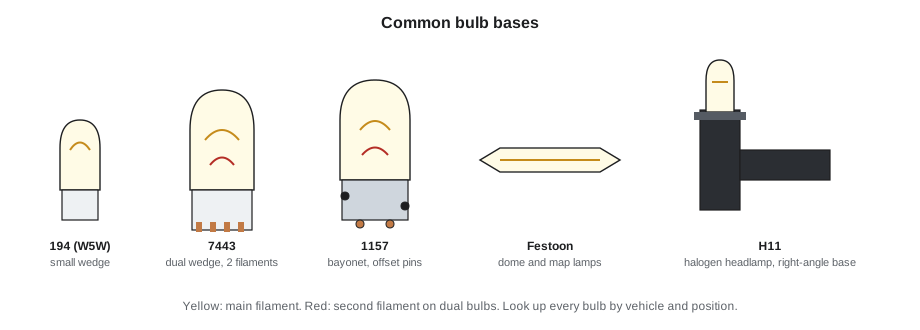
Two points come up often. First, dual-filament bulbs (3157, 7443, 1157) have a dim filament for the tail lamp and a bright one for the brake lamp or signal. A single-filament bulb in a dual socket leaves the tail lamp or brake lamp dark. Second, many "interchangeable" numbers are close but not identical: 3157 and 4157 differ in their contacts, and a 3157 in a socket made for a 3457 or 4157 may work poorly. Sell the number the catalog lists.
LED signal bulbs and the hyperflash problem
Customers also ask for LED replacements for signal, tail and interior bulbs. Apart from the question of whether the lamp still meets its brightness and color requirements, the electrical problem is simple. An LED uses a fraction of the current of a filament bulb, and many vehicles watch the current to detect a burned-out bulb. When the current is too low, the turn signals flash fast (hyperflash) or a "bulb out" warning appears.
Worked problem
Why an LED turn signal flashes fast
A front turn signal circuit has one 3157 bulb on each side of the vehicle, each using its 27 W filament for the signal. At 12.8 V, how much current does one side draw? An LED replacement for the same socket is rated 3 W. How much current does it draw, and what fraction of the original is it?
Show solution
- Current for the filament bulb:
- \[I = \frac{P}{V} = \frac{27}{12.8} = 2.11 \text{ A}\]
- Current for the LED:
- \[I = \frac{3}{12.8} = 0.23 \text{ A}\]
- Fraction:
- \[\frac{0.23}{2.11} = 0.11\]
Answer: About 2.1 A for the filament bulb and 0.23 A for the LED, roughly a ninth. The body control module or flasher sees a current that looks like a burned-out bulb and flashes fast as a warning. Load resistors or special flashers can mask it, but they add heat and complexity, and they do not prove the lamp meets the lighting standard. The simple answer at the counter is the bulb the vehicle lists.
Fuses and relays
Fuses protect wiring from overheating when too much current flows. They are sold by style and rating:
- Blade fuses: standard (ATO or ATC), mini (ATM), low-profile mini, and micro2 and micro3, the small styles in many newer fuse boxes. Maxi fuses are larger blades for heavy circuits.
- Cartridge fuses, often called J-case or JCASE, for high-current circuits in the main fuse box.
- Fusible links and mega or bolt-down fuses near the battery, protecting the main feeds.
Blade fuse ratings are color-coded, for example tan 5 A, red 10 A, blue 15 A, yellow 20 A, clear or natural 25 A and green 30 A, and the rating is molded into the top. The rule to repeat to every customer is to replace a fuse only with the same rating. A larger fuse lets the wire overheat; a fuse that keeps blowing means a fault to diagnose, not a fuse to upsize. Relays switch large currents with a small control current. Many look alike with the same four or five pins and different internal wiring or ratings, so sell the listed part, not one that "has the same pins".
Connectors: the parts of a plug
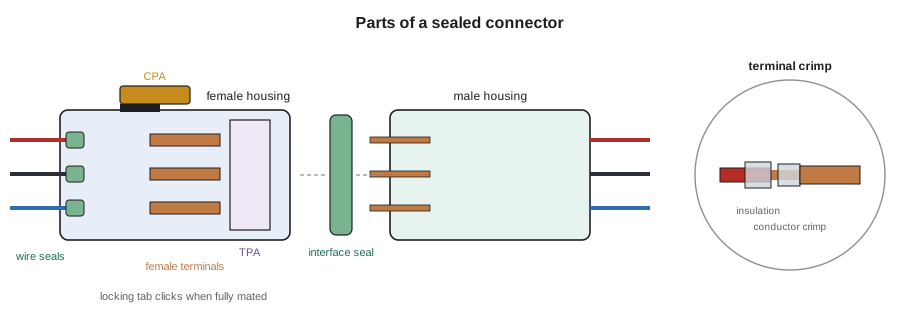
When a connector is damaged, the technician may need a whole harness, a pigtail (a new connector with short leads to splice in), or just terminals, seals or locks. A parts person who knows the names of a connector's parts can find the right one in the catalog or the maker's repair-parts listing.
- Housing: the plastic body, keyed so it fits only its mate.
- Terminals: the metal contacts crimped onto each wire, male (pins or blades) and female (sockets). Terminals come in families and sizes and must match the mating terminal and the wire size.
- Seals: wire seals where each wire enters, and an interface seal between the two halves, on connectors exposed to water. A missing seal lets water in and corrodes the terminals.
- Terminal position assurance (TPA): a lock that holds the terminals fully seated in the housing.
- Connector position assurance (CPA): a secondary lock that keeps the two halves from vibrating apart.
- Locking tab: the main latch that clicks when the connector is fully mated.
Repair parts on the wall include crimp-and-seal butt connectors with heat-shrink sleeves and hot-melt adhesive, solder sleeves, terminal release tools, assorted terminals, and wire. Wire is sold by size: American Wire Gauge (AWG) in North American listings; imported vehicles may list metric wire sizes. A smaller AWG number is a thicker wire. Splices on a modern vehicle should match or exceed the original wire size and be sealed where moisture can reach them. Some makers forbid splicing certain circuits, such as airbag, network or high-voltage wiring, and require a harness or a maker's repair kit instead.
Dielectric grease is sold for connectors and bulb sockets. It is an insulator that keeps moisture out; it is used on seals and around terminals, as the vehicle maker directs. Connectors for networks and low-current sensors are sensitive to contamination, so follow the maker's guidance before suggesting grease.
Identifying a connector or pigtail
A technician who needs a pigtail usually brings the damaged connector or a photo of it. Help by noting:
- The number of terminal cavities and how many are used.
- The housing color and key shape, and whether it is sealed.
- What it plugs into: the part number of the sensor, lamp or module.
- Any letters or numbers molded into the housing.
Tessaro's repair-parts catalog lists pigtails by the component they connect to, so the component's part number is usually the fastest way in. Aftermarket pigtail lines from Corvane are listed by application and by connector type.
Lamp assemblies and the counter
Whole lamp assemblies are big sellers after collisions and for older vehicles with faded or cracked lenses. Questions to ask:
- Halogen, HID or LED? A vehicle may offer more than one in the same year.
- Option codes, such as automatic high beams, adaptive headlamps that turn with the steering, or headlamp washers.
- Which side? Left and right are mirror images and are sold separately. Left is the driver's side in North America.
- New maker's part, certified aftermarket or used? Aftermarket lamps should be marked as meeting the lighting standard, and many collision repairers use lamps certified by an independent program. Some ADAS-equipped vehicles need aiming or calibration after a headlamp is replaced.
- Bulbs included? Many assemblies come without bulbs; add them to the sale.
Large lamp assemblies are fragile and easily scratched. Store them in their boxes, never stacked heavily, and inspect on receipt for cracked mounting tabs, the most common shipping damage.
Selling lighting well
Lighting is one of the easiest sales at the counter and one of the easiest to get slightly wrong. A few habits make it right:
- Look up every bulb by vehicle and position. A vehicle may use four different bulb numbers in the rear lamp alone, and the same position may change between model years or with LED option packages.
- Sell headlamp bulbs in pairs. Halogen bulbs dim and change color as they age; one new bulb beside one old one gives uneven light, and the other will usually fail soon.
- Explain the trade-off on high-performance bulbs. Whiter and brighter usually means a shorter life. A customer who drives at night on dark roads may accept that; a fleet that wants long service intervals may not.
- Do not touch the glass of a halogen bulb. Oil from skin creates a hot spot that shortens its life. Hold it by the base, and pass the advice on.
- Check the socket and connector. A melted or corroded socket, common on older vehicles, causes repeated bulb failures. A pigtail or socket may be the real part needed.
- Mention aiming. A new headlamp assembly, and sometimes a new bulb, should be aimed. Misaimed lamps dazzle other drivers and light the road poorly.
Trailer lighting and auxiliary lamps bring their own questions. A trailer connector must match the trailer, commonly a 4-pin flat or 7-way round connector, and modern vehicles often need a powered converter, as lesson 12 shows. Auxiliary driving lamps and light bars are subject to rules on their use on public roads, so sell those listed for road use and point customers to their state's rules for anything else.
Common mistakes
MistakeSelling LED bulbs for a halogen headlamp.
InsteadNo LED replaceable light source is permitted in a replaceable bulb headlamp; sell the listed halogen bulb.
MistakeReplacing one headlamp bulb only.
InsteadSuggest replacing in pairs so both sides match in color and brightness.
MistakeUpsizing a fuse that keeps blowing.
InsteadReplace with the same rating; repeated blowing means a fault to diagnose.
MistakeSelling a relay or bulb because it looks the same.
InsteadSell the listed number; internal wiring, contacts and ratings differ.
MistakeSelling a butt connector for an airbag or network circuit.
InsteadCheck the maker's rules; some circuits need a harness or a maker's repair kit.
Summary and key terms
- Headlamps are replaceable halogen bulb, HID or integral LED; each takes different parts.
- LED replacement bulbs are not permitted in halogen replaceable bulb headlamps; signal LEDs can cause hyperflash and bulb-out warnings.
- Signal bulb numbers give the base, filaments and wattage; dual-filament bulbs light both tail and brake or signal.
- Fuses are replaced only with the same rating; relays must match the listed part.
- Connectors have housings, terminals, wire and interface seals, TPA and CPA locks; pigtails and repair parts are found through the component part number.
- Integral beam headlamp
- A headlamp whose light source is built into the lamp, as on most LED headlamps; replaced as an assembly or maker's module.
- Hyperflash
- Fast flashing of turn signals when the current draw is lower than the system expects.
- Pigtail
- A replacement connector with short wire leads for splicing into a harness.
- TPA
- Terminal position assurance, a lock that keeps terminals fully seated in a connector housing.
- CPA
- Connector position assurance, a secondary lock that keeps two connector halves mated.
- Dual-filament bulb
- A bulb with two filaments, such as a 3157 or 7443, for tail and brake or signal functions.
Practice problems
Work each problem on paper first, then reveal the answer to check.
A 55 W H11 bulb runs at 13.2 V. About how much current does it draw?
Show answer
55 ÷ 13.2 = 4.2 A.
What does a dual-filament bulb do that a single-filament bulb does not?
Show answer
It provides two light levels, such as tail and brake, from one socket.
A customer asks for a 20 A fuse to replace a 15 A fuse that keeps blowing. What do you say?
Show answer
Use a 15 A fuse; a fuse that keeps blowing points to a fault that needs diagnosis.
Name four parts of a sealed connector.
Show answer
Housing, terminals, wire seals, interface seal, TPA, CPA, locking tab (any four).
What is the quickest way to find a pigtail in the maker's catalog?
Show answer
Use the part number of the component it plugs into.
Lesson quiz · 5 questions
Score 60% or more to complete this lesson.
Create a free account to save your progress, take quizzes and earn a certificate.