
APT-310 · Lesson 10 of 12 · 21 min
Handling high-voltage parts safely
▶ Video coming soon A video version of this lesson is on the way.
On Saturday, October 10, while Rolf and the two other counter staff ran the Saturday counter, Imani, Talia and Sasha spent the morning in a classroom at Cairnmore Safety Training. Their instructor was Lucan Breckin, who had run Talia's and Gideon Achebe's hazardous materials course the week before. This one was called "Electrified vehicle parts awareness", and Lucan opened it with a question. "Who in this room is going to work on a high-voltage system?" Nobody raised a hand. "Good," he said. "Then this course is about how you stay out of it. You'll receive these parts, store them, ship them and sell the equipment that protects the people who do work on them. You need to know what can hurt you, what you must never do, and what to do if something goes wrong." By noon each of them had a certificate, a pocket card listing the warning signs of a damaged battery, and a much clearer idea of the line between a parts person's job and a high-voltage technician's.
What makes high voltage dangerous
The 400 V in an EV pack and the 260 V in a full hybrid are dangerous in several ways at once:
- Electric shock. At these voltages, the current that can flow through a body is far more than enough to stop the heart or cause serious burns inside the body. Direct current at high voltage can also cause muscles to lock, so a person cannot let go.
- Arc flash. A short circuit across a pack or a high-voltage connector can produce an intense arc, with heat, light and molten metal that can burn skin and eyes from some distance.
- Stored energy. A pack cannot be switched off. Even with the contactors open, the pack itself holds its full voltage. Inverters and converters contain capacitors that can stay charged for minutes after the system is shut down, which is why makers set a waiting time before technicians touch anything.
- Fire and chemicals. A damaged lithium-ion battery can go into thermal runaway, release flammable and toxic gases, and burn or reignite, as lesson 8 described. Electrolyte can burn skin and eyes.
- Strong magnets and heavy weight. Drive motors contain powerful permanent magnets that can pinch fingers and affect medical implants such as pacemakers. Packs and drive units weigh hundreds of pounds.
None of these hazards is visible. A high-voltage cable that looks perfectly safe can be live. That is why the rules are strict and simple.
Roles: who may do what
Makers, training providers and safety standards describe a ladder of roles for electrified vehicles. Cairnmore's course used three:
| Role | Who | May do | Must never do |
|---|---|---|---|
| Aware person | Parts staff, drivers, porters, salespeople, cleaners | Recognize HV parts and warning signs; receive, store, move and ship packaged HV parts; drive or move a vehicle as instructed | Open or work on any HV component; touch damaged HV parts; remove service disconnects; cut or probe orange cables |
| Trained HV technician | Technicians trained and certified by the maker, such as Dario Pellicano | Make the system safe (de-energize, verify, secure), remove and install HV parts, diagnose | Work alone on energized parts or without the PPE and tools the procedure requires |
| HV expert or specialist | Technicians with advanced training, often at the maker or a battery center | Open packs, replace modules, work on energized systems where the procedure allows | Work outside the maker's procedures |
Every member of the parts department is, at most, an aware person. Imani, Talia and Sasha left Cairnmore trained to that level, with a refresher due as Tessaro and Cairnmore require. Dario, who started Tessaro's HV technician course in October, would be the dealership's first trained HV technician; Priyanka Rautela planned to send a second technician in the new year.
Rules for the parts department
Lucan's list, which Rolf had laminated and posted in the receiving area and at the HV storage area:
- Never open an HV battery, module, inverter, converter, onboard charger or HV junction box, even to look.
- Never cut, probe, bend sharply or pull an orange cable or HV connector, on a vehicle or on a part.
- Never remove a service disconnect, and never handle a vehicle's HV system to "help".
- Handle HV parts only in their sealed packaging, using the lifting points and equipment the maker specifies.
- Inspect every HV shipment on arrival and treat a damaged one as dangerous: stop, keep people back, report, and call the maker's hotline (lesson 8).
- Never touch a damaged HV part, leaking battery or a part that is hot, smoking or making noise.
- Respect barriers and signs. A vehicle in the shop with an HV warning sign, barrier tape or a "Do not touch: high voltage" tag is off limits, including for delivering parts. Hand parts to the technician outside the barrier.
- Keep metal away. Rings, watches and metal tools near exposed terminals are an arc risk; parts staff have no reason to be that close.
- Know the emergency plan: where the fire extinguishers, first aid kit and emergency numbers are, how to evacuate, and that no one should touch a person receiving an electric shock until the power source is safely removed or isolated by someone trained.
Protective equipment for HV work
Parts staff do not wear HV gloves to handle sealed parts, but they sell and stock the protective equipment the service department uses, and they need to know what it is and how it is checked.
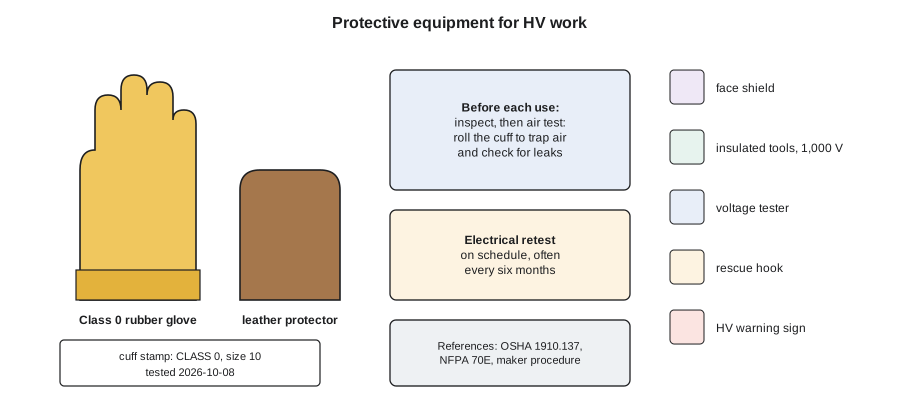
- Insulating rubber gloves, rated by class. Class 0 gloves, the class most used for vehicle HV work, are rated for a maximum use voltage of 1,000 V AC and 1,500 V DC. Class 00 gloves are rated lower and are not enough for most EV packs. Gloves come in sizes and cuff lengths.
- Leather protector gloves, worn over the rubber gloves to protect them from cuts and punctures. Rubber gloves are never used without them, unless the standard allows it for a specific job.
- Testing and dates. Before each use, the technician inspects the gloves and does an air test, inflating them to check for leaks. Gloves must also be electrically tested by a qualified lab, with the test date stamped on the glove, typically every six months once in service; a new pair has a limited shelf time before it must be tested or put into use. A glove with an expired test date or any damage is taken out of service.
- Safety glasses and a face shield rated for arc flash, and arc-rated clothing where the procedure requires it.
- Insulated tools, rated 1,000 V, often with a two-color handle that shows wear through the outer layer.
- A voltage tester rated for the system, a rescue hook with an insulated handle, insulated mats and barriers and signs for the bay.
OSHA's electrical protective equipment rule (29 CFR 1910.137) sets requirements for insulating gloves, including inspection before use and periodic electrical testing, and its electrical safe work practices rules apply to the shop. NFPA 70E, the standard for electrical safety in the workplace, is the usual reference for PPE and safe work practices. Tessaro's procedures and Cairnmore's training build on these.
Worked problem
Keeping glove tests on schedule
The service department put two pairs of Class 0 gloves into service on October 15, 2026, for Dario's training. Under the six-month retest interval used by Tessaro's procedure, when is the latest date each pair must be electrically retested? If Priyanka wants one spare pair on hand so a pair can always be at the test lab, how many pairs should the parts department keep for two trained technicians?
Show solution
- Six months after October 15, 2026:
- \[\text{October 15, 2026} + 6 \text{ months} = \text{April 15, 2027}\]
- Pairs in use, one per trained technician, plus one spare:
- \[2 + 1 = 3\]
Answer: The first retest is due by April 15, 2027, a date the parts department adds to its reminders, and three pairs cover two trained technicians with one always available while another is at the lab. The interval and the stock plan follow Tessaro's procedure for the course; the employer's program and the standard set the real requirements.
Stocking and selling HV protective equipment
HV PPE is a specialty line, and Rolf added it to the stock plan for the EV launch:
- Gloves by class and size, with protectors in matching sizes. Store gloves flat or rolled loosely, in their bag, away from sunlight, heat, ozone sources such as electric motors, and oils. Never fold or crease them.
- Rotation by test date. Gloves on the shelf have a shelf limit before they must be tested; sell the oldest first and check dates on receipt.
- Insulated tool sets and testers rated for the voltage, from the brands Tessaro approves.
- Signs, barrier tape and lockout devices for service disconnects and charge ports.
PPE is personal and safety-critical, so Linmore does not accept returns of opened gloves, and it records the gloves issued to each technician, with their test dates.
When a vehicle is damaged
Electrified vehicles arriving after a collision, a flood or a fire need special care, even in the parking lot. Lucan's points for parts and lot staff:
- A damaged EV or hybrid may have a damaged pack that can heat up and catch fire hours or days later. It is parked outdoors, away from buildings and other vehicles, as the maker's guidance and the fire department direct.
- Flood-damaged EVs are a particular risk, especially after salt water. They are treated as damaged until a trained technician has assessed them.
- Parts staff do not remove parts from damaged electrified vehicles, even 12 V parts, until a trained technician has made the vehicle safe.
- If a damaged pack is removed, it goes to the quarantine spot and is shipped only under the maker's damaged-battery instructions (lesson 8).
Responding to an incident
If a parts person sees smoke, smells a sweet chemical odor, hears hissing or popping from a battery, or sees someone in contact with a high-voltage component, the response is the same: keep away, keep others away, raise the alarm, and call for help. Call the fire department for any battery heat, smoke or fire, and tell them it involves a lithium-ion battery. For an electrical injury, call emergency services; do not touch the person until a trained person has made the source safe, then give first aid. Report every incident and near miss to the manager and, as APT-110 described, to the health and safety representatives.
Training records and refreshers
Awareness training is only useful if it is current and recorded. Cairnmore's certificates for Imani, Talia and Sasha went into the dealership's training file beside their hazardous materials certificates from APT-220, with a refresher date in Rolf's calendar. Tessaro's dealer standard also asked each store to brief every new parts, lot and delivery employee on the basic rules before their first day near the HV storage area, so Talia drafted a one-page briefing for new hires, which Rolf approved.
The briefing covered five points: what orange cables and HV warning labels mean; the rule never to open, cut, probe or touch HV parts; where the HV storage area and quarantine spot are and who may enter them; the signs of a damaged battery; and what to do in an emergency. Each new employee would read it, ask questions and sign it, and the signed copy would go in their file.
Training also covers the people who drive and move vehicles. A hybrid or EV can be silent when it is switched on and in ready mode, so porters and lot staff are taught to check the dashboard's READY indicator, to keep the vehicle in park with the parking brake applied when stopped, and to switch it fully off before leaving it. Gideon Achebe, who sometimes moved vehicles between the lot and the shop, received the same briefing.
The rules apply to deliveries too. When Gideon delivers an HV part to another dealer or a shop, it travels in the maker's packaging with its hazardous materials documents, secured in the van, and he hands it to a trained person who signs for it, as APT-220 described for all hazardous materials.
Common mistakes
MistakeOpening an HV part's box to check it.
InsteadInspect the outside and the indicators; never open an HV component.
MistakeDelivering parts into a bay behind an HV barrier.
InsteadHand parts to the technician outside the barrier.
MistakeSelling Class 00 gloves for EV pack work.
InsteadClass 0 gloves, rated 1,000 V AC and 1,500 V DC, are the usual minimum; follow the maker's procedure.
MistakeStoring insulating gloves folded in a hot window.
InsteadStore them flat or loosely rolled in their bag, away from sun, heat and ozone.
MistakeTouching a person in contact with an HV part.
InsteadKeep clear and call for help until the source is made safe by a trained person.
Summary and key terms
- High voltage brings shock, arc flash, stored energy in packs and capacitors, fire and chemical hazards, strong magnets and heavy weights.
- Parts staff are aware persons: they receive, store, move and ship packaged HV parts, but never open, cut, probe or work on HV components.
- Trained HV technicians make the system safe and work on it; experts open packs and work on energized systems where allowed.
- Class 0 insulating gloves with leather protectors are inspected and air-tested before each use and electrically retested on schedule.
- Damaged electrified vehicles and packs are isolated outdoors; in an incident, keep away, raise the alarm and call for help.
- Aware person
- Someone trained to recognize HV hazards and avoid them, but not to work on HV systems.
- Arc flash
- An intense electrical arc from a short circuit, producing heat, light and molten metal.
- Capacitor
- A component that stores electrical charge; in inverters it can stay charged after shutdown.
- Class 0 glove
- An insulating rubber glove rated for a maximum use voltage of 1,000 V AC and 1,500 V DC.
- Leather protector
- A leather glove worn over an insulating rubber glove to protect it from damage.
- Air test
- A check before each use in which a rubber glove is inflated to find leaks.
Practice problems
Work each problem on paper first, then reveal the answer to check.
Name three things a parts person must never do with HV parts.
Show answer
Open them, cut or probe orange cables, remove a service disconnect, touch a damaged HV part (any three).
Why can an inverter be dangerous after the vehicle is switched off?
Show answer
Its capacitors can stay charged for some minutes.
Gloves are tested on January 20. With a six-month interval, when is the next test due?
Show answer
By July 20.
Where should a damaged EV be parked?
Show answer
Outdoors, away from buildings and other vehicles, as the maker and fire department direct.
What is the first response to smoke from a stored battery?
Show answer
Keep away, keep others away, raise the alarm and call the fire department.
Lesson quiz · 5 questions
Score 60% or more to complete this lesson.
Create a free account to save your progress, take quizzes and earn a certificate.