
APT-310 · Lesson 11 of 12 · 21 min
Electronic parts returns and warranty
▶ Video coming soon A video version of this lesson is on the way.
In early November, Ewan Tullis from Orland Courier brought three van batteries to the counter on a cart, each with its original invoice taped to the top. "Warranty," he said. "All three were slow to crank this week." Imani let Talia run the claim. She checked each battery for damage, then tested each one on the conductance tester. The first read 12.21 V and "Charge and retest"; after an hour on the charger it tested good, and Talia found that the van had sat for three weeks with a dome light on. The second, 19 months old, tested "Replace" and was inside the battery's 36-month free replacement period, so Ewan got a new battery at no charge. The third, 50 months old, also tested "Replace". It was past free replacement but inside the 84-month pro-rated warranty, so Ewan paid part of the price of a new one. Ewan left with two new batteries, his good one back, and three test slips stapled to the claim forms. "That's the fastest warranty I've ever had," he said. Imani told Talia afterward that the speed came from the paperwork: the invoices, the tests and the slips made every answer clear.
Why electronic parts are returned differently
Store return policies, which you met in APT-130, treat electrical and electronic parts more strictly than most parts, and the reasons come from earlier lessons:
- Hidden damage. Static damage (lesson 5), heat, moisture and incorrect installation can harm an electronic part without leaving a mark. Once the static-shielding bag is opened or the part is installed, no one can promise the next customer that it is new.
- Software. A programmed or coded module carries one vehicle's VIN and setup (lesson 6). It is no longer the part the catalog describes.
- Misdiagnosis. Electrical faults are often caused by wiring, grounds, connectors or software. Many electronic parts are bought to try, installed, found not to fix the fault and then brought back. The store cannot carry the cost of those trials.
- Special orders. Many electronic parts are ordered for one VIN and are not returnable to the supplier.
The policy is only fair if the customer hears it before paying. Say it, print it on the invoice and, for expensive parts, ask the customer to initial it, as Imani's rule in lesson 6 put it.
A returns decision for electrical parts
Linmore Tessaro's returns guide for electrical and electronic parts followed a short sequence. The details are store policy, which varies, but the logic is common.
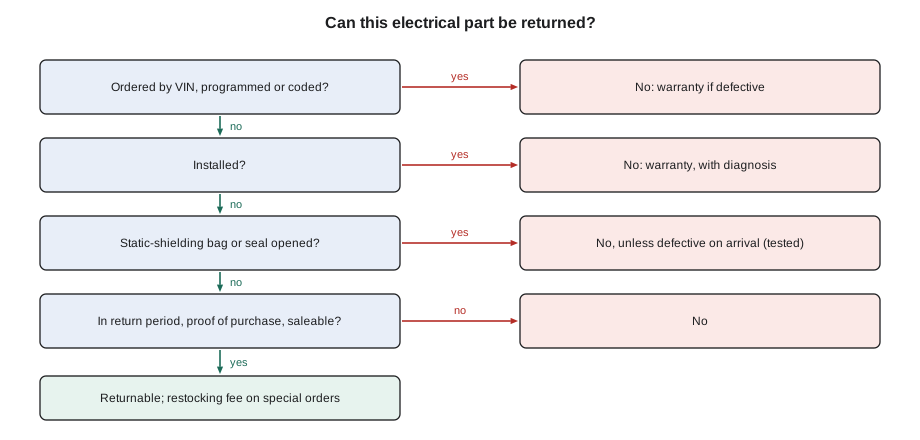
- Ordered by VIN, programmed or coded? Not returnable. If it proves defective, it is handled as a warranty claim.
- Installed? Not returnable. If defective, it goes through warranty, with evidence from diagnosis.
- Static-shielding bag or seal opened? Not returnable, unless the part was defective on arrival and a test confirms it.
- Unopened, within the return period, with proof of purchase and saleable packaging? Returnable, with a restocking fee on special orders, as APT-130 described.
Batteries, starters and alternators have their own path because they can be tested at the counter. Cores are separate from returns: a core credit is not a return of the part sold, and a returned part is not a core.
Warranty: defect, not misfit
Warranty covers a part that fails because of a defect in materials or workmanship within the warranty period. It does not cover a part that was the wrong part, was installed incorrectly, was damaged by another fault in the vehicle, or was simply not needed. That difference is the heart of every electronic warranty claim, and it is why evidence matters.
For an electrical or electronic warranty claim, Linmore asked for:
- Proof of purchase: the invoice, or the customer's account history.
- The part itself, with its labels and serial number intact. Many suppliers want the failed part back for analysis.
- Evidence of failure: a battery or charging test slip, a bench test result, or the technician's diagnosis, codes and readings.
- Installation details: the vehicle, the VIN, the date and mileage installed, and who installed it.
- A description of the problem in the technician's or customer's words.
Tag and keep the failed part separate from good stock and cores, with the claim number, until the supplier decides. A failed part that is lost or thrown away usually means a lost claim.
Battery warranties
Battery warranties are usually in two parts. In the free replacement period, a battery that tests bad is replaced at no charge. After it, in the pro-rated period, the customer receives a credit for the unused part of the warranty toward a new battery. The battery must be tested first, and it must be charged and retested if it is discharged, because a battery that only needed a charge is not defective. The test slip goes with the claim, and the date code on the battery is checked against the invoice.
Worked problem
A pro-rated battery claim
Ewan's third battery cost 230 dollars and carries an 84-month warranty with 36 months of free replacement. It failed at 50 months. Under a common pro-rating method, the credit is the price times the unused share of the total warranty. How much credit does Ewan receive, and what does he pay for a new battery at the same price?
Show solution
- Months of warranty left:
- \[84 - 50 = 34\]
- Credit:
- \[230 \times \frac{34}{84} = 93.10 \text{ dollars}\]
- Amount paid for the new battery:
- \[230 - 93.10 = 136.90 \text{ dollars}\]
Answer: A credit of 93.10 dollars, so Ewan pays 136.90 dollars plus tax for the new battery, and the core is exchanged as usual. The warranty terms are the course's example; each battery maker sets its own periods and method, and the store applies them exactly.
Starter and alternator claims
Rotating electrical parts are the most common warranty returns, and many of them are not defective. Remanufacturers report that a large share of returned alternators test good, because the real problem was a weak battery, a bad connection, a slipping belt, a smart-charging fault or a module that controls charging. Before accepting a claim, Linmore's counter:
- Bench tests the unit, or uses the counter tester's charging test on the vehicle.
- Tests the battery, because a dead battery can overload a new alternator.
- Checks the unit for installation damage: a cracked housing from a dropped unit, a damaged connector, a pulley that has been changed, or signs of oil or coolant contamination from a leak on the engine.
- Records the results on the claim.
A unit that tests good is returned to the customer with the test result and a suggestion to check the rest of the system. A unit damaged by installation or by another fault is not a warranty failure, and the counter explains why. A defective unit is exchanged, tagged and sent to the remanufacturer with the claim. Brenna Coultish's claim in APT-130, a reman alternator for her 2018 Arden, followed this path.
Modules, sensors and keys
Electronic warranty claims depend most on the technician's evidence. A module that fails within its warranty is replaced, but the store and the supplier want to see the diagnosis that shows the module, not the wiring, is at fault: codes, readings, and what was checked. A module that was programmed and then found not to be needed, as in Wen's case in lesson 5, is not a warranty claim. Keys and fobs are covered against defects, but not against loss or water damage. Sensors that fail early are often victims of something else: an oxygen sensor contaminated by coolant or oil, a wheel speed sensor damaged during a hub replacement, a TPMS sensor broken by a tire machine. Ask, record and decide fairly.
High-voltage parts and the maker's programs
HV batteries, inverters, drive units and onboard chargers are handled through the vehicle maker's warranty and return programs, not the counter's returns. Tessaro's warranty on the Marlo EV's pack, like many makers', covers defects for eight years or 100,000 miles, including loss of capacity below a stated level. The service department diagnoses the fault and files the claim; the parts department orders the replacement, receives it, returns the old pack through the maker's hazardous materials return program and keeps the paperwork. A failed or damaged pack is never "returned to the shelf" or sent back by courier.
Telling customers the rules
Clear policies are also a legal matter. Ohio's Consumer Sales Practices Act treats misrepresenting a customer's rights, including return and warranty terms, as a deceptive act, so the counter states the policy accurately and never promises what the policy does not allow.
The counter staff's role is to explain, record and apply the rules consistently. A customer who is turned down should leave understanding why and, where possible, with a next step: a test of the rest of the system, a technician's diagnosis, or a manager's review. As LAST from APT-130 put it, listen, acknowledge, solve and thank, even when the answer is no.
Handling a difficult claim
Not every electronic warranty conversation goes as smoothly as Ewan's. Imani's advice for the hard ones was to slow down and separate three questions: Is the part defective? If not, what caused the problem? And what can the store offer?
Suppose a retail customer brings back a mass airflow sensor bought two weeks earlier. He installed it himself to cure a rough idle, the idle is still rough, and he wants a refund. The bag is open and the sensor has been installed. Under the policy it is not returnable, and nothing suggests it is defective. A cold "no" will lose a customer. A better answer acknowledges the frustration, explains why an installed sensor cannot be resold, and offers a next step: a test of the sensor on the vehicle by the service department, which would show whether it is faulty. If the test shows a defect, the warranty applies. If it does not, the test usually finds the real cause, often an intake leak, and the customer leaves with a diagnosis instead of a grievance. Some stores, at the manager's discretion, offer a goodwill credit toward the repair. The counter person does not promise that; they ask the manager.
Suppliers watch warranty patterns, and so should the store. A part that comes back again and again may have a quality problem, or the store may be selling it for vehicles it does not fit. Rolf reviewed the month's electrical warranty claims at the Monday parts and service meeting with Priyanka, and the two of them looked for repeat parts, repeat vehicles and repeat shops. One result that fall was a change to the counter checklist for the Arden's rear wheel speed sensors, after two claims in a month turned out to be sensors damaged during hub replacement.
Fraud is rare, but it happens: a used part returned in a new part's box, a core passed off as a failed new part, or a part from another store returned for credit. The defenses are simple and fair to everyone: check serial numbers and date codes against the invoice, compare the returned part with the one sold, and keep returned parts until the supplier has decided. Staff never accuse; they check, record and refer to the manager.
Finally, the paperwork has a life of its own. Warranty credits from suppliers can take weeks to arrive, and a claim that is not followed up is money lost. Ruth Brennagh in accounting kept the open claims list, and the counter's job was to make sure every claim on it had its part, its tag and its evidence.
A last note on timing. Most suppliers set a deadline for warranty parts to reach them, often 30 days from the claim, and a claim that misses it may be refused even when the part is clearly defective. Linmore sent warranty parts back with the weekly supplier returns, each in a bag with its tag, and Sasha checked the open claims list against the outgoing pallet every Friday so nothing sat forgotten in a corner of the warehouse.
Talia kept one more habit from the fall: when a claim was refused, she wrote down why in the customer's account notes. The next time that customer came in, whoever served them could see the history and explain it the same way, which kept the store's answers consistent from one counter person to the next.
Common mistakes
MistakeAccepting an opened module back into stock.
InsteadOpened static-shielding bags and installed or programmed modules are not returnable; defects go to warranty.
MistakeApproving a battery warranty without charging and retesting.
InsteadCharge and retest a discharged battery; a flat battery is not a defective one.
MistakeExchanging an alternator without testing it or the battery.
InsteadBench test the unit and test the battery; record the results.
MistakeThrowing away a failed part after exchanging it.
InsteadTag it with the claim number and keep it until the supplier decides.
MistakePromising a refund the policy does not allow.
InsteadState the policy accurately; misrepresenting a customer's rights is an unfair practice.
Summary and key terms
- Electronic parts are returned strictly because of hidden damage, software, misdiagnosis and special orders.
- Ordered-by-VIN, programmed, coded, installed or opened parts are not returnable; defects go to warranty.
- Warranty covers defects, not wrong parts, installation damage, other faults or unneeded parts; claims need proof of purchase, the part, evidence and installation details.
- Battery warranties have free replacement and pro-rated periods; test and retest before deciding.
- HV parts are handled through the maker's warranty and return programs, never the counter's returns.
- Warranty
- A promise to repair or replace a part that fails from a defect in materials or workmanship within a set period.
- Pro-rated warranty
- A warranty that credits the unused share of the warranty period toward a replacement.
- Free replacement period
- The first part of a battery warranty, during which a failed battery is replaced at no charge.
- No fault found
- A warranty return that tests good, showing the fault was elsewhere.
- Defective on arrival
- A part that does not work when first installed or tested, confirmed by a test.
- Claim tag
- A tag that ties a failed part to its warranty claim until the supplier decides.
Practice problems
Work each problem on paper first, then reveal the answer to check.
A 200-dollar battery with a 72-month warranty fails at 48 months, after the free period. What is the pro-rated credit?
Show answer
200 × (72 − 48) ÷ 72 = 66.67 dollars.
A customer returns an alternator that tests good. What should the counter do?
Show answer
Return it with the test result and suggest checking the battery, connections, belt and charging control.
Name four things Linmore asks for with an electronic warranty claim.
Show answer
Proof of purchase, the part, evidence of failure, installation details, a description of the problem (any four).
Is a key fob lost by the customer covered by warranty?
Show answer
No; warranty covers defects, not loss or water damage.
Who files a warranty claim for a failed Marlo EV pack?
Show answer
The service department, through Tessaro's warranty program; parts orders, receives and returns the packs.
Lesson quiz · 5 questions
Score 60% or more to complete this lesson.
Create a free account to save your progress, take quizzes and earn a certificate.