
APT-220 · Lesson 8 of 12 · 22 min
Cores, returns and reverse logistics
▶ Video coming soon A video version of this lesson is on the way.
After the October fire drill found a pallet of returned cores partly blocking the dock exit, Rolf asked Sasha and Imani to sort out the reverse flow. The pallet was moved to a new marked area that morning. The following week, Sasha and Talia counted, tagged and wrapped it: 18 cores, mostly starters and alternators, for the remanufacturer's truck. Each had earned the customer a core refund of 45 dollars, and each should earn the department the same credit back from the remanufacturer. In November the credit statement arrived. The remanufacturer had accepted 16. One alternator had arrived with a broken housing, cracked in transit because it had been stacked loose on the pallet. One starter was the wrong core type for the unit it had been returned against, mixed up when it was tagged at the counter. Two cores, 90 dollars, gone.
"Ninety dollars is not a disaster," Rolf said at the Monday meeting. "But it's ninety dollars we paid out to customers and didn't get back, and it came from two habits we can fix." This lesson covers the reverse flow: customer returns, cores, warranty parts, returns to suppliers, and recycling and disposal.
What flows backwards
Reverse logistics is the movement of goods from the customer back toward the supplier, the manufacturer or a recycler. In a dealership parts department, five main kinds of goods flow backwards:
- Customer returns: parts bought and brought back unused because they were wrong, not needed or ordered by mistake.
- Cores: the used units returned when a customer buys a remanufactured part, such as a starter, alternator, brake caliper, steering rack or transmission.
- Warranty parts: failed parts removed under warranty, held for the manufacturer.
- Supplier returns: wrong or damaged parts going back to the supplier (lesson 3), and non-moving stock going back under the manufacturer's return program (APT-210).
- Recycling and waste: used batteries, scrap metal, cardboard, packaging, and hazardous waste such as spill clean-up materials.
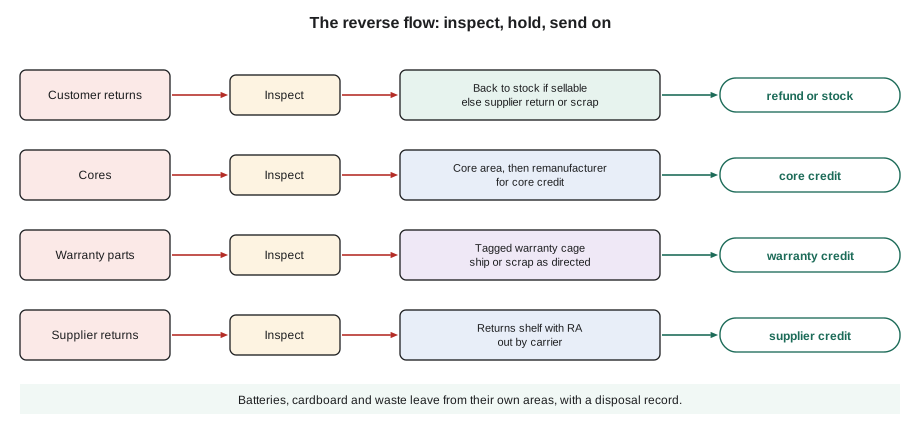
Each has its own rules, paperwork and destination, but they share a path through the warehouse: in at the counter or the dock, inspection, a holding area, and out on a truck. And each holds money: refunds, core credits, warranty credits and supplier credits that are only paid when the goods arrive back in the right condition with the right paperwork.
Customer returns
APT-130 covered the counter side of customer returns: the return policy, receipts, restocking fees and refunds. The warehouse side starts when the counter accepts the part. A returned part is not put back in its bin straight away. It goes to a returns tote or shelf, where someone inspects it:
- Is it the right part? Compare the part with its box and the original sale. Customers sometimes return the old part in the new part's box.
- Is it complete? Check for missing hardware, instructions and small parts.
- Is it new and unused? Look for grease, tool marks, scratches on mounting faces, fluid, and signs of fitting.
- Is the packaging sellable? A crushed or torn box may need replacing before the part goes back on the shelf.
A part that passes goes back to its bin, and the system's return entry puts it back in stock. A part that fails is not sold as new. Depending on why it failed, it may go back to the supplier as a defective part, be credited at a reduced value, or be scrapped and written off. Electrical parts deserve extra care: many suppliers will not accept returns of electrical parts once they have been installed, and a module that has been plugged in may have been programmed to a vehicle and be unusable on another.
Cores
Remanufactured parts are made by rebuilding used units, called cores. To keep cores coming back, the remanufacturer charges the dealership a core charge for each unit, and the dealership charges the same to its customer. When the customer brings back the old unit and it is acceptable, the customer's core charge is refunded. When the dealership sends the core back to the remanufacturer and it is accepted, the dealership's core charge is credited. If either step fails, someone loses the core charge.
A core is usually acceptable if it is the same type of unit, fits the same application, is complete, and is not broken, cracked, burnt, taken apart or badly corroded. Each remanufacturer publishes its own core acceptance rules. A cracked housing, as on the starter brought to the counter on October 30, usually makes a core unacceptable, because it cannot be rebuilt. The counter refused that one, and the customer did not receive the refund.
The warehouse's job is to make sure that every core accepted at the counter is also accepted by the remanufacturer. That depends on four habits:
- Tag every core at the counter with the part number it was returned against, the invoice number and the date. The remanufacturer credits a core against a particular reman part number, and a core tagged to the wrong number will be refused or credited at a lower value.
- Drain and cap where the rules require: power steering racks and pumps, transmissions and some brake parts must be drained of fluid and have their ports capped.
- Pack cores to travel. The best packaging for a core is usually the box the reman part came in, which was designed for that unit. Cores stacked loose on a pallet knock together and crack, as the alternator did.
- Ship cores regularly, on the remanufacturer's schedule. Cores held for months take up space, become a fire and trip hazard, and may pass the remanufacturer's deadline for credit.
Worked problem
The core credit statement
Linmore Tessaro shipped 18 cores, each carrying a core charge of 45 dollars. The remanufacturer accepted 16. How much credit did the department expect, how much did it receive, and how much did it lose?
Show solution
- Expected:
- \[18 \times 45 = 810\]
- Received:
- \[16 \times 45 = 720\]
- Lost:
- \[810 - 720 = 90\]
Answer: The department expected 810 dollars and received 720, so it lost 90 dollars on two cores. Both losses came from warehouse habits, not from customers. The values are samples.
After the statement, Imani added a check at the counter: the person accepting a core reads the core's casting or label number and compares it with the reman unit's application, not just with the customer's receipt. Sasha changed the packing rule: every core goes in a reman box, or in a box of the right size with cushioning, before it goes on the pallet. The core pallet got a fixed pickup day, every second Tuesday, and its own marked area well away from the dock exit.
The core bank and core tracking
Many departments keep a core tracking report in the DMS, listing every reman part sold, whether its core has come back from the customer, and whether it has been shipped and credited. The report shows three kinds of money at risk:
- Cores owed by customers: units sold with a core charge where the customer has not yet returned the core. The customer has paid the charge, but the department still owes the remanufacturer a core.
- Cores on hand: cores returned by customers and refunded, waiting to ship. The department has paid out the refund and not yet earned the credit.
- Cores shipped, not yet credited: cores sent back, waiting for the remanufacturer's inspection and credit.
Rolf reviewed the report each month. Cores on hand for more than a month were a sign the pallet was not shipping often enough. Cores shipped but not credited after six weeks needed a call to the remanufacturer. And a high number of rejected cores pointed to a problem at the counter or in packing.
Warranty parts
When a part fails under the manufacturer's warranty, the dealership replaces it and claims the cost from the manufacturer. The manufacturer may want the failed part back to confirm the failure and study the cause. Warranty parts are therefore held, not thrown away, until the manufacturer says what to do with them.
The usual rules, which each manufacturer sets out in its warranty policy, are:
- Tag every warranty part with the repair order number, the claim number, the vehicle identification number, the date and the reason for failure. Many manufacturers supply their own tags.
- Store warranty parts in a separate, secure area, organized by date or claim, where they cannot be mixed with stock or scrap.
- Hold them for the time the manufacturer requires, often until the claim has been paid or a set number of days has passed.
- Ship them when requested, in the packaging and with the paperwork the manufacturer specifies. A warranty part that cannot be found when requested can mean the claim is charged back to the dealership.
- Scrap them only when the hold period has passed and the manufacturer has not asked for them, following the manufacturer's scrap rules.
Some warranty parts are hazardous materials. An airbag module removed under warranty is shipped back under the rules in lesson 7, in the manufacturer's approved packaging. A failed battery goes with the battery returns. At Linmore Tessaro, the warranty area was a locked cage beside the returns area, managed by the service department's warranty administrator, with the parts department handling the packing and shipping.
Returns to suppliers
Parts going back to a supplier need a return authorization (RA) number, as lesson 3 explained. The returns shelf at Linmore Tessaro had one section for each main supplier, and every part on it carried a tag with the RA number, the reason, the original invoice and the date. Returns were shipped weekly with the supplier's next delivery or by freight, and each RA was entered in a returns log so the credit could be matched when it arrived.
Returns of non-moving stock under the manufacturer's return program are bigger jobs, covered in APT-210. In the warehouse, they mean pulling parts from their bins against a list, checking each one is in sellable condition in its original packaging, packing them, and shipping them by freight before the program's deadline.
Recycling and disposal
The parts department also sends materials out for recycling or disposal:
- Used lead-acid batteries, collected by the battery supplier or a recycler on a schedule. Batteries are stored upright on a pallet or in a container, on a surface that resists acid, away from drains, with spill material close by.
- Cardboard and plastic packaging, baled or flattened and collected by a recycling service. A busy parts department produces a great deal of cardboard, and loose cardboard is a fire hazard.
- Scrap metal, such as damaged parts that cannot be returned.
- Hazardous waste, such as absorbent material from a spill, leaking containers or damaged aerosols, handled by a licensed waste carrier under the rules for hazardous waste.
Records matter here too. A scrapped part must be written off in the system, with the reason, or the books will show stock that no longer exists (APT-210). Waste carriers provide documents showing what was collected, and these are kept as the rules require.
Measuring the reverse flow
Rolf tracked a few simple measures of the reverse flow:
- Core return rate: cores credited by the remanufacturer as a share of reman units sold.
- Core rejection rate: cores refused by the remanufacturer as a share of cores shipped. After the November statement, it was 2 in 18, about 11 in 100; Rolf's target was under 3 in 100.
- Days to credit: how long it takes from sending a return or core to receiving the credit.
- Value of returns on hand: the money waiting on the returns shelf, the core pallet and the warranty cage.
None of these measures is glamorous, but together they show whether the department is getting back money it is owed. Over the following two months, with the counter check and the new packing rule, the core rejection rate fell to 1 in 40.
Recalls and stop-sale notices
Sometimes parts must flow backwards even though nothing is wrong with the way they were stored or sold. A manufacturer or supplier may issue a recall or a stop-sale notice for a part: a batch of brake hoses with a manufacturing defect, an airbag inflator under a safety recall, or a part that has been replaced by an improved version that must be used instead. The notice says which part numbers, and often which lot or date codes, are affected, and what to do with them.
The warehouse's job is to get every affected part out of circulation quickly. The routine is the same each time:
- Find every location for the part in the system, including overflow, hold shelves, kits, the van and the returns area.
- Pull the parts and move them to a marked quarantine location, where they cannot be picked.
- Block the part in the system, so it cannot be sold while the notice is open.
- Check recent sales, so that customers who bought an affected part can be contacted if the notice requires it.
- Return or scrap the parts exactly as the notice directs, and keep the record.
Speed matters, because each day an affected part stays on the shelf is a day it might be sold. Rolf kept recall and stop-sale notices in a binder at the receiving desk, with the date each was completed and the number of parts pulled.
Common mistakes
MistakePutting a customer return straight back in its bin.
InsteadInspect it first: right part, complete, unused, sellable box.
MistakeStacking cores loose on a pallet.
InsteadPack each core in a reman box or a cushioned box of the right size.
MistakeTagging a core with only the customer's name.
InsteadTag it with the part number, invoice number and date.
MistakeThrowing away a failed warranty part before the hold period ends.
InsteadHold it, tagged, until the manufacturer says what to do.
MistakeLeaving the core pallet to fill up for months.
InsteadShip cores on a regular schedule, from a marked area clear of exits.
Summary and key terms
- Reverse logistics moves customer returns, cores, warranty parts, supplier returns and recycling back out of the warehouse.
- Every returned part is inspected before it goes back to stock.
- A core charge is only recovered when the core is accepted twice: by the counter and by the remanufacturer.
- Tag, drain, pack and ship cores regularly; track them in the DMS.
- Warranty parts are tagged, held securely and shipped or scrapped only as the manufacturer directs.
- Reverse logistics
- The movement of goods from the customer back toward the supplier, manufacturer or recycler.
- Core
- A used unit returned so it can be remanufactured.
- Core charge
- A charge added to a reman part and refunded or credited when an acceptable core is returned.
- Core tracking report
- A DMS report showing cores owed, on hand, shipped and credited.
- Warranty part
- A failed part removed under warranty and held for the manufacturer.
- Core rejection rate
- The share of cores shipped that the remanufacturer refuses.
Practice problems
Work each problem on paper first, then reveal the answer to check.
Name three things to check on a customer return.
Show answer
Right part, complete, unused, sellable packaging.
Why did the alternator core fail?
Show answer
It was stacked loose on the pallet and its housing cracked in transit.
Twenty cores at 60 dollars are shipped and 18 accepted. How much credit is lost?
Show answer
2 × 60 = 120 dollars.
What information goes on a warranty part tag?
Show answer
Repair order number, claim number, VIN, date and reason for failure.
Why should cores ship on a regular schedule?
Show answer
They tie up money and space, become a hazard and may miss the credit deadline.
Lesson quiz · 5 questions
Score 60% or more to complete this lesson.
Create a free account to save your progress, take quizzes and earn a certificate.