
APT-220 · Lesson 3 of 12 · 23 min
Damaged, short and wrong shipments
▶ Video coming soon A video version of this lesson is on the way.
On Monday, October 19, a Quillfern Freight truck delivered two pallets from the Torvale brake parts distributor. Linmore Tessaro had ordered them for a fleet brake job and for stock. Talia counted two pallets, matching the bill of lading, but the second pallet leaned, its wrap was torn and one corner was crushed. Sasha opened the damaged corner at the truck with the driver watching. One rotor carton was split, and the rotor inside had a cracked edge. Sasha wrote on the delivery receipt, "Pallet 2 of 2: wrap torn, corner crushed, 1 rotor carton split, rotor cracked," and the driver signed beside it.
The real surprises came when the cartons were opened. The packing slip listed 12 rotors of one part number, but only 8 were on the pallets, and the carton count matched what the supplier had packed, so the missing 4 had never been loaded. Two boxes of brake pads carried the right label on the outside but held pads for a different application, one digit off in the part number. And the next morning, when Talia opened a carton that had looked perfect, she found a second cracked rotor inside. One shipment had produced every kind of problem a receiver meets: visible damage, concealed damage, a shortage and a wrong part.
This lesson explains how to handle each one: what to record, who to tell, who is responsible, and how claims work.
Over, short and damaged
Warehouses group delivery problems under the name OS&D: over, short and damaged. Wrong parts are often added as a fourth group.
- Overage: more arrived than was ordered or shipped, or a part arrived that was not ordered at all.
- Shortage: less arrived than the paperwork shows. A shortage can be a missing piece (a pallet or carton that did not arrive) or a missing part inside a carton that did arrive.
- Damage: parts arrived broken, bent, cracked, wet or otherwise unusable. Visible damage can be seen at delivery; concealed damage is found only when the carton is opened.
- Wrong part: the right number of parts arrived, but at least one is not what was ordered.
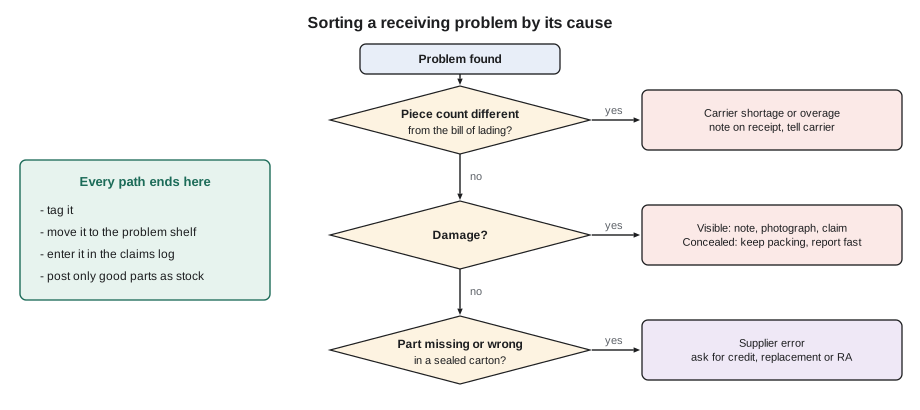
Each kind of problem has a different cause and a different person responsible. Getting that right first saves a great deal of wasted effort. A shortage inside a carton that arrived sealed is almost always the supplier's error, not the carrier's. A crushed carton is almost always the carrier's. A wrong part is the supplier's, unless the dealership ordered the wrong number.
Record it before anything else
Whatever the problem, the first job is to record it while the evidence is fresh. Sasha's routine had five steps:
- Write it on the delivery receipt if the problem can be seen at the truck, as lesson 2 describes.
- Photograph it. Take pictures of the pallet or carton as it arrived, the damage close up, the labels and the packing slip. Photographs taken before anything is moved are the best evidence a claim can have.
- Keep everything. Keep the damaged part, its carton and all the packing material. A carrier may want to inspect them, and a claim can be refused if the packaging has been thrown away.
- Tag it and move it to the problem shelf. The tag gives the date, the purchase order, the supplier, the carrier, the problem and the receiver's initials. Tagged parts are not put into stock and not sold.
- Enter it in the claims log. The log is a simple record of every open problem: what it is, who has been told, what was asked for and when, and what has happened since. It is the department's memory of claims that may take weeks to close.
In the system, the receiver posts only what arrived in good condition. The short lines stay open on the purchase order or are recorded as short, depending on how the DMS handles them, and the damaged parts are either not received or received into a damaged-goods location that cannot be sold from. Posting damaged or missing parts as good stock is the error that turns a claim into a stock loss.
Freight terms: who owns the goods on the road?
Whether the carrier, the supplier or the dealership must chase a damage claim depends on the freight terms of the order: who arranged and paid for the shipping and at what point ownership of the goods passed to the buyer. In North America these are often written as FOB terms, from the old phrase free on board:
- FOB destination: the supplier owns the goods until they are delivered. If they arrive damaged, the loss is the supplier's, and the supplier usually files the claim with the carrier. The dealership's job is to record the damage properly and report it to the supplier.
- FOB origin (or shipping point): the buyer owns the goods from the moment the carrier picks them up. If they arrive damaged, the buyer files the claim with the carrier.
Many supplier agreements also set out their own rules, such as "report damage within 48 hours" or "no credit for shortages not noted on the delivery receipt." Freight paid by the supplier and added to the invoice (often called prepaid and add) is common for aftermarket orders. Manufacturer depot deliveries usually follow the manufacturer's own dealer rules for damage and shortages. The parts department needs to know the terms for each of its main suppliers, and Rolf kept a one-page summary for each one in the receiving desk binder.
The Torvale order was shipped FOB destination. So the crushed rotor was reported to the Torvale distributor, who would claim from Quillfern. Even so, Sasha called Desmond Haverkamp in Quillfern's claims department to report the damage directly, because the carrier would need to inspect it, and she sent him the photographs and the signed delivery receipt the same afternoon.
Shortages
A shortage needs one question answered first: did the missing part leave the supplier? If the piece count on the delivery receipt was short, a whole pallet or carton did not arrive, and the carrier is the first suspect. If every piece arrived but a carton held fewer parts than its slip, the supplier probably packed it short.
At Linmore Tessaro, the four missing rotors were a supplier shortage: the piece count matched, the cartons were sealed, and the packing slip said 12. Talia emailed the Torvale distributor's customer service desk with the purchase order number, the packing slip, the count and a photograph of the opened cartons, and asked whether the missing rotors would ship separately or be credited.
Worked problem
The value of a shortage
The packing slip lists 12 rotors at 61.75 dollars each, but only 8 arrived. What is the value of the shortage, and what should the receiving record show?
Show solution
- Rotors short:
- \[12 - 8 = 4\]
- Value:
- \[4 \times 61.75 = 247.00\]
Answer: The shortage is worth 247.00 dollars. The receiving record shows 8 received, so the three-way match will catch the difference if the invoice charges for 12. The values are samples.
Overages are handled the same way in reverse. A part that arrives with no order behind it, or more parts than were ordered, is not simply put into stock. It is tagged, reported to the supplier, and either returned or kept with the supplier's agreement and an invoice for the extra. Keeping an overage quietly is not a windfall: the supplier will find the error at its own inventory count and bill for it, often months later when nobody remembers what happened.
Wrong parts
A wrong part is treated as a return to the supplier. The receiver confirms that the error is the supplier's, not the dealership's, by checking the purchase order: if the purchase order shows the right part number and the part in the box is different, the supplier picked or labeled it wrongly. If the purchase order itself shows the wrong number, the error was the dealership's, and the return may carry a restocking fee.
The two boxes of pads at Linmore Tessaro were a labeling error. The outer label showed the ordered number, but the parts and their inner labels showed a different number, one digit off. Talia photographed both labels side by side. The supplier issued a return authorization, a number that allows a return and must be written on the outside of the carton, and shipped the correct pads with the next order at no charge. Returning a part without an authorization number is a common way for a return to get lost at the supplier's warehouse.
Wrong parts are also a reason to check part labels, not just carton labels, every time (lesson 2). If the pads had been put into stock, the first sign of the error would have been a technician finding that the pads did not fit a car on the hoist.
Visible and concealed damage
Visible damage is the easier case. It is noted on the delivery receipt, photographed, kept and reported. The carrier usually has the right to inspect the damaged goods and packaging, and the claim is supported by the driver's signature beside the note.
Concealed damage is harder, because the receiver signed a clean receipt. The carrier will ask whether the damage could have happened after delivery. The best protection is speed and evidence: open cartons promptly after delivery, report concealed damage to the carrier and supplier as soon as it is found, keep the damaged part and all the packing material, and photograph everything. Many carriers ask for concealed damage to be reported within a few days of delivery; the exact time is set by each carrier's terms and should be checked.
The second cracked rotor at Linmore Tessaro was found the morning after delivery, in a carton with no outside marks. Sasha reported it to Desmond Haverkamp that morning, with photographs of the carton and the packing, and noted that the carton had been on the damaged pallet, which made it likely that the crush had cracked a rotor inside a carton that did not split.
Carrier liability and claims
In the United States, interstate trucking companies are liable for loss and damage under a federal law known as the Carmack Amendment. A carrier is generally liable for the actual loss, but carriers may limit their liability through their tariffs and bills of lading, often to a set amount per pound unless the shipper declares a higher value and pays for it. Limits vary widely by carrier and by the class of goods. For heavy, low-value goods a per-pound limit is rarely a problem; for light, valuable parts such as electronic modules it can be far below what the parts are worth.
Claims have deadlines. Under the Carmack Amendment, a carrier may not require a claim to be filed in less than 9 months after delivery, or require a lawsuit to be started in less than 2 years after the carrier refuses the claim in writing. Most bills of lading use those times. Courier and parcel services have their own terms, and many limit liability to a small amount, commonly about 100 dollars, unless more coverage is bought.
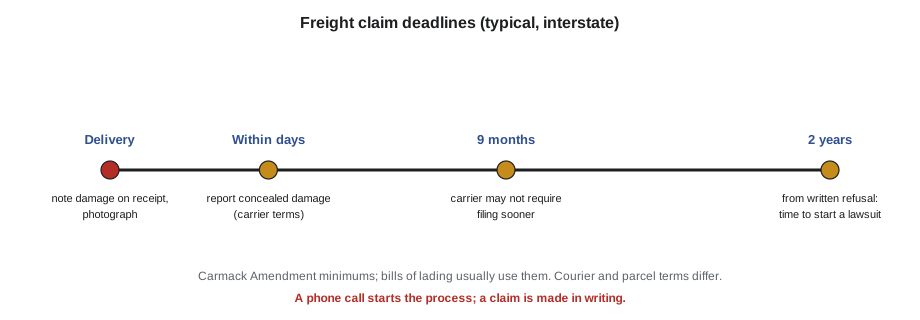
A freight claim usually includes the bill of lading, the signed delivery receipt with its exception note, the supplier's invoice showing the value of the goods, the photographs, a repair estimate or a statement that the part cannot be repaired, and a claim form or letter stating the amount claimed. Claims are made in writing. A phone call is a good start, but it is not a claim.
Worked problem
A claim limited by weight
A single carton holding one rotor, weighing 13.7 lb and worth 61.75 dollars, is lost by a trucking company. The shipper did not declare a value. The carrier's liability limit is a sample 2.00 dollars per pound. What is the most the carrier will pay?
Show solution
- Limit by weight:
- \[2.00 \times 13.7 = 27.40\]
- Compare with the value:
- 27.40 dollars is less than 61.75 dollars
Answer: The carrier would pay about 27.40 dollars, less than half the rotor's value. For valuable, light parts, a declared value or the supplier's own coverage matters.
Following up until it is closed
Claims are easy to start and easy to forget. Each open item in the claims log needs a next action and a date. Sasha looked at the log every Monday morning. An item with no reply after a week got a second email; after two weeks, a phone call; after a month, Rolf took it over. When credit arrived, the item was closed, and accounting matched the credit against the original invoice.
Within ten days, the Torvale order was settled. The supplier credited the 4 short rotors, because they were back-ordered and Linmore Tessaro had bought rotors elsewhere for the fleet job. The 2 cracked rotors were replaced after Quillfern inspected the photographs and the packaging, and the 2 boxes of wrong pads were returned under their authorization. Total value recovered: every dollar, because the evidence had been gathered on day one.
Common mistakes
MistakeThrowing away the damaged carton and packing.
InsteadKeep everything until the claim is settled.
MistakePosting damaged parts into stock to clear the dock.
InsteadReceive only good parts; tag and hold the rest.
MistakePhoning the carrier and thinking the claim is made.
InsteadPut every claim in writing with its documents.
MistakeKeeping an overage as a bonus.
InsteadReport it; the supplier will find and bill it later.
MistakeReturning a wrong part with no authorization number.
InsteadGet a return authorization and mark it on the carton.
Summary and key terms
- OS&D means over, short and damaged; wrong parts are a fourth group.
- Record every problem at once: receipt note, photographs, keep the part and packaging, tag it, log it.
- Freight terms decide who owns the goods in transit and who files the claim.
- A short carton count points to the carrier; a short count inside a sealed carton points to the supplier.
- Carrier liability is often limited and claims have written deadlines; follow each claim until it is closed.
- OS&D
- Over, short and damaged: the main groups of receiving problems.
- Concealed damage
- Damage found only when a carton that looked undamaged at delivery is opened.
- FOB destination
- Freight terms under which the supplier owns the goods until delivery.
- FOB origin
- Freight terms under which the buyer owns the goods from pickup.
- Return authorization
- A number issued by a supplier that allows a part to be returned.
- Claims log
- A record of every open receiving problem, its next action and its outcome.
Practice problems
Work each problem on paper first, then reveal the answer to check.
A pallet count matches the bill of lading, but a sealed carton is 2 parts short. Who is most likely responsible?
Show answer
The supplier, which packed the carton short.
Name four things to do when damage is found.
Show answer
Note it on the receipt, photograph it, keep the part and packaging, tag it and log it.
Under FOB destination, who usually claims from the carrier?
Show answer
The supplier, because it owned the goods in transit.
Three parts at 18.20 dollars are short. What is the value?
Show answer
3 × 18.20 = 54.60 dollars.
Why act quickly on concealed damage?
Show answer
The carrier will question whether it happened after delivery, and many carriers set short reporting times.
Lesson quiz · 5 questions
Score 60% or more to complete this lesson.
Create a free account to save your progress, take quizzes and earn a certificate.