
APT-220 · Lesson 1 of 12 · 22 min
The flow of parts through a warehouse
▶ Video coming soon A video version of this lesson is on the way.
On Talia's second day at Linmore Tessaro, Sasha Esparza had shown her how to read a bin code. A week later Sasha took her back to the start of the line. "You've seen where parts live," she said, standing at the truck door of the receiving dock. "Now I want you to see how they get there, and how they leave. Every part in this building came through one of these two doors, and every part that leaves goes out through the counter, the van or the courier. If you know that path, you know where to look when something goes wrong."
This course follows that path. It covers how a parts warehouse receives shipments and checks them, what to do when a shipment arrives damaged, short or wrong, how parts are put away and stored, how orders are picked, packed and shipped, how hazardous materials are shipped legally, how cores and returns flow back, and how barcodes, layout and delivery routes make the whole system faster and more accurate. The last lesson follows one full day on the receiving dock. This first lesson draws the map.
Two flows: parts and information
A warehouse moves two things at once. The first is the parts themselves: boxes, pallets, tires, bumpers, batteries and the small bags of clips and bolts that make up much of a dealership's stock. The second is information about those parts: what was ordered, what arrived, where it was put, who asked for it, where it went and whether it got there. The two flows have to stay together. When a part moves and the record does not, the system shows stock that is not on the shelf, or a shelf holds parts the system does not know about. Most warehouse problems come from the two flows coming apart.
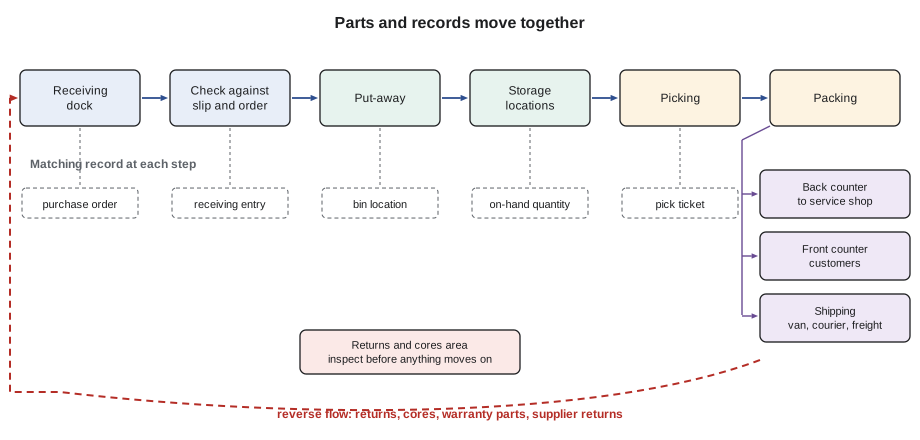
In a dealership, the information flow lives in the dealer management system (DMS) and its parts module. A purchase order records what was ordered; a receiving entry records what arrived; a bin location records where it went; a sale, repair order or transfer records where it left to. Every physical step in this lesson has a matching record, and the habit that keeps a warehouse accurate is simple: the record moves when the part moves, not later in the day and not when someone remembers.
The forward flow, step by step
Parts move forward through the warehouse in a regular order. Each step has its own job, its own risks and its own record.
- Receiving. A shipment arrives at the dock. The receiver confirms it is meant for this location, counts the pieces against the carrier's paperwork, looks for damage, and signs for it. Lessons 2 and 3 cover this in detail.
- Checking. The contents are compared with the packing slip and the purchase order, line by line: right part number, right quantity, right condition. Problems are recorded before the shipment is accepted into stock.
- Put-away. Checked parts are taken to their bin locations, or to overflow locations if the bin is full, and the system is updated. Lesson 4 covers storage methods.
- Storage. Parts sit in their locations until they are needed. Good storage protects them from damage, keeps them easy to find and makes the fastest movers the easiest to reach (lesson 9).
- Picking. When a part is sold, needed for a repair order or ordered by a wholesale customer, someone takes it from its bin. Picking is where most warehouse walking happens and where many errors start (lesson 5).
- Packing. Parts leaving the building are packed so that they arrive undamaged and are easy to identify. Parts going to the service shop or the front counter may only need a bag and a label.
- Shipping and delivery. Parts leave by the counter, by the dealership's own delivery van, or by a courier or freight carrier (lessons 6 and 11). Some leave as hazardous materials, with extra rules (lesson 7).
The reverse flow
Not every part moves forward. Customers return parts they did not need. Cores come back from remanufactured parts such as starters, alternators and brake calipers. Warranty parts come off cars and must be held for the manufacturer. Damaged or wrong parts from a supplier go back for credit, and non-moving stock is returned under the manufacturer's return program. This backward movement is called the reverse flow, or reverse logistics, and lesson 8 covers it fully.
The reverse flow is easy to neglect because it does not earn new sales. But it holds real money: core charges, warranty credits and return credits can add up to thousands of dollars a month in a busy department. It also takes up space, and it is often where the warehouse gets untidy. Returns and cores tend to collect near the dock, because that is where they will eventually leave. At Linmore Tessaro, the October fire drill would later find a pallet of returned cores partly blocking the dock exit, a reminder that the reverse flow needs its own marked space, its own schedule and someone responsible for it.
The dock at Linmore Tessaro
Sasha walked Talia across the dock. It had two overhead doors. The truck-height door had a dock leveler, a hinged steel plate that bridges the gap between the dock and the floor of a trailer, and a vehicle restraint that hooks the trailer's rear bumper so it cannot pull away while someone is inside. The ground-level door was for vans and couriers. Inside the doors was a marked receiving area, about 20 ft by 26 ft, where shipments were set down and checked before put-away. A desk with a computer, a label printer and a scanner stood at one side. Along one wall was the marked area for returns, cores and claims.
"The receiving area is a holding zone," Sasha said. "Nothing lives here. If a box is still on this floor at the end of the day, something is wrong: either it's waiting on a problem, and then it gets a tag saying what the problem is, or somebody didn't finish the job."
Deliveries came at regular times. The weekly stock order from Tessaro's regional parts depot arrived on Wednesday morning on the depot's own truck, usually on several pallets plus loose cartons. Emergency orders placed by 3 p.m. arrived the next morning on the same delivery network. Couriers brought parcels from aftermarket suppliers through the day. Linmore Parts Supply and other local suppliers dropped off parts by van, sometimes several times a day. And Gideon Achebe's delivery van left for wholesale customers at 10 a.m. and 2 p.m., with order cut-offs at 9:30 and 1:30.
| Time | Typical dock activity |
|---|---|
| 7:30 a.m. | Overnight emergency parts arrive; checked and delivered to the shop first |
| Morning (Wednesday) | Weekly stock order arrives from the regional depot: several pallets and loose cartons |
| 9:30 a.m. | Cut-off for the 10 a.m. van run; orders picked and packed |
| 10 a.m. and 2 p.m. | Delivery van leaves; returns and cores come back when it does |
| Through the day | Courier parcels and local supplier drop-offs |
| Late afternoon | Courier pickup for outgoing parcels; receiving area cleared |
One-way flow and the holding zones
A well-run warehouse keeps parts flowing in one direction as far as possible: in at the dock, through checking, into storage, out through picking and shipping. When flows cross, parts get mixed up. A box of returns set down next to a new shipment can be received by mistake; a part picked for a customer and left on the receiving bench can be put back into stock. Clear, marked holding zones keep the flows apart:
- Receiving area: new shipments waiting to be checked.
- Problem area or claims shelf: shipments with damage, shortages or wrong parts, tagged and waiting for a decision (lesson 3).
- Staging area for outgoing orders: parts picked and packed, waiting for the van, the courier or the customer.
- Returns and cores area: parts coming back, waiting to be inspected, credited and sent on (lesson 8).
- Hazardous materials area: batteries, aerosols, flammable fluids and other hazardous materials, stored and shipped under their own rules (lesson 7).
Each zone has a sign on the wall and painted lines on the floor, and each has an owner. At Linmore Tessaro, Sasha owned receiving and the problem shelf, the counter staff owned the staging area for counter orders, Gideon owned the van staging lane, and Imani kept the returns and cores area moving with Sasha's help.
Measuring the flow
Warehouses measure how well their flow works. A few measures appear in almost every operation, from a dealership parts department to a large distribution center:
- Dock-to-stock time: how long a part takes from arrival at the dock until it is in its bin and available to sell. Many dealerships aim to have the whole stock order put away the same day.
- Receiving accuracy: how many received lines match the purchase order and packing slip without correction.
- Order accuracy: how many orders are picked and shipped with the right parts in the right quantities.
- On-time shipping: how many orders leave by their promised time, such as the van run or the courier pickup.
- Damage rate: how many lines are damaged in the warehouse or in shipping.
These measures are simple fractions: the good results divided by the total. In this course they are written as a number in 100, such as "90 in 100."
Worked problem
Dock-to-stock on stock order day
One Wednesday the stock order had 140 lines. By 4 p.m., 126 lines were in their bins and available to sell. The rest were still on the receiving floor or the problem shelf. What fraction of the order met the same-day target?
Show solution
- Divide the lines put away by the total lines:
- \[126 \div 140 = 0.90\]
- Lines still waiting:
- \[140 - 126 = 14\]
Answer: 90 in 100 lines were put away the same day, and 14 lines were not. Sasha would look at the 14 one by one: were they waiting on a claim, a full bin, a missing location, or just time?
The measures matter because each delay has a cost. A part that sits on the receiving floor for a day looks like it is in stock in the system as soon as it is received, but nobody can find it on the shelf. A technician waits, the counter calls the supplier, and sometimes an emergency order is placed for a part already in the building. Fast, accurate flow is not about speed for its own sake; it is about keeping the system's picture of the warehouse true.
People and roles in the warehouse
In a large distribution center, receiving, put-away, picking, packing and shipping are separate jobs done by separate teams. In a dealership parts department, the same few people usually do all of them. At Linmore Tessaro, Sasha led the warehouse and did most of the receiving, Gideon drove the van and helped with shipping, the counter staff picked parts for their own customers, and Talia, as the newest member of the team, would spend time on every step. Rolf Ingvaldsen, the parts manager, set the rules and checked the measures.
Sharing jobs has advantages. Everyone understands the whole flow, and work can move to wherever the backlog is. It also has a risk: when everyone is responsible for a step, nobody may be. Clear ownership of each zone and each daily task, written down, keeps that from happening.
Some tasks also need to be kept apart for control. The person who orders parts should not be the only person who receives them, because a dishonest buyer could order parts and record them as received when they were never delivered. In a small department this separation may be as simple as having one person receive and another check the receiving report against the order. Lesson 2 returns to this.
Safety along the flow
APT-110 covered warehouse safety in detail. The main hazards follow the flow of parts. On the dock: falls from the dock edge, trailers that move while someone is inside, forklifts and pallet jacks, and heavy or awkward boxes. In storage: overloaded racking, falling objects, ladders and the mezzanine edge. In picking and packing: lifting and carrying, box cutters and strapping. In shipping: lifting into vans, hazardous materials and driving. The safety rules are part of the flow, not separate from it. A receiving procedure that says "check the trailer is restrained before entering" or a packing procedure that says "cut away from the body" is as much a part of the job as counting the boxes.
Sasha's rule for the dock was short: "Restrain, check, then step in. Lift with the cart, not your back. Clear the floor before you go home."
What Talia drew
At the end of the tour, Sasha asked Talia to sketch the flow on the back of a packing slip: the doors, the receiving area, the aisles, the counters, the van lane and the returns area, with arrows. Talia's first sketch had an arrow running from the returns area straight back into the racking. "That's the arrow that causes trouble," Sasha said. "A return never goes straight back on the shelf. It goes through inspection first, the same as a new part goes through checking. Otherwise we put back a part with a missing bolt, and the next customer finds out." Talia redrew the arrow through an inspection box.
Common mistakes
MistakeMoving a part and updating the record later.
InsteadUpdate the record when the part moves.
MistakeLeaving received boxes on the dock floor overnight with no tag.
InsteadPut stock away the same day, or tag it with the reason it is waiting.
MistakePutting returns straight back on the shelf.
InsteadInspect every return before it goes back into stock.
MistakeLetting returns and cores pile up near the dock exit.
InsteadKeep them in their own marked area with an owner and a schedule.
MistakeHaving one person both order and receive with no check.
InsteadSeparate the jobs, or have a second person check the receiving report.
Summary and key terms
- A warehouse moves parts and information together; most problems come from the two flows coming apart.
- The forward flow runs from receiving and checking through put-away, storage and picking to packing and shipping.
- The reverse flow brings back returns, cores, warranty parts and supplier returns; it holds real money and needs its own space.
- Marked holding zones keep the flows apart; each zone needs an owner.
- Measures such as dock-to-stock time, receiving accuracy and order accuracy show how well the flow works.
- Receiving
- Accepting a shipment at the dock after counting and inspecting it against the carrier's paperwork.
- Put-away
- Moving checked parts to their storage locations and recording where they went.
- Picking
- Taking parts from their storage locations to fill an order.
- Reverse flow
- The movement of returns, cores, warranty parts and supplier returns back through the warehouse; also called reverse logistics.
- Holding zone
- A marked area where parts wait between steps, such as receiving, staging or returns.
- Dock-to-stock time
- The time from a part's arrival at the dock until it is in its bin and available to sell.
Practice problems
Work each problem on paper first, then reveal the answer to check.
Name the main steps of the forward flow in order.
Show answer
Receiving, checking, put-away, storage, picking, packing, shipping or delivery.
Why must a return be inspected before it goes back on the shelf?
Show answer
It may be damaged, incomplete or used, and the next customer would get a faulty part.
A stock order has 150 lines and 141 are put away the same day. What fraction met the target?
Show answer
141 ÷ 150 = 0.94, or 94 in 100.
What should happen to a box left on the receiving floor at the end of the day?
Show answer
It should be tagged with the reason it is waiting, or put away.
Why should the person who orders parts not be the only person who receives them?
Show answer
Without a check, a dishonest buyer could record parts as received that never arrived.
Lesson quiz · 5 questions
Score 60% or more to complete this lesson.
Create a free account to save your progress, take quizzes and earn a certificate.