
APT-220 · Lesson 2 of 12 · 23 min
Receiving and checking shipments
▶ Video coming soon A video version of this lesson is on the way.
The depot truck backed onto the Linmore Tessaro dock at 8:40 on a Wednesday morning. Sasha checked that the vehicle restraint had hooked the trailer, lowered the dock leveler onto the trailer floor, and took the driver's paperwork. "Six pallets and eleven loose cartons," she read out. Talia counted as the driver and Sasha brought them off with the pallet jack: six pallets, ten cartons. They counted again. Ten. Sasha wrote "1 carton short, 10 of 11 received" on the delivery receipt above her signature, and the driver initialed it. Twenty minutes later the missing carton turned up in the trailer behind another store's pallets, and the driver brought it back. Sasha crossed out the note, both of them initialed the change, and the count was right.
"That's why we count before we sign," she told Talia. "Once I sign a clean receipt, I've said everything arrived in good order. If a carton is missing after that, it's our problem to prove."
This lesson covers receiving: getting ready for a shipment, checking it at the truck, unloading it safely, checking the contents against the paperwork, and recording the receipt in the system. Lesson 3 covers what to do when the check finds a problem.
Before the truck arrives
Good receiving starts before anything reaches the dock. The receiver should know what is coming. For a stock order, the DMS holds the purchase order: every part number and quantity ordered, and the expected arrival date. Many suppliers also send an advance shipping notice, an electronic list of what was actually shipped, so the receiver knows about back orders and substitutions before the boxes are opened.
Getting ready means having space, equipment and people in place. The receiving area should be clear of the last shipment. The pallet jack should be charged, the scanner working and the label printer loaded. If a large order is due, someone should be free to unload it, so that the driver is not kept waiting and the shipment does not sit half unloaded on the dock. Sasha looked at the purchase order every Tuesday afternoon, after the stock order was sent, to see how big Wednesday's delivery would be and whether anything unusual, such as a bumper or a windshield, would need special handling.
At the truck: count, look and sign
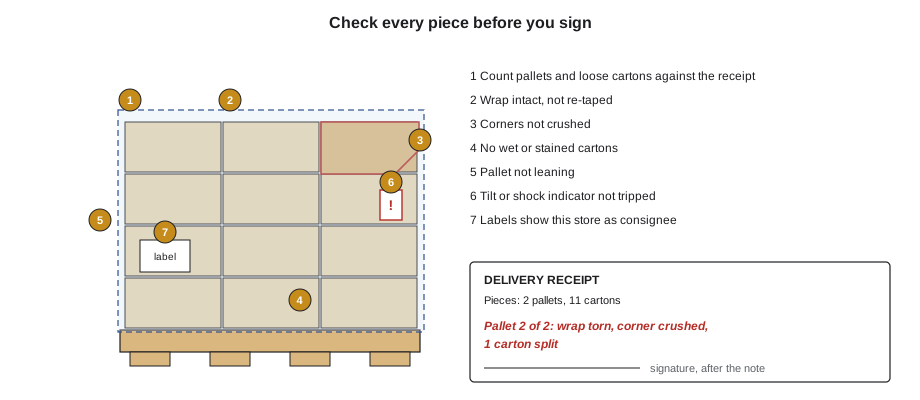
When a carrier delivers, the driver hands over a delivery receipt or a copy of the bill of lading, the carrier's document that lists the shipper, the consignee, and the number of pieces and their weight. By signing it, the receiver confirms that the stated pieces were delivered in good condition. Before signing, the receiver should:
- Confirm the shipment is for this location. Check the consignee name and address. Depot trucks often carry orders for several dealers, and a pallet for another store can come off by mistake.
- Count the pieces. Count pallets and loose cartons and compare them with the number on the paperwork. Count pallets as pallets; do not try to count every carton on a wrapped pallet at the truck.
- Look at the outside of every piece. Check for crushed corners, holes, wet or stained cartons, torn or re-taped wrapping, leaning pallets and anything rattling. Look at tilt and shock indicators if the shipment has them.
- Write down anything wrong on the receipt before signing. Be specific: "1 carton short," "pallet 3 wrap torn, 2 cartons crushed," "carton wet on one side." Have the driver initial or sign the note if possible.
A vague note such as "subject to inspection" protects very little, because it does not say what was wrong. Carriers usually treat it as a clean signature. The note should describe what the receiver can see. If a pallet looks damaged, the receiver can open it at the truck, with the driver present, to see how bad the damage is.
Sasha had a rule for drivers in a hurry: "Your hurry isn't my problem. I'll be as quick as I can, but I count before I sign." Most drivers accepted this. A few courier drivers used handheld devices that asked for a signature on a screen before the parcels were handed over. In that case Sasha counted the parcels on the driver's cart first, then signed, and if the device had no space for a note she called or emailed the courier the same day.
Unloading safely
Unloading follows the dock rules from APT-110. Before anyone enters a trailer, its wheels are chocked or the vehicle restraint is engaged, the dock leveler is resting securely on the trailer floor, and the trailer floor looks sound. Many dock rules also ask the driver to hand over the keys or stay away from the cab until unloading is finished, so the truck cannot pull away with someone inside. Pallets come off with a pallet jack or forklift operated by someone trained to use it. Loose cartons are carried or carted, not thrown, and heavy items such as brake rotors, batteries and transmission parts are lifted with help or a cart.
Parts are set down in the receiving area, not in the aisles or in front of exits. Pallets should be placed so that each one can be reached and broken down without moving the others. Fragile items, such as glass, lamps and painted panels, go to one side where they will not be stacked on.
Checking the contents
Once the shipment is on the dock, the cartons are opened and the contents checked. The check compares three things: what was ordered (the purchase order), what the supplier says it shipped (the packing slip or packing list in the cartons), and what is actually there. For each line, the receiver confirms:
- The part number. Read the label on the part, not just the label on the carton, and compare it digit by digit. A carton labeled for one part can contain another.
- The quantity. Count every piece. Watch for package quantities: a part sold in boxes of ten may be listed as one box or as ten pieces.
- The condition. Look for damage inside the carton, missing hardware, opened or resealed packages, and signs that a part has been used.
- Special instructions. Look for parts that need special handling: hazardous materials, fragile parts, parts with a shelf life, and parts ordered for a particular customer or repair order.
There are two ways to check. In checking against the slip, the receiver reads each line of the packing slip and finds and counts the matching parts. It is quick, but it invites the receiver to see what the slip says should be there. In blind receiving, the receiver counts and records what is actually in the cartons without seeing the expected quantities, and the system compares the count with the order afterwards. Blind receiving is slower, but it catches more errors, because the receiver cannot simply tick the slip. Many warehouses use blind receiving for high-value parts and spot checks for the rest.
Sasha used a mix. For the stock order, she and Talia checked every line against the slip, but they counted every piece rather than just looking for the right number of boxes. For lines over 200 dollars, such as modules, catalytic converters and complete headlamps, she used blind counts: Talia counted and wrote the number down, and Sasha compared it with the slip.
The three-way match
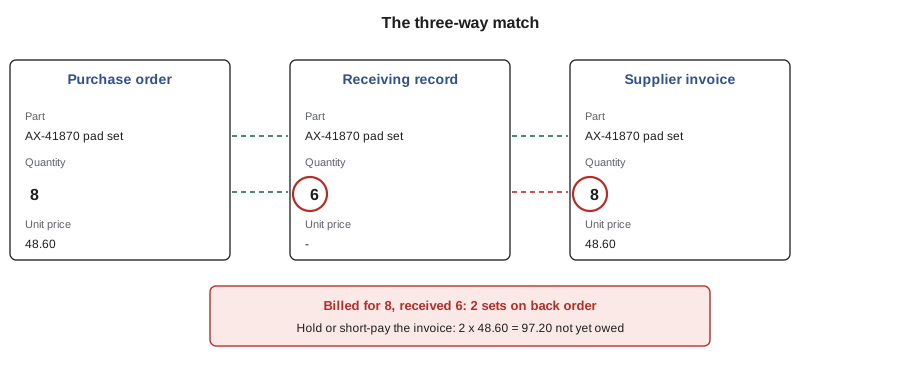
Receiving is also part of how the business pays its bills correctly. Before the supplier's invoice is paid, accounting compares it with the purchase order and the receiving record. This is called the three-way match:
- The purchase order says what was ordered and at what price.
- The receiving record says what actually arrived in good condition.
- The invoice says what the supplier is charging for.
If all three agree, the invoice is paid. If the invoice charges for parts that were not received, or at a different price, the difference is investigated before payment. The receiving record is the middle piece of this check, which is why accurate receiving matters to accounting as much as to the warehouse. A part received in the system but never actually delivered will be paid for and never seen.
Worked problem
Finding an overbilling
A supplier's invoice charges for 8 brake pad sets at 48.60 dollars each. The purchase order was for 8 sets, but the receiving record shows only 6 arrived, and the packing slip shows 2 on back order. How much would the dealership overpay if the invoice were paid in full now?
Show solution
- Sets billed but not received:
- \[8 - 6 = 2\]
- Value of those sets:
- \[2 \times 48.60 = 97.20\]
Answer: 97.20 dollars would be paid for parts that have not arrived. The invoice should be held or short-paid until the back-ordered sets arrive, following the supplier's terms. The values are samples.
Recording the receipt
Once the contents are checked, the shipment is received in the system. In most dealer systems, the receiver opens the purchase order, confirms or corrects the quantity received on each line, and posts the receipt. Posting adds the parts to the quantity on hand, closes or reduces the open order quantity, and records any lines not received as back orders. It also starts several other things:
- Bin labels print for parts with locations, and parts without a location are flagged so one can be assigned (lesson 4).
- Special orders are flagged, so the customer or the service advisor can be told the part has arrived.
- Back orders are filled: if a customer was waiting for a part that arrived, the system shows the order, so the part goes to that customer rather than into the bin.
- Cost and pricing are updated if the part's cost has changed.
Talia learned to sort the received parts into three groups as she checked: parts for a waiting job (special orders, back orders and emergency parts for the shop), which went to the front of the line; stock parts, which went to put-away; and problem lines, which went to the problem shelf with a tag. The shop's parts went first, because a technician waiting for a part is lost labor for the service department. On most mornings Sasha had the shop's parts on the back counter within half an hour of the truck arriving.
Receiving in the system should happen promptly, but not before the parts are checked. Posting a whole purchase order as received and then checking later is a common shortcut, and it creates two problems: any shortage is now a stock error rather than a claim, and the system shows parts on hand that may still be on the dock floor.
Measuring receiving accuracy
Receiving accuracy measures how many received lines match what was ordered and what was billed, with no correction needed. Errors include wrong parts, wrong quantities, damaged parts and parts received against the wrong order. Some come from the supplier; some from the receiver. Both matter, because each one costs time to fix and can cause a stock error or a wrong payment.
Worked problem
Receiving accuracy for one stock order
A stock order of 140 lines arrives. On checking, 137 lines match the packing slip and the purchase order exactly. One line has a wrong part, one is short and one has a damaged part. What is the receiving accuracy for this order?
Show solution
- Divide the clean lines by the total:
- \[137 \div 140 \approx 0.979\]
- Round:
- about 98 in 100
Answer: About 98 in 100 lines arrived clean. The three problem lines go to the problem shelf and are handled as lesson 3 describes.
Rolf kept a simple log of supplier errors: date, supplier, part number and the kind of error. Over a few months, patterns appeared. One aftermarket supplier often sent the wrong color of trim clip; another often under-packed fasteners. The log gave Rolf the facts to raise with the supplier's sales representative, and it showed which suppliers' shipments needed closer checking.
Controls that keep receiving honest
Receiving is one of the places where a business can lose money through error or theft. The person who receives shipments controls the record that says parts arrived and should be paid for. Common controls include:
- Separating ordering from receiving, or at least having a second person review the receiving report against the order.
- Receiving only against a purchase order. Parts that arrive with no order behind them are held until someone explains them.
- Blind counts for high-value lines.
- Keeping the dock door closed and the dock area restricted when nobody is receiving, so parts cannot leave the way they came in.
- Reviewing adjustments. Rolf reviewed every receiving correction and every received quantity changed after posting.
These controls protect honest staff too. When a part goes missing, a clear record of who received, counted and put it away shows where the error happened, rather than leaving everyone under suspicion.
Common mistakes
MistakeSigning a clean receipt and counting afterwards.
InsteadCount pieces and look for damage before signing.
MistakeWriting "subject to inspection" as the only note.
InsteadWrite exactly what is wrong: "1 carton short," "2 cartons crushed."
MistakeReading only the carton label.
InsteadRead the part label too, and compare it digit by digit.
MistakePosting the receipt before checking the contents.
InsteadCheck first, then post what actually arrived.
MistakePutting special-order parts into stock bins.
InsteadRoute them to the waiting customer or repair order.
Summary and key terms
- Prepare for each shipment: know what is coming, clear the area and have equipment and people ready.
- At the truck, confirm the consignee, count pieces, inspect the outside and write specific exceptions on the receipt before signing.
- Check every line for part number, quantity and condition; blind counts catch more errors.
- The three-way match compares the purchase order, the receiving record and the invoice before payment.
- Post the receipt only after checking, and send parts for waiting jobs out first.
- Delivery receipt
- The carrier's document signed by the receiver to confirm the pieces delivered and their condition.
- Bill of lading
- The carrier's shipping document listing the shipper, consignee, pieces and weight; it is also the contract of carriage.
- Packing slip
- The supplier's list of what was packed in a shipment.
- Advance shipping notice
- An electronic list of what a supplier has shipped, sent before the shipment arrives.
- Blind receiving
- Counting and recording a shipment's contents without seeing the expected quantities.
- Three-way match
- Comparing the purchase order, receiving record and invoice before paying a supplier.
Practice problems
Work each problem on paper first, then reveal the answer to check.
Why should exceptions be written on the delivery receipt before signing?
Show answer
A clean signature says everything arrived in good order, which makes a later claim hard to prove.
What three documents make up the three-way match?
Show answer
The purchase order, the receiving record and the invoice.
An invoice bills 5 filters at 12.40 dollars, but 3 arrived. How much is billed for parts not received?
Show answer
2 × 12.40 = 24.80 dollars.
What is the advantage of blind receiving?
Show answer
The receiver counts what is actually there rather than ticking the expected quantities.
Which received parts should go out first?
Show answer
Parts for waiting jobs: special orders, back orders and emergency parts for the shop.
Lesson quiz · 5 questions
Score 60% or more to complete this lesson.
Create a free account to save your progress, take quizzes and earn a certificate.